A red tag on an elevator changes the tone of a workday fast.
One minute, you’re dealing with tenants, vendors, deliveries, and budget questions. The next, you’re staring at a Correction Order and trying to figure out whether the elevator can stay in service, how serious the violation is, who can fix it, and how much disruption is coming next.
That’s a familiar situation in Troy. Office buildings, apartments, medical facilities, mixed-use properties, and older commercial sites all run into the same problem. The notice itself is usually short. The important work starts after you read it.
Most owners and property managers don’t need more jargon. They need a clear path. They need to know what the state is looking for, which violations can turn into shutdown risk, what has to be permitted before work starts, and how to get from a violation notice to a compliant elevator without wasting time on the wrong repair plan.
That’s what practical Troy Michigan Elevator Services should deliver. Not vague promises. Real violation correction, documented scope, code-focused repairs, permit handling, testing, and a clean handoff back into legal operation.
That Red Tag A Troy Property Manager's Worst Nightmare
It usually starts with a phone call from the building.
A tenant says the elevator was inspected. Someone found a notice. The property manager gets onsite, opens the machine room or checks the lobby area, and sees the paperwork that now controls the day. Questions pile up fast. Is this a simple correction? Is it a shutdown issue? Does the elevator stay in service? What needs to happen first?
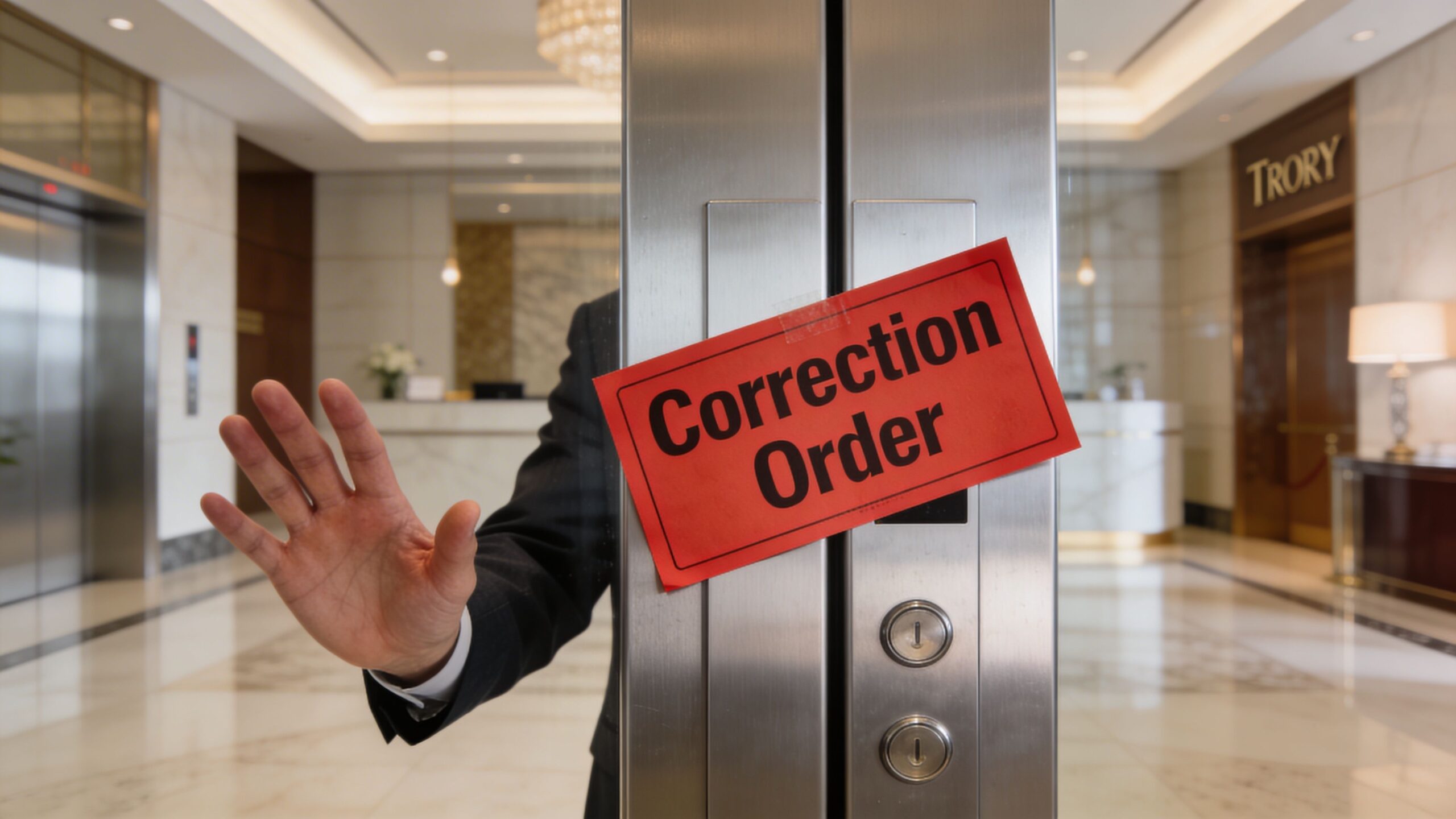
In Troy, that stress is usually made worse by one thing. Property managers and owners don’t encounter violation notices often enough to know the process cold. They may know the building well, but not the state’s elevator enforcement language. So they end up trying to decode technical comments while tenants keep asking when the unit will be back to normal.
What the notice usually means in practice
A Correction Order doesn’t automatically tell you the whole story. It tells you where the state found non-compliance. It does not tell you the smartest repair path, whether multiple conditions are tied together, or whether a partial fix will only lead to another round of work.
That’s where owners lose money. They authorize isolated repairs without asking the right questions:
- Is the cited item the root cause or just the visible symptom
- Will this correction trigger permit drawings or component documentation
- Does the proposed part fit current code requirements
- Will the elevator pass reinspection after this repair, or only get halfway there
Practical rule: Treat a violation notice as the start of a technical review, not as a shopping list.
Why panic leads to expensive decisions
The worst response is rushing into a sole-sourced recommendation without understanding the code issue behind it. That’s how buildings end up approving oversized scopes, replacing the wrong components, or accepting a temporary patch that doesn’t hold up at the next inspection.
A better response is simple. Secure the situation, gather the notice, confirm operating status, and get a contractor involved who knows how Michigan violation work moves from field diagnosis to permit, repair, and final compliance.
When that happens, the red tag stops being a crisis and becomes a project. That shift matters. Once the work is organized correctly, most of the confusion goes away.
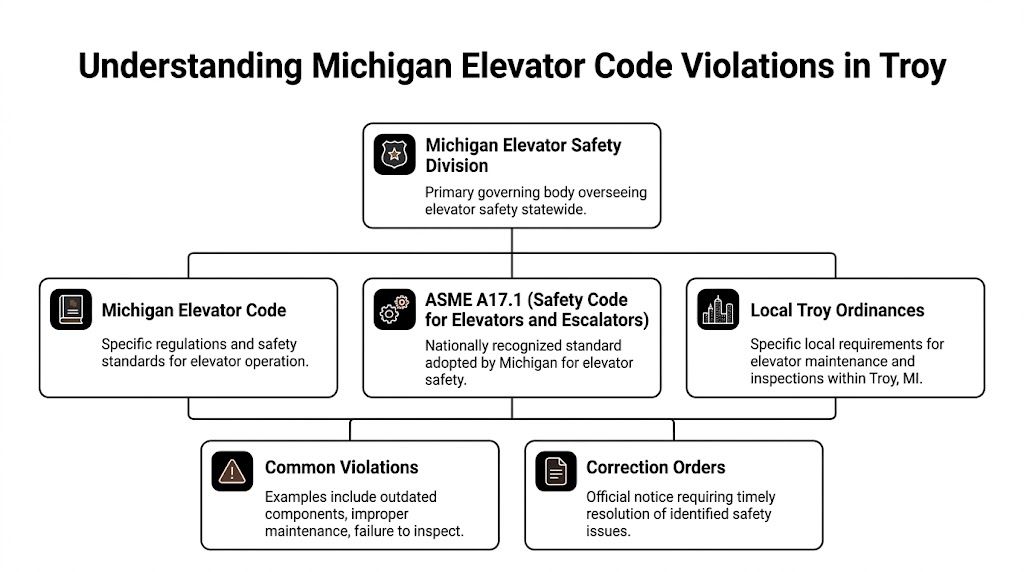
Understanding Michigan Elevator Code Violations in Troy
A Troy elevator can run every day, answer calls, and still fail inspection. That is the part many owners do not see until a state notice is in hand.
Troy properties are held to adopted safety standards, not to whether the car feels normal to passengers. The city’s current Troy code list identifies ASME A17.1 (2010) as the primary elevator safety standard, along with ASME A18.1 (2011) for platform lifts and ASME A90.1 (2009) for belt manlifts. For a property owner or manager, that changes the conversation. A violation is a compliance problem tied to a specific code requirement, not just a service item.
Function is not the same as compliance
Elevators often stay operational long after they have drifted out of code. Doors open. The car travels. Calls register. Owners assume the unit is acceptable because tenants are still using it.
Inspectors are checking something different. They verify whether required safety functions, operating devices, machine room conditions, and test records meet the code adopted in Michigan and enforced in Troy. If a required condition is missing, damaged, altered, undocumented, or does not perform during inspection, the elevator can be cited even if riders never noticed a problem.
That gap between "it still works" and "it still complies" is where expensive mistakes start.
Common violation groups that affect Troy properties
Violation notices usually point to a handful of repeat problem areas. The code language can look technical, but the field issues are usually straightforward once you know what the inspector is trying to prevent.
Machine room and equipment space issues
Some of the costliest violations are outside the cab.
Machine room ventilation, housekeeping, clearances, lighting, access, and equipment condition all matter because heat, dust, moisture, and blocked access shorten component life and create safety exposure for anyone servicing the unit. I have seen buildings spend money chasing intermittent controller faults when the underlying issue was poor room conditions that kept stressing the equipment.
These are building-side issues as much as elevator issues. If a renovation changed airflow, storage ended up in the room, or maintenance standards slipped over time, the elevator contractor may not be able to close the violation without help from the building team.
Top-of-car and operating device deficiencies
Top-of-car inspection controls get cited for good reason. When a mechanic is working on top of the car, the operating device and speed limitation are there to control risk during inspection and service work.
If those controls are outdated, damaged, bypassed, or no longer match the adopted requirement, the fix is about more than replacing a switch. The contractor has to confirm the device, wiring, and car-top operating mode function correctly as a system. A quick part swap that ignores the underlying circuit condition can leave the unit failing again at reinspection.
Communication, testing, and safety function problems
Another common group involves features that are rarely used in normal traffic but have to work correctly on demand. Emergency communication, fire service operation, standby power functions, door protection, and periodic testing records fall into this category.
These violations frustrate owners because passengers may never report an issue. The state will still cite them if the function does not perform during testing or the building cannot produce the required documentation. From an enforcement standpoint, undocumented testing can be just as damaging as a failed device.
An elevator can serve tenants reliably for months and still fail inspection if a required safety function or test record is missing.
Why some violations are simple repairs and others point to bigger exposure
The practical question is not whether a violation exists. The notice already answers that. The true question is what kind of problem sits behind it.
| Violation type | What it usually means for the owner |
|---|---|
| Maintenance-related deficiency | A targeted repair may solve it, but records and verification still matter |
| Safety-device non-compliance | Higher liability exposure and closer scrutiny at reinspection |
| Infrastructure or equipment-space issue | Building work may be required alongside elevator work |
| Control or modernization mismatch | The system may need engineering review, not just replacement parts |
Older Troy buildings often have mixed generations of equipment. A controller update from one contractor, door equipment from another, and a later code change can leave the elevator operating in a way that is functional but no longer aligned with current requirements. That is why violation work should start with a field review tied back to the cited code section.
Owners planning capital work should also look beyond the current notice. This guide to the Michigan elevator code deadline January 1st 2028 helps frame longer-term budgeting decisions for aging equipment and upcoming compliance work.
Your Step-by-Step Plan to Correct Elevator Violations
The right response after a violation notice is disciplined, not dramatic.
Most bad outcomes happen because the first few steps are sloppy. Someone calls the wrong vendor, approves a guess, delays paperwork, or assumes the state will schedule around the building’s convenience. That’s not how violation correction works.
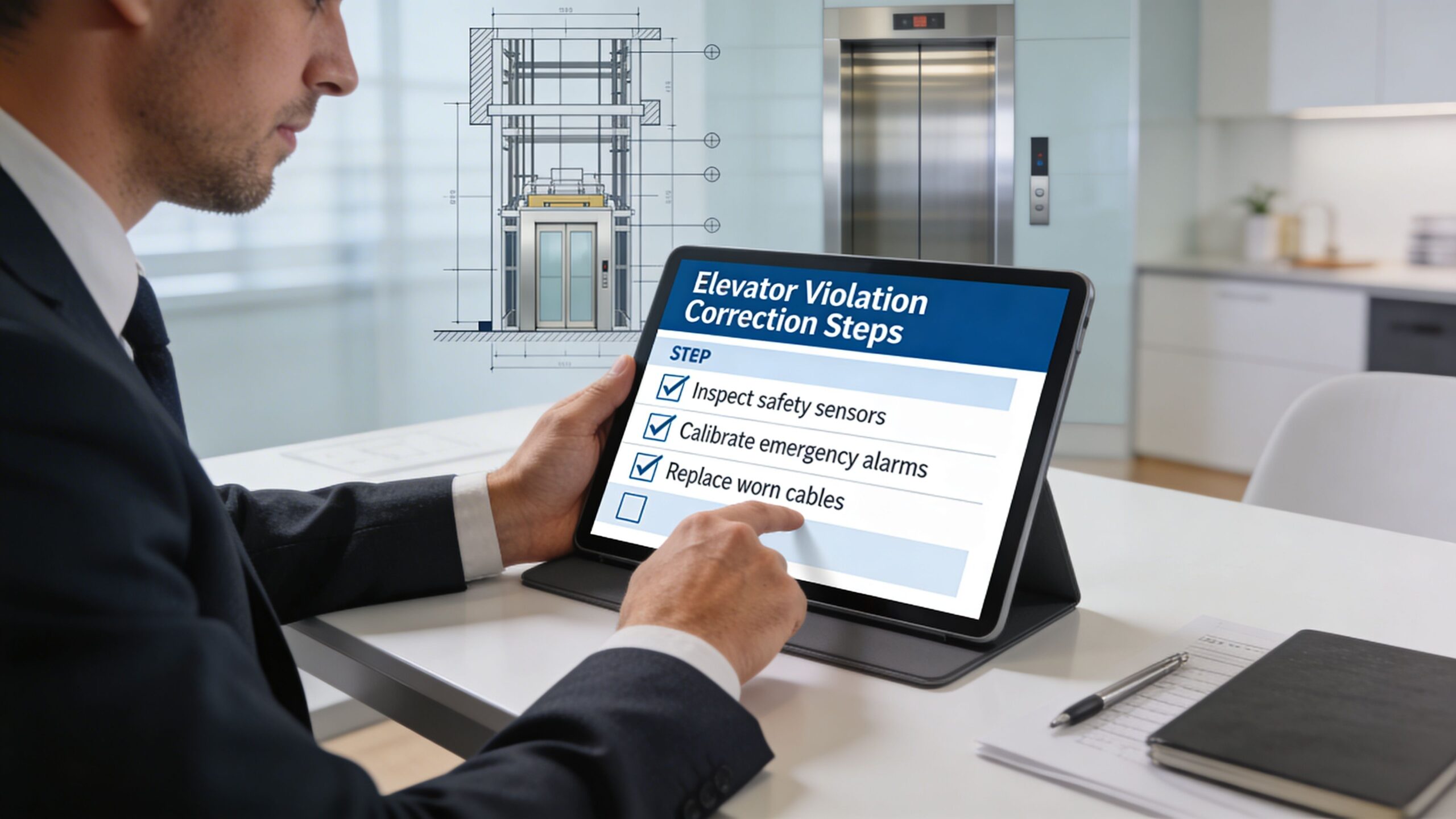
Step one secure the elevator and collect the documents
Start with the notice itself. Read every line. Match each listed issue to the exact elevator unit and serial information. If the condition affects safe operation, restrict use as needed and document what you found onsite.
At this stage, property teams should gather:
- The Correction Order with all cited items visible
- Prior service records tied to the same unit
- Inspection or test history if available
- Photos of the cited area if the issue is visible
- Any prior proposals from other contractors
This prevents a common mistake. People rely on memory, not paperwork. Elevator violation work goes smoother when the scope starts with actual records.
Step two get a real diagnosis, not just a bid
A strong correction plan starts with cause, not price.
If the state cites a safety device, a ventilation issue, or a top-of-car control problem, the contractor needs to inspect the full condition around that item. Good diagnosis answers three questions: what failed, why it failed, and what has to change so it passes reinspection.
This is also where a second opinion matters. In proprietary environments, owners sometimes get pushed toward broader replacement than the violation requires. Sometimes broad replacement is justified. Sometimes it isn’t.
Field advice: Don’t approve a modernization-sized quote to solve a repair-sized code item until someone explains the code path clearly.
Step three build a correction scope that matches the code
The repair proposal should map directly to the cited condition. If it doesn’t, ask why.
A usable scope identifies the affected components, the code reason for correction, any related deficiencies discovered during review, and whether the work is repair, alteration, or part of a larger modernization path. That distinction matters because Michigan treats alterations differently from routine service work.
When owners need testing after corrections, it helps to understand the process in advance. This overview of elevator testing is useful when planning post-repair compliance work.
Step four account for permit time before field work starts
This step gets underestimated constantly.
In Michigan, before an elevator alteration to correct a violation can begin, a licensed elevator contractor must submit detailed plans in triplicate to the enforcing agency for permit approval, and manufacturer documentation must confirm the components will comply, according to the state’s elevator permit information page. That requirement creates a real pre-construction phase.
It affects scheduling in several ways:
- Drawings take time because existing conditions must be verified
- Component selection matters because documentation has to support compliance
- Permit approval can’t be skipped if the work qualifies as alteration
- Field crews can’t mobilize first and fix paperwork later
If a property manager promises tenants a fast turnaround without accounting for permit review, they’re setting up unnecessary conflict.
Here’s a short visual that helps explain why timing often depends on more than labor availability.
Step five complete repairs and close the loop
Once the permit path is clear and parts are approved, the repair phase should be tightly managed. Good contractors verify not just the corrected item, but adjacent functions likely to be reviewed during reinspection.
That’s important because passing a reinspection often depends on the whole safety sequence working properly, not just the single device that triggered the original notice.
A clean closeout usually includes:
- Completed field correction of the cited items
- Verification testing of related safety functions
- Documentation package for the owner’s records
- Coordination for final inspection or signoff
- A follow-up maintenance plan so the same issue doesn’t return
Violation correction is not just repair work. It’s compliance project management. Owners who treat it that way usually regain control faster.
Beyond Violations Proactive Maintenance Prevents Future Issues
A Troy property can clear a violation, pass reinspection, and still end up back in trouble six months later. I see that happen when the owner treats the red tag as a one-time event instead of evidence that the maintenance program is missing something.
Preventive maintenance is how you stop repeat violations, nuisance shutdowns, and tenant complaints from stacking up into a larger operating problem. The goal is simple. Keep the elevator clean, adjusted, tested, and documented well enough that small defects get corrected before they turn into code issues or service interruptions.
What preventive maintenance looks like in the field
Good maintenance is hands-on work, not a route sheet with a few boxes checked.
For Troy buildings, that usually means cleaning machine rooms, pits, and car tops, inspecting door equipment for wear and drag, checking safety circuits, watching leveling accuracy, and correcting minor defects that inspectors often cite as failure-to-maintain conditions. It also means tracking repeat callbacks. A door fault that shows up three times in two months is not three separate problems. It is one unresolved problem.
Older equipment makes this even more important. Hydraulic units develop leak patterns. Traction elevators drift out of adjustment. Mixed-generation controls and fixtures can create intermittent faults that only show up under regular traffic. Wheelchair lifts, dumbwaiters, and freight units have their own wear points and inspection triggers. A mechanic who knows the equipment history can usually spot the pattern before the state does.
Why service strategy matters
Maintenance quality depends partly on access. If the equipment is tied to a closed service model, even routine corrections can take longer and cost more than they should.
That is why many owners ask for a non-proprietary elevator service approach when they review long-term maintenance options. The practical advantage is simple. More qualified contractors can diagnose the equipment, source parts, and recommend repairs without waiting on a single manufacturer-controlled channel.
That does not eliminate every problem. Some systems still include manufacturer-specific components. But owners have far more control over pricing, response time, and future bidding when the core service strategy is not locked down.
The failure patterns reactive service creates
Reactive service usually produces the same set of problems.
- Deferred cleaning. Dirt, oil, and debris interfere with switches, door equipment, sensors, and controllers.
- Repeat adjustments instead of root-cause repair. The symptom goes quiet for a week, then comes back under normal traffic.
- No trend documentation. Callbacks get handled one at a time, so nobody sees that the same circuit, operator, or valve keeps failing.
- Budget surprises. Minor wear items are ignored until they trigger an outage, a tenant complaint, or a violation.
Those patterns are expensive because the failure rarely stays isolated. A leaking hydraulic component can contaminate surrounding equipment. Poor door performance can lead to nuisance faults, entrapments, and inspection issues. Misleveling complaints often start as an adjustment problem, then turn into a safety and liability problem if they are left alone.
Most repeat elevator trouble in commercial buildings comes from ordinary wear that was visible early and ignored too long.
What owners should expect from a maintenance partner
A serious maintenance program should give the owner a clear record of what is being inspected, corrected, and watched over time.
Use these questions when reviewing Troy Michigan elevator services:
| Maintenance question | Why it matters |
|---|---|
| Does the contractor clean pits, car tops, and machine spaces thoroughly? | Contamination causes avoidable faults and can create inspection exposure |
| Are recurring callbacks tracked by symptom and equipment location? | Patterns help identify root cause before the next shutdown |
| Does the mechanic correct minor wear items during routine service? | Small parts often cause larger interruptions when they are ignored |
| Can the contractor service different makes and older control packages? | Flexibility matters when equipment ages or ownership changes |
| Are testing and written maintenance notes part of each visit? | Owners need a usable service history for budgeting, planning, and compliance |
Owners should also expect honest advice about trade-offs. Some elevators are good candidates for continued maintenance with targeted repairs. Others are consuming enough labor and replacement parts that modernization planning should start now. A contractor should be able to explain that line clearly, with reasons tied to reliability, parts access, and code exposure.
Preventive maintenance does not remove every repair bill. It does reduce avoidable failures, gives owners better budget control, and makes the next inspection far less likely to turn into another compliance project.
The Crane Elevator Advantage of Non-Proprietary Service
The biggest long-term service decision many owners make isn’t about one repair. It’s about whether their elevator is tied to a closed ecosystem.
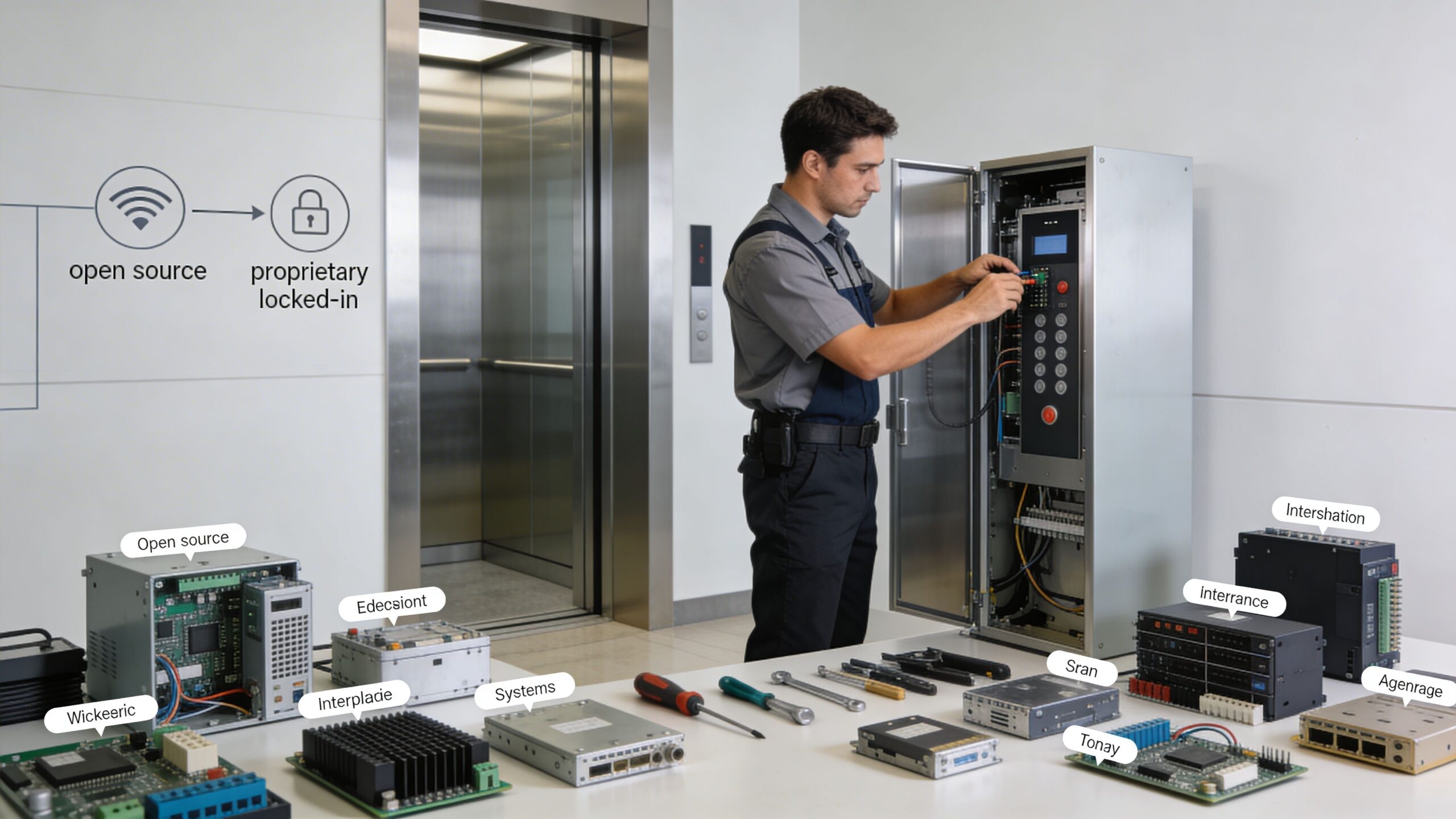
A proprietary setup works like a device that only the original manufacturer can access, diagnose, and repair with its own approved pathway. A non-proprietary setup is closer to standard professional equipment. Qualified elevator contractors can service it, source compatible parts, and compete for the work.
That difference becomes very real when a violation notice lands.
Where proprietary service hurts owners
Vendor lock-in usually shows up in four places.
- Diagnosis control: Only one service channel can fully access the system.
- Parts control: Replacement options narrow fast.
- Quote pressure: Competitive bidding becomes difficult.
- Upgrade pressure: A relatively limited issue can be framed as a larger manufacturer-only package.
Sometimes proprietary parts are unavoidable. Many systems contain manufacturer-specific elements. But owners should understand when they’re facing a true technical limitation and when they’re facing a business model.
Why non-proprietary strategy ages better
Buildings change hands. Managers change. Budgets tighten. Equipment outlives original service relationships all the time.
A non-proprietary strategy gives the owner more room to maneuver because any qualified provider can step in after the work is complete. That matters in Troy, where many buildings are balancing aging equipment, tenant expectations, and a need for competitive pricing without giving up compliance.
For owners evaluating modernization paths, this overview of non-proprietary elevators helps clarify the practical trade-offs.
The regional depth behind that approach
This isn’t a theoretical model. It’s backed by an operating network with a long history in Michigan.
ESI was founded in 1987 in Grand Rapids and expanded non-proprietary service expertise into the Detroit metro area, including Troy, through the acquisition of Elevator Technology, as described in Business View Magazine’s profile of Elevator Service Inc.. That history matters because it reflects technical depth across all makes and models, not a narrow single-brand philosophy.
A side-by-side owner view
| Service model | Typical owner experience |
|---|---|
| Proprietary-focused | Fewer service choices, less pricing leverage, more dependence on one channel |
| Non-proprietary | Broader service access, easier competitive bidding, better long-term flexibility |
Owner takeaway: The best modernization isn’t just the one that runs today. It’s the one you can still service competitively years from now.
Many Troy Michigan Elevator Services conversations should start here. Not with glossy promises. With a direct question. After this repair or modernization, who controls your options?
Our Comprehensive Elevator Services in Troy and Lower Michigan
Violation correction gets attention because it’s urgent. But most owners need a contractor that can handle the entire lifecycle of the equipment.
That means not only resolving a state notice, but also keeping elevators reliable, compliant, and serviceable across years of ownership. In Troy and throughout Lower Michigan, that usually requires a broad technical bench. Buildings don’t all run the same equipment, and they don’t all fail the same way.
Core service categories owners actually use
A capable regional provider should cover these practical needs:
- Emergency response: 24/7/365 support for entrapments, shutdowns, door failures, and unsafe conditions.
- Preventative maintenance: Regular service built around cleaning, adjustment, inspection, and wear-part planning.
- Repairs: Hydraulic and traction repair work, door equipment troubleshooting, control issues, leaks, ride quality problems, and replacement of failed mechanical and electrical components.
- Code-required testing and inspections: Support for required testing, documentation, and correction of deficiencies found during inspection activity.
- Modernization: Full and partial upgrades for aging controllers, fixtures, machines, power units, jacks, communication systems, and safety devices.
- Specialized equipment support: Residential elevators, wheelchair lifts, material lifts, dumbwaiters, and older freight equipment that still needs dependable service.
Why regional coverage matters
Many Troy properties don’t need a contractor that serves just one city. They need one that can support multiple sites, ownership groups, and property portfolios across Southern Michigan.
According to the verified company data, ESI’s Michigan network serves over 20 cities across Michigan, including Ann Arbor, Flint, Lansing, and Kalamazoo, as described on the ESI website. For property managers, that kind of footprint usually means stronger logistical support for dispersed facilities and a deeper field service bench.
What that means for Troy clients
In practical terms, strong Troy Michigan Elevator Services should support:
- Office buildings that need tenant-facing reliability
- Industrial sites where freight and material handling equipment often has unique service demands
- Healthcare properties where downtime creates immediate operational problems
- Municipal and education facilities that have strict documentation expectations
- HOAs and apartment properties where resident communication and uptime matter every day
- Residential owners with accessibility equipment that has to remain safe and dependable
A key advantage of thorough service isn’t marketing breadth. It’s continuity. The same provider can handle routine maintenance, diagnose a code issue, execute the repair, support testing, and advise whether the next step should be a targeted replacement or a broader modernization.
Owners benefit most when those decisions are connected instead of fragmented.
Take Control of Your Elevator Compliance Today
A violation notice is serious, but it doesn’t have to become a drawn-out operational mess.
The key is responding in the right order. Confirm the condition. Get a real diagnosis. Match the correction to the code issue. Allow for permit requirements when the work qualifies as an alteration. Finish with proper testing, documentation, and reinspection support.
That approach works better than panic, guesswork, or patching one visible symptom and hoping the state accepts it next time.
If you’re dealing with a red tag, recurring shutdowns, or an elevator that’s clearly drifting toward compliance trouble, get a second opinion before approving a broad repair plan. If your equipment hasn’t been in trouble yet, this is the right time to tighten up maintenance and prevent the next violation from happening.
Crane Elevator Company brings over 25 years of hands-on experience, family-owned accountability, 24/7/365 availability, free second opinions, competitive quotes, and a price-beat guarantee. For Troy property owners, that means practical support whether you need immediate violation correction or a maintenance strategy that reduces future risk.
Frequently Asked Questions
| Question | Answer |
|---|---|
| Do state elevator inspectors schedule visits in advance | Not always. Michigan inspectors often arrive unannounced during normal business hours based on the state guidance referenced in the verified data. |
| What should I do first after receiving a violation notice | Confirm the exact unit involved, collect the notice and service records, and have a qualified elevator contractor review the cited conditions before approving repairs. |
| Can I start correction work right away | Not if the work qualifies as an alteration requiring permit approval. In Michigan, that approval step has to be addressed before alteration work begins. |
| Do certificates have to be posted | The state guidance says certificates must be onsite, but not necessarily posted. |
| Is there a faster way to get certificate documentation | Yes. Owners can email elevsafety@michigan.gov with the elevator serial number to request digital certificates and avoid a potential 4-week mailing delay, according to the Michigan Elevator Section guidance PDF.pdf?rev=8d3e490586154a0aa34426604378d564&hash=151929512859651FF8530BFC00845A75). |
| Can one company handle both violation corrections and long-term maintenance | Yes, and that’s usually the most efficient path because the same team can connect the repair history, code issues, testing needs, and preventative service plan. |
If you need help with elevator violations, inspections, modernization planning, or maintenance in Troy and across Lower Michigan, contact Crane Elevator Company. They provide free, no-obligation second opinions, responsive repair support, non-proprietary solutions for all makes and models, and practical guidance that helps owners move from violation notice to compliant operation.