A lot of property managers start looking for the best elevator maintenance company after the worst possible moment. A car is down on a Monday morning. Tenants are calling. A resident is asking why the same door fault keeps coming back. Someone from leadership wants to know if the annual testing is current, and nobody wants to discover a compliance problem during an outage.
That's the decision point in Southern Michigan. You’re not just hiring a mechanic. You’re choosing who keeps a regulated piece of life-safety equipment operating, documented, and ready for inspection.
If you manage a commercial building, school, medical office, municipal site, apartment community, or industrial property, the right service partner affects three things at once. Code compliance. Operating cost. Asset life. Those three are tied together much more tightly than most generic “best elevator maintenance company” lists admit.
Your Guide to Local Elevator Maintenance and Category Test Compliance
An elevator rarely fails at a convenient time. It stops during tenant move-in, during clinic hours, during a school day, or right before an inspection window. The trouble isn’t only the repair itself. The trouble is everything attached to it. Complaints, access issues, potential violations, and the question every owner eventually asks: was this preventable?
In Michigan, that question matters because elevator service isn’t just about sending a mechanic when something breaks. The work has to line up with a documented maintenance program, regular testing, and records that hold up when an inspector asks for them. If your provider is weak on documentation or category testing, you don’t just have a maintenance issue. You have a compliance issue.
What commercial managers usually need
Most buyers aren’t looking for flashy technology or a sales pitch. They need a company that can do the routine work correctly and handle the regulated work on schedule.
That usually includes:
- Stable maintenance execution: Clean equipment, lubricated components, adjusted doors, and callbacks tracked instead of ignored.
- Code-required testing support: Annual and periodic category tests handled on time, with the right paperwork.
- Emergency readiness: A clear path for after-hours entrapments, shutdowns, and recurring faults.
- Long-term flexibility: Equipment and service choices that don’t trap the building into one vendor forever.
Practical rule: If a company can’t explain how it handles Maintenance Control Program records, recurring callbacks, and Category 1, 3, and 5 testing, it isn’t ready to manage your elevator portfolio.
Why local matters in Southern Michigan
National brands have scale. That can help on some projects. But day-to-day maintenance in Detroit, Ann Arbor, Lansing, Flint, Kalamazoo, and surrounding communities often comes down to responsiveness, familiarity with local inspection expectations, and whether the provider follows through.
The strongest local providers know that a building owner doesn’t judge service by a glossy proposal. They judge it by whether the elevator is running, whether the test date was missed, and whether the service log tells a clear story.
That’s where “Local Elevator Maintenance Company for Category Test Compliance” becomes more than a title. It’s the practical standard. If your provider can keep the units running and keep your Cat 1, Cat 3, and Cat 5 obligations organized, you’re in a much better position than an owner who only shops by monthly price.
Comparing Top Elevator Maintenance Companies in Southern Michigan
A quick comparison helps narrow the field before you start collecting proposals. The point isn’t to pick a winner from a logo sheet. The point is to see which companies fit your building type, service expectations, and compliance needs.
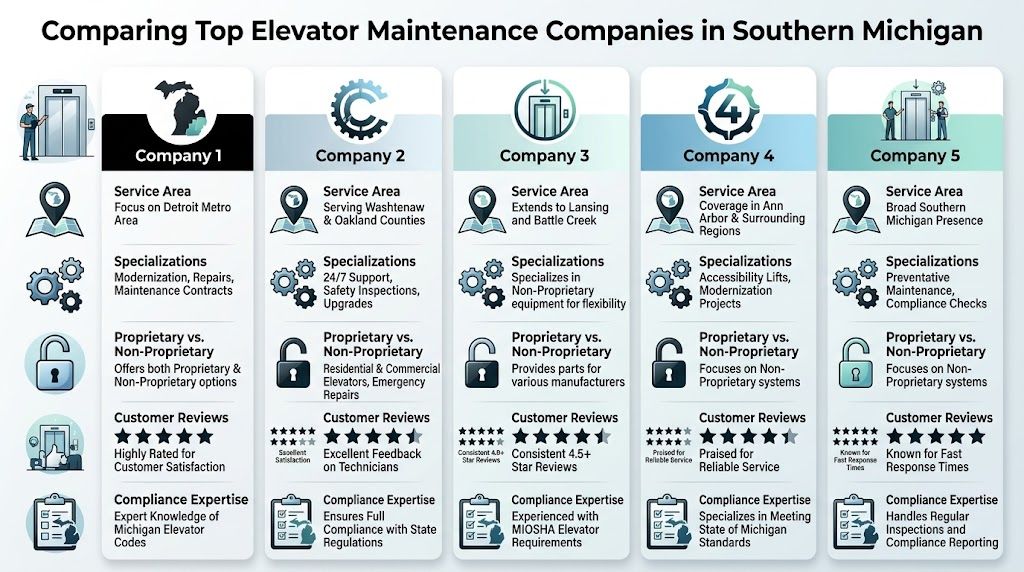
For readers evaluating elevator maintenance companies in Michigan, the most useful comparison points usually aren’t marketing claims. They’re the service mechanics behind the contract.
What to compare side by side
| Company type | Typical strength | Typical trade-off |
|---|---|---|
| Global OEM provider | Large infrastructure, broad technical resources | May lean proprietary and less flexible on service structure |
| Regional independent | Faster local communication, broader all-brand support | Coverage depth depends on staffing and territory discipline |
| Modernization-focused contractor | Useful for aging equipment and capital planning | Routine maintenance quality can vary by team |
| Service-heavy local firm | Practical field support and local accountability | You need to verify documentation discipline and testing capability |
The filters that matter most
Use these criteria first:
- Non-proprietary capability: Can they service multiple makes and models without locking you into one ecosystem?
- Emergency availability: Is there a real after-hours service path, or just an answering service?
- Compliance experience: Can they manage Michigan testing requirements and associated documentation?
- Territory fit: Do they already work in your city and surrounding area, or are you on the edge of their route structure?
- Building-type familiarity: A medical office, freight application, senior housing property, and school all create different maintenance priorities.
The major global players still shape the industry. Otis, KONE, Schindler, and TK Elevator remain the four primary global leaders, while regional specialists often compete on local responsiveness and long-term relationships, according to Statista’s overview of leading elevator companies.
That last point matters in Southern Michigan. If your building needs fast communication, all-brand support, and practical testing coordination, the best elevator maintenance company for your property may not be the biggest one.
Core Criteria for Evaluating Any Elevator Service Provider
Before comparing proposals, set a minimum standard. A lot of poor contracts look acceptable until the first outage, first disputed invoice, or first missed test date. Good vetting upfront saves a lot of grief later.
Licensing insurance and field readiness
Start with the basics. The provider should be properly licensed for the work it performs, adequately insured, and able to explain who is doing the work in the field. Ask whether repairs, testing support, and callback service are performed by their own technicians or heavily outsourced.
Then press on practical details:
- Insurance proof: Ask for current certificates, not verbal assurances.
- Service coverage: Confirm the company services your city with regular field presence.
- Dispatch process: Ask who answers after-hours calls and how entrapments are escalated.
- Record ownership: Clarify who keeps maintenance logs, testing records, and violation follow-up documentation.
A vague answer here usually means future confusion when something goes wrong.
Emergency response has to be defined
“24/7 service” sounds good in a brochure. It means very little unless you know how the company triages calls.
Ask what happens in these situations:
- Passenger entrapment
- A car taken out of service by a door fault
- A recurring leveling issue
- A failed test item close to permit deadlines
Each scenario should have a clear response path. A serious provider should explain who gets dispatched, what qualifies as emergency work, and how temporary shutdowns are communicated.
If the company can’t explain its emergency protocol in plain language, expect confusion at night, on weekends, and during inspections.
Technician training is not a minor detail
Skill level shows up in small things first. Clean adjustments. Better troubleshooting. Fewer repeat callbacks. Better reports. Then it shows up in the big things, like whether the mechanic catches a safety issue before it becomes a shutdown.
NEIEP training sets the gold standard for elevator maintenance companies, covering inspection and troubleshooting of doors, cables, sheaves, motors, and safety interlocks, as noted by Metro Elevator’s discussion of choosing a service company.
That matters because elevators don’t fail in one dramatic way most of the time. They degrade through door problems, worn rollers, contamination, poor lubrication, loose connections, nuisance faults, and ignored patterns.
Questions that expose quality fast
Use a short screening list before you ask for a proposal:
- Who works on my units: Are your field technicians trained on traction, hydraulic, and machine-room-less equipment?
- How do you handle callbacks: Do you track repeat issues by unit and component?
- What does a maintenance visit include: Is it inspection only, or actual cleaning, adjustment, and preventive work?
- Who handles category tests: Do you coordinate the test, the paperwork, and any resulting corrective work?
The best elevator maintenance company won’t dodge those questions. A weak one usually answers with generalities.
The Critical Importance of Non-Proprietary Elevator Service
Most building owners focus on monthly price first. That’s understandable, but it’s often the wrong first filter. The bigger financial decision is whether your elevator system stays open to competitive service or gets locked into one provider’s tools, parts, and controls.
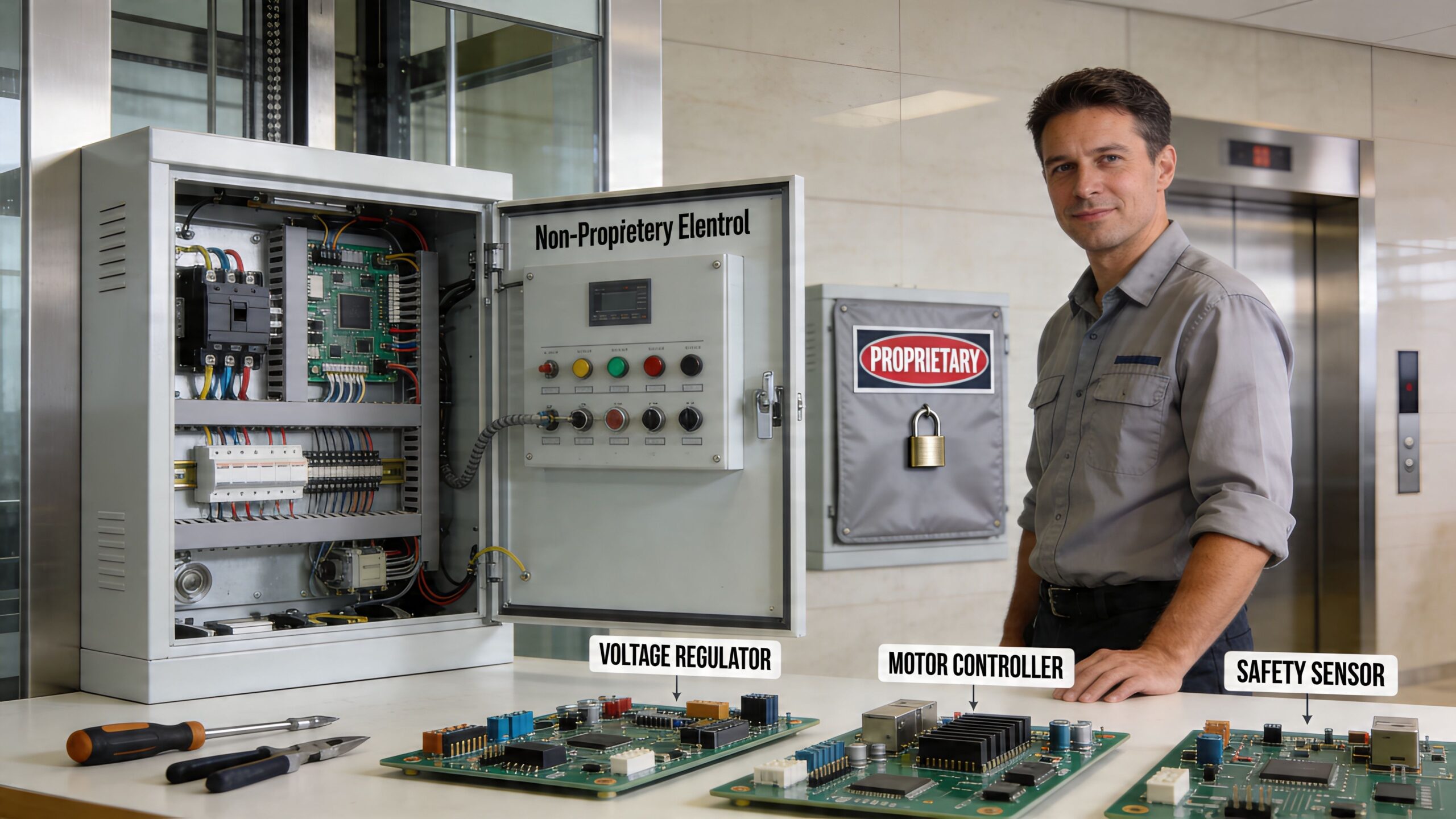
A good starting point is understanding non-proprietary elevators and how they affect future maintenance, modernization, and service competition.
What proprietary really means in practice
A proprietary setup usually means one or more critical parts of the system are tied to a specific manufacturer or service network. That can include control systems, software access, diagnostic tools, or parts channels.
For the owner, the consequences are practical:
- Fewer service options
- Harder quote comparisons
- Longer waits for specialized parts or access
- Less negotiating power on renewals and repairs
That’s why “proprietary” isn’t just a technical label. It’s a budgeting issue and a control issue.
Why non-proprietary service usually ages better
A non-proprietary approach gives owners more freedom. More than one qualified provider can work on the equipment. Parts access is generally broader. Modernization planning is often easier because the building isn’t boxed into one vendor’s roadmap.
The long-term savings can be substantial. Globally, industry reports indicate proprietary services can increase lifetime costs by 20-30% due to limited competition, according to Southwest Elevator’s discussion of proprietary versus universal compatibility.
That tracks with what many property managers learn the hard way. The cheapest proposal at installation or renewal can become the most expensive contract over the life of the equipment if the owner loses the ability to shop the work.
Owner advice: Don’t ask only, “What’s the monthly maintenance rate?” Ask, “Can another qualified company service this system without replacing the brains of the elevator?”
Where buyers get misled
A lot of “best elevator maintenance company” content online focuses on ratings, local lists, or broad service claims. It often skips the one issue that changes your control for years. Vendor lock-in.
That’s why this should be part of every bid review:
- Control system access
- Parts compatibility
- Diagnostic tool dependence
- Ability to transfer service to another qualified contractor
- Future modernization flexibility
For Southern Michigan owners, especially those managing aging equipment across multiple buildings, this isn’t theoretical. It affects every renewal conversation, every shutdown, and every capital plan.
Defining a Truly Proactive Preventive Maintenance Plan
A preventive maintenance contract should reduce trouble calls. If it mainly produces paperwork and recurring callbacks, it isn’t preventive. It’s just scheduled attendance.
The global elevator maintenance market reflects that shift. It was valued at approximately $38.33-$41.7 billion in 2026 and is projected to reach $62.7-$68.25 billion by 2033-2034, with projected CAGR of 6.1-7.50%, driven by an aging installed base and movement toward condition-based and predictive maintenance, according to Fortune Business Insights’ elevator maintenance market overview. That market direction makes sense because owners are done paying for repetitive failures that a stronger maintenance program could have caught earlier.
What a real maintenance visit should accomplish
A quality visit involves more than looking around and resetting faults. It should include hands-on preventive work based on the actual equipment condition and usage pattern.
Look for evidence of:
- Clean-down work: Machine room, pit, and car top housekeeping matter because dirt, oil, debris, and moisture hide problems and shorten component life.
- Door system attention: Most nuisance shutdowns start with doors. Rollers, tracks, gibs, operators, interlocks, and closing forces need regular attention.
- Lubrication and adjustment: Not guesswork. Correct lubricant in the correct location, with follow-through on wear.
- Wear-item replacement: Burned-out indicators, weak buttons, damaged guides, and tired contactors shouldn’t wait for a complaint.
- Pattern tracking: A good report notes repeated faults and what changed at the unit, not just that the car was returned to service.
What weak maintenance looks like
Poor programs usually have the same fingerprints.
| Strong preventive plan | Weak break-fix plan |
|---|---|
| Tracks recurring faults by unit | Treats every callback as isolated |
| Includes cleaning and adjustment | Focuses on reset and leave |
| Plans around equipment age and use | Uses the same visit style for every building |
| Produces readable service records | Produces vague ticket notes |
| Coordinates with testing schedule | Treats compliance as separate and reactive |
What to ask for in a service report
A useful report should help a manager understand both current condition and upcoming risk. It doesn’t need to read like an engineering manual, but it should identify what was inspected, what was adjusted, what was cleaned, what was replaced, and what needs follow-up.
You also want reports that distinguish between:
- Immediate safety concerns
- Near-term maintenance needs
- Modernization-related deterioration
- Recurring issues that suggest a deeper fault
That’s how you separate a company that’s managing the equipment from one that’s just touching it.
Cleanliness is not cosmetic in elevator maintenance. A dirty pit, car top, or machine room usually means other details are being missed too.
Navigating Michigan's Elevator Compliance and Category Testing
Michigan owners need a provider that can keep maintenance and testing connected. If those are handled as separate worlds, dates slip, records get messy, and failed test items drag on longer than they should.
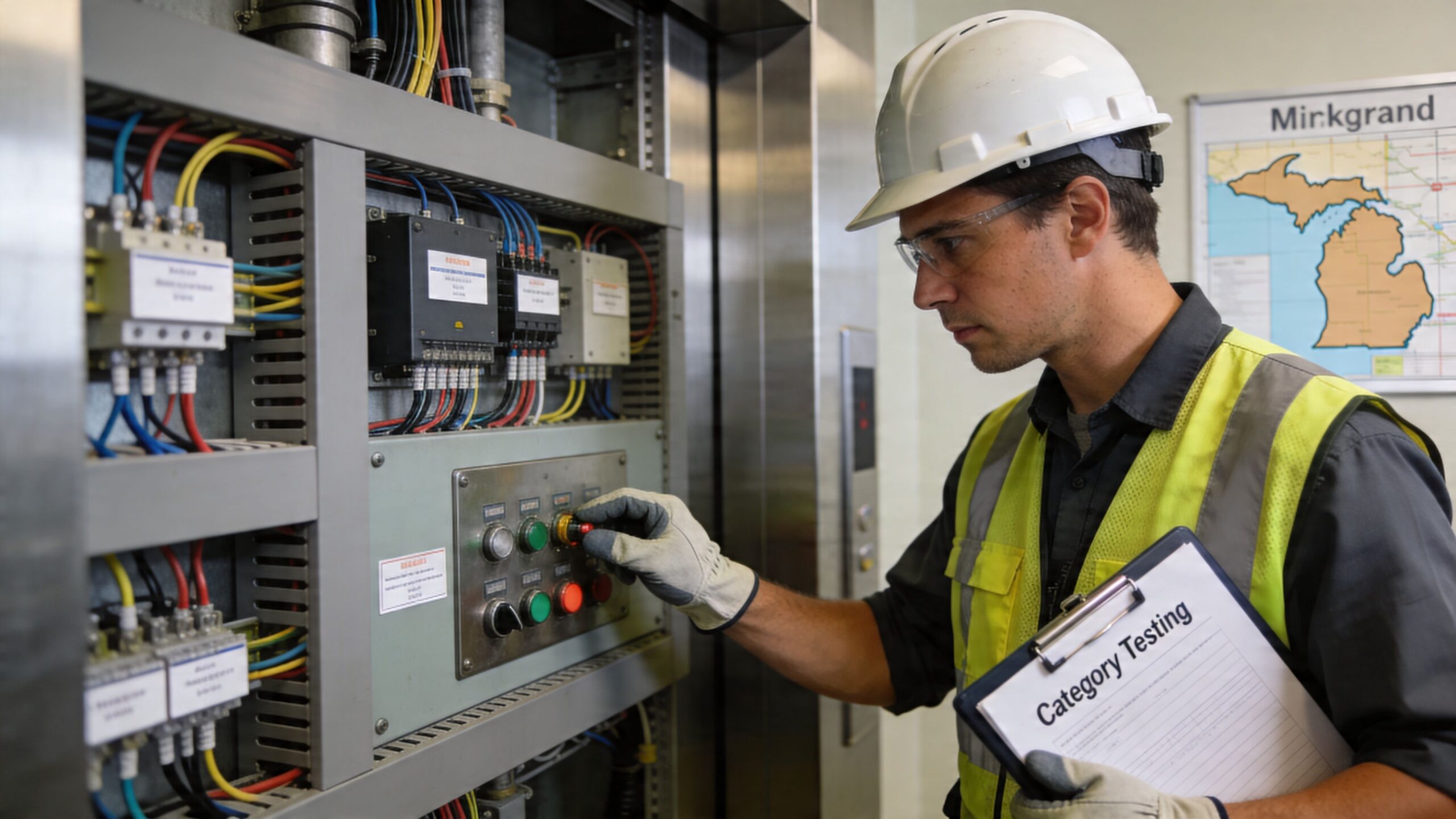
For buildings that need scheduled code testing, elevator Cat tests should be treated as part of ongoing asset management, not as a last-minute scramble.
The compliance baseline
ASME A17.1/CSA B44 requires a Maintenance Control Program for all elevators, and Section 8.6.1.2.1 requires a detailed plan for regular examination and testing with records retained onsite for at least five years, according to ElevatorInfo’s explanation of Maintenance Control Programs.
For Michigan owners, that has two immediate implications:
- Your elevator needs a documented maintenance framework.
- Your testing records need to be complete and available.
The same source notes that selecting a company offering non-proprietary parts and full testing services helps avoid violations that could cost $10,000+ in fines.
Cat 1 testing
Category 1 testing is the routine periodic test most owners become familiar with first. In practical terms, it’s the recurring test cycle that verifies key safety functions and operating condition under code-required procedures.
For a property manager, the important part is not memorizing every technical step. It’s making sure the provider:
- Schedules it on time
- Prepares the equipment in advance
- Has the needed personnel and test setup ready
- Documents results properly
- Resolves deficiencies quickly
If a company treats Cat 1 testing as a calendar reminder instead of a managed process, the owner ends up carrying the administrative burden.
Cat 3 and Cat 5 testing
Category 3 and Category 5 tests are more involved and often create stress when a building hasn’t been maintained consistently.
In practical terms:
- Cat 3 testing is commonly associated with specific safety-component and pressure-related testing, especially relevant on hydraulic equipment.
- Cat 5 testing is the more extensive full-load and safety verification cycle that owners need to plan for well before the due date.
These tests can expose deferred maintenance. A neglected valve, weak door equipment, poor leveling, compromised jack components, or unreliable safeties may not cause daily shutdowns right away, but they often surface during category testing.
The provider’s job before and after the test
A serious maintenance partner should handle more than the test day itself.
That includes:
- Reviewing due dates early
- Inspecting the unit beforehand
- Correcting obvious deficiencies before the inspector sees them
- Coordinating access and shutdown windows
- Providing clean records and follow-up documentation
Michigan compliance gets easier when maintenance, records, and category testing are all in one disciplined workflow.
Featured Profile Crane Elevator Company
In Southern Michigan, many owners aren’t looking for another national call center. They want a contractor that knows the local territory, works across different equipment types, and can support both routine service and category testing without forcing the building into a proprietary lane.
Crane Elevator Company fits that independent regional model. The company is family-owned, serves Lower Michigan, and brings over 25 years of hands-on experience across maintenance, repairs, testing, and modernization for all makes and models of vertical transportation, according to the publisher background provided for this article.
Where that profile stands out
The company’s service model lines up with what many Michigan property managers need day to day:
- Proactive preventive maintenance
- Code-required Cat 1, Cat 3, and Cat 5 testing support
- 24/7 repair availability
- Non-proprietary modernization and service
- Coverage across Detroit, Ann Arbor, Lansing, Flint, Kalamazoo, and nearby communities
That combination matters because the burden for many owners isn’t one major modernization project. It’s managing older equipment, recurring door issues, emergency calls, and test deadlines across a portfolio.
What practical service looks like
The strongest part of Crane’s profile is that its offering is operational, not abstract. The maintenance program includes full clean-downs of machine rooms, pits, and car tops, plus common small-item replacement such as COP and PI bulb replacement. Those details may sound minor, but they usually signal whether a provider is serious about preventive work or merely stopping by.
The company also offers non-proprietary solutions across older freight units, passenger elevators, residential elevators, wheelchair and material lifts, and dumbwaiters. For owners, that means more service flexibility later.
A regional elevator contractor earns trust by handling the boring work well. Clean logs, clean pits, on-time tests, and fewer repeat callbacks matter more than polished sales language.
Why regional independents still matter
The industry is dominated by Otis, KONE, Schindler, and TK Elevator, but regional specialists often differentiate through local knowledge, personalized service, and long-term relationships, as noted in the earlier Statista reference.
That distinction is important in Michigan. A local provider can be easier to reach, easier to hold accountable, and better positioned to support mixed portfolios with legacy equipment.
Crane also lists practical owner-facing policies such as No Show, No Pay, free second opinions, competitive quoting, and financing options for modernization work. Those policies won’t matter much if field execution is poor. But when paired with disciplined maintenance and testing support, they can make contract oversight easier for building managers who are trying to avoid surprise costs and recurring breakdowns.
If you’re trying to identify the best elevator maintenance company for a Southern Michigan property, that’s the frame to use. Not just brand size. Not just monthly price. Look at local coverage, non-proprietary capability, category test support, and how the company handles the routine work that keeps violations and shutdowns from piling up.
Understanding Elevator Service Contracts and Pricing Models
Most elevator disputes start with a contract the owner didn’t fully parse. The monthly rate looked manageable. The exclusions didn’t get enough attention. Then the first expensive repair lands, and everyone realizes the agreement covered far less than expected.
The common contract structures
You’ll usually see a few broad models.
Full Maintenance is the most extensive form. It generally covers routine labor and a wider range of parts, though “full” never means every component without exception. Owners still need to read the exclusion list.
POG, meaning parts, oil, and grease, is a narrower arrangement. It often covers scheduled maintenance basics and limited materials, while major components and many repairs remain billable.
Time-and-materials or survey-style agreements are the lightest structure. The provider performs periodic checks or minimal maintenance, then bills separately for repairs, callbacks, and replacement work.
What changes the real cost
The contract type is only part of the picture. Actual cost exposure is influenced by the equipment itself.
Expect pricing and risk to move based on:
- Elevator age
- Hydraulic versus traction configuration
- Usage pattern
- Current condition
- Parts availability
- Whether the system is proprietary or open
A low monthly number on neglected equipment can be misleading. If the unit has deferred maintenance, weak door equipment, contamination, or obsolete controls, you may be shifting the spend from maintenance line items to repair invoices.
How to compare bids without getting fooled
Use a side-by-side worksheet and force each bidder into the same categories.
| Contract item | Bid A | Bid B | Bid C |
|---|---|---|---|
| Routine maintenance labor | |||
| Common wear parts | |||
| Major component exclusions | |||
| Callback billing rules | |||
| Category test coordination | |||
| Recordkeeping support | |||
| Auto-renewal language |
Then ask each bidder to define what is excluded from coverage in plain English.
If the contract is hard to understand before signing, it won’t become easier after a shutdown and an emergency repair invoice.
A practical negotiating stance
Don’t negotiate only on rate. Negotiate on structure.
Push for clarity on:
- Response obligations
- Testing support
- Documentation standards
- Exclusion language
- Renewal terms
- Parts sourcing flexibility
That’s how owners protect total cost of ownership, especially in a market moving toward predictive and condition-based maintenance rather than bare-minimum scheduled visits.
Key Questions to Ask Every Potential Maintenance Provider
Take these questions into every sales meeting and ask them in the same order. You’ll get much cleaner comparisons.
- Who will service my units: Ask whether your building gets dedicated route mechanics or rotating coverage.
- Are your technicians NEIEP-trained: Don’t ask generally about “experience.” Ask about formal training and equipment familiarity.
- Do you offer non-proprietary service: If the answer is evasive, keep digging.
- What exactly happens on a maintenance visit: Ask for the work steps, not a brochure phrase.
- How do you track repeat callbacks: Good providers can explain how they identify recurring faults by unit.
- Do you handle Cat 1, Cat 3, and Cat 5 testing support: Ask who schedules, prepares, documents, and follows up.
- What records stay onsite: This matters for inspections and owner oversight.
- How are after-hours emergencies dispatched: Get the specific process.
- What parts are excluded from your contract: You want specifics, not “standard exclusions.”
- How do you handle older all-brand equipment: Especially important for mixed portfolios in Southern Michigan.
The best elevator maintenance company for your building should answer those questions directly, without hiding behind jargon.
Red Flags to Watch For When Hiring an Elevator Company
Watch for warning signs early. Elevator contracts are easier to avoid than unwind.
A few red flags show up again and again:
- Vague proposals: If the company won’t state what maintenance includes, expect disputes later.
- Soft answers on non-proprietary service: That often signals future lock-in.
- Poor communication during bidding: Slow and unclear before the sale usually means worse after the sale.
- No clear testing process: If Cat 1, Cat 3, and Cat 5 support sounds improvised, that’s a problem.
- Messy service records: Weak documentation creates inspection risk.
- Pressure to sign quickly: Good service companies don’t need to rush owners past exclusions and renewal language.
A dependable provider should make your compliance burden lighter, not harder. If the sales process already feels confusing, the service relationship probably will too.
If you’re reviewing maintenance coverage, category testing, or modernization options in Lower Michigan, Crane Elevator Company can provide a practical second look at your current setup, including non-proprietary service options, preventive maintenance scope, and Cat 1, Cat 3, and Cat 5 compliance support. Learn more at Crane Elevator Company.