

If you're running a commercial property in Southern Michigan, the escalator and stairs decision usually shows up at the worst time. You're already balancing tenant demands, capital planning, accessibility issues, and a renovation schedule that keeps slipping. Then someone asks a question that sounds simple and isn't: should this building rely on stairs, add an escalator, keep an aging escalator, or rethink the whole circulation plan?
In Detroit retail, that question often comes up around peak traffic and visibility. In Ann Arbor, it tends to appear during retrofit work in older academic or mixed-use buildings where footprint is tight. In Lansing office and municipal properties, the issue is often less about appearance and more about uptime, code, and whether the current layout still makes operational sense.
This isn't a style choice. It's a long-term asset decision that affects space planning, maintenance exposure, accessibility obligations, and how people move through the building every day. If you need a quick baseline on vertical transport options beyond escalators and stairs, Crane Elevator has a useful overview of different types of lift systems.
The Vertical Circulation Decision
A facility owner usually starts with one visible problem and then discovers four hidden ones.
The visible problem might be crowding at a mall entrance, poor floor-to-floor movement in a hospital connector, or an aging escalator that has become unreliable. The hidden problems show up later. They include lost leasable area, shutdown risk, accessibility gaps, deferred modernization, and the truth that occupants don't move the way designers assume they will.
Early in planning, this is the comparison most owners need.
| Decision factor | Escalator | Stairs |
|---|---|---|
| Primary role | Continuous people movement between two fixed points | Universal vertical path and required egress function |
| Best fit | Retail, transit, high-traffic public circulation | All buildings, emergency egress, lower-volume daily use |
| Space impact | Large fixed footprint and landing requirements | More layout flexibility |
| Accessibility | Not an accessible route by itself | Not sufficient for many users with mobility limitations |
| Maintenance profile | Specialized maintenance and modernization planning | Simpler upkeep, but still requires lighting, slip resistance, and repair attention |
| Outage effect | Immediate disruption to traffic flow and customer experience | Still usable unless blocked or unsafe |
| Business risk if ignored | Queueing, downtime, parts issues, safety exposure | Falls, code deficiencies, poor evacuation performance |
For a Southern Michigan owner, the right answer is rarely "escalator versus stairs" in the abstract. The fundamental question is how the building performs over time. A downtown property with heavy public traffic may justify an escalator. A low-rise office renovation may not. A school or municipal facility may need to focus less on speed and more on egress, accessibility, and maintenance predictability.
A circulation system that looks efficient on a floor plan can still fail in daily operation if the landings, routes, and backup paths don't match how occupants actually travel.
That is why the best decisions usually come from lifecycle thinking, not product preference. The hardware matters. The operating model matters more.
Understanding Pedestrian Flow Dynamics
Escalators and stairs do different jobs, even when they sit side by side.

An escalator is a directional people mover. It works best when the building needs continuous flow between two points and the operator wants traffic to follow a predictable path. That's why escalators show up in retail centers, transit facilities, stadium-adjacent spaces, and large public venues. They don't ask users to make much effort, so they capture more voluntary use.
Stairs do something different. They are the building's universal fallback path, daily circulation route, and emergency backbone. They don't depend on power. They don't require the same level of mechanical service. They also ask more of the user, which changes how often people choose them when another option is nearby.
Layout drives behavior
Owners often treat user choice as a matter of signage. In practice, layout does more work than messaging.
A field study in Beijing found that spatial separation between stairs and an escalator was the single biggest factor influencing use, and a model including that distance could explain about 45% of the variance in stair-climbing behavior. The same study found that 25.4% of users chose stairs going up and 32.8% chose them going down, which shows that both route geometry and direction affect circulation performance in real settings, according to the Beijing stair and escalator study indexed in PubMed.
That matters in Michigan retrofits. If the stair is hidden behind a fire door or pushed far off the natural path, the majority of occupants won't use it for daily circulation. If it's visible, direct, and convenient, it can take real load off the escalator.
What works and what doesn't
A practical review usually starts with three questions:
- Where do people enter and queue. If arrivals bunch at one entrance, the first few feet of route geometry often determine whether the escalator gets overloaded.
- What direction creates friction. Going up and going down don't behave the same way. Downward stair use is often easier to encourage.
- What happens during outages. If an escalator stops, the fallback route needs to be obvious, safe, and manageable.
For buildings with adjacent elevator systems, the maintenance side also affects traffic behavior. A property with recurring shutdowns ends up training occupants to avoid the entire vertical system. That's one reason owners often coordinate escalator planning with broader elevator maintenance in Lansing and surrounding markets.
A short visual overview helps show how public environments balance these systems in practice.
The operating takeaway
Escalators win when you need predictable, high-volume movement. Stairs win when you need always-available access and egress. Most circulation problems come from forcing one to do the other's job.
Footprint Capacity and Design Constraints
The fastest way to make a bad escalator decision is to look only at the opening in the floor.
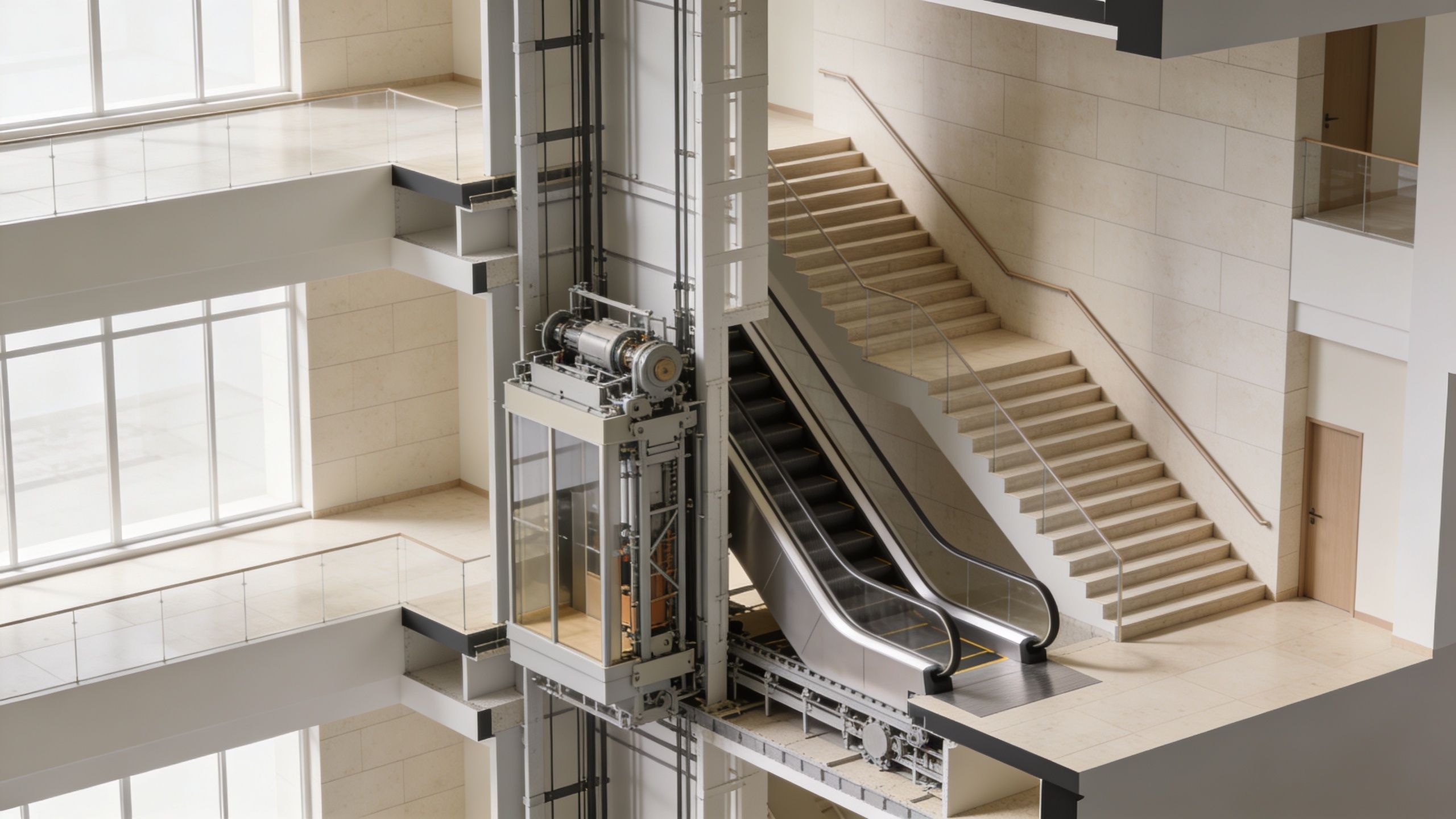
An escalator doesn't just occupy the visible ride path. It also commits you to fixed landings, a defined approach, structural support, and an arrangement that is difficult to move later. In a new building, that can be planned cleanly. In a retrofit, especially in older Southern Michigan buildings, that fixed geometry can drive the whole renovation.
Stairs are different. They may take meaningful space, but they offer more design freedom. They can turn, stack, widen, narrow, and fit around structural realities in ways an escalator can't.
The footprint issue most owners underestimate
The angle matters.
Standard escalator angles are typically 30° or 35°, and that choice directly affects horizontal run and floor consumption, as described in this overview of escalator dimensions and angle tradeoffs. A steeper angle can save space, but it also has to be evaluated against landing behavior, passenger comfort, queue buildup, and long-term operating implications.
Critical trade-off: A steeper escalator may save floor area on paper, but if it creates landing congestion or awkward approach paths, the building loses that gain in daily use.
In a Detroit-area retail renovation, for example, preserving frontage and merchandising space might make the shorter run attractive. In a hospital or civic building, the cleaner user experience of a different arrangement may be worth more than reclaiming a few feet of floor plate.
Side-by-side design realities
| Design issue | Escalator impact | Stair impact |
|---|---|---|
| Horizontal run | Fixed by rise and angle choice | Can be broken into flights and landings |
| Routing flexibility | Low | High |
| Visibility | Strong visual draw for users | Depends heavily on placement and openness |
| Retrofit difficulty | High when structure is constrained | Moderate, but still significant in older buildings |
| Landing congestion | Common if approach is undersized | Common if width or sightlines are poor |
Where escalators make sense
Escalators usually earn their footprint in buildings where traffic is public, repetitive, and concentrated.
- Retail environments where customers expect quick floor-to-floor movement.
- Transit-adjacent buildings where arrivals come in waves.
- Large mixed-use projects where circulation itself shapes tenant value.
Where stairs often outperform expectations
Stairs are usually better than owners think when the design supports them.
A broad, visible stair near the natural path can reduce dependence on machinery, improve resilience during outages, and simplify long-term planning. In campuses, office buildings, and civic properties with moderate inter-floor traffic, a well-designed stair often solves the practical problem without adding the service burden of an escalator.
That doesn't mean stairs are "free." A bad stair layout creates choke points, poor accessibility outcomes, and weak evacuation performance. But from a planning standpoint, stairs give the design team more options to solve real constraints without locking the owner into one mechanical path.
The Michigan retrofit lens
Older properties in Ann Arbor, Flint, Kalamazoo, and Detroit often have a familiar mix of low floor-to-floor clearances, awkward structural bays, legacy entrances, and limited room for new pits or support work. In those buildings, the escalator and stairs decision is often a property strategy decision disguised as a circulation question.
If you don't have room for proper landings and clean approaches, the escalator may be the wrong answer even if demand is real. If you do have the traffic but not the layout, a hybrid strategy often performs better than trying to force one device into a bad footprint.
Construction Retrofitting and Lifecycle Costs
Most owners don't get in trouble on escalators because they misread the purchase price. They get in trouble because they underestimate everything that follows.
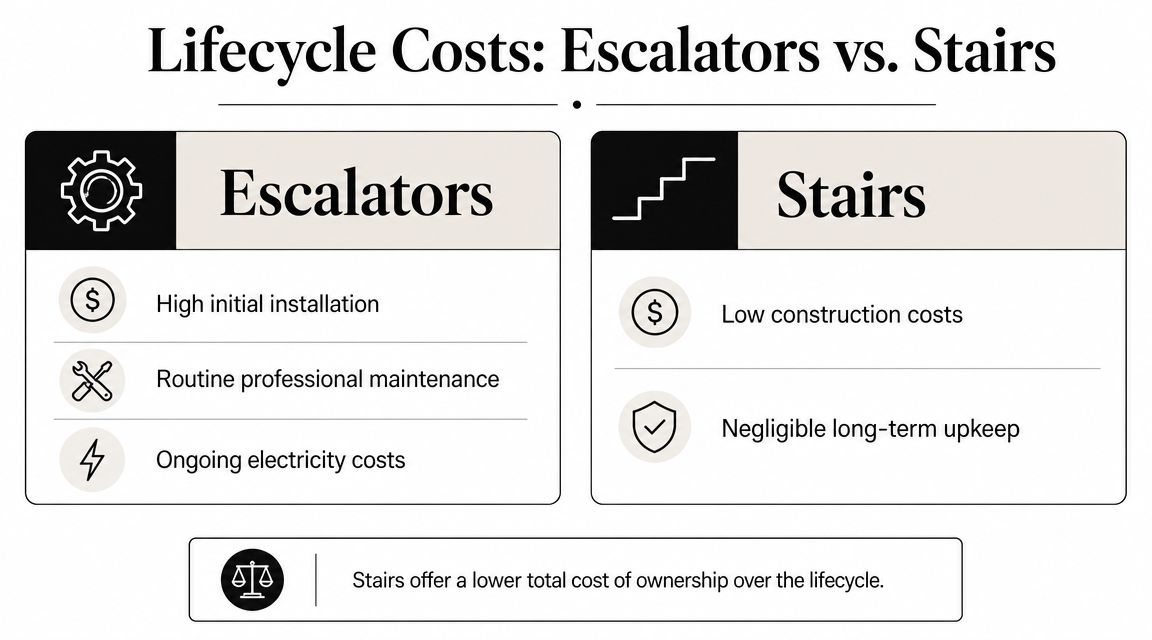
An escalator is a mechanical system with ongoing service needs, electrical use, wear components, inspections, shutdown exposure, and eventual modernization. A stair is a constructed element that still needs maintenance, but its cost pattern is much simpler. For budgeting, that's the split that matters.
How the cost profile actually differs
Escalator costs usually appear in four phases.
Initial construction and installation
This includes equipment, structure coordination, finishes, electrical work, and schedule complexity. In a retrofit, demolition and building modifications often become major line items.Routine operating and maintenance costs
Escalators require professional maintenance, periodic parts replacement, cleaning around mechanical spaces, and responsive repair support when components fail or safety devices trip.Downtime costs
These don't always show up in the capital budget, but they are real. In retail, downtime affects customer movement and tenant satisfaction. In hospitals, campuses, and public buildings, it creates staff workarounds and user frustration.Modernization or replacement
Aging equipment eventually reaches the point where patch repairs stop being economical. At that stage, owners have to choose between ongoing reactive spending and planned modernization.
Stairs have their own cost pattern, but it is more predictable.
- Construction cost depends on structure, finishes, and enclosure requirements.
- Operating cost is mostly tied to lighting, cleaning, slip resistance, and occasional repairs.
- Lifecycle interventions tend to involve finishes, handrails, lighting upgrades, and localized concrete or steel work rather than full mechanical overhauls.
What goes wrong in retrofits
The mistake I see most often is treating an escalator as a one-time build decision.
In older Michigan properties, retrofits often uncover hidden structural limitations, utility conflicts, approach-space problems, and finish restoration costs. That can turn a seemingly straightforward project into a disruptive construction sequence that affects adjacent tenants and access routes far beyond the escalator opening itself.
If the building can't support clean installation, safe landings, and a realistic maintenance path, the escalator's lifecycle cost goes up before the first passenger uses it.
Financing changes the decision
Some owners still assume modernization has to wait for a large capital event. It doesn't. If the equipment is strategically important, financing can convert a painful deferred project into a planned operating expense.
One local option is Crane Elevator Company, which handles non-proprietary modernization, maintenance, repairs, inspections, and financing support for vertical transportation systems across Lower Michigan. That matters because non-proprietary modernization can reduce long-term vendor lock-in and make future service options more flexible.
A practical budget filter
Before committing to escalator work, ask:
- Is this device essential to tenant experience or public circulation, or just desirable?
- Can the building support the installation without major collateral renovation?
- Do we have a maintenance model that fits the asset for the next phase of ownership?
- Would a reworked stair and elevator strategy deliver similar value with less mechanical exposure?
If the answer to the first question is weak, stairs often win. If the answer is strong, then the owner needs to budget for the whole service life, not just the opening day ribbon cut.
Code Accessibility Safety and Maintenance
Code doesn't treat escalators and stairs as equals, and owners shouldn't either.
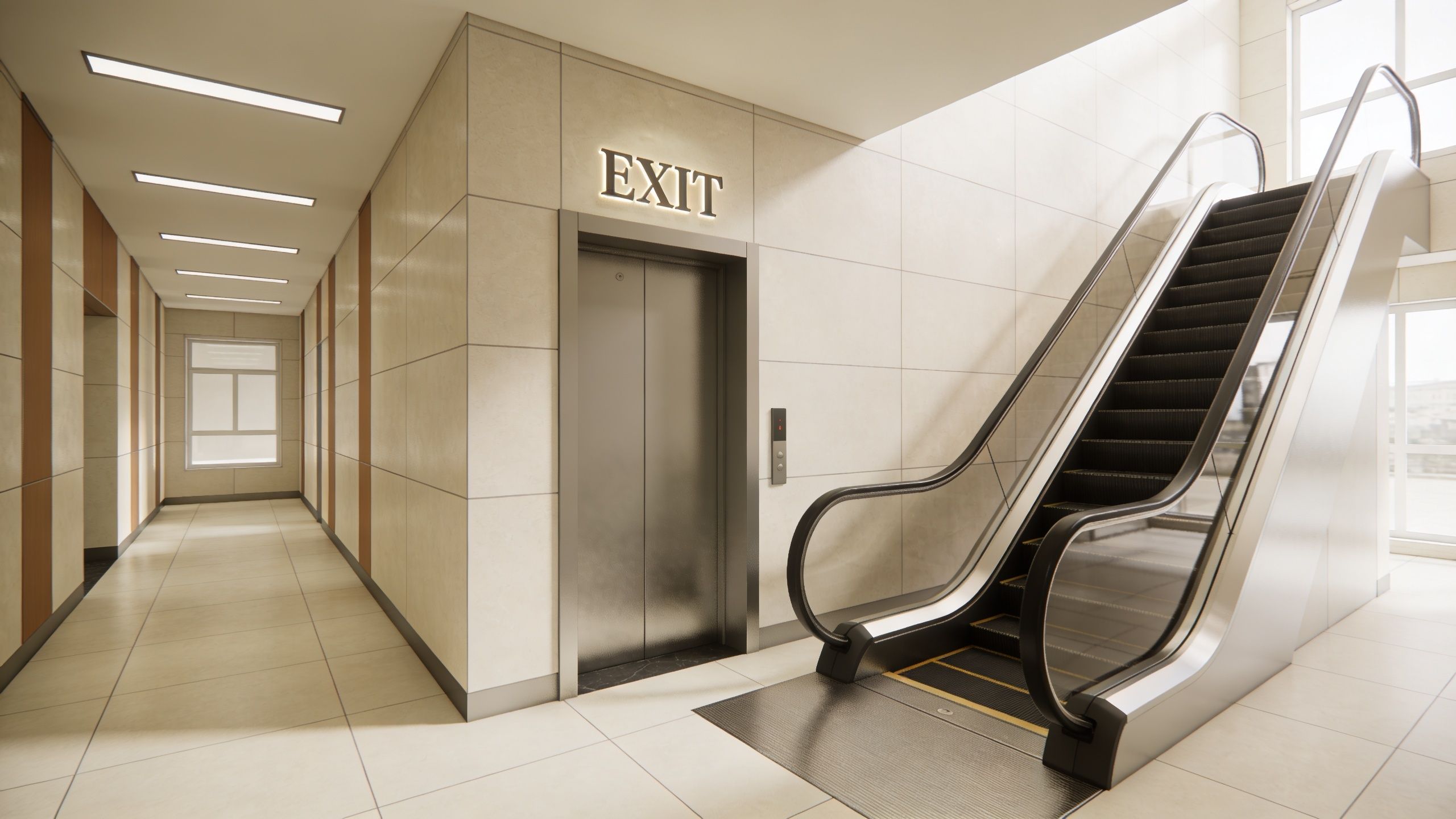
A stair is part of the building's life-safety framework. An escalator is not a substitute for required egress. That distinction matters in design review, renovation planning, and liability exposure.
Egress is not optional
In practical terms, stairs carry the burden of emergency exit planning. If a building owner underinvests in stair condition, width, lighting, handrails, slip resistance, and clear path management, the risk isn't theoretical. It affects both compliance and daily safety.
A comparative summary on stair use and injury context notes that stairs are linked to far more injury and death events overall than elevators or escalators, largely because people use them far more often. The same summary reports more than 8.7 million fall-related injuries annually tied to stair-and-fall contexts and over 30,000 deaths from falls each year nationwide, while also arguing that elevators are safer on a per-use basis after adjusting for volume, according to this discussion of elevators compared with stairs.
That doesn't mean stairs are a problem to avoid. It means owners have to manage them like critical infrastructure, not leftover architecture.
Escalator safety is different
Escalator incidents are fewer in absolute number than stair-related falls, but they involve a different hazard profile.
A peer-reviewed study indexed in PubMed Central reported about 10,000 escalator-related injuries per year requiring emergency department treatment in the U.S., with the majority caused by slipping or falling. In that study, 133 of 173 cases, or 77%, were caused by slipping or falling, and 62% of documented accidents occurred in public transport facilities while 30% occurred in shopping centers. Other summaries of CPSC-based data estimate roughly 6,000 escalator injuries annually, with falls accounting for about 75% of incidents and entrapment about 20%, according to the PubMed Central escalator injury review.
For owners, the practical takeaway is straightforward:
- High-traffic public settings carry concentrated escalator risk
- Falls remain the dominant issue
- Entrapment hazards require maintenance discipline, not just signage
Accessibility changes the whole plan
Escalators are not an accessible route by themselves. If your building relies on them for primary public circulation, you still need an accessible means of travel. In many properties, that means elevator availability becomes part of the same planning conversation. For a useful baseline on this issue, review ADA elevator compliance requirements.
The maintenance standard owners should expect
A safe system isn't created by annual panic right before an inspection. It comes from routine attention.
- For stairs that means lighting, tread condition, handrails, slip resistance, and housekeeping.
- For escalators that means regular professional maintenance, code-required testing, comb plate and skirt condition checks, demarcation visibility, and quick correction of recurring faults.
- For paired elevator systems it means uptime, communication systems, and fire service readiness.
The liability question isn't whether stairs or escalators are inherently "safe." It's whether the owner maintained the system that occupants were expected to use.
That is the standard that matters when an incident occurs.
Hybrid Solutions and Strategic Modernization
Most high-functioning buildings don't choose between escalator and stairs. They assign each one a job.
A retail center may use escalators as the primary public route and rely on stairs for egress and secondary movement. A hospital connector may push routine public circulation toward elevators and maintain stairs for staff use and emergency conditions. A campus building may direct daily traffic to a feature stair while preserving elevators for accessibility and using no escalator at all.
The better planning question
The useful question isn't "Which is better?" It's "What happens when one part of the system is unavailable?"
That is where vertical mobility continuity becomes important. Basic guidance usually assumes stairs solve the fallback problem, but that breaks down quickly for older adults, people with temporary injuries, users with mobility impairments, and anyone moving carts, equipment, or strollers. As noted in a summary about escalator emergency use, stairs are the default emergency route, but standard building design often fails to address how that disadvantages many users, which is why owners increasingly need an integrated approach to stairs, elevators, and escalators as a system, discussed in this overview of the escalator and emergency movement context.
When modernization beats replacement
If a building already has an aging escalator, the decision is rarely simple.
A full replacement may be justified when the equipment is badly obsolete, the structural work is already planned, or reliability has collapsed. But many owners are better served by strategic modernization, especially when the escalator remains central to public circulation and the existing footprint still works.
Modernization can make sense when:
- The truss and major structure remain serviceable
- The building can't tolerate a full rip-out easily
- Safety components, controls, and wear parts are the actual problem
- The owner wants better reliability without redesigning the whole floor plan
What a hybrid strategy often looks like
A practical Southern Michigan plan often includes:
| Building type | Primary daily movement | Backup and continuity plan |
|---|---|---|
| Retail or public venue | Escalator plus elevator | Visible stairs, outage routing, maintenance response plan |
| Office or civic building | Stairs plus elevator | Clear egress routes and accessible alternative path |
| Healthcare or education | Elevator-centered circulation with stair support | Redundant accessible movement and managed shutdown procedures |
Stairs are necessary. They are not, by themselves, a complete continuity plan for every occupant.
Owners who accept that early usually make better modernization decisions. They stop looking at isolated devices and start looking at system performance during normal use, outages, inspections, and emergency conditions.
Making the Right Choice for Your Michigan Property
The right escalator and stairs strategy depends on how your building operates, not on what looks standard in another property.
If you manage a Southern Michigan facility, start with a short decision filter.
Ask these questions first
How concentrated is peak traffic
If large groups move between the same two floors at predictable times, an escalator may be justified. If traffic is lighter or more dispersed, stairs and elevators may perform better.How much floor area can you really give up
Not just at the opening. At the landings, approaches, and surrounding circulation zone.What is the building's accessibility obligation
Escalators do not solve that issue. A complete route has to work for all users.What is your maintenance posture
If the ownership group delays mechanical spending until failure, adding escalator dependence may create recurring operational stress.What happens during an outage
This is the question many teams skip. It should be one of the first.
The practical conclusion
Choose stairs when you need resilient, flexible, lower-complexity circulation and egress. Choose escalators when public traffic volume and user expectations are high enough to support the cost and maintenance burden. Choose a hybrid solution when the building needs both throughput and resilience.
For many Michigan properties, especially retrofits, the best long-term answer isn't a generic escalator versus stairs comparison. It's a property-specific review of code, footprint, maintenance capability, accessibility, and modernization timing.
If you're planning a renovation in Detroit, evaluating aging equipment in Ann Arbor, or trying to stabilize service costs across a Lansing portfolio, get the layout and lifecycle review done before design assumptions harden. The expensive mistakes in vertical circulation usually happen early, then stay in the building for decades.
Crane Elevator Company serves Lower Michigan with maintenance, repairs, inspections, and non-proprietary modernization support for vertical transportation systems. If you need a practical assessment of circulation, compliance, or modernization options for your property, contact Crane Elevator Company for a project review.