When a commercial elevator goes down, the search for commercial elevator repair near me usually starts under pressure. A tenant is calling. A staff member is waiting in the lobby. Deliveries are backing up. If the building has one car, the whole day can turn sideways fast.
Most property managers don't need a sales pitch in that moment. They need a clear way to decide three things. Is this an emergency or a scheduled repair? Is the problem fixed or just reset? And is the contractor solving the root cause, or buying a few days before the next shutdown?
Your Guide to Navigating an Elevator Outage
A typical outage call starts the same way. The elevator is parked, the doors won't close, or the car is stopping unevenly and tenants are nervous. Someone asks for a quick restart. Someone else wants to know how long the unit will be down. Meanwhile, the building manager is trying to decide whether this is a one-time issue or the latest round in a pattern that keeps repeating.
The importance of that distinction is often underestimated. A single failed door contact can put a car out of service. So can a worn roller, a dirty sill, a control issue, a hydraulic leak, or a safety circuit fault. The visible symptom is often simple. The actual cause usually isn't.
What to do first
When the elevator is down, the first job is to control the scene and gather facts.
- Confirm building impact: Is it one car or all cars? Is anyone trapped? Is the issue affecting accessibility, patient movement, deliveries, or tenant operations?
- Document the symptom: Note whether the doors are cycling, the car is leveling poorly, the unit is dead, or the hall stations are active but the car won't move.
- Check recent history: If the same fault has happened before, that changes the repair conversation immediately.
- Preserve the condition: Don't let multiple people keep cycling power or forcing doors. That can erase clues and create more damage.
If your building is already dealing with a shutdown, this guide on what an elevator out of service condition means for building operations is a practical starting point.
A good outage response doesn't start with replacing parts. It starts with narrowing down whether the elevator failed once or has been warning you for months.
The right mindset during a shutdown
The goal is to restore service quickly, but speed alone isn't enough. A fast reset that leaves the root problem untouched can create the worst outcome. The elevator comes back for a short time, everyone relaxes, and then it fails again during peak traffic.
Property managers usually make better decisions when they ask one direct question early: What evidence tells us this is the failed component, not just the first thing we saw? That question separates surface troubleshooting from real diagnosis.
Emergency Response vs Scheduled Service Calls
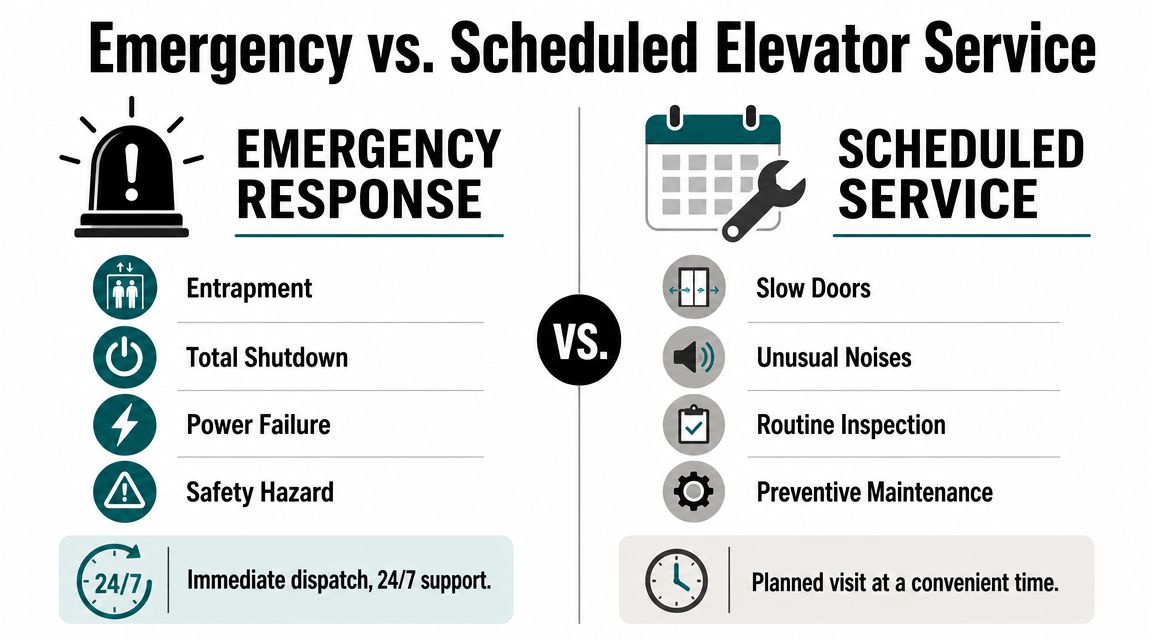
Not every service call belongs on the same path. Some failures need immediate 24/7 dispatch. Others are better handled as planned work with time for deeper diagnostics and parts coordination.
When it is an emergency
An emergency call is about safety and immediate building function. Entrapments, total shutdowns, fire service concerns, communication failures, and conditions that make the car unsafe to run belong in this category.
The trade itself is built around that reality. The U.S. Bureau of Labor Statistics notes that elevator repairers may be on call 24 hours a day and often work in cramped conditions, which is why local response matters for commercial buildings. The same occupation had a median annual wage of $106,580 in May 2024, with employment projected to grow 5% from 2024 to 2034 and about 2,000 openings per year on average, according to the Bureau of Labor Statistics occupation profile for elevator installers and repairers.
In a true emergency visit, the technician's first priorities are usually:
- Make the site safe: secure the car, hoistway access, and any affected landing.
- Release trapped passengers if needed: this comes before ordinary troubleshooting.
- Determine if the car can return safely to service: not every outage should be reset and released.
- Stabilize the problem: a temporary correction may restore limited operation while a full repair is planned.
For urgent dispatch situations, building teams should know what a provider includes in emergency elevator service.
When scheduled service is the smarter path
A scheduled call is different. The elevator may still be running, but something is off. Slow doors. Rough stops. Repeated nuisance faults. Noise from the machine room. A unit that intermittently drops out of service but comes back after a reset.
Those issues still matter. They just benefit from a different process.
| Service type | Main objective | What to expect |
|---|---|---|
| Emergency response | Protect people and restore safe operation | Triage, immediate diagnosis, temporary or permanent repair depending on parts and conditions |
| Scheduled repair | Find root cause and plan a durable correction | More time for testing, history review, parts sourcing, and code-related documentation |
The trade-off most managers miss
Emergency work is often about restoring function under pressure. Scheduled work is where contractors can test thoroughly, verify intermittent faults, and avoid swapping parts based on guesswork.
Field reality: If a car only fails during heavy traffic, a quiet after-hours emergency visit may not reproduce the same symptom. That's one reason recurring problems often need a scheduled return with a more deliberate test plan.
The Anatomy of a Commercial Elevator Repair Visit
Most property managers only see two moments of a repair call. The elevator is down, then a technician arrives. What happens in between is where the good work lives.
The first ten minutes on site
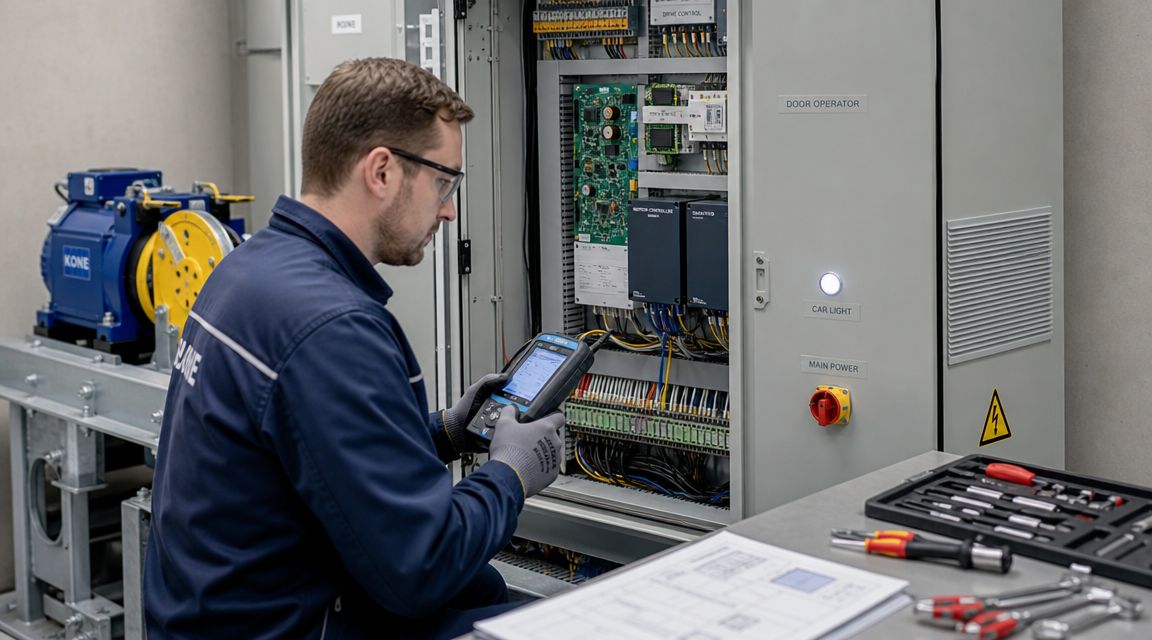
A proper visit starts with information gathering, not a wrench. The technician should ask what the car was doing when it failed, whether the issue is repeatable, what happened before the outage, and whether any recent work was performed.
Then comes isolation of the failure zone. In practice, that usually means narrowing the issue into one of these buckets:
- Door-related fault
- Control or electrical issue
- Hydraulic or mechanical problem
- Safety circuit or code-required subsystem issue
The same symptom can come from different systems. A car that won't run might have a healthy machine and a failed door confirmation. A leveling complaint might be hydraulic drift, but it could also be a control problem or a door-zone related issue.
Why door systems get checked early
Door faults are one of the highest-probability causes of downtime. As TK Elevator's maintenance guidance explains, shutdowns often trace back to misaligned interlocks, worn rollers, dirty sill channels, failing door operators, or unreliable safety-edge and light-curtain signals. If the controller doesn't see a valid closed-door signal, the car won't run.
That is why a real diagnosis goes beyond replacing whatever looks worn.
A competent technician will often inspect and test:
- Interlocks and locking contacts: Are they aligned and making consistently?
- Rollers, hangers, and gibs: Are they worn enough to create unstable door travel?
- Sills and tracks: Dirt and debris can create repeat faults that look electrical at first.
- Operator performance: Is the operator weak, inconsistent, or out of adjustment?
- Protective devices: Are the safety edge or light curtain giving false inputs?
What happens after the probable cause is found
Once the likely fault is isolated, the next step is to verify it under operating conditions. That's where weak service calls often cut corners. The car gets reset, it runs once, and everyone moves on. A strong repair visit confirms the fault, performs the correction, and then cycles the car enough to see whether the issue is resolved.
This is worth watching if you want a better feel for how elevator systems are diagnosed in the field.
If the explanation ends at "we reset it and it's working now," you don't yet know why it failed.
The final checks before the technician leaves
Before returning a commercial elevator to service, the technician should verify safe operation and note any follow-up work still required. Depending on the issue, that may include observing multiple runs, checking door performance at several floors, confirming communication devices, reviewing fire service functions, or documenting parts that need replacement on a return trip.
For the property manager, the most useful closeout question is simple: What failed, what was tested, and what still needs to be addressed so this doesn't return as another outage?
Decoding Repair Costs and Financing Options
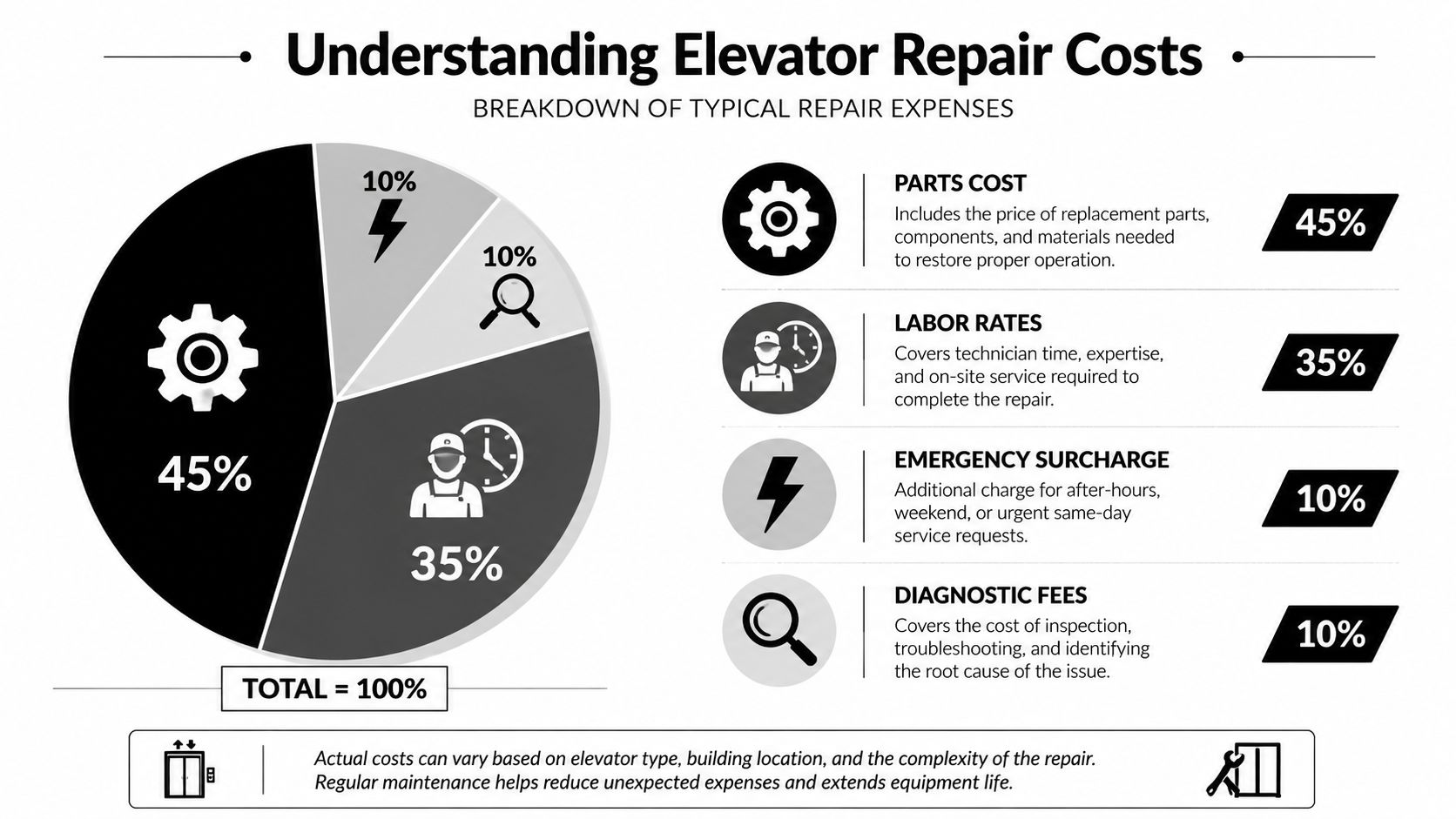
Repair cost is rarely about one line item. It is the combination of labor conditions, part availability, how much diagnosis is needed, and whether the elevator has aging or proprietary components that limit options.
That matters because the invoice people expect and the invoice they receive are often different things.
What usually drives the bill
The biggest cost variables are usually not mysterious. They come from four practical factors.
- Timing of the call: Emergency work can cost more than planned work because it pulls a technician into after-hours dispatch conditions.
- Depth of diagnosis: Intermittent faults often take longer than obvious failures.
- Parts path: Some equipment can accept non-proprietary replacement strategies. Other systems tie you to specific OEM channels or obsolete components.
- Age and condition of the unit: Old equipment tends to create layered repairs. You replace one worn item and the next weak point appears soon after.
The broader market reflects that elevator service is not a one-time event. Fortune Business Insights projects the global elevator maintenance market will grow from $38.33 billion in 2026 to $68.25 billion by 2034 at a 7.50% compound annual growth rate, and it describes maintenance as including inspections, preventive service, repairs, modernization, component checks, lubrication, replacement of worn parts, and software or control updates in its elevator maintenance market outlook.
What makes one repair cheap and another expensive
Here's the practical difference.
| Cost factor | Lower-cost scenario | Higher-cost scenario |
|---|---|---|
| Labor | Straightforward fault, easy access, standard hours | Intermittent fault, after-hours dispatch, repeated troubleshooting |
| Parts | Common wear items available locally | Proprietary or obsolete components with longer sourcing paths |
| Scope | Single failed component | Multiple related failures or code-related deficiencies discovered during repair |
| Strategy | Repair restores stable service | Repair becomes a bridge to modernization planning |
Financing is not just for full replacements
Some building owners treat financing as something to consider only when the elevator is beyond repair. In practice, it can also make sense when a major repair, control update, or phased modernization would otherwise hit the operating budget all at once.
For managers comparing options, elevator modernization cost considerations are useful because they frame the decision as cash flow and lifecycle planning, not just a one-time spend.
One example in Michigan is Crane Elevator Company, which offers commercial elevator financing and modernization financing alongside non-proprietary repair and modernization work. That doesn't change the technical question. It changes how a building can absorb the work financially when the right answer is more than a minor service call.
Cost rule: The cheapest approval is often the one that stops repeat outages, not the one with the smallest immediate invoice.
How to Vet Your Local Elevator Repair Contractor
When you're searching commercial elevator repair near me, the wrong first question is usually, "How fast can you get here?" Speed matters. It just shouldn't be the only screen.
A contractor can arrive quickly and still leave you with a recurring fault, unclear documentation, and a repair path that gets more expensive every month.
The questions worth asking on the first call
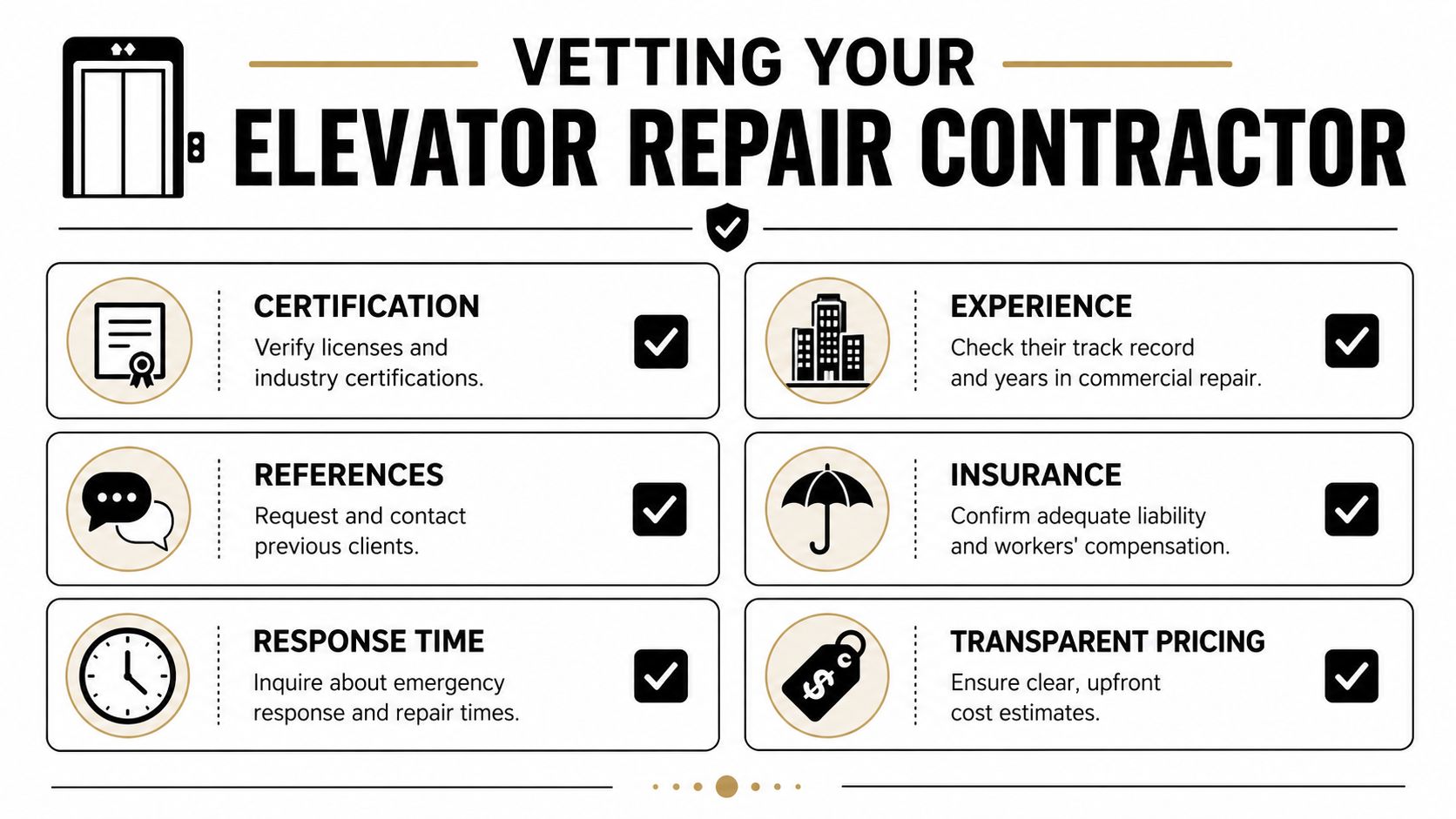
The useful vetting questions are specific enough to reveal how the company works.
- Ask about your exact equipment: What experience do you have with this controller, operator, or hydraulic system?
- Ask how they diagnose repeat faults: Do you rely on reset-and-return, or do you test the full circuit and operating sequence?
- Ask about parts sourcing: What happens if the failed part is proprietary, discontinued, or delayed?
- Ask about compliance closeout: After the repair, what gets tested, documented, and communicated back to us?
- Ask who will perform the work: Is the technician assigned to commercial repairs regularly, or is this just the nearest available dispatch?
According to Metro Elevator's San Francisco service guidance, a major gap in owner-facing information is whether a provider can handle the intersection of parts constraints, code requirements, and emergency response. That is the true test, especially on aging equipment.
What strong answers sound like
You don't need polished language. You need clear operational answers.
| Question | Weak answer | Strong answer |
|---|---|---|
| Can you service this model? | "We work on most elevators." | "Yes, and here's how we handle that controller and its common failure points." |
| How do you manage hard-to-find parts? | "We'll see what's available." | "We verify whether the part is OEM-dependent, identify alternatives where appropriate, and tell you the likely path before ordering." |
| How do you close out a repair? | "We let you know when it's running." | "We test operation, note any remaining deficiencies, and explain what was corrected versus what still needs planned work." |
The best contractor is not the one with the fastest script. It's the one that can explain the repair path before the second outage happens.
References still matter
For commercial properties, references should match your building type when possible. A contractor who understands office traffic may not approach a hospital, school, or municipal facility the same way. Ask how they handle outage communication, repeat failures, code-related findings, and part lead times on older equipment.
Shifting from Reactive Repairs to Proactive Maintenance
Reactive service feels cheaper until the pattern becomes obvious. The car goes down, someone approves a repair, it comes back, and a few weeks later another fault shows up. That cycle burns staff time, irritates tenants, and usually costs more than disciplined maintenance.
The easiest comparison is vehicle service. If you skip oil changes long enough, you don't save money. You just delay the bill until the repair is bigger, harder, and more disruptive.
How to tell a one-off repair from a systemic problem
Some failures are isolated. A part wears out, it gets replaced, and the elevator returns to normal service. Others are warning signs that the unit is aging into repeat downtime.
Common signals of a deeper lifecycle issue include:
- Repeat calls on related components: especially doors, leveling, communication, or nuisance shutdowns
- Repairs that restore service briefly: then fail under normal traffic again
- Visible housekeeping problems: dirty machine rooms, neglected pits, and debris around working components
- Aging equipment with shrinking parts options: each repair takes more effort to source and justify
- Growing code and reliability friction: the elevator runs, but confidence in it keeps dropping
A recurring outage pattern should trigger a harder review of maintenance quality and lifecycle planning. As TK Elevator's Fresno service area page notes, a key owner question is whether a repair is a one-off fix or evidence of a deeper problem, especially as many elevators in major markets are over 20 years old and modernization becomes a risk-management decision.
What preventive maintenance actually changes
Good maintenance is not just lubrication and a signature on a route sheet. It is regular inspection, cleaning, adjustment, early replacement of wear items, and documentation that helps explain why a unit is changing over time.
That approach works because many elevator problems don't begin as dramatic failures. They start as drag, contamination, minor misalignment, intermittent contact issues, or a small leak that keeps getting ignored.
What a practical maintenance mindset looks like
For property managers, a strong preventive program usually includes:
- Clean machine rooms, pits, and car tops: dirt and neglected housekeeping hide problems and contribute to repeat issues
- Attention to consumables and wear items: rollers, contacts, lamps, edges, and similar components don't last forever
- Trend tracking: if the same car generates the same complaint repeatedly, treat it as a pattern
- A modernization threshold: know when you're authorizing repairs that are only postponing a larger decision
If a contractor can't explain why the same failure keeps returning, you don't have a maintenance strategy. You have a dispatch pattern.
Why Crane Elevator is the Right Choice for Michigan
Property managers in Lower Michigan usually need the same mix from an elevator partner. Fast response when the building is under pressure. Solid troubleshooting when the problem is not obvious. Clear communication on compliance, parts, and whether the fix is temporary or durable.
That is where local knowledge matters. The contractor needs to understand mixed equipment, older installations, modernized units, and the operational realities of offices, healthcare buildings, schools, municipalities, and industrial properties across the region.
Crane Elevator Company fits that role because its service model is built around the exact issues that make commercial elevator repair difficult in the field. The company handles emergency response, inspections, proactive maintenance, non-proprietary modernizations, and repair work across all makes and models. Its maintenance approach also addresses common repeat-failure drivers directly through full clean-downs, included COP and PI bulb replacements, and a No Show, No Pay policy that puts accountability on the service side.
For building owners, the bigger advantage is decision clarity. When an elevator goes down, the key question isn't only who can show up. It's who can tell you whether this is a small repair, a recurring systems problem, or the point where modernization becomes the smarter path.
If your building needs immediate dispatch, a second opinion on a recurring elevator problem, or a practical plan for repair versus modernization, contact Crane Elevator Company. They serve Lower Michigan with 24/7/365 field response, code-focused service, and non-proprietary solutions designed to reduce repeat downtime.