If you're dealing with an elevator that's suddenly down in Detroit, running rough in Ann Arbor, trapping tenants in a multifamily building near Lansing, or failing inspections in Flint, you're not looking for theory. You need to know what to shut down, what to report, what the contractor should do next, and whether you're fixing a single failure or managing a bigger asset problem.
That distinction matters. A lot of Michigan owners treat elevator repair as a one-time service call. In practice, the better approach is to manage repairs, maintenance, compliance, parts risk, and modernization as one operating strategy. That's how you reduce downtime, avoid repeat callbacks, and keep older equipment from turning into a constant emergency.
Your Guide to Managing Elevator Downtime
The hard part of elevator downtime isn't only the breakdown itself. It's the cascade that follows. Tenants complain. Deliveries slow down. Accessibility becomes an immediate issue. Staff start improvising around a system they rely on every day.
In a commercial building, healthcare property, school, or multifamily site, a down elevator changes how the building functions. It also puts pressure on the owner to make fast decisions with limited information. That's where bad choices happen. Owners approve patchwork repairs on obsolete equipment, wait too long to shut a unit down, or assume that passing service calls means the system is under control.
What building owners actually need
Most owners don't need a lecture on elevator mechanics. They need a practical framework:
- How to spot a real warning sign: Not every noise means a shutdown, but some symptoms do.
- How to describe the problem clearly: Better information at dispatch usually means faster diagnosis on site.
- How to separate repair from long-term planning: A door issue is one thing. Chronic parts delays on a legacy controller are something else.
- How to avoid getting trapped by proprietary equipment: If only one provider can source parts or access the system efficiently, your downtime risk goes up.
- How to keep the repair compliant: Getting the elevator running isn't enough if the work creates inspection or code problems later.
A lot of owners first start asking those questions when the car is already out of service. If that's where you are now, this guide on what an elevator out of service condition means for your building is a useful starting point.
Practical rule: The fastest way to lose control of elevator repair is to treat every outage as an isolated event.
What works and what doesn't
What works is disciplined triage, clear documentation, qualified technicians, and a plan for aging equipment.
What doesn't work is guessing, restarting the unit repeatedly, delaying shutdown on a suspect elevator, or approving one more hard-to-source repair without asking whether modernization is the smarter move.
Symptoms and Initial Diagnostics
Most elevator failures give warning before they become shutdown events. Building staff usually see the signs first. The key is knowing which signs point to a nuisance issue, which suggest a developing component failure, and which mean the unit should be taken offline immediately.
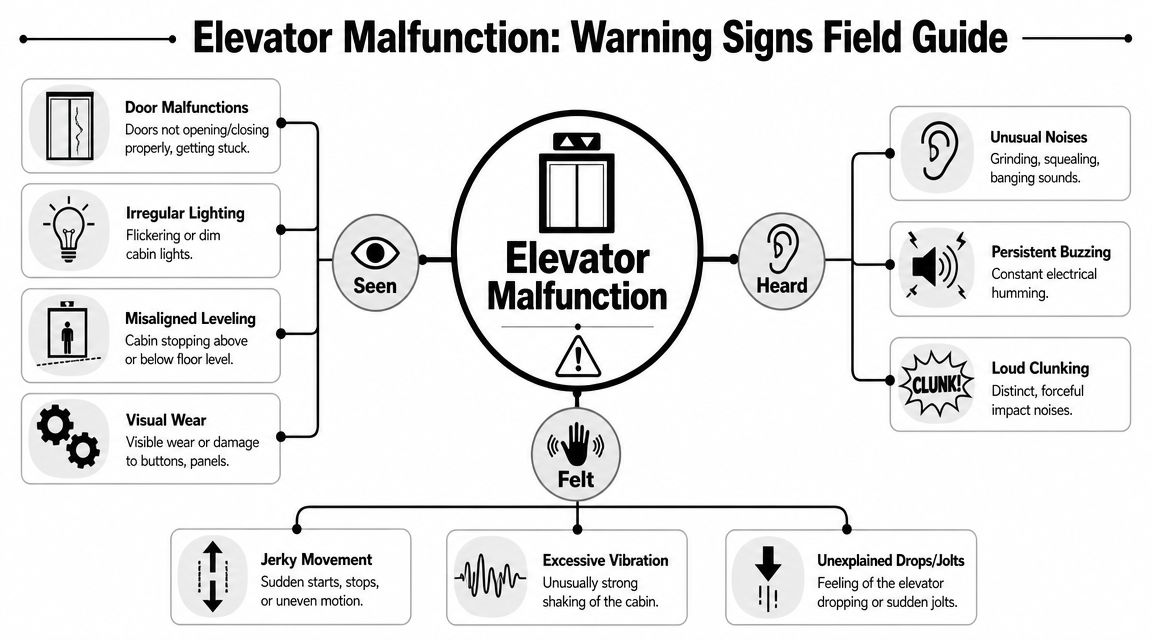
What you can see
Visual symptoms are often the easiest for a property manager or maintenance lead to report accurately.
Look for:
- Door problems: Doors hesitate, reverse repeatedly, fail to close cleanly, or stop short.
- Poor leveling: The car stops above or below the landing floor.
- Panel or fixture issues: Call buttons fail, floor indicators misread, lights flicker, or hall stations behave inconsistently.
- Visible wear: Damaged sills, loose buttons, bent panels, or heavy dirt buildup around door tracks.
Among common failures, door malfunctions are identified as the most common elevator repair issue by Southern Elevator, often tied to misalignment, dirty tracks, or worn sensors, and their guidance is clear that the unit should be taken offline and a licensed provider contacted when that problem appears (Southern Elevator on common repair issues).
What you can hear
Noise matters, but only if you document it well. “It sounds weird” doesn't help much on a dispatch ticket. A better report names where the sound is coming from and when it happens.
Useful descriptions include:
- Grinding at the doors: Often points to door equipment, rollers, tracks, or operator issues.
- Buzzing or humming: May suggest an electrical issue, relay problem, or fixture component beginning to fail.
- Loud clunk on stop or start: Can indicate brake, drive, leveling, or mechanical engagement issues.
- Machine-room noise that's changed recently: That deserves attention even if the elevator is still running.
What you can feel
A tenant may not notice technical details, but they will notice motion quality immediately.
Pay attention to:
- Jerky starts or stops
- Excessive vibration
- Hesitation before movement
- Hard releveling
- A drop or jolt sensation
These symptoms don't all mean the same thing. Some point to leveling system problems. Others suggest control, drive, or hydraulic behavior that needs prompt diagnosis.
If the car feels unstable, levels poorly, or the doors aren't operating predictably, don't keep testing it by riding it again and again.
When to shut it down
Take the elevator out of service and call for licensed elevator repair if you have any of the following:
- Doors that won't operate safely
- The car stopping uneven with the floor
- Repeated entrapments or fault resets
- Burning smell, smoke, or obvious electrical distress
- A hard jolt, unexplained drop feeling, or severe vibration
- Any condition that makes occupants unsure whether the unit is safe to use
For the service call, gather basic facts before the technician arrives:
- Which car is affected
- Whether passengers were trapped
- What the elevator was doing just before failure
- Whether the issue is constant or intermittent
- Any recent work, power event, or inspection activity
That information saves time on diagnosis and helps the contractor bring the right expectations to the site.
Common Elevator Repair Categories
“Elevator repair” covers several very different systems. Owners make better decisions when they stop thinking in terms of one vague repair bucket and start looking at the actual subsystem involved. A door operator problem, a hydraulic leak, a controller fault, and a code-related safety issue all follow different timelines, scopes, and risks.
Hydraulic, electrical, mechanical, and safety work
Hydraulic elevators often develop issues that show up as slow performance, rough starts, poor leveling, leaks, or temperature-related inconsistency. Typical repair work may involve jack packing, oil line problems, tank or power unit components, pumps, valves, or related control adjustments. In older Michigan buildings, especially lower-rise properties in Flint or Lansing, hydraulic equipment can stay serviceable for a long time, but neglected leaks and weak leveling never fix themselves.
Electrical repairs usually involve the controller, relays, wiring, traveling cables, COP or hall fixtures, selectors, communication devices, or signal problems. These jobs can look minor from the lobby and still be labor-intensive on the backend. A button that intermittently fails might be the button itself, or it might be a larger control or communication fault. If you want a clearer picture of how these systems affect reliability, this overview of elevator controls and control system upgrades is worth reviewing.
Mechanical and cab system repairs are the issues owners notice most because occupants feel them directly. That category includes door operators, rollers, guides, sheaves, machine components, cables or ropes, and visible cab equipment. Mechanical wear usually announces itself before total failure. Doors drag. The ride quality worsens. The unit gets noisier. Then the shutdown happens.
Safety system repairs are in a category of their own because the question isn't convenience. It's whether the elevator should be running at all. That work may involve brakes, governors, door lock monitoring, emergency communication, fire service functions, or other code-sensitive devices. Owners should treat any safety-system defect as a compliance issue first and a repair issue second.
Quick Guide to Elevator Repair Types
| Symptom | Potential System | Common Repair | Urgency |
|---|---|---|---|
| Doors reopen, stall, or won't close | Door operator or sensor system | Sensor replacement, track cleaning, alignment, operator repair | High |
| Car stops above or below floor | Leveling or control system | Releveling adjustment, control diagnosis, component replacement | High |
| Slow or rough travel on hydraulic unit | Hydraulic system | Valve, packing, pump, or oil-related repair | Medium to high |
| Buttons or hall calls fail intermittently | Electrical or fixture system | Button, wiring, relay, or control circuit repair | Medium |
| Grinding, clunking, or abnormal machine noise | Mechanical drive or door system | Mechanical inspection and component replacement | High |
| Emergency phone or fire service issue | Safety and code-related system | Device repair, testing, compliance correction | High |
What owners often misunderstand
A small symptom doesn’t always mean a small repair. A single recurring door fault can burn staff time for months if no one addresses the root cause. On the other hand, not every outage means the whole elevator is finished.
What matters is pattern recognition. If the same subsystem keeps failing, the discussion should shift from “what part do we change next?” to “is this equipment still practical to support?”
- One isolated failure: Repair it and monitor.
- Repeat failures in the same area: Review maintenance quality and parts condition.
- Multiple systems degrading at once: Start budgeting for modernization.
- Parts scarcity or proprietary dependence: Reassess the long-term strategy immediately.
The Typical Elevator Repair Process
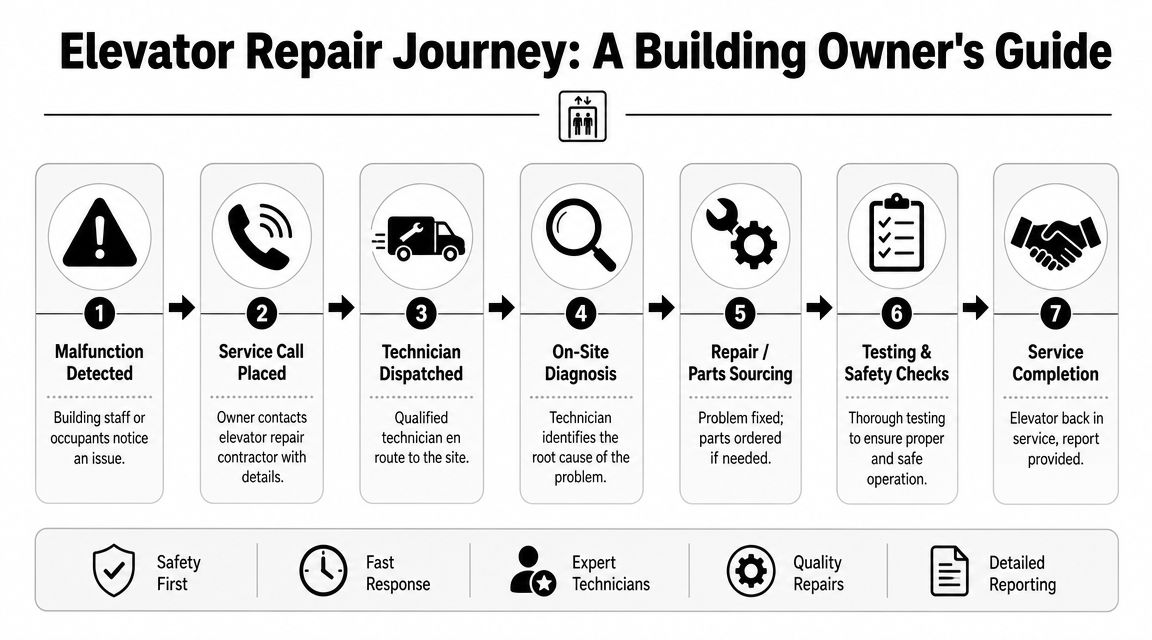
A professional elevator repair call should feel structured, not improvised. Owners don’t need every technical detail, but they should know what a proper process looks like so they can tell the difference between disciplined work and guesswork.
The first stage is straightforward. Someone in the building notices a problem, the unit is secured if needed, and the service call goes out with as much usable detail as possible.
From dispatch to diagnosis
Once dispatch has the site information, a qualified technician is sent to the property. At arrival, access matters. If machine rooms, control spaces, roofs, pits, or locked areas aren’t available, diagnosis slows down before it starts.
A proper on-site process usually includes:
- Initial condition review: What fault is active, what the building reported, and whether the unit is safely isolated.
- Safety lockout: Before repair begins, the technician secures the equipment under documented safety procedures.
- System diagnosis: The technician tests, inspects, traces faults, and determines whether the issue is mechanical, electrical, hydraulic, or code-related.
- Repair decision: Some issues can be corrected immediately. Others require parts, follow-up labor, or a broader proposal.
Technical safety guidance for elevator work stresses engineered anchor points, PPE, pre-task hazard assessment, and that equipment should be locked out, tagged out, tested, and verified to remove stored energy before work proceeds unless a specific energized diagnostic task is required by code and company procedure (technical guidance on anchor testing and safety procedures).
Approval, parts, and return to service
Once the fault is identified, the owner should receive a clear explanation of what failed, whether the elevator can remain out of service safely, and what the next step is. If the issue requires approval, the quote should state the component or scope plainly. “Miscellaneous repair” isn’t enough.
This video gives a useful general look at elevator service work and what owners should expect during a repair event.
After approval, the path splits:
- Immediate repair: The technician has the part or can complete the correction during the same visit.
- Deferred repair with temporary shutdown: The unit remains offline until parts arrive or follow-up work is scheduled.
- Temporary restoration with further recommendation: The elevator returns to service, but the contractor flags a larger issue that still needs action.
At completion, the equipment shouldn’t just “run again.” It should be tested for proper operation, safety functions, and return-to-service condition.
A clean closeout includes what was found, what was repaired, what was tested, and what still needs attention.
For owners, that documentation matters almost as much as the repair itself.
Distinguishing Repair from Maintenance
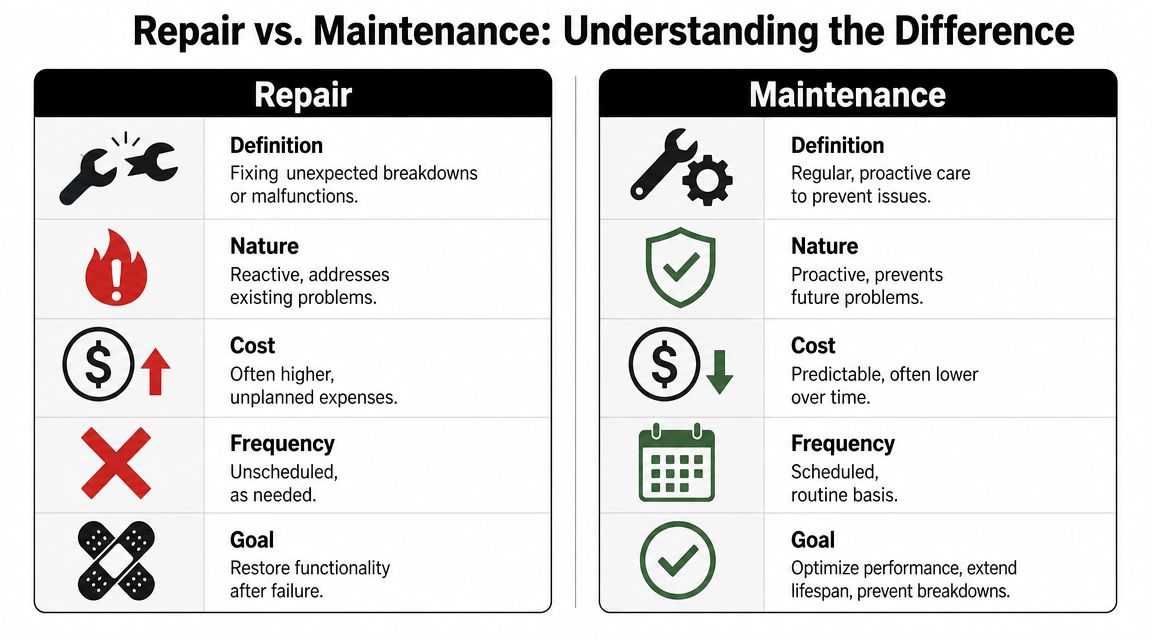
Most expensive elevator repair calls start long before the shutdown. They start when routine cleaning, adjustment, inspection, testing, and recordkeeping slip. Then a small defect grows into a failure that affects tenants, accessibility, and operations.
That’s the difference between repair and maintenance. Repair responds after something has already failed. Maintenance is the work that keeps failure from showing up early and keeps small issues from multiplying.
What maintenance actually includes
Good maintenance isn’t a quick look through the machine room and a signature on a ticket. It includes regular inspection of moving parts for wear, testing of safety systems such as brakes and alarms, replacement of routine consumables like lubrication and lights, and disciplined logkeeping so recurring patterns are visible before they become downtime events.
Industry guidance is explicit on this point. An effective elevator repair program should be built around preventive maintenance because small defects often become costly failures if service is skipped or delayed (preventive maintenance guidance for elevator systems).
For owners, that usually means the maintenance contract should support these practical habits:
- Scheduled visits with real scope: Not vague “as needed” language.
- Full cleaning of critical areas: Dirt in tracks, pits, and machine spaces contributes to avoidable failures.
- Adjustment before failure: Doors, rollers, contacts, and leveling systems need attention before the callback.
- Pattern tracking: If the same car repeats the same issue, someone should flag it.
What repair looks like when maintenance is weak
Repair becomes more frequent and less predictable when maintenance is superficial. The building sees a cycle like this:
| Repair pattern | Maintenance reality |
|---|---|
| Same door fault returns repeatedly | Door equipment was never fully cleaned, aligned, or corrected |
| Car rides rough for months before shutdown | Early ride-quality symptoms were ignored |
| Intermittent faults keep reappearing | Poor recordkeeping hid the pattern |
| Emergency calls increase on older units | No long-term parts or modernization plan exists |
That doesn't mean maintenance prevents every failure. It doesn't. Components still wear out, and older systems still become obsolete. But preventive work changes the cost curve by catching defects earlier, reducing emergency labor, and giving the owner time to plan rather than react.
The better budgeting mindset
Owners often approve repairs faster than maintenance upgrades because repairs feel urgent and maintenance feels optional. In practice, the opposite is true. If the building depends on the elevator every day, maintenance is operating infrastructure.
One practical example in the market is Crane Elevator Company's maintenance approach, which includes full clean-downs of machine rooms, pits, and car tops along with COP and PI bulb replacement as part of ongoing service. That kind of scope is relevant because many repeat service calls start with conditions that should have been caught or cleaned during routine maintenance.
Maintenance protects reliability. Repair restores it after you've already lost it.
Code Compliance and Inspections in Michigan
In Michigan, elevator repair isn't just a mechanical issue. It's a compliance issue. Owners in Ann Arbor, Detroit, Flint, Lansing, and surrounding communities need to think beyond “Can the car run?” and ask “Will this unit pass inspection, meet current requirements, and hold up under scrutiny after the repair is complete?”
That mindset exists for a reason. A major occupational study found 244 U.S. deaths linked to elevators and escalators over a ten-year period, with 49% of work-related fatalities resulting from falls into elevator shafts (occupational study on elevator and escalator deaths and injuries). Those safety risks are why elevator codes and inspection requirements are strict, and why owners should never treat code corrections as paperwork.
Where owners run into trouble
The issues that create violations are often not dramatic. They are basic compliance items that went unresolved too long or were handled too narrowly during prior work.
Common examples include:
- Door lock monitoring issues
- Fire service problems
- Emergency phone deficiencies
- Safety test deficiencies
- Violation items left open after prior inspections
- Repairs that restore operation but don't fully restore compliance
Michigan owners also need to track code deadlines and update obligations as they apply to their equipment. This resource on the Michigan elevator code deadline and required planning is worth reviewing if you're trying to budget ahead instead of dealing with compliance at the last minute.
What a compliant repair approach looks like
A qualified contractor should evaluate a repair in context, not as an isolated part swap. If a door component fails, the question isn't only whether the door runs again. The question is whether the full function remains compliant and safe. The same goes for emergency communications, fire recall, brake performance, and any alteration that affects inspection status.
Owners should ask direct questions:
- Does this repair trigger follow-up inspection or testing?
- Are there related code items we should address while the unit is down?
- Will the equipment return to service in a compliant condition, not just an operating condition?
- Is this a standalone repair, or is it part of a larger modernization conversation?
Why short-term thinking gets expensive
Deferred code work tends to pile up around older units. One fix leads to another. Then the owner pays for repeated downtime, piecemeal labor, and growing operational risk.
The better approach is to treat compliance as part of asset management. That means planning corrections early, documenting what has been completed, and making sure every significant repair supports the long-term status of the elevator instead of creating another loose end.
Modernization as a Long-Term Repair Strategy
Some elevators are good candidates for repair. Others are telling you, repeatedly, that repair is no longer the main answer.
Owners usually recognize that point by pattern, not by a single catastrophic event. The same unit goes down again. Parts get harder to find. The controller becomes a chronic problem. Ride quality slips. Tenants lose confidence. At that stage, modernization stops being a capital project you'd rather avoid and starts becoming the most practical form of elevator repair available.
When repeated repairs stop making sense
Modernization deserves serious consideration when you see several of these conditions at once:
- Recurring breakdowns in the same elevator
- Long waits for replacement parts
- Legacy equipment with shrinking service options
- Poor leveling, slow operation, or rough ride quality
- Open code issues that keep returning to the budget
- A service strategy that depends too heavily on one manufacturer or one proprietary platform
Axios notes that the United States has about 1 million elevators, and that maintenance is becoming more time-intensive and expensive. The same reporting notes that buildings with broken elevators can face long waits for replacement parts because the technician pool is limited and supply chains are complicated (Axios reporting on elevator parts delays and service constraints).
That's especially relevant for Michigan owners running older commercial and institutional equipment. If a unit in Detroit or Lansing depends on hard-to-source proprietary parts, every future outage gets riskier.
Why non-proprietary matters
A non-proprietary modernization gives owners more service flexibility over the life of the equipment. That's the practical value. It reduces dependence on a single vendor, broadens who can work on the system, and improves the odds that future parts and support stay available.
That doesn't mean every proprietary system is bad. It means owners should understand the trade-off before investing more money into one. The wrong setup can lock the building into limited service competition and slower recovery when things fail.
A stronger modernization strategy usually focuses on:
| Long-term concern | Better modernization response |
|---|---|
| Obsolete controls | Replace with supportable non-proprietary controls |
| Repeated door failures | Modernize door equipment and operators together |
| Chronic ride-quality issues | Address drive, leveling, and control logic as a package |
| Inspection pressure on aging systems | Fold code-related updates into the modernization scope |
| Future service lock-in | Specify equipment that multiple qualified providers can support |
Repair budget or capital plan
Owners often hesitate because modernization feels like “giving up” on repair. It isn't. It's choosing a different repair strategy for a different stage of asset life.
What usually doesn't work is spending year after year on isolated component failures while ignoring obsolescence. Each approved repair looks manageable by itself. The total operating burden tells a different story.
If the building keeps paying to preserve an unreliable platform, the repair budget becomes a delay tactic.
For healthcare, education, municipal, multifamily, and commercial owners, modernization also creates a cleaner budgeting path. Instead of repeated unplanned outages, you move into scheduled work, planned downtime, clearer scope, and a system that's easier to service going forward.
Selecting a Reliable Elevator Repair Contractor
Choosing the right elevator repair contractor has more impact than most owners realize. A strong contractor doesn't just fix isolated failures. They help the building make better decisions about shutdowns, documentation, code exposure, parts strategy, and long-term equipment planning.
That matters because elevator work is specialized labor. The U.S. Bureau of Labor Statistics reports that elevator and escalator installers and repairers had 24,200 employed workers in 2024, a median annual wage of $106,580, and projected employment growth of 5% to 6% from 2024 to 2034. BLS also notes the work is physically demanding and often involves cramped crawl spaces, machine rooms, shafts, overtime, and on-call response, which reinforces that this is a licensed trade, not general handyman work (BLS profile for elevator installers and repairers).
What to verify before you sign
A contractor should be able to answer basic vetting questions clearly and without sales fog.
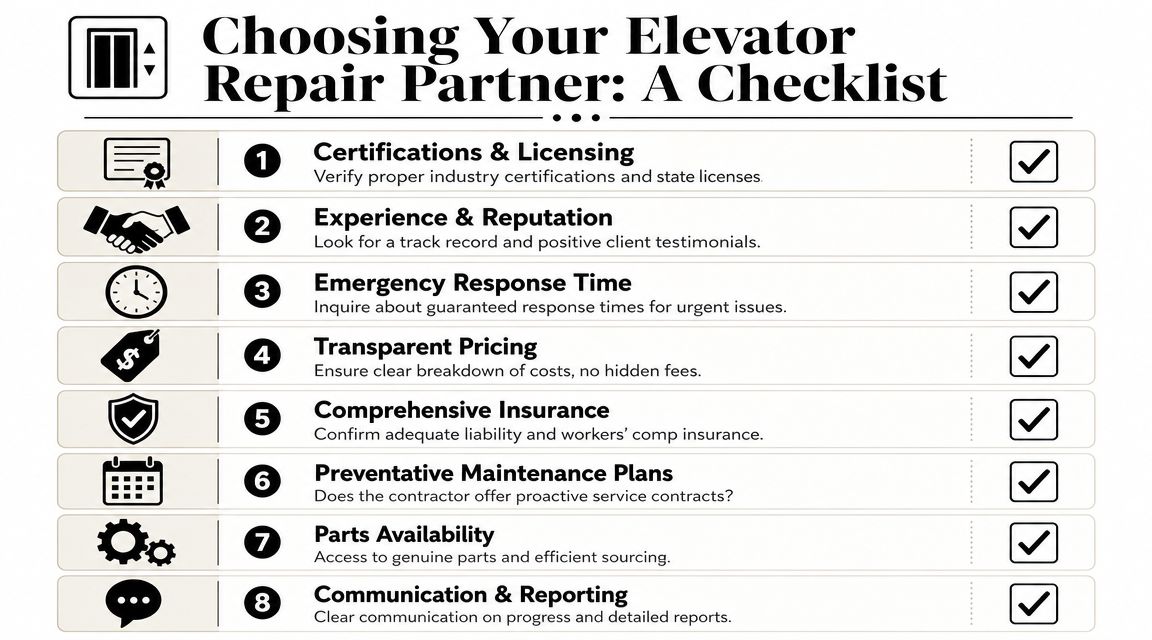
Use this checklist:
- Licensing and qualifications: Confirm the company uses qualified elevator personnel and works within the applicable code and regulatory framework.
- Insurance coverage: Verify liability and workers' compensation coverage before work starts.
- Local experience: Ask for references in your area. A contractor serving Ann Arbor may also know downtown Detroit traffic patterns, parking limitations, and older building conditions very differently than an out-of-market provider.
- Emergency response capability: Ask how after-hours calls are handled and who is dispatched.
- Documentation quality: Demand repair reports that identify the failed condition, corrective action, and any remaining concerns.
- Maintenance support: If the company only wants callbacks and doesn't want preventive work, that's a bad sign.
- Parts strategy: Ask how they handle obsolete components and whether they push owners toward proprietary dependence.
- Code awareness: Make sure they can explain whether the repair affects testing, inspection, or violation status.
Questions that expose weak contractors quickly
Some of the most useful screening questions are simple:
- If this unit goes down again for the same issue, how will you determine whether it's a component failure or a system-level problem?
- Do you support non-proprietary modernization options?
- How do you document safety procedures during repair work?
- If parts are delayed, what temporary operating or shutdown recommendations do you provide?
- Will you give a second opinion before recommending major modernization or replacement?
Weak contractors tend to answer in generalities. Good ones get specific about process, scope, and constraints.
What Michigan owners should value most
In Southern Michigan, local coverage matters. Buildings in Flint, Lansing, Ann Arbor, and Detroit all have different logistical realities, but the core priorities are the same:
- Clear communication
- Disciplined safety procedures
- Real maintenance capability
- Comfort working on mixed and older equipment
- A practical view of modernization
- No pressure to stay locked into one proprietary path unless there's a valid reason
The cheapest proposal often becomes the most expensive relationship if the work is reactive, poorly documented, or tied to recurring callbacks. Owners should hire for competence, compliance, and long-term flexibility.
If you need help evaluating an ongoing elevator problem, planning repairs on aging equipment, or comparing maintenance and modernization options in Lower Michigan, Crane Elevator Company handles elevator repair, inspections, preventive maintenance, and non-proprietary modernization for commercial, municipal, healthcare, education, residential, and multifamily properties across the region.