If you're searching elevator service companies near me in Michigan, you're probably not browsing casually. You're dealing with a car that keeps dropping calls, tenants who are starting to complain, a property team that's tired of repeat shutdowns, or an aging unit that nobody wants to budget for until it fails again.
That search usually starts as a repair problem. It quickly turns into a business problem.
In Detroit, Lansing, Ann Arbor, Flint, and Kalamazoo, I see the same pattern. An owner hires for the immediate fix, gets a low monthly number or a cheap repair quote, and then pays for it later through callbacks, trapped passenger events, delayed inspections, obsolete parts, and forced modernization on someone else's timeline. Elevators are long-life assets. If you evaluate service vendors like commodity repair contractors, you usually increase both cost and risk.
The better approach is simple. Find a service partner that can keep the equipment compliant, serviceable, and financially predictable over time.
Your Guide to Finding the Right Elevator Partner in Michigan
A Detroit property manager gets three service calls on the same elevator in one month. First it is a door fault. Then the car starts missing the floor. A week later the controller trips during morning traffic. The elevator is back in service after each visit, but the building keeps paying for the same underlying problem in different forms.
Hiring an elevator company is not just about immediate repairs. You are choosing a partner who will influence that asset's total cost of ownership for years through maintenance quality, parts strategy, code knowledge, and modernization advice.

The cheap fix often costs more
Low monthly pricing gets attention. Repeat shutdowns, entrapments, worn door equipment, and after-hours callbacks erase that savings fast. In Michigan, I often see owners approve the smaller invoice up front, then absorb the bigger costs later through tenant complaints, staff time, failed inspections, and rushed capital decisions.
Crane Elevator Company has also pointed out the long-term value of proactive maintenance and non-proprietary modernization. That matters because the service model you choose affects future repair speed, parts access, and whether you can change providers without replacing major equipment.
Focus on lifecycle cost, not just this month's bill.
If the same elevator keeps failing in different ways, stop treating each ticket as an isolated event. Ask what condition in the system is producing repeat failures and whether the current provider is documenting that pattern clearly.
What a real partner changes
The right elevator partner helps an owner make decisions before the equipment forces them. That includes questions such as:
- Does repeated repair still make financial sense, or are you spending capital money in small pieces without a plan?
- Are key components becoming obsolete, which will turn every future outage into a parts hunt?
- Will this equipment remain open to multiple service providers later, or are you drifting into vendor lock-in?
- Is the maintenance program reducing wear and catching trends early, or is it mostly dispatching mechanics after complaints?
Those choices affect more than uptime. They affect liability, tenant confidence, insurance exposure, and how predictable your operating budget stays from year to year.
A good elevator company restores service. A better one protects serviceability, keeps options open, and helps you avoid paying twice for the same problem.
First Assess Your Building's Elevator Needs
Before you call anyone, define the problem clearly. Owners often search elevator service companies near me when what they really need is one of four different things. If you don't separate them, you'll get proposals that look similar on paper but solve very different problems.
Four service categories that matter
Here's the simplest way to sort your situation:
| Need | What it usually means | What to look for |
|---|---|---|
| Preventative maintenance | The elevator is operating, but you want fewer shutdowns and better reliability | Regular scheduled service, cleaning, adjustment, documentation, and wear tracking |
| Repair | Something already failed or is intermittently failing | Troubleshooting depth, parts access, and clear root-cause reporting |
| Modernization | The equipment still runs, but it's aging, obsolete, or costly to keep alive | A phased plan, serviceability after upgrade, and code-aware design |
| Inspection and code correction | You have a required test, deficiency, or violation to address | Documentation discipline, testing support, and correction capability |
A lot of waste starts when an owner buys repair labor for a modernization problem. If your doors fail repeatedly, your controller is obsolete, or your leveling is inconsistent across months, the issue may not be “bad luck.” It may be old equipment that's reached the point where patchwork service costs more than a structured upgrade plan.
Know your equipment well enough to ask better questions
You don't need to be a mechanic, but you should know the basic elevator type in your building.
Hydraulic elevators are common in lower-rise buildings. They use a power unit, fluid, and cylinder to move the car. Owners often deal with valve issues, leaks, ride quality complaints, heat-related performance changes, and aging power unit components.
Traction elevators are more common in taller or busier buildings. They rely on motors, ropes, sheaves, controls, and more complex door and dispatch systems. These systems can deliver strong performance, but they also demand disciplined maintenance and knowledgeable troubleshooting.
Freight elevators, wheelchair lifts, dumbwaiters, and material lifts add another layer. They may see rough usage, irregular loading, or specialized operating conditions. A provider that handles standard passenger units well may not always be the right fit for these categories.
If you can tell a contractor, “We have a hydraulic passenger unit with chronic door faults and intermittent leveling issues,” you'll get a much better conversation than, “The elevator acts up sometimes.”
Ask what's urgent and what's structural
Start with two internal questions:
-
What needs attention right now?
A current outage, safety concern, inspection issue, or tenant complaint. -
What keeps coming back?
Door calls, callbacks after service, slow starts, noisy travel, oil leaks, controller faults, or parts delays.
That second question usually reveals whether you need a better maintenance program, a better repair strategy, or a modernization discussion. Owners in places like Flint or Ann Arbor often save time by gathering the last year of service tickets before calling a vendor. Patterns matter more than isolated events.
Key Criteria for Comparing Michigan Elevator Companies
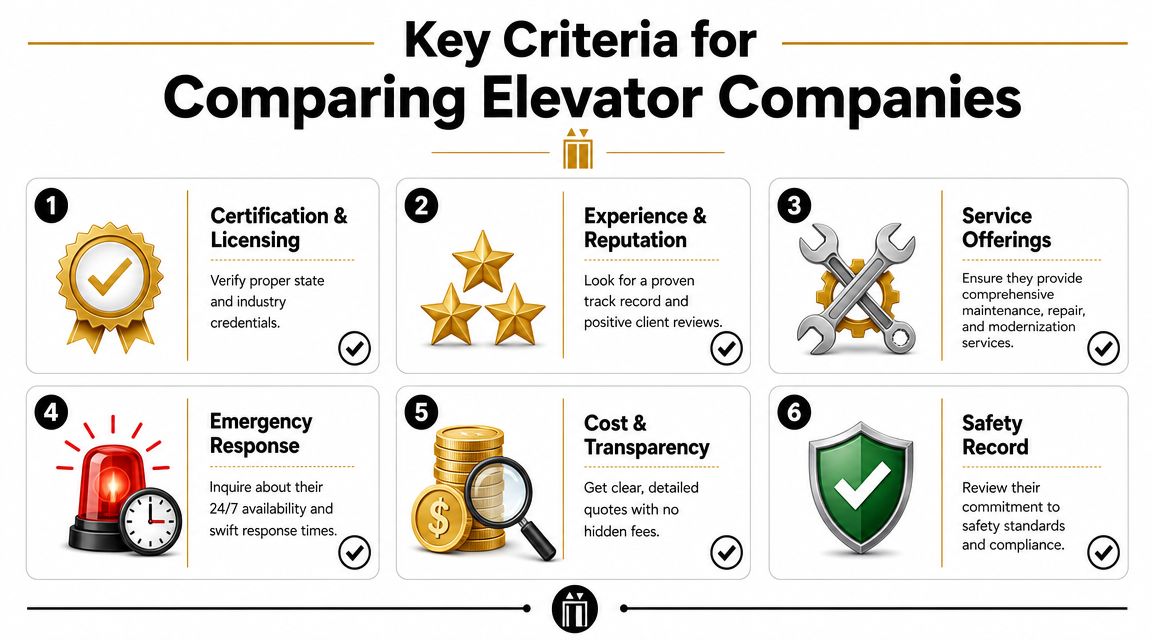
When owners compare providers, they often focus on monthly maintenance price first. That's understandable, but it's the wrong lead metric. Elevator service should be evaluated like risk control for a regulated mechanical asset. Price matters. Scope, responsiveness, compliance support, and long-term serviceability matter more.
Start with legal and operational basics
Michigan owners should first confirm whether the provider is set up like a real elevator contractor, not just a general maintenance vendor that occasionally touches conveyance equipment.
Crane Elevator Company notes that in regulated states like Michigan, elevator service is a licensed trade, and a credible provider should be able to show that it employs state-licensed mechanics and carries appropriate insurance because owner liability is tied directly to using qualified, compliant vendors for maintenance and repairs. That point appears in its guide to elevator maintenance cost considerations.
That should be a gatekeeper issue, not a tie-breaker.
The six criteria I'd score on every quote
-
Emergency response coverage
If a car is down in a medical office, senior housing property, municipal building, or apartment complex, you need to know what happens after hours. Ask whether coverage is 24/7/365, whether calls are routed to field personnel, and whether the company will commit to a response expectation in writing. -
Preventative maintenance scope
Not all maintenance contracts are equal. Some are little more than periodic check-ins. Others include actual preventive work, cleaning, adjustment, wear inspection, and documented attention to high-failure components. Ask what technicians are expected to do on each visit, not just how often they visit. -
Non-proprietary versus proprietary equipment strategy
This is one of the biggest long-term cost drivers. If your controls, diagnostics, or replacement parts lock you into one provider or one supply channel, your negotiating power decreases. Future service gets harder to compare because alternatives may not have the same access. -
All makes and models capability
Mixed portfolios are common. A manager in Lansing may have one older hydraulic unit in a suburban office building and another newer passenger elevator in a different property. You need to know whether the vendor can support varied equipment without steering every issue toward replacement. -
Inspection and code correction support
A good contractor should understand the inspection side, paperwork side, and correction side. If your provider only performs repairs but leaves you scrambling when deficiencies appear, your internal staff ends up coordinating multiple parties under time pressure. -
Modernization financing options
If a contractor can only talk about major upgrades as cash projects, many owners delay work too long. A financing path can turn a forced future crisis into a planned project.
The best service agreement isn't the cheapest document. It's the one that reduces surprises you'd otherwise pay for later.
What weak proposals usually look like
Watch for these warning signs:
- Vague maintenance language that doesn't define tasks, only “service as needed”
- No discussion of parts philosophy, especially on controls and door equipment
- No clear emergency procedure beyond a generic answering service
- No inspection support language for code corrections and follow-up work
- Heavy pressure toward proprietary replacement without showing other serviceable options
A good proposal gives you enough detail to compare risk, not just price.
What Comprehensive Elevator Service Really Means
Full elevator service isn't “we fix things when they break.” That's dispatch work. Real asset management is broader and more disciplined.
It covers the whole lifecycle
A complete service approach handles maintenance, repair, code-driven corrections, and modernization planning as one connected responsibility. The point isn't to sell every service category at once. The point is to keep the owner from making isolated decisions that create new problems later.
Industry benchmarks described by Crane Elevator Company say full service includes the ability to maintain all makes and models with non-proprietary parts, provide documented preventative work on critical components such as door operators and safety circuits, and support code-driven needs without forcing vendor lock-in. That same philosophy is reflected in its explanation of non-proprietary elevator systems.
That benchmark matters because many Michigan portfolios are mixed. A healthcare facility in Ann Arbor may have one type of passenger unit, an older service elevator, and a lift in a secondary building. A school district near Flint may be dealing with older equipment that still has useful life if someone maintains it correctly. Complete service has to mean more than servicing one favored platform.
It documents what others gloss over
The difference between average and strong service often shows up in the paperwork and in the machine room, not in the sales pitch.
A thorough provider should be able to show:
- What was inspected, adjusted, cleaned, or tested
- Which recurring components are wearing
- Whether faults point to a deeper modernization need
- How code-related issues will be tracked and corrected
Good elevator service leaves a trail. If there's no meaningful record of preventive work, you're probably paying for reactive service under a maintenance label.
There's also a practical ownership issue here. Non-proprietary service strategy keeps your future options open. If another qualified provider can maintain the equipment later, you preserve your negotiation power and avoid getting cornered when prices rise or response quality drops.
One Michigan option that fits this model
In Southern Michigan, Crane Elevator Company is one example of a contractor built around this lifecycle approach. It services all makes and models, handles maintenance, repairs, inspections, emergency work, and non-proprietary modernization, which is the kind of scope owners should look for when comparing local partners.
That's the standard worth using, even if you're evaluating several firms.
How to Choose the Right Service Partner for Your Building
Once you know your building's needs and your evaluation criteria, the next job is to run a clean selection process. Most bad hires happen because owners ask for “a quote” instead of asking for comparable answers to the same business questions.
Build your RFQ around risk, not just price
Your request should describe the equipment, recent problems, property type, occupancy sensitivity, and any known inspection or performance issues. Attach service history if you have it. If one elevator has repeated door faults or intermittent shutdowns, say so plainly.
Then require written responses to the questions that matter most. Crane Elevator Company recommends asking vendors the following: Do you service all makes/models? Do you use non-proprietary parts? Is your emergency coverage 24/7/365 and what is your guaranteed response time? Can you manage all required state inspections and code corrections? Those are the right filters because they expose whether a contractor is built for long-term support or just basic dispatching.
Get a second opinion before approving major work
This is one of the most useful steps a Michigan owner can take. If your current provider says you need a major repair, controller replacement, or immediate modernization, get another qualified contractor to inspect the same equipment.
A second opinion helps you answer three things:
- Is the diagnosis sound
- Is the proposed fix proportional to the actual problem
- Will the repair preserve or reduce future service flexibility
That matters most when the proposed solution pushes you toward closed systems, unusual parts dependency, or a large capital decision under time pressure.
Don't compare proposals until you normalize the scope. One vendor may be pricing a real preventive program while another is pricing little more than coverage for callback dispatches.
Compare proposals side by side
Use a simple scoring sheet. Don't overcomplicate it.
| Category | What to compare |
|---|---|
| Scope | Tasks included, excluded labor or parts, inspection support, code correction handling |
| Response | After-hours process, emergency coverage, communication path |
| Serviceability | All makes/models support, proprietary risk, parts approach |
| Documentation | Visit reports, maintenance records, repair explanations |
| Financial flexibility | Repair versus modernization planning, financing availability |
| Fit | Experience with your building type and occupancy needs |
If a quote is lower, ask why. Sometimes that’s efficiency. Sometimes it’s because work has been left out.
Look for partnership behavior early
You can usually tell within the first meeting whether a company thinks like a partner. Good signs include careful questions about recurring issues, candid discussion of repair-versus-modernize tradeoffs, and willingness to explain what they can and can’t support. Weak vendors avoid specifics and default to generic promises.
For owners in Detroit, Lansing, or Kalamazoo, the right service partner should make the building feel easier to run, not harder to decode.
Navigating an Elevator Emergency in Michigan
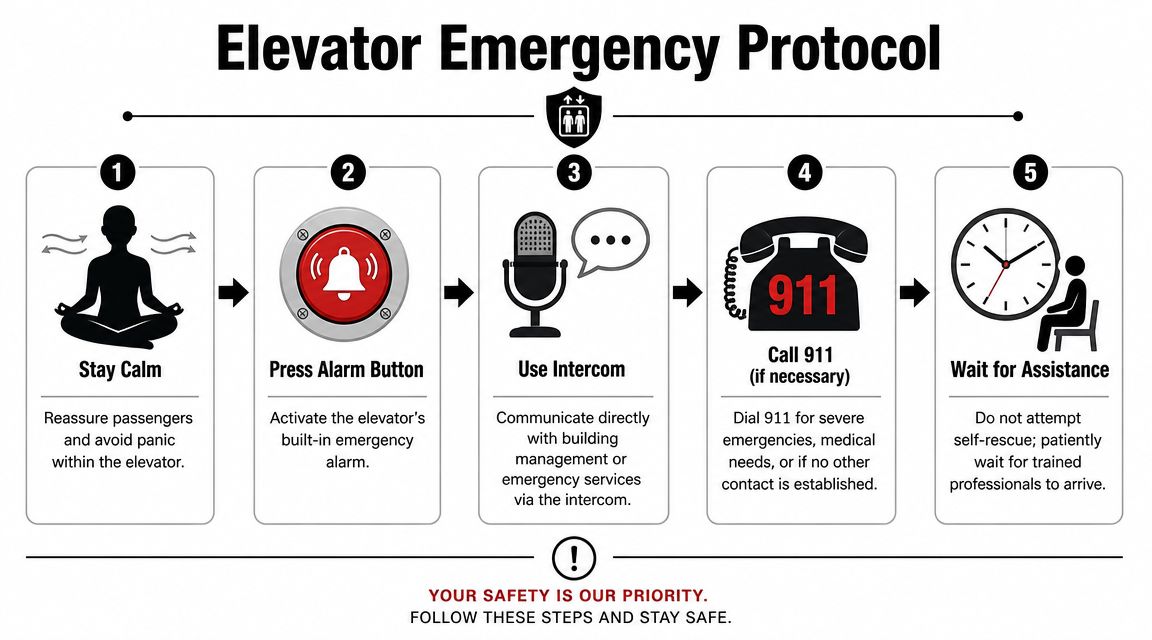
When an elevator stops unexpectedly, the priority is safety and controlled communication. Panic creates bad decisions. Building staff need a simple procedure they can follow every time.
What staff should do first
If passengers are inside the car, tell them to stay calm and confirm that help is being called. Instruct them not to force doors open and not to attempt self-rescue. If the elevator has an alarm button or intercom, have them use it while building staff contact the service provider.
For buildings that need a written procedure, keep the contractor’s emergency number posted at the front desk, in the management office, and with maintenance staff. If you’re reviewing what that support should look like, this overview of emergency elevator service procedures is the type of operational framework worth asking vendors to match.
A short training video also helps staff remember the basics in a high-stress moment.
The call script matters
When staff call for service, they should be ready to provide:
- Building address and elevator location
- Whether passengers are inside
- Any medical concern or distress
- What the car is doing, such as stopped between floors, doors not opening, or power loss
- A callback name and number
If there’s a medical event, fire, smoke concern, or no reliable communication with trapped passengers, call emergency responders immediately. Don’t wait on a standard service callback in those cases.
If people are trapped, your job is communication and coordination. Rescue belongs to trained personnel.
What to do after the event
Once passengers are out and the area is stable, document the incident. Note time, symptoms, who was called, and what building staff observed. Then ask the service company for a written explanation of cause and next steps.
That post-event record matters. It helps you distinguish between a one-time fault and a recurring pattern that points to deeper equipment issues.
Planning for Smart Elevator Modernization
A Michigan property owner usually reaches modernization the same way. The elevator starts missing service expectations more often, repair invoices get less predictable, parts take longer to find, and tenants stop treating the outages as a one-off problem. By the time the budget conversation gets serious, the building has already absorbed avoidable cost.
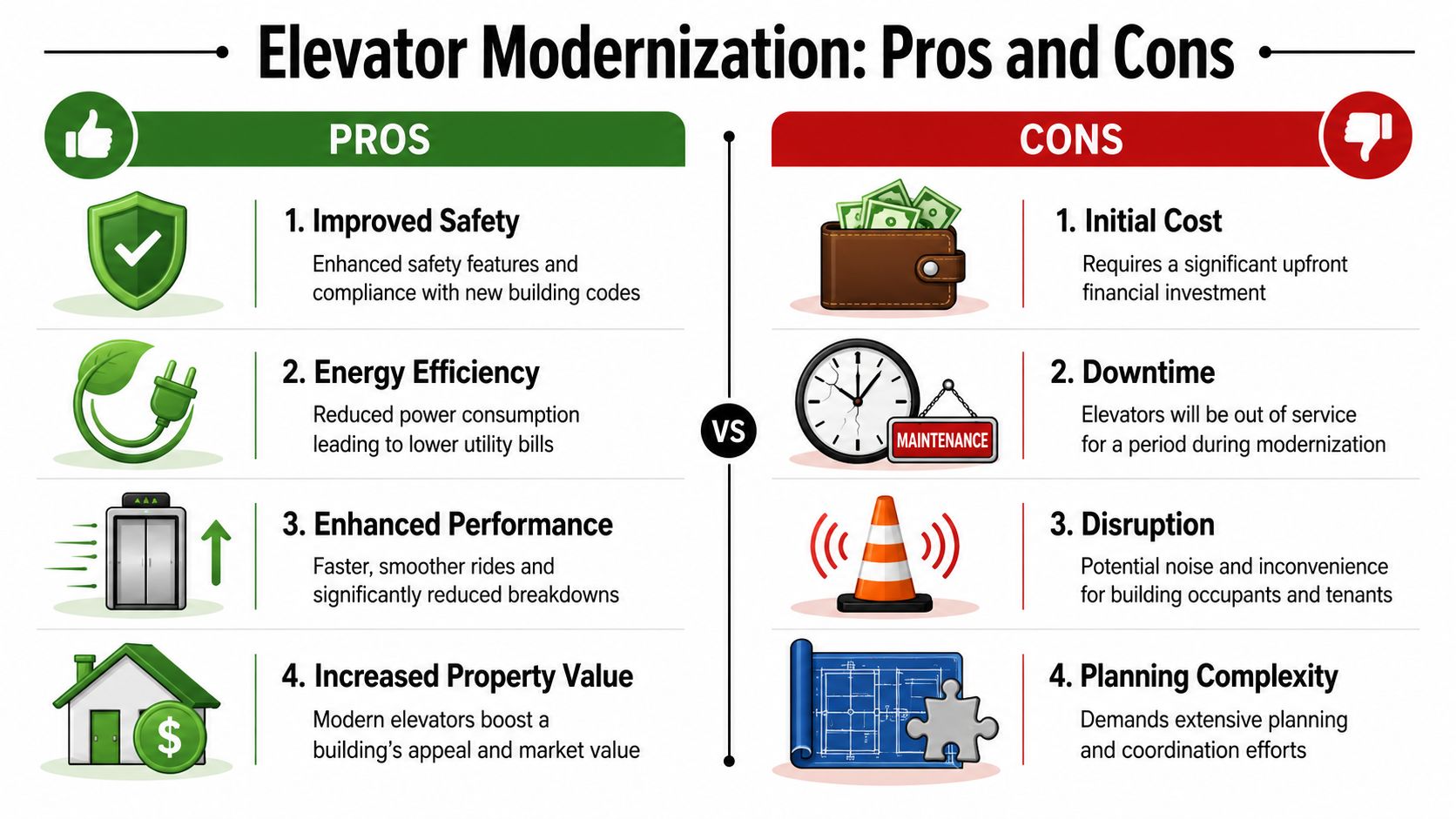
Treat modernization as a planned asset decision rather than a crisis response. Owners who wait too long usually pay twice. First in repeat repairs and downtime, then again in a rushed project with limited options.
Repair versus modernization
A large repair does not automatically justify a full modernization. The right call depends on failure pattern, parts support, equipment age, and how much operational risk the building can tolerate.
Repair usually makes sense when the problem is isolated, replacement parts are still obtainable at reasonable lead times, the controller remains supportable, and the elevator has been running well between service calls.
Modernization deserves a serious review when the same faults keep returning, door equipment is wearing out across the system, the controller is obsolete, ride quality is declining, or outages are affecting tenant retention, staffing, and daily building operations.
Here is the practical comparison:
| Situation | Usually the better path |
|---|---|
| Single component failure on otherwise stable equipment | Repair |
| Chronic door faults across many months | Evaluate modernization |
| Obsolete controller with difficult parts sourcing | Modernization often wins |
| Repeated outages causing operational strain | Modernization review |
| Equipment that can still be maintained openly by qualified firms | Repair or phased upgrade |
| Equipment pushing you toward vendor lock-in | Non-proprietary modernization |
The key is total cost of ownership. A cheaper repair can still be the more expensive decision if it keeps the building tied to hard-to-source parts, frequent callbacks, and one vendor's proprietary tools.
Why non-proprietary upgrades matter
Modernization changes more than equipment. It changes your future service market.
If the new controller, diagnostics, or software can only be handled by the installer or a narrow group of authorized providers, your bargaining power drops after the project is complete. That affects labor rates, response options, and long-term maintenance pricing. I advise Michigan owners to ask this question early: after the modernization, how many qualified firms will be able to service this elevator without special restrictions?
That answer has direct financial value. Open, serviceable systems usually give owners more options on maintenance contracts, second opinions, and repair pricing over the next decade.
Financing can change the timing
Many owners know the equipment is near the end of its useful life but do not have capital available in the current cycle. That delay has a cost. Aging equipment keeps generating service calls while the building waits, and those calls rarely stay isolated for long.
Crane Elevator Company has noted that financing often lets owners start modernization sooner than a standard capital-budget schedule would allow. In practice, that can reduce exposure to repeat outages, tenant complaints, and emergency repair spending. It also gives ownership more control over scope and timing instead of forcing a rushed decision after a major failure.
For properties in Detroit, Ann Arbor, or Lansing, a phased plan can make more sense than either extreme. Full deferral usually increases risk. Full replacement all at once may strain cash flow. A well-scoped modernization, scheduled in phases and built around non-proprietary serviceability, often gives the best balance of cost control, compliance support, and long-term flexibility.
Your Next Steps for Reliable Elevator Service
If you searched elevator service companies near me, the right answer isn't just a list of names. It's a way to screen out bad fits before they lock you into higher lifetime costs.
Start with your own building. Identify whether you need maintenance discipline, a repair solution, inspection support, emergency response coverage, or a modernization plan. Then compare vendors on the issues that affect ownership: licensing, insurance, all-makes capability, non-proprietary serviceability, emergency process, code correction support, and financial flexibility.
For Michigan owners, especially across Southern Michigan cities such as Detroit, Flint, Lansing, Ann Arbor, and Kalamazoo, the strongest move is often to get a second opinion before approving expensive work or signing a maintenance agreement that looks inexpensive but leaves out the hard parts. A contractor should be able to explain what it will do, how it will keep the equipment serviceable, and what happens when the elevator ages into bigger decisions.
If you want more predictable elevator costs, fewer repeat failures, and less dependence on any single vendor, choose for lifecycle value. That's what usually lowers stress for both ownership and on-site staff.
If you need a practical next step, contact Crane Elevator Company for a second opinion, a maintenance quote, or a modernization review. For building owners in Lower Michigan, the useful questions are simple: can the contractor support all makes and models, respond around the clock, keep the equipment non-proprietary where possible, and help you control long-term cost instead of just fixing the next breakdown.