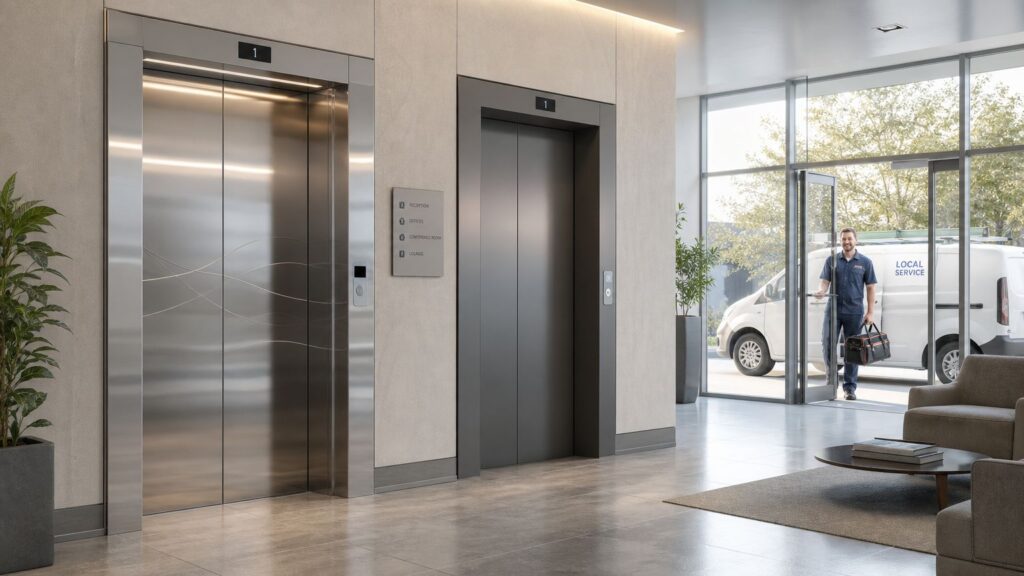
When your elevator starts getting labeled “slow” by tenants, the complaint usually isn't just about speed. It's about missed deliveries, residents waiting in the lobby, staff fielding the same calls all day, and a building manager trying to figure out whether the problem is maintenance, dispatching, age, or the service company itself. In Southern Michigan, that situation shows up everywhere, from office buildings in Detroit and Troy to medical buildings in Ann Arbor, apartments in Lansing, schools in Flint, and mixed-use properties in Kalamazoo.
Fast elevator service is rarely about one heroic emergency repair. It comes from the service model behind the equipment. That's where the OEM versus independent decision matters. One path often ties you to the original manufacturer's tools, parts pipeline, and contract structure. The other usually gives you more flexibility on parts, modernization strategy, and day-to-day support.
That choice matters because elevator maintenance is a major long-term operating category, not a side expense. The elevator maintenance market is projected at US$41.7 billion in 2026 and US$62.7 billion by 2033, with 6.1% CAGR. Building owners don't need a theory lesson to understand that. They need fewer shutdowns, cleaner inspections, predictable invoices, and a provider that answers when a car is down.
Your Guide to Fast Elevator Service in Michigan
A building manager in Southern Michigan usually calls about “fast elevator service” for one of three reasons. The elevator is down. The elevator is running, but tenants say it feels unreliable. Or the unit passes basic operation, yet the building still suffers long waits at the worst times of day.
Those are different problems, and they don't all get solved the same way. In Detroit, a commercial tower may need stronger dispatch tuning and better after-hours response. In Ann Arbor, a medical or university building may need stricter preventive work because shutdowns disrupt patient flow or class changes. In Jackson, Battle Creek, Novi, Dearborn, or Ypsilanti, the issue may be an older system that still runs but has been patched so many times that every small failure turns into another service call.
What building owners usually miss
Most owners focus first on the mechanic who shows up after the breakdown. The more important decision is the company structure behind that mechanic.
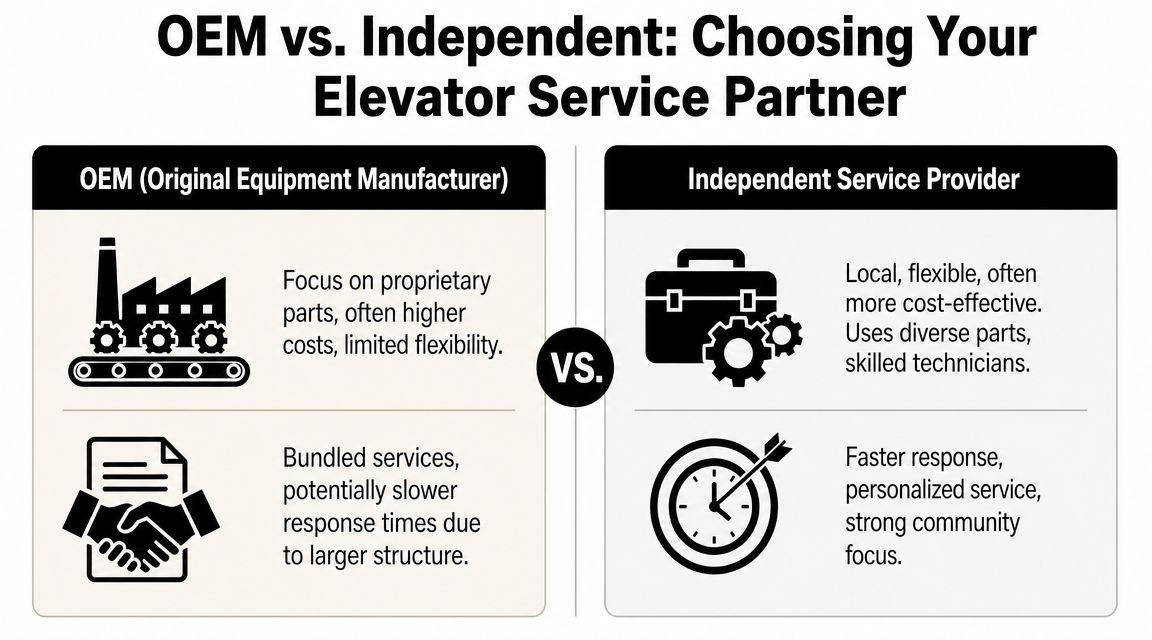
An OEM service model typically means the original manufacturer controls more of the process. An independent model usually means a contractor works across multiple brands and can support equipment without tying the owner to a single manufacturer's ecosystem. That difference affects:
- Response flexibility
- Parts options
- Contract terms
- Modernization planning
- Your advantage when costs rise
Fast elevator service starts long before the emergency call. It starts with the maintenance strategy, documentation quality, and whether your provider can act without waiting on a proprietary bottleneck.
A quick side-by-side view
| Service factor | OEM service model | Independent service model |
|---|---|---|
| Equipment familiarity | Strong on its own brand | Broad across many makes and models |
| Parts and software access | Often tied to proprietary systems | Often more flexible with non-proprietary solutions |
| Contract structure | Can be more rigid | Can be more customizable |
| Response path | Often routed through larger systems | Often more direct and local |
| Long-term flexibility | May keep owner tied to one vendor | Usually gives owner more service freedom |
In Michigan, that difference shows up in practical ways. If your property sits in Detroit, Southfield, Livonia, Monroe, or Adrian, you don't just need a vendor. You need a service partner that can keep cars available, close out violations, and help you make decisions that still make sense five years from now.
OEM vs Independent The Two Paths for Elevator Service
The elevator business has two main service tracks. Understanding them clearly saves owners a lot of frustration later.
What OEM service actually means
OEM means original equipment manufacturer. If your elevator was installed by a major brand, that same brand may offer the maintenance contract, repairs, software access, callback support, and modernization package.
That setup can work well, especially when the equipment is newer and heavily integrated with the manufacturer's own controls. OEMs know their own systems well. They also tend to have formal processes, national support structures, and established parts channels.
But OEM service often comes with a catch. The system may rely on proprietary tools, firmware, boards, or diagnostics that limit who else can work on it. That's where owners start to feel locked in. If pricing changes, response slows, or modernization recommendations get too expensive, your alternatives may be narrower than you expected. Owners evaluating brand-specific support often start by looking at service pathways such as Schindler elevator service options.
What independent service means in practice
An independent elevator contractor works across multiple brands, vintages, and building types. In practical terms, that usually means broader field experience and a stronger bias toward repairability rather than replacement.
The most important distinction is whether the independent provider keeps the equipment non-proprietary or can move it in that direction during modernization. Non-proprietary service gives the owner more future freedom. Another qualified company can step in later. Parts and technical support don't have to funnel through a single manufacturer whenever something fails.
Decision lens: If you want one company to control the elevator for its whole life, OEM service can fit. If you want negotiating leverage, broader service options, and more freedom at modernization time, independent service usually fits better.
The lock-in question
Vendor lock-in doesn't always show up in the first year. It usually shows up when:
- A controller or board fails and only one channel can supply the replacement
- Software access becomes essential for diagnostics or adjustment
- A modernization proposal arrives that replaces large portions of the system instead of targeted components
- Contract renewal time comes and you realize switching providers is harder than expected
For Michigan building owners, this isn't abstract. A hospital in Ann Arbor, a municipal building in Lansing, or a residential tower in Detroit needs uptime. If your service model limits your options when the system ages, the “fast” part disappears quickly.
Comparing Critical Service Factors
The OEM versus independent debate gets settled in the field, not in brochures. Building managers care about four things: what it costs, how fast someone responds, whether maintenance prevents shutdowns, and whether inspections get handled cleanly.
Costs and contracts
OEM contracts often look straightforward until you get into exclusions, material terms, software issues, and what counts as billable work outside the maintenance agreement. Independent contracts can vary too, but they're often easier to tailor to the actual building and traffic pattern.
That matters because the U.S. has a very large service base and a limited labor pool. Stax says there are over 1 million vertical transportation units in the U.S., and the Bureau of Labor Statistics reports 5% projected employment growth for elevator and escalator installers and repairers from 2024 to 2034, with about 2,000 openings per year. In a tight labor market, contract clarity matters. If your provider is stretched, vague scope language usually benefits the provider, not the owner.
A good maintenance agreement should make clear:
- What preventive work is included
- How callbacks are handled
- What gets billed separately
- Whether key wear items are covered
- How response expectations are documented
If you're reviewing terms, a detailed lift maintenance contract gives you a useful benchmark for what should be spelled out before you sign.
If a contract sounds cheap but leaves major components, cleanup, adjustment work, and after-hours support ambiguous, it usually won't stay cheap.
Response time and after-hours support
Response isn't only about distance. It's about dispatch structure. A large national system may route your call efficiently, but the field result still depends on technician availability, territory load, and whether the assigned mechanic knows your equipment history.
A local team has an advantage when the building is in regular rotation and the mechanic already knows the machine room, recurring door issue, or troublesome landing. In places like Dearborn, Farmington Hills, Brighton, or Portage, that familiarity often saves more time than a polished call center script.
What works in practice:
- A consistent route mechanic who knows the equipment's behavior
- Clean service records that show repeat failures and prior fixes
- Stocked common parts for the systems maintained in the region
- Direct communication when the problem requires a return visit or shutdown window
What doesn't work:
- Sending a different technician every time
- Using callbacks as the main maintenance strategy
- Treating every intermittent fault as isolated
- Promising urgency without documenting response expectations
Preventive maintenance that actually prevents trouble
The gap between average and effective maintenance is usually visible. Open the machine room, pit, and car top. You can tell quickly whether the provider is inspecting and cleaning properly or just touching the minimum points required to keep the account.
Good preventive maintenance is specific. It includes cleaning, adjustment, lubrication where applicable, checking door operation, reviewing safety circuits, watching leveling performance, and documenting parts that are drifting toward failure. It also means fixing small issues before they become tenant-facing problems.
Owners should ask one blunt question: are you maintaining my elevator so it avoids breakdowns, or are you maintaining it just well enough to explain the next breakdown?
Inspection and code compliance
Michigan owners don't benefit from a service company that treats inspections as a separate headache. The right provider handles them as part of normal operations. That means keeping records in order, identifying likely violations early, correcting issues without drama, and coordinating safety tests without disrupting the building more than necessary.
A local provider usually has an advantage here because they understand how regional inspectors, building types, and recurring local issues line up. That matters in older facilities in Flint and Jackson just as much as it does in newer suburban properties around Novi or Auburn Hills.
For building managers, compliance work is where service quality gets exposed. Anybody can talk about uptime. Fewer companies keep the paperwork, corrective work, and field execution aligned.
Modernization and Long Term Asset Value
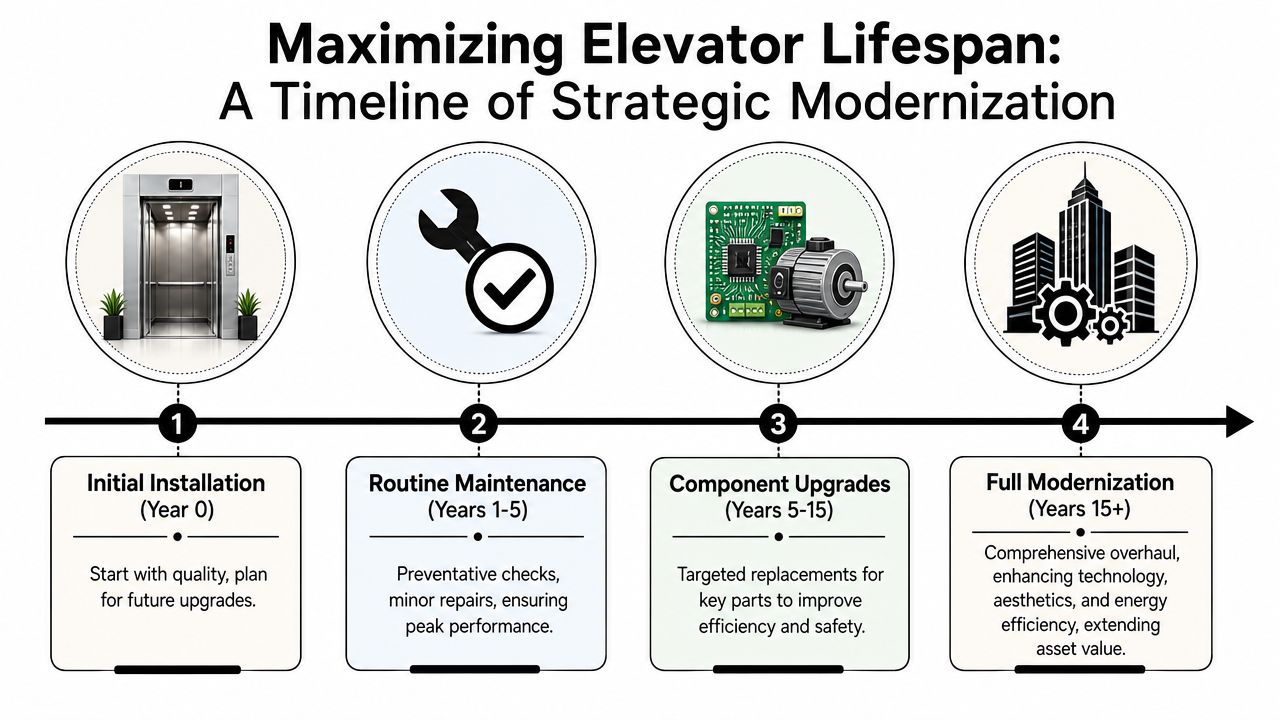
Owners often ask for fast elevator service when the bigger question is whether the system still fits the building. That's where modernization becomes an asset strategy, not just a repair category.
Repairing the right thing
An OEM modernization proposal often leans toward replacing broad sections of the system with newer branded equipment. Sometimes that's justified. Sometimes it isn't. A well-run independent approach usually starts with a narrower question: which components are limiting reliability, safety, ride quality, or serviceability?
That can mean replacing a controller, door operator, machine, jack, fixtures, or wiring package without turning the whole job into a proprietary reset. For an owner, that preserves future options.
The key trade-off is simple. Full replacement may create a cleaner technical platform, but targeted modernization may produce the better financial result if the core equipment can still serve the building well.
Why some elevators feel slow even when they aren't broken
A lot of owners blame maintenance for what is really a traffic and design problem. That's especially common in residential and mixed-use buildings.
A widely discussed explanation is that North American buildings often devote fewer elevators to the number of units they serve, partly because larger cab requirements affect planning density. One analysis notes a common planning ratio of roughly one elevator per 50 to 100 apartment units in North America versus about one per 30 units in Europe. It also cites a proposed Toronto tower at one per 161 homes in the discussion of why some buildings feel slow by design, not only from maintenance issues, in this analysis of elevator design trade-offs.
That matters in Southern Michigan, especially in apartments, senior living, and mixed-use properties where the complaint is “the elevators are always slow” even when breakdowns are limited.
Sometimes the elevator is healthy. The traffic pattern is the problem. Repairing parts won't fix poor dispatching, uneven zoning, or a building that was under-elevated from the start.
Modernization without crippling the building
The biggest mistake owners make during modernization is treating it like a simple buy-or-don't-buy decision. The hard part is phasing. If the building has limited cars, every outage window affects tenants, accessibility, deliveries, and staff operations.
A competent modernization plan should address:
- Sequencing: Which car goes first, and what backup service exists while it's out
- Tenant impact: When heavy work happens and how building users are informed
- Accessibility: How the building maintains access during shutdown periods
- Future serviceability: Whether the new package preserves flexibility or narrows it
In healthcare sites, older residential towers, and municipal buildings, this planning work matters as much as the hardware itself. Fast elevator service over the long term comes from modernization choices that improve reliability without creating a future lock-in problem.
Your Transition Checklist Switching Providers
Switching elevator service companies isn't complicated, but it does need to be handled carefully. Most problems happen because owners rush the paperwork or fail to collect the technical handoff items before the prior contract ends.
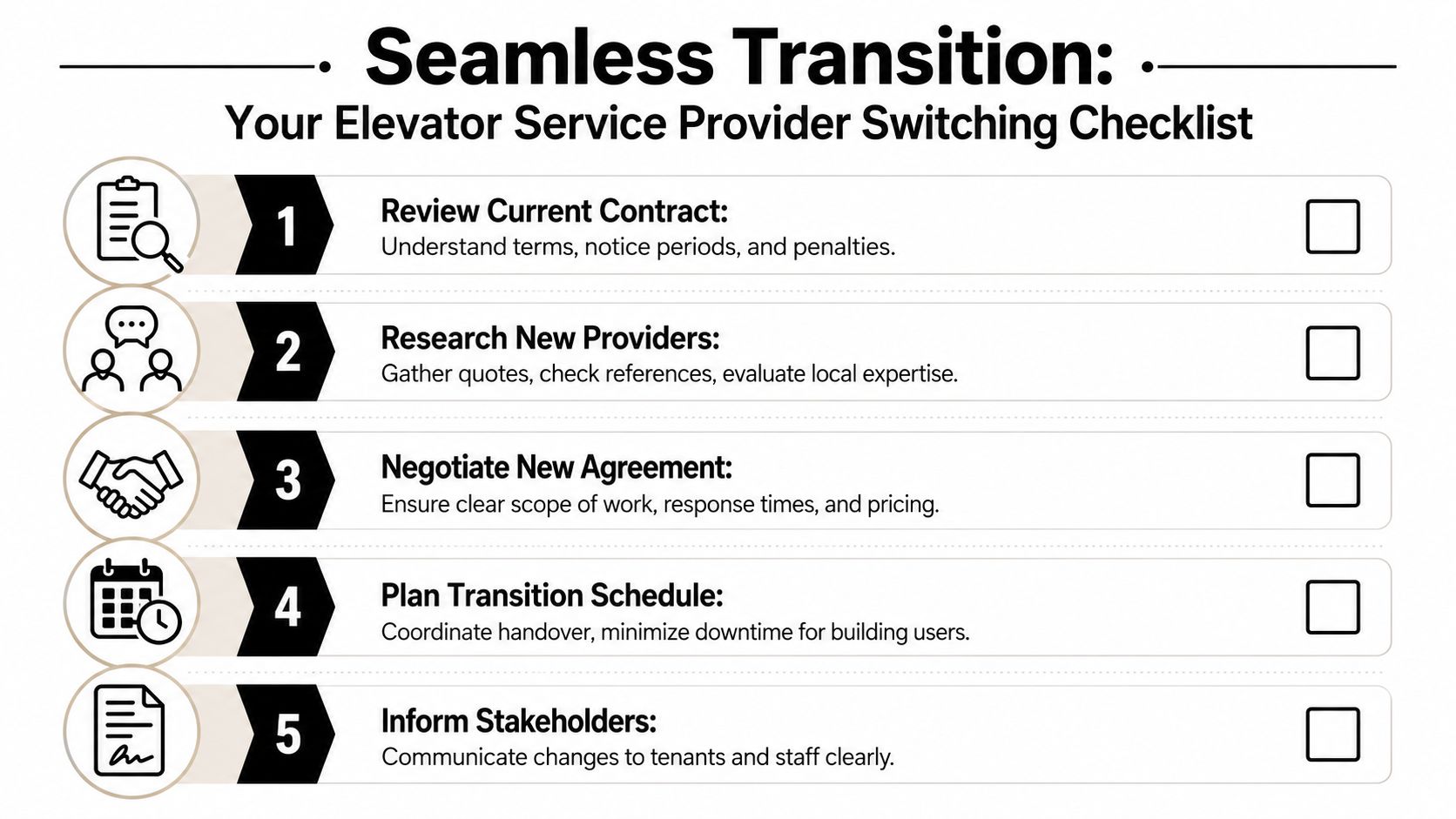
Step 1 Review your current agreement closely
Start with the termination clause, notice period, renewal terms, and any language around proprietary tools, software access, or parts ownership. Building owners sometimes think they can switch on short notice, then discover the contract auto-renewed or requires formal notice well in advance.
Pull every document tied to the account:
- Maintenance agreement
- Repair proposals still open
- Inspection reports
- Violation notices
- Testing records
- Prior callback history
Step 2 Get an outside assessment
Before changing providers, have another qualified contractor inspect the equipment and explain what they see. The value isn't just the quote. It's the second diagnosis.
A useful outside review should identify recurring failure points, deferred items, code concerns, and whether the current setup is proprietary enough to complicate the transition. It should also separate immediate safety or reliability issues from items that can wait for a planned upgrade cycle.
Step 3 Define the new service scope before signing
Don't switch providers based only on a lower monthly price. Define what the new company is taking responsibility for from day one.
Ask direct questions:
- Who answers after hours
- How callbacks are documented
- What preventive tasks happen on each visit
- How inspection support is handled
- Whether the company can service all equipment in the building, including lifts or dumbwaiters if applicable
A clean transition starts with scope. If both sides don't define the work clearly, the first breakdown will expose the gaps.
Step 4 Plan the physical and information handoff
A smooth transition includes more than a signed contract. The new company needs access and records to work effectively.
That usually includes:
- Machine room keys and access protocols
- Logbooks and maintenance records
- Controller documentation if available
- Inspection certificates and testing history
- Contact names for property staff and after-hours responders
For occupied buildings in places like Detroit, Ann Arbor, Lansing, or Flint, it's smart to schedule the handoff around low-traffic periods so the new route mechanic can inspect equipment without fighting tenant flow on the first day.
Step 5 Communicate internally
Tell building staff what's changing. They should know who to call, how entrapments are handled, and how to escalate recurring service issues. If the property has residents or tenants, keep the message simple and operational. They don't need the contract details. They need to know service support is changing and building management is tracking performance closely.
Crane Elevator The Right Choice for Southern Michigan
For owners in Southern Michigan, the independent model makes the most sense when the priority is flexibility, non-proprietary service, and direct local accountability. That's especially true for buildings with mixed equipment ages, budget pressure, or a history of callback-heavy service.
A practical benchmark for service quality isn't just whether the car runs. High-performance elevators are judged by leveling within 1/4 inch of the landing regardless of load and by average peak wait times often targeted below 30 seconds in mid-rise buildings and below 45 seconds in high-rise buildings, as outlined in this guide to elevator performance specifications. That's the right way to think about fast elevator service. Reliability, ride quality, and wait time all matter.
Why local matters in this market
In Lower Michigan, a service company has to deal with older hydraulic units, traction cars in busy commercial buildings, freight elevators that can't sit idle, wheelchair lifts, and modernization projects where the owner needs service continuity. That takes field judgment, not just dispatch volume.
One regional option is Crane Elevator Company, a family-owned contractor serving communities including Detroit, Ann Arbor, Lansing, Flint, Kalamazoo, and surrounding towns. Its published service scope includes non-proprietary maintenance, repairs, inspections, modernization, and 24-hour elevator repair support, which is the kind of model many Michigan owners look for when they want to avoid long-term vendor lock-in.
The practical fit
This fit is strongest for owners who want:
- Multi-brand service instead of a brand-only lane
- A path away from proprietary dependence
- Preventive maintenance that includes detailed cleaning and correction
- Inspection and violation support from a provider that works locally
- Modernization planning that focuses on serviceability as well as new hardware
For a Southern Michigan building manager, that's usually the primary decision. Not which sales pitch sounds smoother, but which service structure gives the building better uptime, cleaner compliance, and more control over future costs.
Frequently Asked Questions About Switching Service
Can I switch if my OEM contract hasn't expired
Usually, yes, but timing matters. Review the notice period, renewal language, and termination terms first. Many owners don't have a service problem so much as a contract calendar problem. If the agreement is still active, use the remaining time to collect records, get another inspection, and line up the replacement provider so the transition happens cleanly when notice takes effect.
Will I lose warranty protection if I use a third-party service company
That depends on the equipment, the age of the installation, and the exact warranty terms. Don't rely on assumptions from either side. Pull the warranty documents and read what is covered, who can perform the work, and what maintenance conditions apply. If the language is unclear, ask for written clarification before changing anything.
Is independent service always cheaper
Not always. Some buildings are a straightforward fit for independent service and save money quickly. Others have enough proprietary hardware or deferred issues that the near-term costs may still be significant. The better question is whether you get stronger long-term value, more flexibility, and fewer avoidable delays when something fails.
What should I ask before signing with a new provider
Ask how they handle callbacks, after-hours entrapments, preventive maintenance tasks, code issues, and modernization planning. Ask whether they can maintain the system as it exists today and whether they can move it toward a more serviceable non-proprietary setup over time. Also ask who your route mechanic is likely to be and how service history is documented.
How long does a transition usually take
It varies by contract terms and building complexity. A small property with clear records can move quickly. A larger site with multiple cars, outstanding violations, and proprietary controls takes more planning. The goal isn't speed for its own sake. The goal is changing providers without losing visibility into the equipment or creating avoidable downtime.
If your building in Detroit, Ann Arbor, Lansing, Flint, Kalamazoo, or anywhere in Lower Michigan needs a clearer path to fast elevator service, talk with Crane Elevator Company. A practical review of your current contract, equipment condition, and service history can tell you whether repair, maintenance changes, or a non-proprietary modernization plan makes the most sense next.