
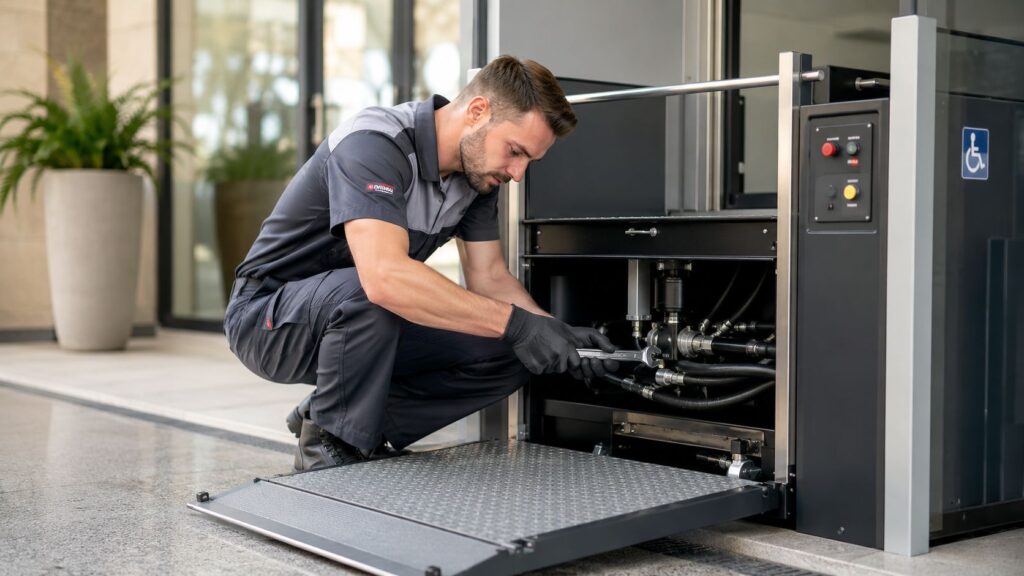
A platform lift usually goes down at the worst possible time. A tenant is waiting. A patient needs access. A staff member has already taped an out-of-service note to the gate, and now you’re trying to figure out whether this is a quick adjustment, a major repair, or the start of a long fight with a manufacturer’s service department.
That uncertainty is what drives repair costs up. Owners lose time, approve work they don’t fully understand, and get pushed into proprietary parts and service arrangements that make every future call more expensive and slower than it needs to be.
A better approach is to treat platform lift repair as both a technical issue and a vendor decision. You need to know what usually fails, what you can safely check before calling, what a technician should do on site, and how to choose a repair partner who doesn’t lock you into one brand’s ecosystem.
Your Guide to Platform Lift Problems and Solutions
Most building managers don’t need to become lift mechanics. They do need a working map of the problem. When a platform lift stops, the first question isn’t “What part failed?” It’s “What kind of failure am I dealing with?”
Some shutdowns are simple. A gate isn’t latched. The emergency stop button is pushed in. A breaker tripped. Other failures involve worn hardware, leaking hydraulic components, damaged wiring, or a controller fault that needs proper diagnosis. The mistake I see most often is treating all no-move conditions like a major breakdown. That leads to panic, rushed approvals, and unnecessary downtime.
Start with the symptom, not the assumption
A lift that won’t run at all is different from a lift that starts and stops. A lift that drifts, jerks, or lands unevenly points to a different set of likely causes than one with dead controls. Platform lifts share some service logic with other accessibility systems, but their layouts, interlocks, and drive arrangements vary by application. If you want a helpful overview of related equipment categories, different types of lift systems can show where platform units fit in the broader vertical transportation picture.
What owners need most
The practical priorities are straightforward:
- Restore access safely: Never bypass a gate switch, safety edge, or interlock just to get the unit moving.
- Reduce wasted service calls: Some shutdowns can be identified by basic checks before dispatching a technician.
- Avoid vague repair recommendations: A good mechanic should explain whether the problem is adjustment, wear, damage, or obsolescence.
- Keep future options open: Non-proprietary service matters because it gives you more than one path for parts, maintenance, and long-term support.
A broken platform lift is rarely just a mechanical inconvenience. In many buildings, it becomes an accessibility problem, a tenant relations problem, and a liability problem within the same day.
When you understand the warning signs and the repair process, the job becomes manageable. You stop guessing, and you start making decisions based on downtime, safety, and serviceability.
Recognizing the Need for Platform Lift Repair
The clearest repair warnings usually show up before a total shutdown. Platform lifts don’t often fail without giving clues. The trick is knowing which clues matter and which ones are just normal operating sounds.
If the platform starts moving and then stops, it’s comparable to a car that cuts out because a safety system intervened. The machine may be healthy enough to run, but the control logic is seeing a condition it won’t accept. For vertical platform lifts, the most common repair-triggering failures aren’t the drive unit itself but safety-chain interruptions such as an engaged emergency stop, an open or mislatched gate or door, a tripped breaker, or an under-platform obstruction. The control logic is designed to fail safe until every interlock is satisfied, as noted in this vertical platform lift troubleshooting guidance.
That’s why a no-move complaint isn’t automatically a motor or pump failure. In day-to-day service, simple interlock issues are often the first place a competent technician checks.
Listen for changes, not just noise
Grinding, scraping, or harsh vibration deserves attention. I’d compare it to hearing brake pads grind on a car. You might still have motion for the moment, but metal-on-metal wear, misalignment, or loose hardware can turn a scheduled repair into an outage.
Other signs are easier to overlook:
- Slow travel: Often points to drag, hydraulic issues, or electrical weakness.
- Jerky motion: Can mean inconsistent pressure, binding components, or control interruptions.
- Gate trouble: If a gate doesn’t close cleanly or needs an extra shove, don’t ignore it. That small nuisance often grows into repeated shutdowns.
- Inconsistent landing: If the platform doesn’t stop where it normally does, the unit needs inspection before people start adapting to bad leveling.
Small symptoms become expensive downtime
A platform lift that still runs but acts differently is telling you something. Owners get into trouble when they wait for a complete stop because the lift is “still working.” By then, the original fault may have taken other parts with it.
Practical rule: If the lift’s sound, speed, or stopping behavior changed this week, schedule service this week. Waiting usually trades a controlled repair for an emergency call.
The best repair calls happen before the lift goes fully out of service. That’s when the problem is still narrow, the parts list is shorter, and the building stays accessible.
Understanding Common Platform Lift Failures
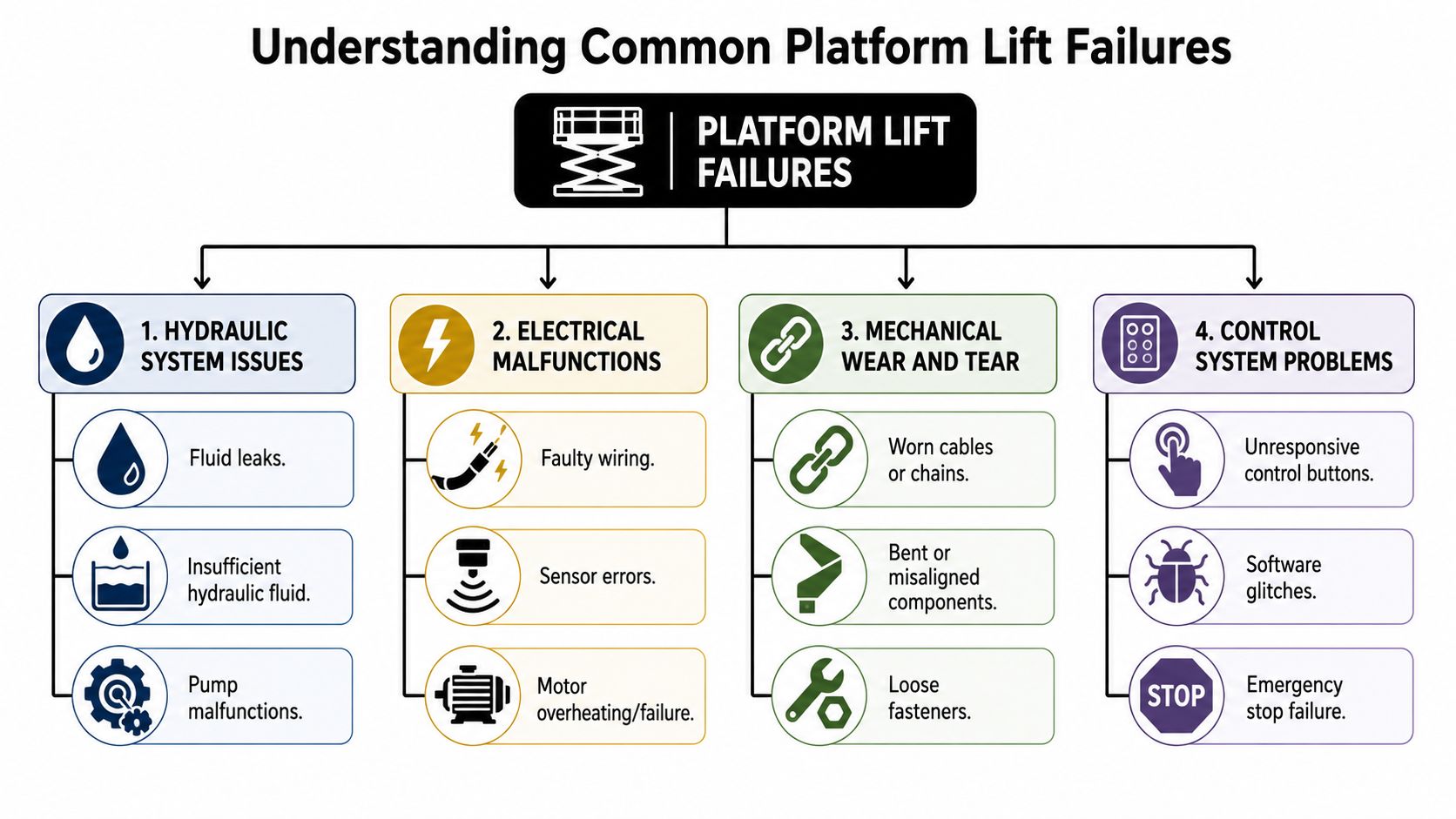
When a platform lift goes down, the useful way to think about it is by system. Most faults fall into four buckets: hydraulic, electrical, mechanical, or control and safety. That matters because each bucket fails differently, and each one points to a different repair path.
Hydraulic problems
Hydraulic units depend on clean fluid, stable pressure, and tight sealing. Leaks don’t always start as puddles. Sometimes the first sign is slow travel, drift, or a platform that feels hesitant under load. A worn hose, bad fitting, contaminated fluid, or a valve that isn’t behaving properly can all produce similar symptoms.
Model-specific service is paramount. Repair scope and parts selection are strongly driven by the lift’s rated load, travel height, and machine type. Published vertical platform lift specifications show units spanning up to 750 lb capacity and 14 ft travel heights in some applications, which means wear patterns accelerate with duty cycle and load, and technicians need to match repairs to the exact model’s tolerances, as shown in these platform lift installation and repair service specifications.
Electrical faults
Electrical trouble often presents as inconsistency. The lift works in the morning and fails in the afternoon. A button responds sometimes but not every time. A relay picks up, then drops out. Wiring issues, loose terminations, failing switches, damaged connectors, and overheating components all fit this pattern.
A lot of owners hear “electrical issue” and assume that means a controller replacement. It often doesn’t. Good troubleshooting starts at the field devices and power path, not at the most expensive board in the cabinet.
Mechanical wear
Chains, rollers, hinges, bearings, gate hardware, and fastening points wear gradually. Mechanical failures usually announce themselves. You hear chatter, grinding, rubbing, or impact that wasn’t there before. You may also see a gate sag slightly or notice that one latch point lines up worse over time.
Here’s the practical point. Mechanical wear tends to create secondary faults. A bent or loose component can put a sensor out of position. Then the owner gets a shutdown complaint, but mechanical alignment is the cause, not electronics.
Control and safety problems
The safety chain is where many “mystery failures” live. Gate contacts, emergency stop circuits, safety pans, limit devices, and call stations all have to agree before the lift moves. One weak contact or misadjusted switch can produce an intermittent outage that frustrates everyone because the unit passes one test and fails the next.
The most expensive diagnosis is the one that starts with parts replacement before anyone proves the fault path.
That’s why experienced platform lift repair isn’t just about swapping components. It’s about separating the symptom from the cause. A dead lift can have a simple fault. A running lift can still be close to a larger failure.
A Practical Troubleshooting Guide Before You Call
Before you place a service call, do a few safe checks. This won’t fix every problem, and it won’t replace a qualified mechanic, but it can rule out the common shutdown conditions that waste time and money.
The safe owner checklist
Start with the controls and access points.
- Check the key switch. Make sure it’s fully turned to the operating position.
- Reset the emergency stop. If the red E-stop is pressed in, twist or reset it according to the lift’s labeling.
- Inspect the breaker. A tripped breaker can leave the lift completely unresponsive.
- Confirm every gate and door is closed and latched. “Almost closed” doesn’t count on a safety circuit.
- Look under the platform. Debris, small objects, or contact at the under-platform safety area can stop motion.
- Try one command at a time. Don’t mash multiple buttons. Give the controls a clear input.
What not to do
Don’t remove covers. Don’t jumper out switches. Don’t force a gate closed with tools. Don’t keep cycling the lift if it moves unevenly, makes harsh mechanical noise, or stops unpredictably.
Those shortcuts often turn a minor service call into a real repair. If your building also uses other accessibility equipment, it helps to understand how service expectations differ for similar systems such as material lift repair and maintenance, but the same rule applies across the board. Never bypass a safety device to get through the day.
If the lift is making grinding or scraping noise, stop troubleshooting and wait for a mechanic. Noise like that usually means continued operation will damage more than the original failed part.
Call when the checks don’t clear it
Once you’ve verified power, controls, latching, and obstructions, you’ve done the useful owner-level work. After that, the value comes from proper diagnosis with tools, schematics, and service knowledge. That’s where you want a technician who can work through the system logically instead of reading the problem as “replace parts until it runs.”
The Professional Repair Process Demystified
A platform lift is down at 8:15 a.m. Tenants are arriving, staff need an answer, and the first question is always the same. Is this a same-day fix, or are we looking at parts, approvals, and downtime? A professional repair process should answer that quickly and clearly.
The best service calls follow a repeatable sequence. That matters because a lift can fail in ways that look simple from the hallway but point to very different repairs once a mechanic tests the system.
What happens on site
A qualified technician starts by confirming the complaint and checking whether the lift can be inspected safely. Then the diagnostic work begins. That usually means testing the safety chain, checking power quality, verifying door or gate interlocks, inspecting relays or contactors, reviewing control inputs, and looking at hydraulic or drive components for wear, leakage, contamination, or misalignment.
After diagnosis, you should get a plain-language report. You need to know what failed, what evidence supports that conclusion, whether the issue is adjustment or part replacement, whether the lift can return to service that day, and whether a return trip is likely.
Good mechanics also separate the immediate repair from the long-term recommendation. A gate interlock may be adjusted today and still need replacement soon if the hardware is worn or the mounting has shifted repeatedly.
Why labor costs what it costs
Platform lift repair is skilled trade work with life-safety responsibility attached to it. The U.S. Bureau of Labor Statistics notes that elevator and escalator installers and repairers earn high wages and often work overtime or remain on call, which helps explain why lift service labor is priced well above general maintenance labor in this BLS occupational profile for elevator installers and repairers.
That does not excuse vague billing.
A solid quote breaks out diagnostic time, labor hours, parts, travel if applicable, and any follow-up testing or return visit. If a contractor cannot explain the difference between a one-hour adjustment and a board-level electrical diagnosis, the invoice is going to be hard to trust.
Parts, approvals, and the proprietary trap
The repair itself is only part of the decision. The sourcing path matters just as much. Some lifts can be repaired with standard switches, relays, hoses, valves, batteries, and industrial electrical parts. Others get pushed toward manufacturer-only boards, locked programming, or assemblies sold only through one channel.
That is where owners lose time and pricing control. A simple failure turns into a wait for brand approval, special-order parts, or a full assembly swap when one failed component may have been repairable.
Ask direct questions before approving work:
- Is the failed part available through normal industrial supply channels, or only through the manufacturer?
- Are you recommending replacement of the whole assembly, or only the failed component?
- If we approve this repair, can another qualified contractor service it later?
- Will this repair keep the lift serviceable without locking us into one provider?
For Michigan owners comparing service options, wheelchair lift repair across makes and models is worth prioritizing over a service model tied to a single proprietary line.
Estimated Platform Lift Repair Costs 2026
| Repair Type | Typical 2026 Cost Range |
|---|---|
| Basic diagnostic service call | $325 to $650 during regular hours. After-hours or emergency response often runs $550 to $1,100 |
| Gate interlock adjustment or minor switch alignment | $350 to $850, depending on access, wear, and whether return testing is needed |
| Hydraulic hose or fitting replacement | $700 to $1,800, higher if the hose routing is difficult, fluid is contaminated, or multiple fittings are leaking |
| Control station or button replacement | $450 to $1,200, with cost increasing if wiring damage, water intrusion, or obsolete parts are involved |
| Safety edge or sensor correction | $500 to $1,400, depending on whether the issue is adjustment, wiring repair, or sensor replacement |
| Controller board replacement | $1,800 to $4,500, largely driven by brand, programming requirements, and part availability |
| Major hydraulic component repair | $2,500 to $7,500, especially if the pump unit, valve assembly, cylinder components, or cleanup work are involved |
Those ranges are not a price list. They are a reality check.
The final number depends on three things more than owners expect. Access to the equipment. Whether the diagnosis ends with an adjustment or a true parts failure. Whether the lift uses open components or proprietary parts with long lead times and limited sourcing.
The best repair process leaves you with more than a running lift. It leaves you with a clear record of what failed, what was replaced, what remains worn, and whether the repair path kept your future service options open.
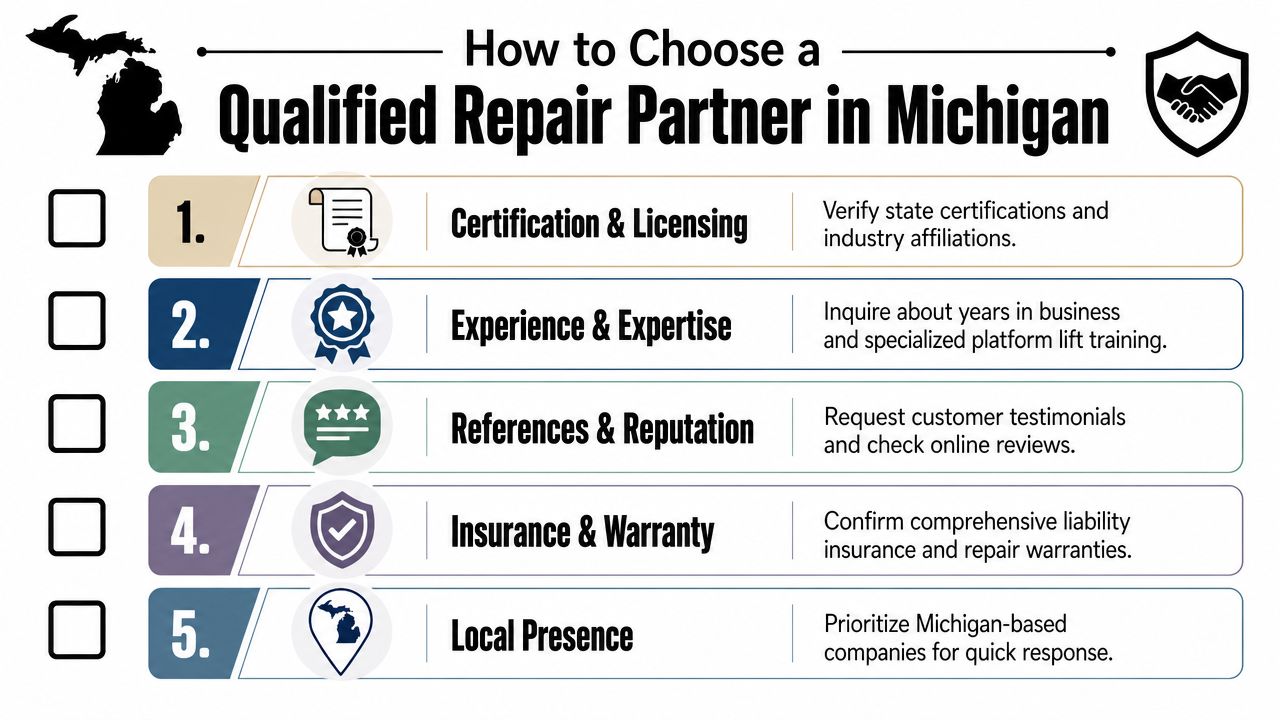
How to Choose a Qualified Repair Partner in Michigan
A Michigan building manager usually finds out whether they chose the right repair company on a bad day. The lift is down. A tenant or visitor needs access. The first vendor says they can come out, but only if you approve a service call with no clear scope, no parts options, and no answer about who can work on the unit after the repair. That is how owners get pushed into expensive service relationships they did not plan for.
The company you hire should solve the immediate failure without narrowing your future choices. That matters more than many owners realize. A lift can be repaired in a way that keeps service open to qualified independents, or in a way that ties the building to one vendor, one parts channel, and one pricing structure.
What non-proprietary service really means
Non-proprietary service means the repair approach keeps the unit serviceable by more than one qualified company whenever possible. Some parts will always be brand-specific. The key question is whether the contractor defaults to open, supportable solutions or steers every problem toward a closed system that only a small group can touch.
For owners, the practical impact shows up fast:
- Faster response options: You are not waiting on a single authorized source.
- Better cost control: You can compare repair recommendations and pricing.
- Less long-term risk: Future maintenance and callbacks are easier to place with another qualified provider if service slips.
This is not just a technical preference. It affects downtime, approval speed, and how much negotiating power you keep after the current repair is done.
Questions worth asking before you sign anything
Start with licensing and insurance. In Michigan, that answer should be clear and specific, not vague.
Then ask questions that expose how the company works:
- Do you service multiple lift makes and models? A narrow answer often means limited options later.
- Will you provide a written scope before major work begins? You need labor, parts, testing, and exclusions spelled out.
- Can you explain whether the repair keeps future service open to other qualified companies? If they dodge that question, pay attention.
- Do you stock common wear items or rely entirely on special-order parts? That affects downtime.
- Can the same company handle maintenance after the repair? A contractor focused only on emergency calls may not be set up to keep the unit reliable.
If you are reviewing Michigan wheelchair lift repair companies that offer ongoing service, compare more than arrival time. Compare documentation, parts strategy, communication, and whether the company is willing to explain trade-offs in plain language.
What good partners do differently
A qualified repair partner gives you a diagnosis you can follow. They document what failed, what they tested, what they recommend now, and what can wait. They also tell you when a cheaper short-term fix is reasonable and when it will probably create another shutdown.
That kind of honesty matters. I have seen owners approve a quick repair because it looked cheaper, only to pay for another service call weeks later when the underlying issue was never addressed.
Good partners also avoid creating dependency where it is not needed. They do not treat every issue like a brand-controlled event. They look for the safest, code-appropriate, supportable repair path.
Poor partners usually sound similar at first. The difference shows up in the details. Vague diagnosis. Weak paperwork. No discussion of part lead times. No explanation of what happens if the same fault returns.
Choose the company that leaves you with a working lift and a clear path for future service. That is the repair partner worth keeping.
From Repair to Reliability with Preventative Maintenance
Emergency repair restores function. Preventative maintenance preserves access. Those are not the same thing, and owners who treat them as the same usually spend more over the life of the lift.
A platform lift almost never wakes up one morning and decides to fail for no reason. In most cases, someone could have found the warning signs earlier. A latch was getting sticky. A hose was starting to seep. A roller was wearing unevenly. A safety contact was drifting out of adjustment. Maintenance catches those conditions while the lift is still usable and the repair scope is still controlled.
What preventative work actually does
A proper maintenance visit is not just “look it over and leave.” It should include cleaning, inspection, adjustment, lubrication where appropriate, and testing of the operating and safety functions that commonly interrupt service.
That kind of work reduces repeat shutdowns because it addresses the small conditions that create nuisance faults:
- Misaligned gates and latches that start causing intermittent no-move complaints
- Developing hydraulic issues before they turn into obvious leaks or poor travel
- Loose hardware and worn rollers before they create noise and secondary damage
- Dirty or degraded contacts and switches before they produce unreliable operation
Why reactive-only service costs more
Owners often try to save money by skipping maintenance and paying only when the lift stops. On paper, that feels efficient. In practice, it usually means more downtime, more urgent labor, and more avoidable inconvenience for the people who rely on the lift.
There's also a building-management benefit that gets overlooked. A maintenance relationship gives the technician history. They know whether a recurring issue is new, repeated, weather-related, or tied to a previous repair. That context shortens diagnosis and improves decision-making.
The standard you should expect
If you're setting up a maintenance program, look for one that goes beyond bare-minimum inspection. The better programs include full clean-downs of working areas, attention to recurring minor faults, and routine replacement of small wear items before they trigger a call-back.
For Michigan owners, that approach is especially useful in mixed portfolios where the same provider may also be handling passenger elevators, home lifts, dumbwaiters, or accessibility equipment. The fewer silos you create, the easier it is to keep service consistent.
Maintenance is where you either protect reliability quietly or pay for failures publicly.
The cheapest repair is often the one that never turns into an outage. That's the true value of a preventative plan. It protects accessibility, reduces operational disruption, and keeps your options open for the next service event instead of forcing rushed decisions under pressure.
If your platform lift is down, acting intermittently, or getting harder to keep in service, Crane Elevator Company provides non-proprietary repair, maintenance, inspections, and modernization support for vertical transportation equipment across Lower Michigan. For property owners who want a clear diagnosis, flexible service options, and a maintenance-first approach, it's worth starting the conversation before the next shutdown becomes an emergency.