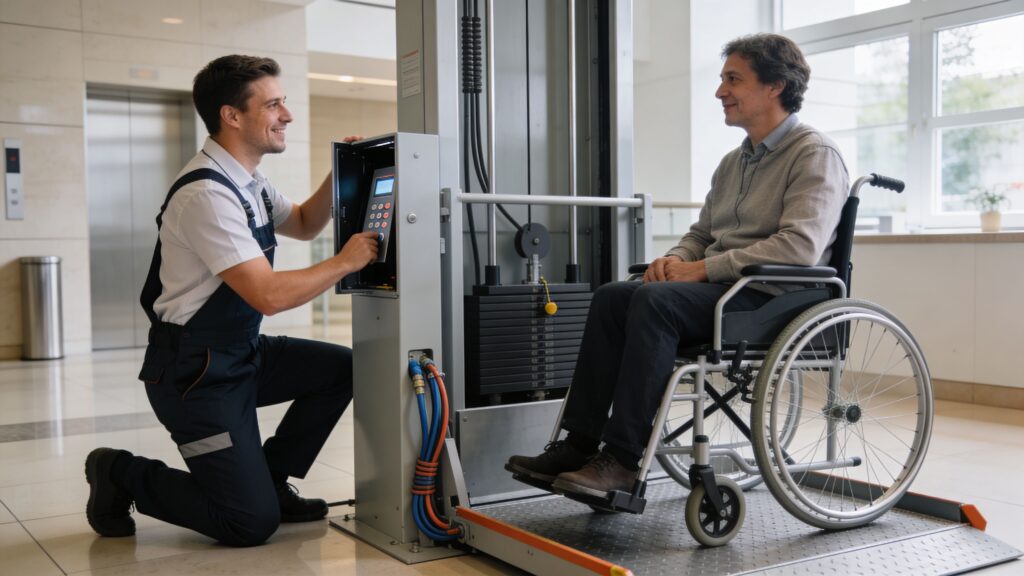
A wheelchair lift usually fails at the worst possible time. A tenant is waiting in the lobby. A patient transport is due in minutes. A staff member is standing by the controls pressing the call button again and again, hoping the platform will move on the next try. Meanwhile, you’re thinking about access, complaints, code exposure, and how long this outage is going to drag on.
That’s the moment people often type wheelchair lift repair near me and start calling whoever answers first.
Sometimes that works. Sometimes it gets you a rushed diagnosis, a temporary patch, and the same breakdown a few weeks later. Southern Michigan property managers usually need something more practical than a vendor list. You need to know what to do in the first ten minutes, what signs you should’ve caught sooner, what the likely repair path looks like, what the cost conversation should sound like, and how to judge whether a contractor is fixing your problem or locking you into future ones.
A wheelchair lift is an accessibility device, but from an operations standpoint it’s also a risk point. If it’s down, your building loses function immediately. That changes how you should respond. Calm matters. Documentation matters. The right repair partner matters even more.
Your Wheelchair Lift Is Down What Now
A typical call goes like this. The lift was working yesterday. This morning it’s dead, or it starts and stops halfway through travel. Someone hears a buzz, sees a flashing control, or notices the platform isn’t level at the landing. Nobody wants to touch it because they’re afraid of making it worse.
That instinct is usually correct.
The first priority isn’t speed. It’s safe control of the situation. If a lift has failed in a public, healthcare, school, municipal, or multifamily setting, the outage becomes more than a maintenance item. It affects access, staff workflow, and potential liability the minute a user encounters it.
Practical rule: Treat a failed wheelchair lift like a life-safety access issue, not a minor equipment nuisance.
Property managers often lose time in two places. First, they let multiple people test the controls after the first failure. Second, they call for service without gathering the few details that help a technician narrow the problem. That combination can turn a clean diagnosis into a longer outage.
A better response is simple. Secure the lift, identify whether the problem looks electrical, hydraulic, or mechanical, and prepare the basic facts before you call. Model, symptoms, whether the platform is stuck at a landing or between levels, whether any alarms are active, and whether the issue started after weather, cleaning, power interruption, or a recent inspection all matter.
If you handle those first steps correctly, the repair call goes faster and the technician arrives with a more realistic plan.
Immediate Safety Steps for a Broken Wheelchair Lift
A broken wheelchair lift can turn into an access problem, a tenant issue, and a compliance issue in the same hour. The first job is to control the scene so nobody gets hurt and staff do not make the outage worse by repeatedly trying the controls.
Secure the lift and protect access
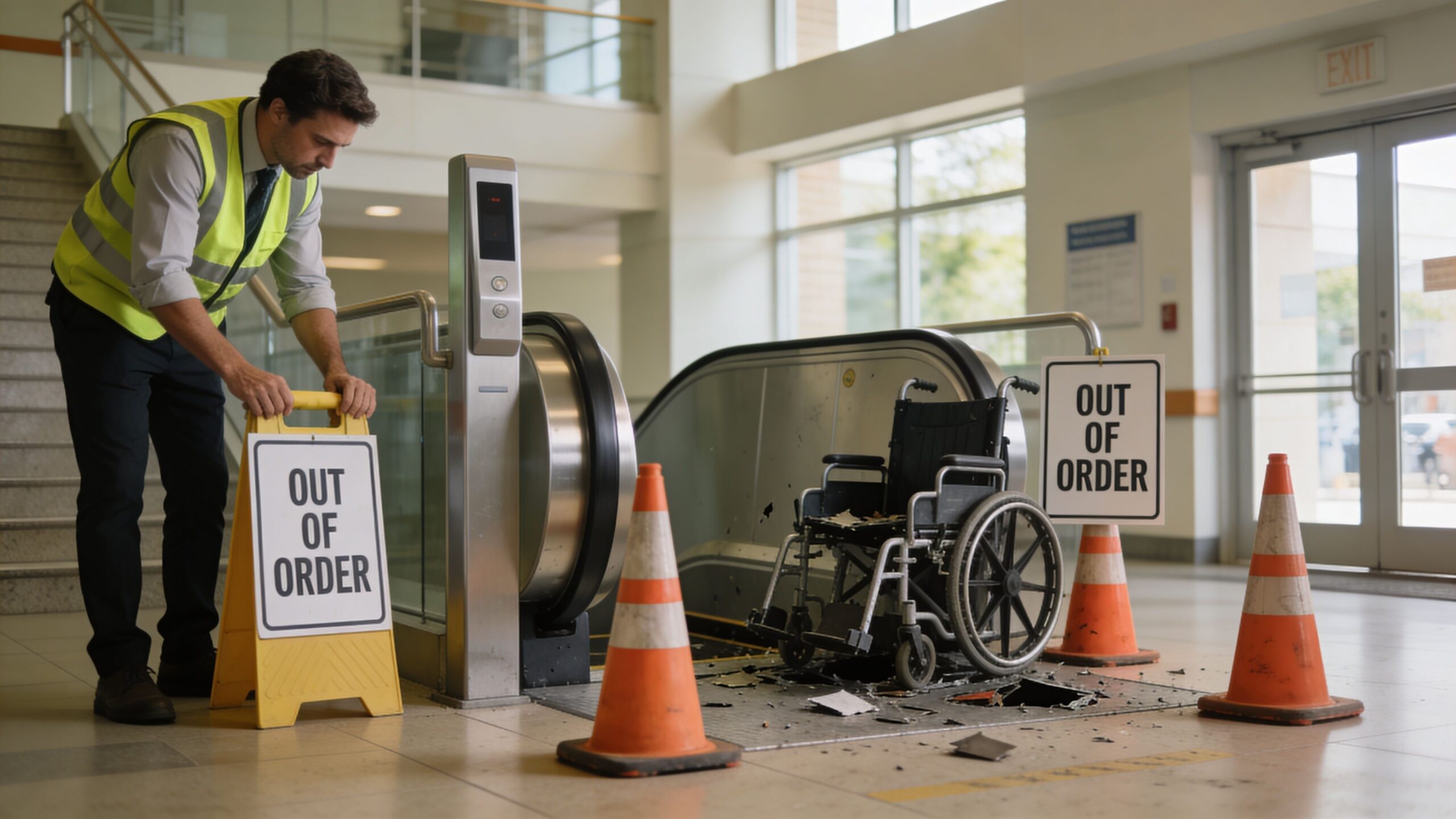
Treat the unit as out of service the moment it fails or behaves unpredictably. Post signs at every landing, not just one entrance. If the lift serves residents, patients, students, or the public, direct people to the alternate accessible route right away and make sure staff know what that route is.
If someone is stranded on the platform, follow your site emergency procedure and call a qualified contractor immediately. For urgent help after hours or during a building access disruption, use a provider that handles emergency elevator repair in Southern Michigan.
Keep a simple incident record. Note the time, who reported it, whether anyone was using the lift, and what action staff took. That matters later if there is a complaint, inspection question, or dispute about response time.
Check only what a property manager can check safely
Facility staff can confirm basic conditions. They should not bypass interlocks, open protected components, reset faults repeatedly, or try to force movement. A quick, disciplined check helps the service company decide whether to send a mechanic prepared for an electrical, hydraulic, or mechanical problem.
Use this triage list:
Check the breaker once
If it is tripped, note it. If it trips again after a reset, leave it alone and report that to the technician.Confirm the disconnect and building power
A lift with no incoming power will often look like a major failure when the issue is upstream.Look for obvious obstructions
Trash, ice, debris, or a damaged threshold can keep a gate or platform from completing its safety circuit.Verify gates and doors are fully secured
Many lift shutdown calls come down to an interlock that never proved closed.Listen and watch during one controlled test, if safe to do so
No response, a relay click, a motor hum, or partial movement all point the mechanic in different directions.
Stop immediately if you see leaking oil, exposed wiring, burnt odor, damaged gates, or grinding from the drive area. Those conditions raise the risk and usually mean the call is no longer routine.
Gather the details that shorten the outage
A good service call starts before the technician gets in the truck. Southern Michigan property managers save time and money when they report the exact symptoms instead of just saying the lift is down. That improves dispatch, helps with parts planning, and reduces the chance of paying for one trip to diagnose and a second trip to return with the right material.
| What to note | Why it helps |
|---|---|
| Lift brand and model | Tells the contractor what manuals, common parts, and tooling may be needed |
| Exact symptom | Dead, slow, jerky, misleveling, and mid-travel stoppage suggest different failure paths |
| Lift position | Lower landing, upper landing, or between levels affects both access planning and rescue approach |
| Recent event | Storm, cleaning, impact, power outage, or inspection often explains what changed |
| Visible condition | Leaks, fault lights, damaged barriers, loose panels, or alarm activity help narrow the cause |
One more practical point. If this lift serves a building with regular public traffic, do not judge repair companies only by who can show up first. Fast arrival matters, but long-term value comes from a contractor who can support the equipment after the emergency, explain whether the unit uses proprietary parts, and tell you candidly if you are paying for another patch on a lift that needs modernization. That decision affects downtime, budget planning, and ADA access risk far more than a single service call.
Warning Signs Your Wheelchair Lift Needs Repair
Most wheelchair lift failures don’t come out of nowhere. The machine usually gives warning signs first. The problem is that busy buildings normalize those signs until the lift finally quits.
Sounds that should get your attention
A healthy lift has a normal operating sound. It shouldn’t grind, scrape, bang, or clunk at transition points.
If you hear grinding, look at wear points, chains, bushings, or alignment issues. If you hear a sharp clunk at start or stop, suspect loose hardware, worn pivot areas, or landing issues. A buzz or hum without movement often points toward power, relay, motor, or hydraulic unit trouble depending on the design.
The important point is consistency. If the sound changed, the condition changed.
Strange noise is not cosmetic. It’s usually the first cheap warning before the expensive failure.
Operating behavior that tells you more than people think
Property managers often describe trouble as “it still works, just not smoothly.” That’s the stage where a service visit usually costs less and causes less disruption.
Watch for these patterns:
- Jerky travel: The platform moves unevenly or shudders during lift.
- Slow operation: The unit takes longer than normal to complete a cycle.
- Misleveling: The platform doesn’t align cleanly at the landing.
- Intermittent starts: Controls respond sometimes, then don’t.
- Gate or barrier problems: The barrier hangs up, binds, or won’t latch cleanly.
Each of those symptoms points to a different repair path. Jerky movement can come from wear, hydraulic issues, or alignment. Slow operation can indicate drag, fluid issues, or power trouble. Intermittent starts often point toward electrical faults, control issues, or safety circuits.
Visual red flags you shouldn’t ignore
A quick visual walk-by can catch developing failure before a shutdown.
Look for:
- Hydraulic fluid where it shouldn’t be
- Frayed or damaged wiring jackets
- Loose covers or visibly loose fasteners
- Platform edge damage
- Rust at critical mounting areas
- Barrier or gate misalignment
- Flickering indicators or inconsistent control response
A lot of managers wait until a lift is fully down before they call. That’s backwards. The best time to schedule repair is when the machine is still telling you what’s wrong.
What a symptom usually means
| Symptom | Likely area to inspect professionally |
|---|---|
| Grinding or scraping | Mechanical wear, chain, pivot, alignment |
| Slow lift speed | Hydraulic system, drag, power supply |
| Uneven landing | Mounting, platform alignment, wear points |
| Intermittent power | Wiring, breaker path, control circuit |
| Barrier not working right | Gas spring, pins, binding, interlock |
If your team has noticed one of these signs more than once, don’t wait for a full outage. That’s how “wheelchair lift repair near me” turns from a planned service call into an after-hours emergency.
Typical Wheelchair Lift Failures and How They Are Fixed
A down lift is rarely a mystery for long. In the field, the failure usually traces back to one of three areas: electrical, hydraulic, or mechanical. The expensive mistakes happen when a service company swaps parts before it isolates the actual fault, or fixes the immediate symptom and leaves the underlying cause in place.
For a Southern Michigan property manager, that distinction matters. A one-time repair may get the platform running for the week. A proper diagnosis tells you whether you are dealing with a simple service call, repeated downtime risk, or a lift that is close to a larger capital decision. If you are weighing repeated repairs against replacement, it helps to compare those service patterns with broader wheelchair lift installation cost factors before another patch job turns into sunk cost.
Electrical failures
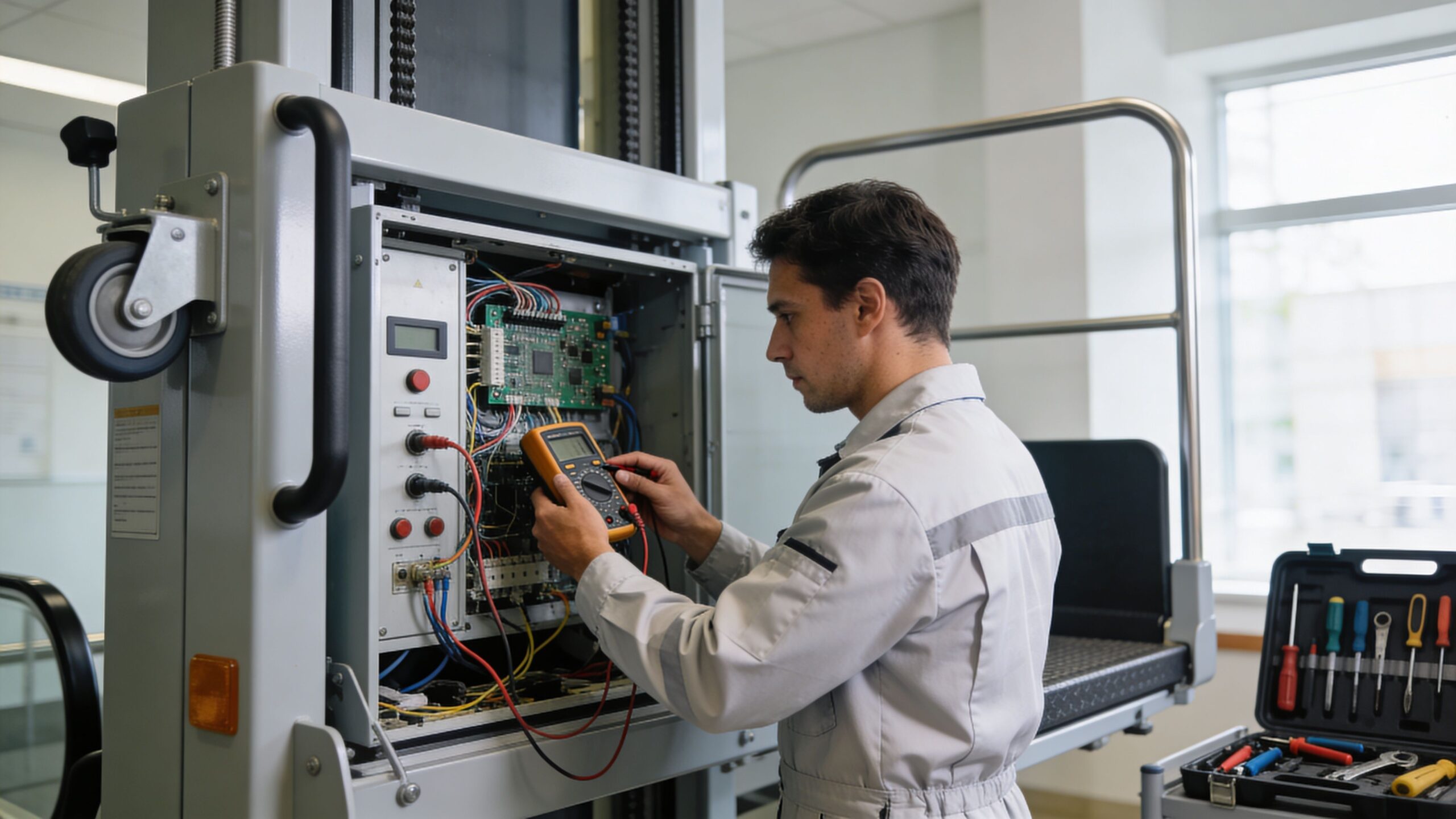
Electrical problems cause a large share of no-start calls. The lift may look completely dead, or it may power up and fail one step into the sequence because an interlock, limit, or control input is open.
Manufacturer installation guidance from Ricon warns against routing power cables through structure without proper protection and specifies torque values for mounting hardware because poor cable protection and loose fasteners lead to wear, shorts, and misalignment over time, according to the Ricon KlearVue installation and service documentation.
A competent electrical repair starts with disciplined testing:
- Verify incoming power under load
- Check breakers, disconnects, and fusing
- Inspect cable routing for abrasion or pinch points
- Test interlocks, limits, and control inputs in sequence
- Confirm grounding and terminal tightness
- Inspect vibration-prone mounting points that can affect alignment and switch operation
Inexperienced troubleshooting gets costly. If a technician replaces a control part before checking the safety circuit, you can pay for a board and still have the same outage.
Hydraulic failures
Hydraulic lifts usually give warning before they quit. Travel slows down. The platform drifts. The unit sounds strained. You may also see oil at the base, on a hose run, or around the power unit.
The right repair path depends on what failed and what the fluid condition looks like. A leaking fitting is different from a scored cylinder, and both are different from contamination inside the system. Topping off fluid without finding the leak source is not a repair plan. It is how small leaks turn into seal damage, poor leveling, and another callback.
A proper hydraulic service visit often includes:
- Checking fluid level and condition
- Inspecting hoses, fittings, and seals for leaks
- Testing pump operation and pressure behavior
- Looking for cylinder leakage or drift
- Confirming full travel, landing accuracy, and platform stability
Here’s a useful visual overview before the next point in the discussion:
Mechanical wear and structural issues
Mechanical wear drives a lot of repeat service in older lifts. Bushings wear out. Chains stretch. Barrier hardware binds. Mounting points loosen. None of that stays isolated for long. One worn pivot can throw off platform travel, increase strain on the drive system, and create a code and liability problem if the barrier or landing alignment is affected.
On this type of call, the technician should inspect the full motion path, not just the loudest or most visible part.
| Failure type | What the tech looks for | Typical fix |
|---|---|---|
| Worn bushings | Play at pivots, uneven movement | Replace worn components, lubricate approved points, retest travel |
| Chain wear or stretch | Elongation, slipping, poor tracking | Adjust or replace chain and inspect sprockets |
| Binding barrier | Pin wear, spring issues, misalignment | Correct binding, replace worn hardware, verify interlock function |
| Loose mounting | Shift, vibration, platform misalignment | Re-secure, torque to spec, inspect anchoring and surrounding structure |
A lift that keeps getting adjusted without replacing worn parts is a budget trap. You keep paying for labor, the downtime keeps returning, and the property never gets back to reliable service.
The best repair companies explain that trade-off clearly. Sometimes the right answer is a straightforward fix. Sometimes the better business decision is to stop pouring money into a proprietary or badly worn unit and move toward a non-proprietary modernization that parts suppliers and local technicians can support for years.
Understanding Repair Costs and Response Times in Michigan
A wheelchair lift can fail at 7:30 a.m., right before tenants arrive, a clinic opens, or a resident needs access. At that point, the repair bill is only part of the problem. Downtime affects building operations, creates accessibility exposure, and puts pressure on staff to explain why a required access route is out of service.
What the first visit usually covers
For Southern Michigan property managers, the first invoice is usually a diagnostic and service call. Midwest Mobility notes that initial diagnostics for power equipment often average $95, including the first hour of labor, based on its service and repair pricing. Treat that as an entry point, not the full repair number.
On site, a competent technician should verify the complaint, run the lift through basic testing if it can be operated safely, inspect the drive and control side, and determine whether the unit can be returned to service that day. Sometimes that first call ends with a completed repair. Sometimes it ends with a parts quote, a safety shutdown, or a recommendation to stop spending money on a unit that keeps failing for the same reason.
That difference matters.
A cheap first visit does not mean a cheap repair. After-hours dispatch, return trips, special-order parts, and code-related corrective work can change the total quickly. The property manager’s job is to get a clear scope early, because vague service tickets turn into budget creep.
Repair versus modernization
The larger cost decision is rarely about one bad part. It is about whether the lift still makes business sense to keep. Midwest Mobility also notes that full modernization or replacement can run from $12,000 to $35,000. That is a wide range, but the bigger point is straightforward. Repeated service calls on an aging lift can cost more than managers expect once you factor in downtime, tenant disruption, and repeat labor.
Use this framework:
- Approve a repair when the failure is isolated, the lift has decent service history, and parts are available.
- Approve a targeted upgrade when one subsystem keeps creating callbacks, such as controls, interlocks, or aging drive components.
- Budget for modernization or replacement when the lift has chronic downtime, poor parts access, or a proprietary setup that ties you to expensive delays.
If you are weighing that larger capital decision, review a realistic wheelchair lift installation cost range in Michigan before approving another short-term fix.
Non-proprietary equipment usually gives managers more options over the life of the lift. More technicians can service it. Parts are easier to source. You are less likely to be cornered into waiting on one manufacturer channel while the building carries the operational risk.
Response times in the real world
Response time depends on your service agreement, the day and hour of the call, and whether the contractor stocks common lift parts in the region. A company may advertise emergency response, but the better question is what they can accomplish on that first trip. Fast arrival without parts access or platform-lift experience is not much help.
For occupied buildings, the practical standard is simple. You want a contractor who can tell you three things clearly:
- whether the lift is safe to leave in service
- whether the problem is likely repairable on the first call
- how long the building may be without the lift if parts are required
That is what lets a property manager make decisions, notify occupants, and document the issue properly.
Documentation affects cost too
Insurance, reimbursement, and internal approvals can slow everything down. Building-integrated accessibility equipment does not always fit neatly into a claim process, and many managers find that out after the work is done. Clear service notes, parts detail, and a written explanation of the failure make a real difference when ownership, accounting, or a carrier asks why the cost was necessary.
If the invoice only says "adjusted lift" or "repaired unit," expect friction later.
Good repair companies write tickets that hold up under scrutiny. They document what failed, what was tested, what was replaced, and what risk remains if the property delays the next step. That is how you separate a one-time fix from a long-term service partner.
Your Checklist for Vetting Local Repair Companies
Choosing who handles wheelchair lift repair near me isn’t a one-call decision. It’s a vendor-risk decision. If the company lacks the right licensing, documentation habits, parts strategy, or response capability, you won’t just have one bad service call. You’ll inherit a long-term operating problem.
Start with the non-negotiables
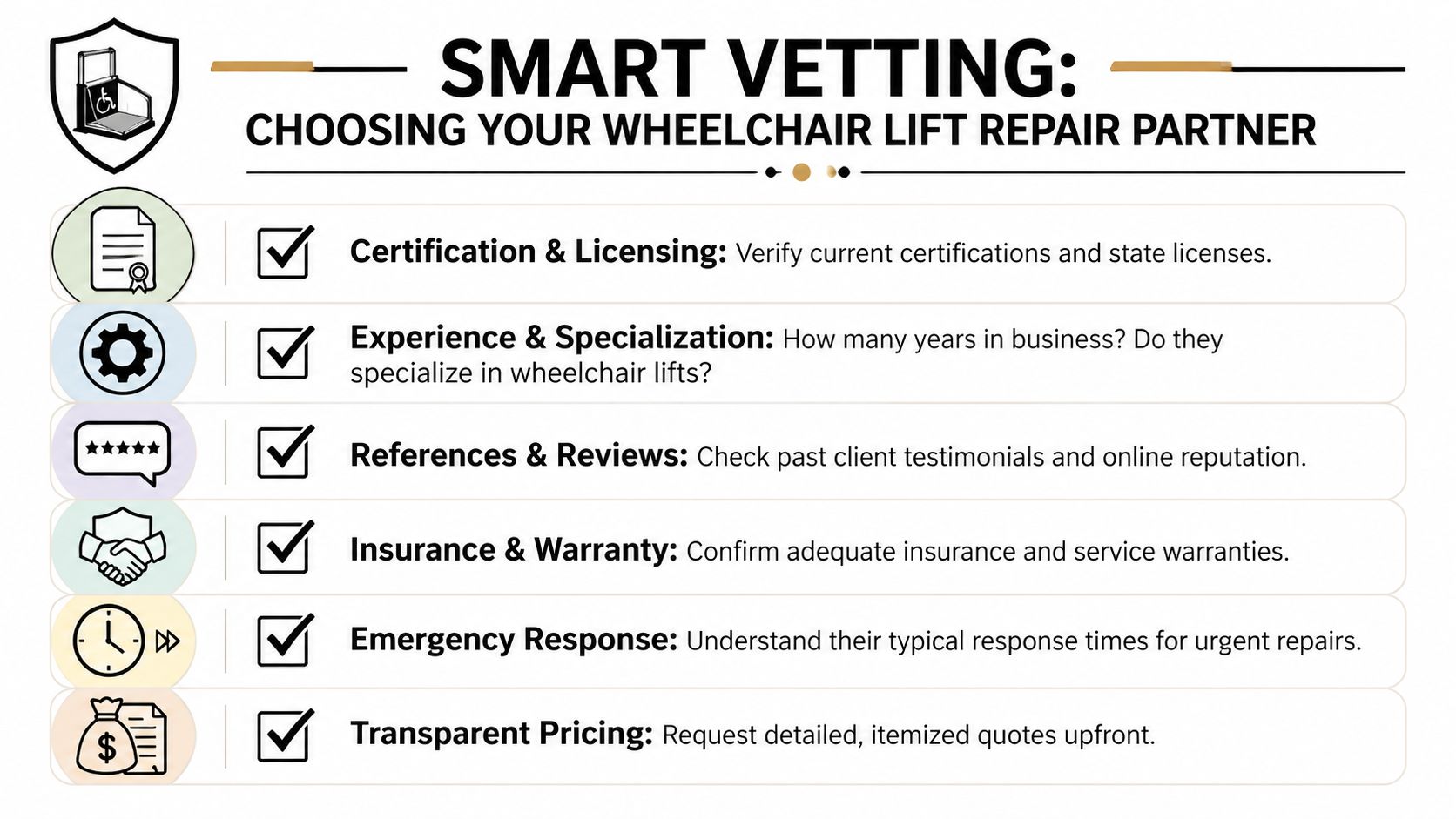
A credible repair company should be able to answer these questions directly:
Are you properly licensed and insured for this work?
Don’t settle for vague reassurance. Ask for current documentation.Do you service wheelchair lifts specifically, or only general mobility equipment?
A contractor who works regularly on platform lifts, inclined lifts, and related accessibility equipment will diagnose faster.Do you provide emergency service outside normal business hours?
If your building operates evenings, weekends, or around the clock, this isn’t optional.Can you service multiple brands and older equipment?
That answer tells you a lot about long-term flexibility.
If you’re comparing providers, use a local benchmark such as an elevator repair company near me in Michigan and measure each bidder against the same criteria.
Ask how they handle parts and vendor lock-in
Many building owners often face a difficult situation. Some lifts and control packages push owners toward proprietary parts, proprietary software access, or manufacturer-only service paths. That can slow repair, raise prices, and limit your options.
A better long-term model is non-proprietary serviceability. That means qualified contractors can diagnose, source, and maintain the equipment without artificial restrictions.
Ask these direct questions:
| Question | Why it matters |
|---|---|
| Are your repair recommendations proprietary or non-proprietary? | Protects future service flexibility |
| Will another qualified company be able to service this setup later? | Prevents lock-in |
| Are common wear parts available through standard channels? | Reduces downtime risk |
| Will you document part numbers and changes made? | Helps future maintenance and budgeting |
“Can another qualified contractor work on this later?” is one of the smartest questions a property manager can ask.
Review how they communicate, not just how they fix
Technical skill matters. So does discipline.
A good company gives you:
- Clear diagnosis language: Not just “bad board” or “needs adjustment”
- Itemized quoting: You should see labor, parts, and any return-trip assumptions
- Service records: Useful for code issues, recurring faults, and budgeting
- Maintenance recommendations tied to condition: Not generic upselling
- Warranty terms in writing: Parts and labor should be easy to understand
Check whether they think beyond the current outage
The best repair companies don’t just restore operation. They tell you what caused the failure, what else looks worn, and whether the lift should stay on a repair path or move toward modernization.
That difference matters in Southern Michigan buildings with aging equipment. A one-time fix may be right. But if the lift is drifting toward chronic downtime, the right contractor will say so before you waste more money on reactive service.
The Crane Elevator Advantage Proactive Maintenance and Modernization
A lift that fails once during business hours is a service call. A lift that keeps failing becomes an operations problem, an accessibility risk, and a budget problem. Property managers in Southern Michigan need more than a company that can get a platform moving again. They need a partner who can tell the difference between a repairable unit, a unit that needs tighter maintenance, and a unit that is costing too much to keep alive.
Maintenance works when it is tied to failure patterns
Preventive maintenance only pays off if the technician is inspecting the parts that lead to these lifts shutting down. On wheelchair lifts in older Michigan buildings, that usually means wear at pivots, chain or drive components, interlocks, gate hardware, limit devices, and hydraulic components on hydraulic models. Good maintenance also includes cycle-based review where the manufacturer calls for it, operating tests under load, and written notes that show what is wearing before it becomes an outage.
That record matters.
Without trend notes, every failure looks isolated. With trend notes, a property manager can see that a gate switch has needed adjustment three times, a chain is reaching the end of its service life, or a hydraulic unit is starting to show contamination and heat-related issues. That is how you stop paying for the same shutdown twice.
A useful maintenance visit should include work such as:
- Inspecting pivots, bushings, and mechanical linkages for wear
- Checking chain condition, tracking, and tension where applicable
- Reviewing hydraulic fluid condition, leaks, and cylinder performance
- Testing interlocks, barriers, gates, and limit switches
- Lubricating approved points with the correct products
- Documenting slow starts, leveling issues, unusual noise, and repeat faults
Modernization is often a financial decision, not a technical one
Some lifts deserve another repair. Some do not.
If parts lead times are stretching out, callbacks are becoming normal, or the lift depends on proprietary components that narrow your service options, the lowest invoice today may produce the highest cost over the next two years. I have seen owners spend money three times on short-term fixes when one planned modernization would have reduced downtime and simplified future service.
Non-proprietary modernization gives a building more flexibility. Another qualified contractor can usually source parts more easily, service records stay useful, and the owner has better control over long-term maintenance costs. For a property manager, that is not just a technical preference. It is a purchasing advantage.
Why the operating model matters
Southern Michigan owners need a contractor who can handle emergency response, routine maintenance, inspections, documentation, and modernization planning under one roof. They also need straight answers about whether a lift should stay on a repair path or move to a capital plan.
Crane Elevator Company is built around that model. The company serves Lower Michigan with proactive maintenance, non-proprietary modernizations, code-required inspections, and 24/7/365 response. Their maintenance program includes a No Show, No Pay policy, and they offer free second opinions plus financing options that can help owners plan larger accessibility and vertical transportation work before a full failure forces the decision.
That is the key advantage. Fast repair matters on the day the lift is down. A clear maintenance plan and a modernization strategy matter for every month after that.
If your Southern Michigan property needs a dependable partner for wheelchair lift repairs, preventative maintenance, inspections, or a non-proprietary modernization plan, contact Crane Elevator Company. They provide 24/7/365 service across Lower Michigan, free second opinions, and practical guidance that helps building owners reduce downtime, control long-term costs, and keep accessibility equipment compliant and serviceable.