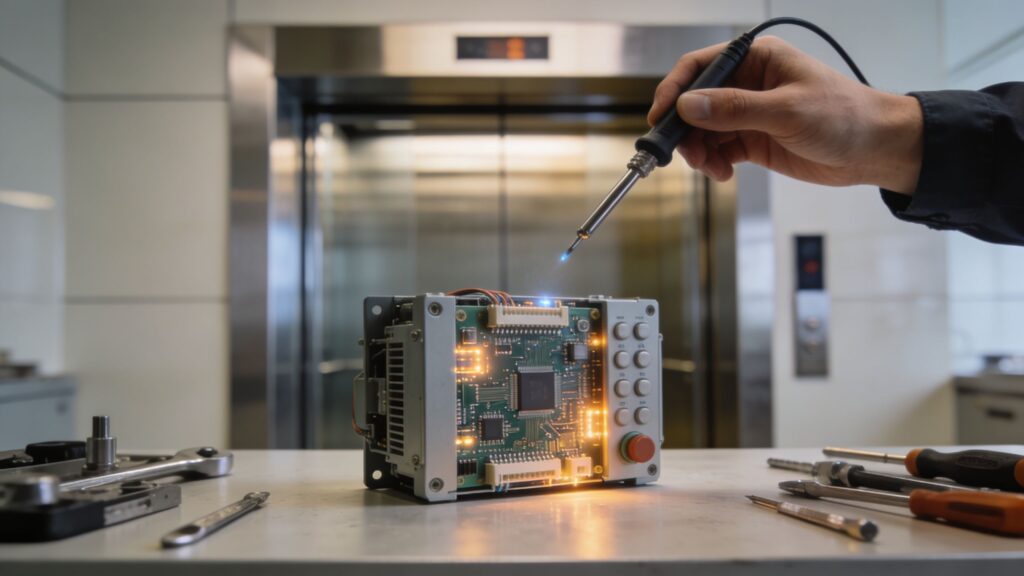
You’re staring at a modernization proposal, and one line keeps pulling your eye back: Smartrise controller.
If you own or manage a building, that line matters more than it looks. The controller is the part that decides how the elevator starts, stops, levels at the floor, responds to calls, talks to door equipment, and handles faults. It’s not a minor accessory. It’s the operating logic of the job.
That’s why building owners ask the same questions when they see a smartrise elevator package in a quote. What is it, exactly? Is it open enough to avoid lock-in? Will it be practical to maintain years from now? And if it starts acting up, can an independent company diagnose it and fix it, or are you stuck waiting on one narrow channel of support?
Those are fair questions. They’re also the right questions.
Your Modernization Quote Mentions a Smartrise Elevator
A common scenario goes like this. Your elevator is aging, callbacks are getting more frequent, and ride quality has started to slip. You ask for modernization proposals, and one contractor recommends a Smartrise package. Another pushes a manufacturer-branded system. A third talks about a fully non-proprietary approach.
At that point, most owners aren’t comparing circuit architecture or drive logic. They’re trying to answer practical questions:
- Will this reduce downtime
- Will my maintenance company be able to service it
- Will parts be available
- Will I regret this choice five years from now
Smartrise shows up in a lot of modernization conversations for a reason. It was founded specifically to give independent elevator contractors access to flexible technology, and by 2019 it had become the largest independent open-market controller manufacturer in the United States, according to Elevator World’s profile of Smartrise’s growth.
That matters because it tells you two things. First, you’re not looking at an obscure niche product. Second, these systems became common because independent contractors needed an alternative to tightly closed controller ecosystems.
Owner’s rule of thumb: Don’t ask only whether a controller is modern. Ask who can support it after the installation crew leaves.
A modernization quote that mentions Smartrise isn’t automatically the best option, and it isn’t automatically the wrong one either. It means the proposal is built around an independent controller platform rather than a complete elevator package from a single legacy manufacturer.
For many buildings, that can be a strong middle ground. For others, it may still leave serviceability questions that need to be answered before you sign.
The right way to evaluate a smartrise elevator proposal is to treat it like a long-term operating decision, not just a line item in a construction budget.
What Exactly Is a Smartrise Elevator System
A lot of owners hear “Smartrise elevator” and assume Smartrise manufactures the whole elevator. That’s not what they do.
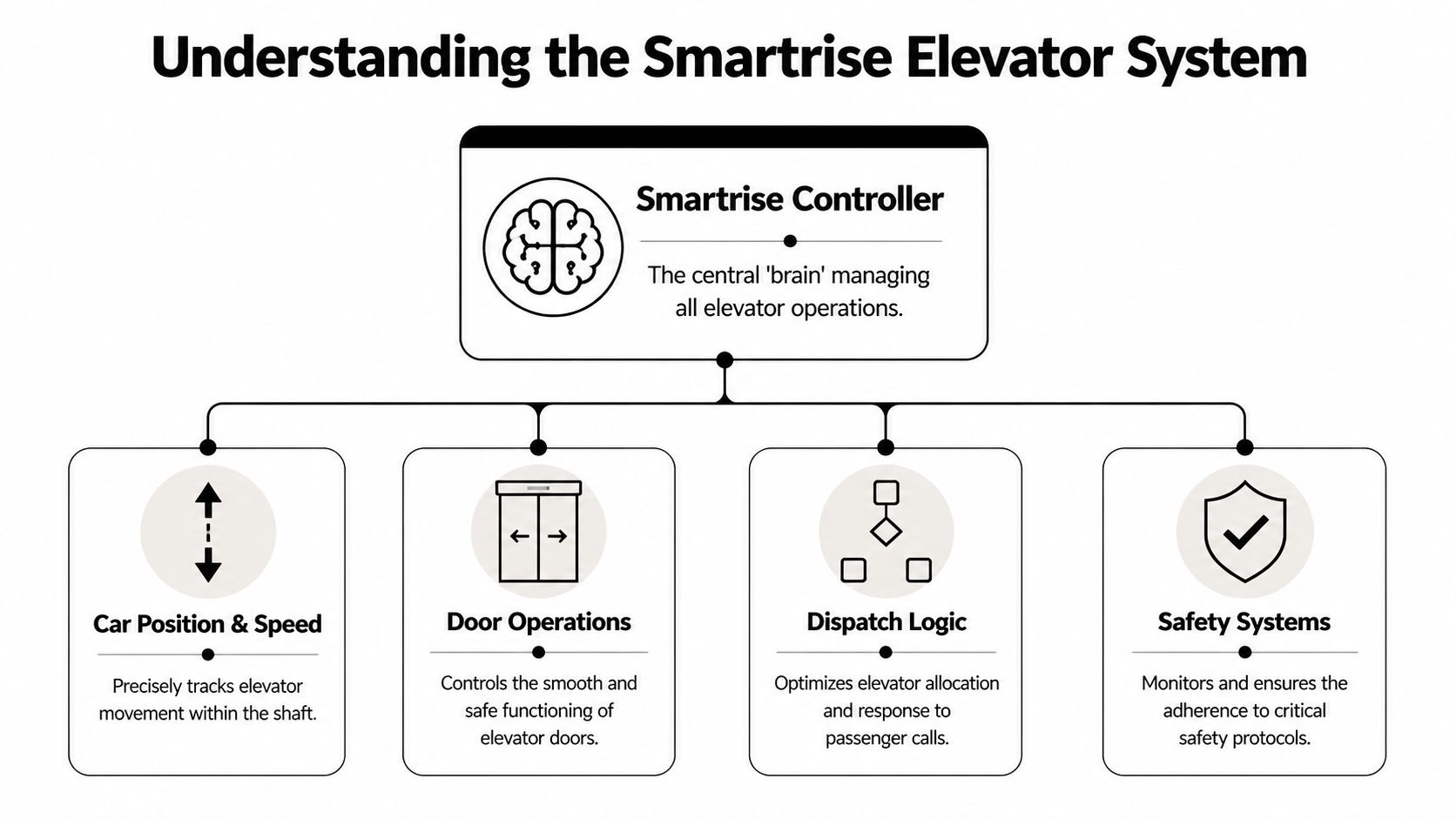
Smartrise Engineering makes the controller, which is the elevator’s central control system. It functions similarly to the computer in a modern vehicle. The machine, motor, door operator, fixtures, and safety devices are all critical, but the controller is what coordinates them into one working system.
The controller is the brain, not the whole elevator
When a passenger presses a hall call button, the controller decides what to do with that input. It tracks where the car is, manages speed changes, checks door status, processes safety circuits, and tells the elevator how to travel and stop.
In practical terms, the controller affects:
- Ride quality by managing acceleration, deceleration, and stopping
- Leveling performance so the car lands properly at the floor
- Door behavior including timing and response logic
- Troubleshooting because fault history and parameters live there
If the controller is poorly configured, even good mechanical equipment can perform badly. If the controller is solid and set up correctly, an older elevator can feel much better after modernization.
Why Smartrise became popular with independent contractors
Smartrise was founded in 2004 to equip independent installers with more capable technology, and its universal PCB design allows consistent product delivery across hydraulic or traction elevators. Its non-proprietary approach uses readily available parts compatible with most elevator components, as described in this background on Smartrise Engineering and its open-market design.
That open-market philosophy is the key idea.
Instead of forcing the entire job into one manufacturer’s closed ecosystem, a Smartrise controller is designed to work with a wide range of elevator components. That can make modernization more flexible, especially when a building already has usable equipment that doesn’t need full replacement.
Here’s the practical distinction:
| System type | What it usually means for an owner |
|---|---|
| Closed proprietary system | Service, parts, and software access may be restricted |
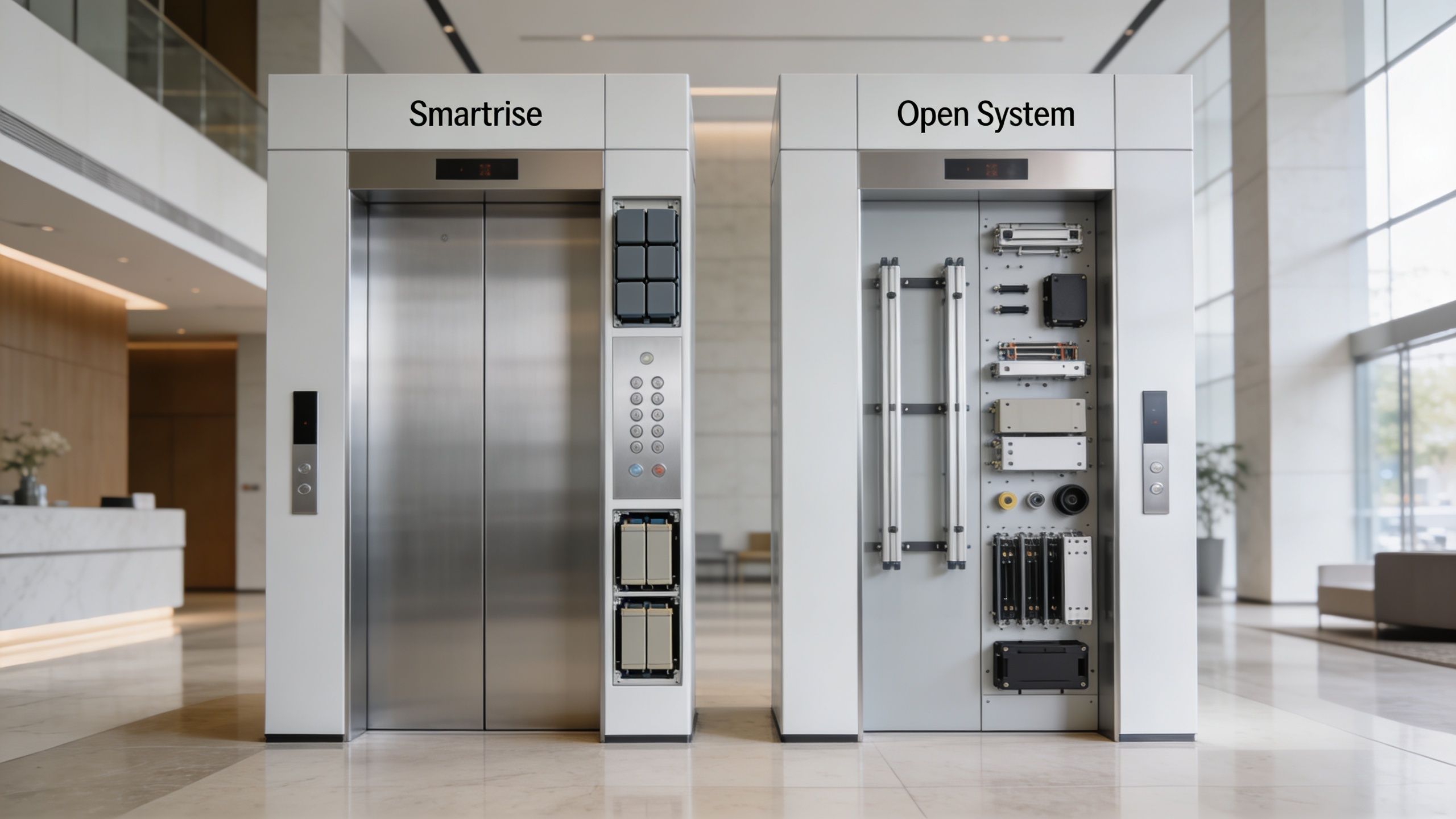
| Open-market controller | More flexibility in matching components and sourcing support |
| Fully non-proprietary modernization | The broadest long-term service access when executed correctly |
A Smartrise system can be a smart option when you want modern controls without rebuilding your project around one manufacturer’s locked service model.
That said, “open-market” doesn’t automatically mean “every technician will diagnose every issue equally well.” The hardware strategy and the field service reality aren’t always the same thing. That’s where experience matters.
How Smartrise Controllers Actually Function
The technical side of a smartrise elevator only matters if it changes what people in the building feel and what your maintenance budget sees.
At the passenger level, controller performance shows up as smooth starts, accurate stops, consistent door behavior, and fewer nuisance faults. At the service level, it shows up in how cleanly the system communicates with the rest of the equipment and how stable the parameters remain over time.
What the C4 traction controller does in the field
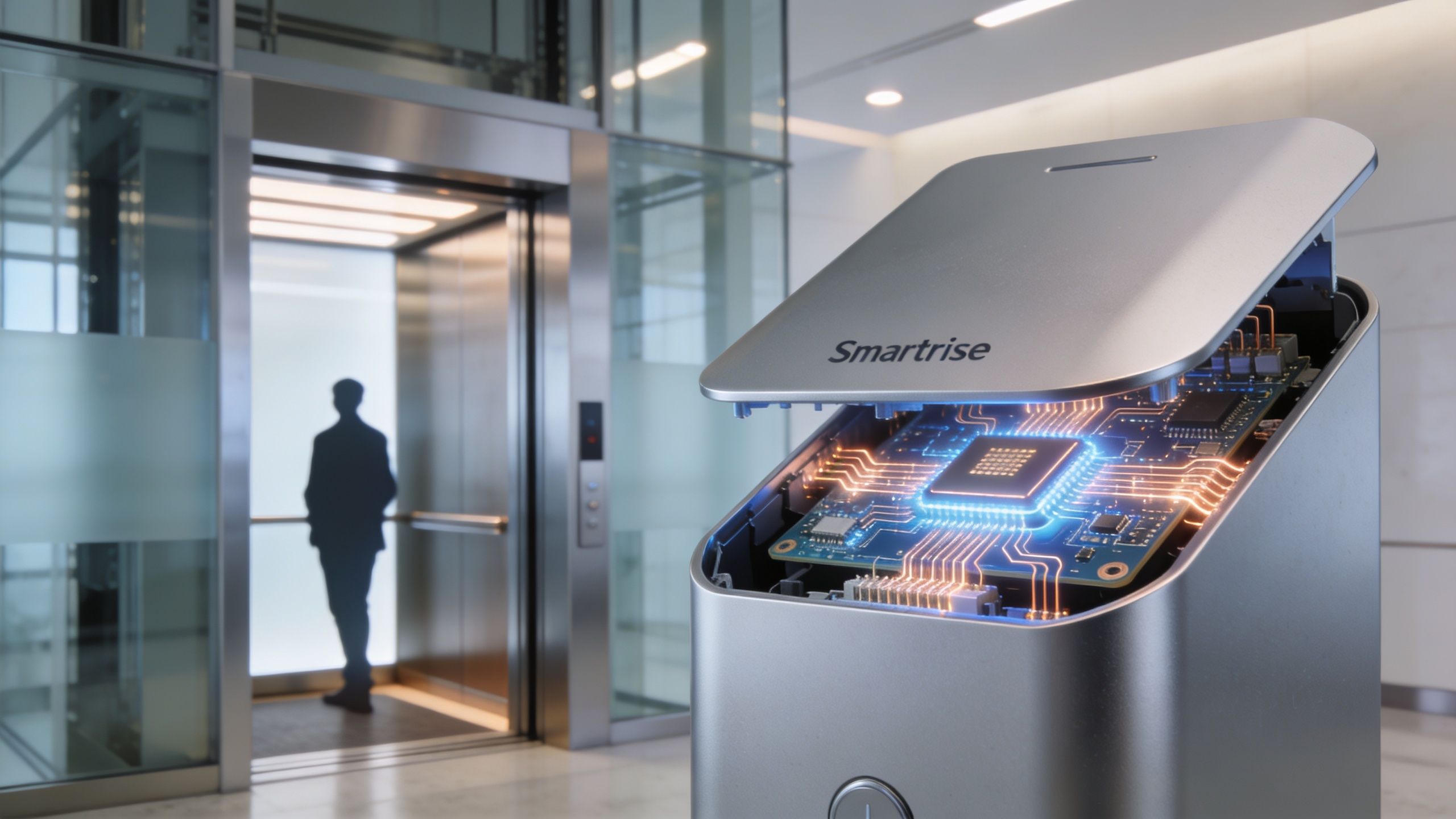
For traction applications, the Smartrise C4 Traction Controller is designed for high-performance operation. Smartrise states that the C4 can move elevators at speeds over 2,000 feet per minute and achieve self-leveling accuracy within 0.25 inches, which directly reduces passenger discomfort and safety risks tied to misleveling in older systems, according to Smartrise C4 traction controller specifications.
Those numbers matter because misleveling isn’t just a comfort issue. It creates real trip risk at the landing and often leads to recurring service calls when an older system drifts in and out of adjustment.
For taller buildings or busier traffic patterns, a controller like that can support stronger dispatch behavior and cleaner motion control than outdated relay logic or worn legacy electronics.
What hydraulic owners should pay attention to
Hydraulic systems have different headaches. Load changes can throw off stopping distance, leveling can drift, and ride quality can vary depending on temperature, oil behavior, and valve performance.
The Hydro:Evolved Controller addresses that with machine learning-driven slowdown distance recalibration and self-leveling logic that adjusts position using real-time operating data. It also supports up to 96 floors and 8 kiosks per floor for destination dispatch, and requires voice annunciation for speeds above 200 fpm or destination systems, according to Smartrise product requirements for Hydro:Evolved.
For owners, the takeaway isn’t the buzzword. It’s the result. A hydraulic elevator that levels more consistently is safer, more comfortable, and less frustrating for tenants, patients, staff, or visitors.
What works and what doesn’t
A well-applied Smartrise controller usually works well when:
- The rest of the system is evaluated objectively and not every legacy problem gets blamed on “the old controller”
- Field wiring is clean and communication paths are dependable
- The job is parametered carefully instead of rushed through startup
- Door equipment and related hardware are matched properly to the control strategy
What doesn’t work is dropping a modern controller into a tired system and pretending software will fix worn mechanical problems.
Good control logic can improve a system dramatically. It can’t make neglected door equipment, poor hoistway wiring, or bad field setup disappear.
That’s where many modernization disappointments start.
Smartrise Versus Truly Non-Proprietary Modernization
A Smartrise package is often described as non-proprietary. That description is partly right, but owners should understand the difference between open-market and fully non-proprietary before making a final decision.
Where Smartrise is strong
Smartrise has real advantages in modernization work.
It has broad recognition in the independent market, supports a range of applications, and is built around an approach that avoids tying every component to one legacy manufacturer. For many buildings, that already represents a major improvement over closed systems that limit parts sourcing and service options.
A Smartrise-based job can make sense when you want:
- Modern controls with broad component compatibility
- A controller familiar to many independent contractors
- A practical alternative to full manufacturer lock-in
Where owners need to look closer
Open-market doesn’t always equal total service independence in every real-world scenario.
Some systems are technically open but still depend on specific field familiarity, software access habits, startup knowledge, or brand-specific troubleshooting experience. That doesn’t make them bad systems. It just means your future maintenance picture depends on who will support the equipment once the modernization is complete.
Here’s the clean comparison:
| Question | Smartrise-based modernization | Fully non-proprietary modernization |
|---|---|---|
| Component flexibility | Strong | Strong |
| Independent market familiarity | Strong | Depends on the package |
| Long-term service freedom | Good, but varies by service expertise | Usually the main objective |
| Ease of field troubleshooting by any qualified provider | Not always equal across providers | Usually prioritized from the start |
Owners exploring non-proprietary elevator options should focus less on labels and more on practical service outcomes. Ask who can change parameters, trace intermittent faults, source replacement parts, and keep the system running without delay.
A short visual overview helps frame that decision:
The trade-off that matters most
The best choice depends on your building’s risk tolerance.
If you want a widely used independent controller with good modernization flexibility, Smartrise may fit well. If your top priority is making sure any qualified service company can step in later with minimal friction, a more deliberately non-proprietary package may be the better answer.
Neither path should be chosen by brochure language alone. The right question is simple: How easy will this elevator be to maintain, troubleshoot, and keep code-compliant for the rest of its service life?
Crane Elevator’s Expertise in Troubleshooting Smartrise Controls
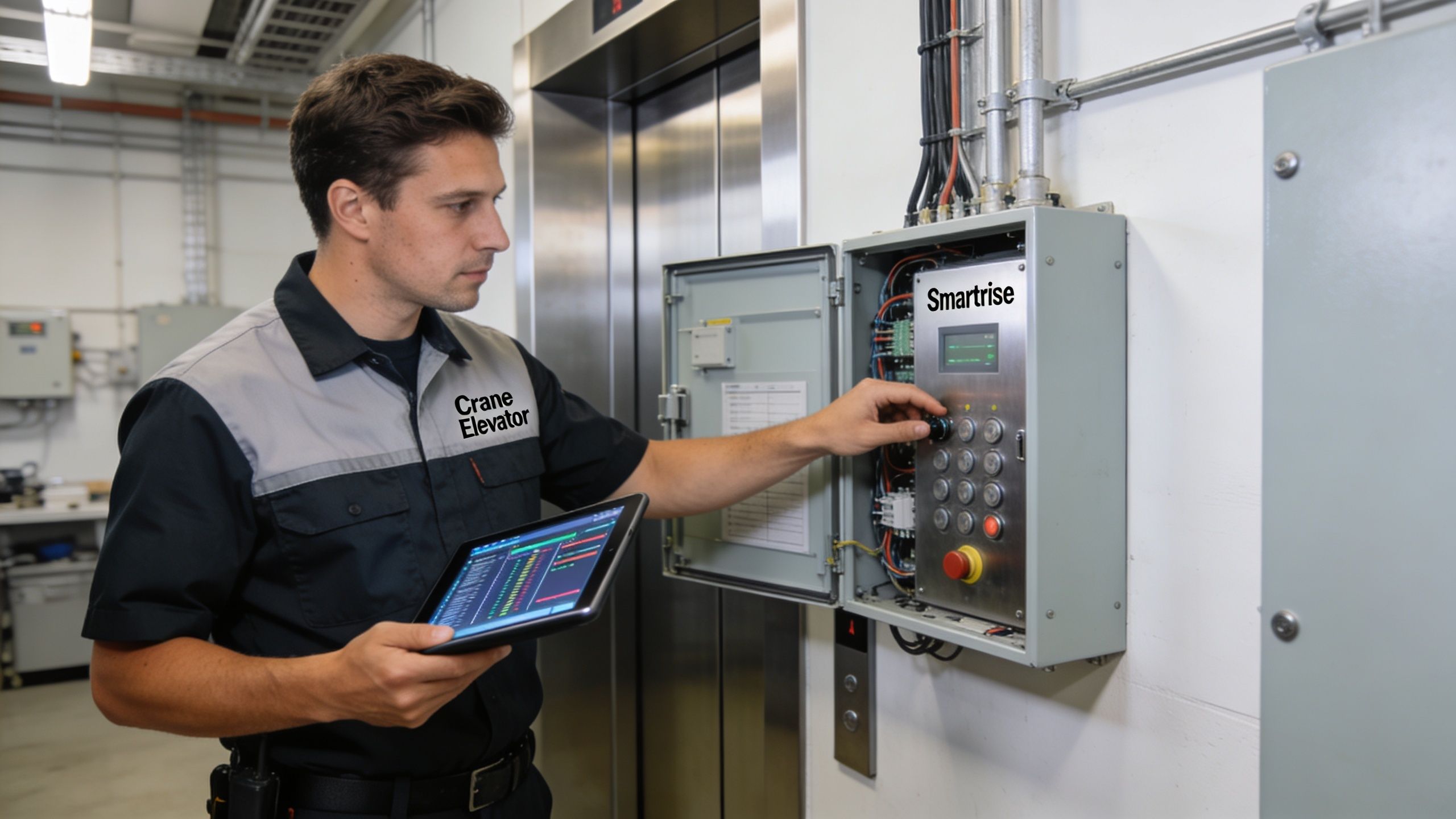
A Smartrise controller can be solid equipment. But when it develops intermittent faults, many building owners run into the same problem. The official documents tell you how the system is built and how it should be configured. They don’t always tell a field technician how to isolate a real-world failure that only appears under specific conditions.
That gap is well documented. There is a significant lack of public, real-world troubleshooting content for Smartrise systems, and the available technical manuals focus on internal parameters rather than practical field diagnostics for independent contractors, as noted in this discussion of the troubleshooting gap around Smartrise systems.
Why Smartrise faults can be hard to pin down
A Smartrise issue doesn’t always announce itself as a failed board or obvious hardware breakdown. In the field, the harder problems are often intermittent and layered.
Examples include:
- Communication faults that appear only during certain travel conditions or after another component starts dropping out
- Leveling complaints that look like a controller issue but are tied to the surrounding system
- Door-related nuisance shutdowns that trigger callbacks even though the root cause sits outside the controller cabinet
- Parameter drift after previous service work where the elevator still runs, just not consistently
Those are the jobs that separate simple parts replacement from actual diagnosis.
What experienced troubleshooting looks like
A technician who knows Smartrise controls doesn’t start by swapping boards and hoping the fault disappears. The process is more disciplined.
First, they confirm whether the controller is the source of the problem or whether it’s reacting correctly to a bad input from another device. Then they trace the sequence that leads to the fault. After that, they verify whether the issue is electrical, mechanical, setup-related, or code-related.
Field reality: The expensive mistake is replacing controller parts when the actual problem is upstream wiring, unstable inputs, or door equipment that’s feeding bad information into the system.
Specialty is key. Companies that spend real time troubleshooting Smartrise systems learn the patterns. They know which complaints point to setup issues, which ones suggest field wiring trouble, and which ones indicate a legitimate control problem.
Why that saves owners money
Faster diagnosis does more than reduce frustration. It changes the cost profile of the building.
When the wrong company handles a recurring fault, owners pay in several ways:
- Repeat callbacks that never fully solve the issue
- Tenant disruption from unreliable service
- Misdiagnosed replacements that spend money without fixing root cause
- Longer outages while people debate what failed
Specialized Smartrise troubleshooting reduces that churn. The goal isn’t just to get the elevator running today. It’s to stop the same failure from coming back next month under a slightly different symptom.
For owners, that’s the true value of working with a team that understands these controls beyond installation-level familiarity.
Ensuring Your Smartrise System Meets Michigan Code
A controller upgrade doesn’t automatically mean the whole elevator meets current code. That’s where many owners get surprised.
The uncertainty is real. Existing guidance on Smartrise controllers often lacks specific detail on how installations align with evolving requirements for fire service, emergency phones, and generator testing, which leaves building owners unsure whether their systems need compliance updates, as described in this review of code guidance gaps around Smartrise installations.
The controller is only one part of compliance
When a building modernizes around a smartrise elevator controller, the compliance review should extend beyond the cabinet.
That review usually includes:
- Fire service operation to confirm the elevator responds properly during emergency modes
- Emergency communication so phone or communication equipment works as required
- Backup power and generator interaction where applicable
- Door lock monitoring and related safety functions when required by the job
A modern controller can support code compliance, but it doesn’t replace the need to inspect the connected devices and the overall system behavior.
What owners in Michigan should ask
For Michigan properties, the smartest move is to ask your elevator contractor for a code-focused audit tied to your actual installation, not a generic promise that the controller is “code compliant.”
Ask questions like these:
- What existing components can remain in service
- What devices must be updated to match current requirements
- What testing is needed after the work is complete
- What items are outside the controller scope but still affect approval
If you’re planning around upcoming requirements, review the Michigan elevator code deadline information in the context of your own equipment and inspection history.
A passing modernization proposal isn’t enough. The building needs a system that inspectors will accept and occupants can rely on during normal operation and emergency conditions.
That’s why code review should happen before parts are ordered, not after startup problems begin.
Cost Considerations and Financing Your Upgrade
Most owners start with the proposal total. That’s normal, but it’s not enough.
A smartrise elevator modernization should be judged on total cost of ownership, not just the contract price. The cheaper quote can become the expensive one if it leaves behind recurring faults, weak service flexibility, or compliance items that need to be corrected right after the job closes.
How to read the quote correctly
When you compare modernization proposals, focus on what the price includes.
Look for:
- Scope clarity because vague controller language often hides exclusions
- Related equipment decisions such as door work, fixtures, communication devices, and other items that affect long-term reliability
- Serviceability after turnover so you’re not buying a system that becomes hard to support
- Warranty and support structure including who handles problems after startup
If one quote is lower, ask why. Sometimes that means efficiency. Sometimes it means the proposal leaves major aging components in place and shifts the risk back onto the owner.
Budgeting beyond the install
Modernization doesn’t have to be treated as one painful capital hit if the building has financing options available.
Owners evaluating elevator modernization cost factors should think in terms of predictability. A properly planned upgrade can replace erratic repair spending with a more stable maintenance picture. It can also reduce the operational drag that comes from repeated shutdowns, tenant complaints, and deferred compliance corrections.
The best financial decision usually isn’t the lowest initial number. It’s the option that gives you the clearest path to reliable service, manageable follow-up costs, and fewer unpleasant surprises after the install crew leaves.
A good modernization quote should help you answer one simple question: Will this improve the elevator’s long-term value, or am I just moving today’s problems into a newer cabinet?
If you’re dealing with Smartrise faults, weighing a modernization quote, or trying to figure out whether your current setup is repairable or ready for replacement, Crane Elevator Company can help. Crane specializes in troubleshooting and repairing Smartrise Engineering elevator controls, along with full non-proprietary modernizations, code compliance work, and long-term service planning for buildings across Lower Michigan. Reach out for a second opinion, a competitive quote, or a practical review of what will work for your building.