A dinner rush is underway when the restaurant manager presses the dumbwaiter call button and hears only a click. In a hospital, the equivalent call may come from a facilities team after a material lift stops between floors with carts waiting on both levels. The operational problem is immediate, but the bigger question is less obvious: is this a routine service call, or has the equipment entered a condition that requires shutdown, documentation, testing, and inspection?
Dumbwaiter repair isn't a matter of replacing a worn part and sending the car back into service. The work sits inside a formal safety framework that covers operation, inspection, maintenance, alteration, and repair. In North America, ASME A17.1/CSA B44 safety-code coverage includes dumbwaiters and material lifts, so a repair affecting a door interlock, control circuit, limit switch, or safety device can have consequences beyond downtime.
For facility managers in Michigan and Ohio, the right response depends on the failure, the equipment's condition, the applicable inspection schedule, and whether the repair changes a safety-related function. The practical approach is to secure the unit first, document what staff observed, and have a qualified elevator contractor determine whether the dumbwaiter can remain available or must be removed from service.
When Your Dumbwaiter Stops Working
The first mistake is treating every stoppage as a mechanical inconvenience. A dumbwaiter that won't move may have a failed motor, but it may also be refusing to run because a landing door isn't locked, a limit switch is open, or a protective circuit has detected an unsafe condition. Bypassing that circuit to restore production is not a repair strategy. It's a way to turn a visible shutdown into a concealed hazard.
Start with the operating decision
Ask staff to stop using the unit and keep people away from the car and shaft openings. Don't allow anyone to enter the hoistway, climb on the car top, defeat a door contact, or repeatedly cycle controls in an attempt to make the equipment work. Record the last known normal operation, the floor where the car stopped, unusual sounds, door behavior, visible damage, and any recent electrical or construction work.
A unit that stops because of a nuisance control issue may be a service call after a technician evaluates it. A unit with a door that can open while the car is away from the landing, a failed safety device, uncontrolled movement, damaged ropes or chains, or unsafe access conditions should be treated as an immediate shutdown condition until inspected and tested.
Practical rule: If the failure involves a protective device, don't judge the risk by whether the car still moves. Judge it by whether the system can prevent movement or access when conditions are unsafe.
The distinction matters because acceptance inspection and testing are required after installation, and testing takes place in the presence of an inspector to verify that safety and electrical protective devices function correctly under the applicable rules. New Brunswick's elevator and dumbwaiter regulations illustrate the principle clearly. Repairs that affect controls, interlocks, safeties, or electrical protection need code-based functional validation before the equipment returns to service.
Why the paperwork matters
A manager who documents the failure, isolates the equipment, and obtains a written evaluation has a defensible maintenance record. A manager who tells staff to keep using the unit after an interlock is defeated may create a liability problem even if no one is injured. For local service planning, the Toledo elevator repair resource is a useful starting point for owners dealing with a stoppage in Toledo and surrounding communities.
The key question isn't only, “Can the technician get it running?” It's, “Can the technician return it to operation with its protective functions intact, its repair documented, and any required inspection or test completed?”
Common Dumbwaiter Failures and What They Mean
Dumbwaiters tend to reveal their condition through repeatable symptoms. A car that stops at the same floor, a door that requires extra pressure, or a ride that becomes rough is giving maintenance staff useful information. The symptom doesn't identify the final repair by itself, but it tells a qualified technician where to begin and whether continued operation is sensible.
Door interlocks and limit circuits
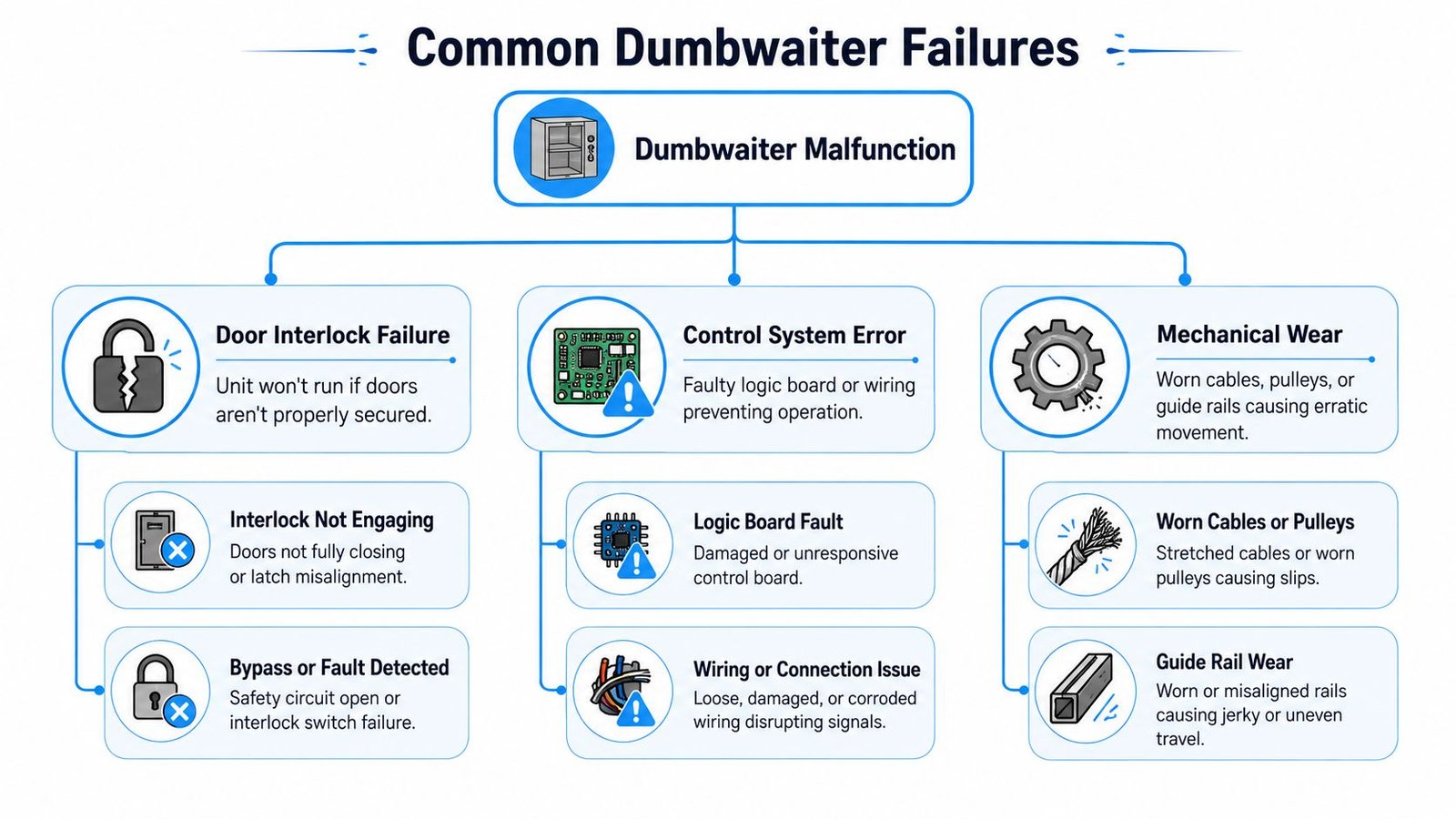
A door interlock failure commonly presents as a car that won't run from one landing, a unit that runs only after someone pushes or lifts a door, or a controller that shows a door-open fault. The interlock may be worn, misaligned, contaminated, or electrically defective. The landing door may appear closed while the lock contact hasn't proven the condition required for operation.
This isn't a component to bypass. If the interlock doesn't reliably prevent operation with an unsecured door, the dumbwaiter should be taken out of service until the fault is corrected and the safety circuit is tested. A technician may adjust the door, replace the lock, repair wiring, or correct the related mechanical alignment, but the final decision depends on measured operation, not appearance.
Limit switch trouble produces different symptoms. The car may stop short of a landing, overrun its normal position, fail to respond at the top or bottom of travel, or level inconsistently. A dirty, worn, or misadjusted switch can be a routine repair when the protective system remains intact, but a failed terminal limit or uncontrolled travel condition calls for shutdown and testing.
Mechanical wear and control faults
Worn guide shoes, rollers, rails, pulleys, ropes, or chains often cause scraping, vibration, swaying, delayed movement, or uneven floor stops. Wear can result from poor lubrication, contamination, misalignment, overload, or age. A rough ride isn't automatically an emergency, but visible rope or chain damage, abnormal slack, broken strands, damaged attachments, or evidence of car movement outside its intended path demands immediate attention.
Older controllers add another layer. Relays may stick, wiring insulation may deteriorate, contacts may burn, and obsolete boards may fail intermittently. Intermittent operation is especially dangerous because staff may interpret a temporary recovery as proof that the unit is safe. The correct response is to identify the fault, preserve the protective logic, and test the system after repair.
| Symptom staff notice | Likely area to investigate | Operating decision |
|---|---|---|
| Car won't run from one floor | Door interlock, contact, wiring, or alignment | Keep out of service if the lock can't prove a secure door |
| Jerky travel or scraping | Guide shoes, rails, pulleys, ropes, or chains | Stop use when wear or uncontrolled movement is suspected |
| Poor floor stopping | Limit switch, control logic, or mechanical adjustment | Inspect before continued use if travel limits are affected |
| Intermittent starts or stops | Controller, relay, wiring, or protective circuit | Don't reset repeatedly or bypass the fault |
| Door appears closed but unit won't move | Interlock circuit or door alignment | Treat as a safety-related service call |
The applicable inspection framework matters because periodic inspections examine safety appliances and reported defects. North American inspection and testing provisions show why recurring issues involving door interlocks, ropes or chains, limit switches, and maintenance condition should be corrected before they become inspection findings.
Michigan and Ohio Inspection Requirements
Inspection planning changes the repair decision. A facility manager who knows the local interval can schedule testing, preserve records, and address developing defects before an inspector finds the unit unavailable or unsafe. The rules aren't identical across Michigan and Ohio, and equipment classification matters.
Michigan's Elevator Section enforces the Michigan Elevator Code through inspections of installations and alterations and conducts annual safety inspections for many categories of elevating equipment. Michigan's official Elevator Section information lists broad equipment categories subject to annual inspection, while Michigan's specific rule gives dumbwaiters a different interval from most passenger and freight equipment. Under Michigan Administrative Code R 408.7102, dumbwaiters, stairway chairlifts, one-person elevators, hand-powered one-person elevators, platform lifts, and power sidewalk elevators must be inspected at least once every 24 months.
Ohio's requirements must be read with the equipment classification in mind. Ohio law requires passenger elevators, escalators, moving walks, and freight elevators, including gravity elevators, to be inspected twice every 12 months, and the related administrative rule requires periodic safety tests to follow ASME A17.1 standards, including at least one full-load safety test every five years. The requirements are set out in Ohio Revised Code Section 4105.10. A material lift or dumbwaiter may fall under a different classification, so the owner should confirm the applicable category with the authority having jurisdiction and the licensed contractor rather than assuming that a passenger-elevator schedule applies.
Detroit adds another local planning consideration. The city ordinance requires covered power elevators, escalators, and moving walks to be inspected and serviced at least every 30 days by a licensed unlimited-elevator journeyperson, with a possible extension to 90 days by special permission when low usage justifies it. Other covered equipment is generally inspected and serviced at least quarterly, as described in the Detroit ordinance material.
| Jurisdiction | Inspection frequency | Key requirements |
|---|---|---|
| Michigan | Dumbwaiters at least once every 24 months | Confirm classification, maintain inspection records, and address alterations or safety defects through the applicable process |
| Ohio | Covered passenger and freight elevator categories twice every 12 months | Periodic safety tests follow ASME A17.1, with a full-load safety test at the required interval |
| Detroit | Certain covered power elevators at least every 30 days, extendable to 90 days by permission | Licensed service personnel and local ordinance requirements apply to covered equipment |
A repair becomes a code-review issue when it alters a safety circuit, control method, rated capacity, doors, hoistway arrangement, structural support, or other regulated function. Before work begins, gather the unit's serial information, inspection certificate, maintenance logs, prior violations, wiring diagrams, and repair history. After work, retain the technician's findings, parts installed, test results, and any reinspection documentation.
For owners evaluating equipment, dumbwaiter lift service information can help frame the questions to ask, but the authority having jurisdiction controls the final compliance determination.
Repair Versus Modernization Decisions
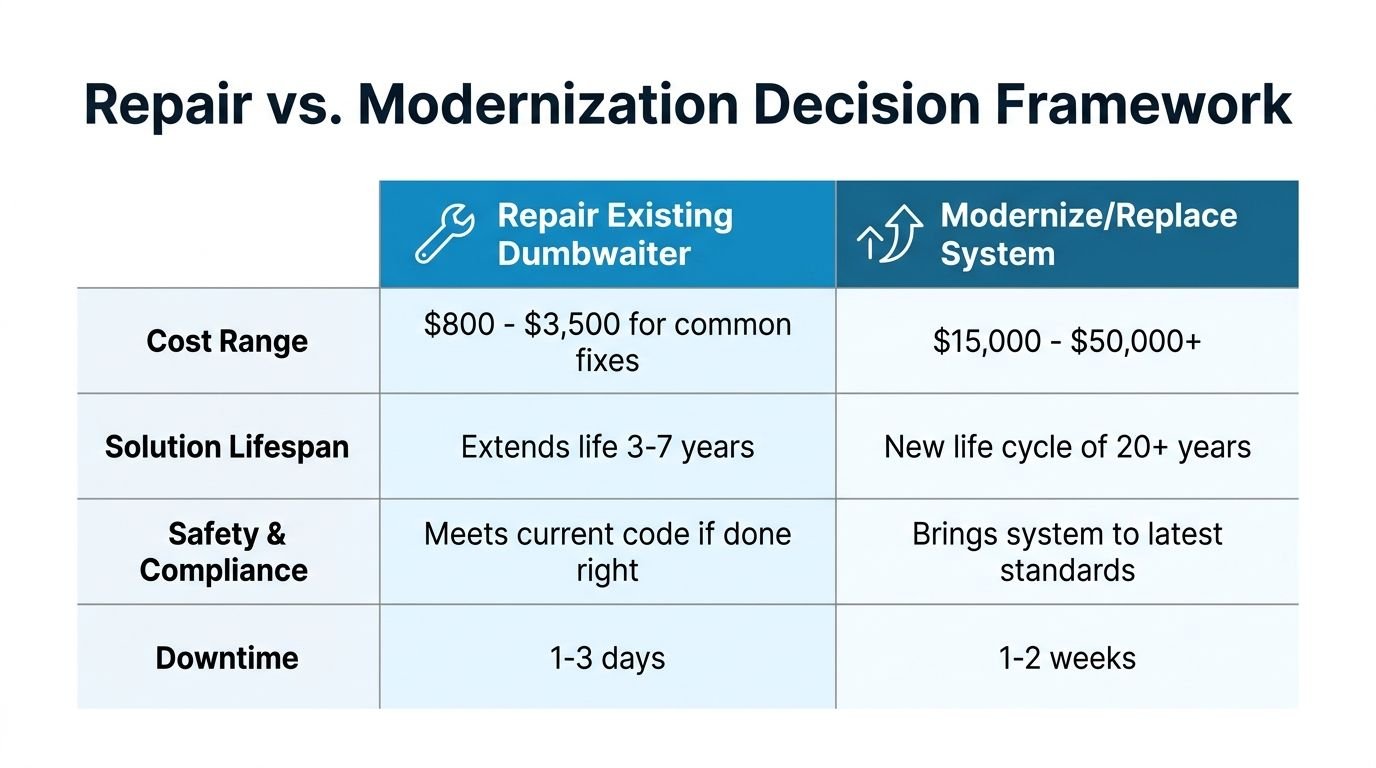
A repair makes sense when the equipment has a sound structure, available compliant parts, a manageable fault, and a maintenance history that supports continued service. Modernization becomes more persuasive when failures repeat, parts are obsolete, the controller can't support required safety functions, or the existing arrangement creates recurring inspection problems.
The most useful comparison isn't a single invoice. It's the relationship between the immediate repair, the likelihood of another outage, the cost of emergency access, and the operational impact of taking the unit down again. A door adjustment and interlock replacement may restore a healthy system. The same repair on a unit with deteriorated wiring, worn hoistway components, and an obsolete controller may only postpone a larger project.
What pushes a project toward modernization
Start with the equipment condition, not the age alone. A well-maintained older dumbwaiter can be a better repair candidate than a newer unit that has suffered water intrusion, structural movement, or repeated unsafe modifications. Ask whether replacement parts are available, whether the control system can be tested reliably, and whether the doors, guide system, ropes or chains, and safety devices remain serviceable.
Operational changes also matter. A facility may need more dependable service, different landing arrangements, improved controls, or a system compatible with current electrical infrastructure. Modernization can address several related problems at once, but it also introduces design, permitting, construction, testing, and downtime requirements.
The real project drivers
Travel height, access to the shaft, machine-room conditions, electrical upgrades, structural modifications, fire-rated construction, and site protection can change the scope substantially. A quote that lists only equipment and installation may not include demolition, patching, wiring, permits, inspections, or corrections discovered during opening-up work.
For commercial properties, financing can make a modernization project easier to schedule, but financing terms vary by project and provider. Owners should request an itemized scope that separates equipment, labor, controls, electrical work, structural work, testing, and closeout documentation. Compare that proposal with the cost and risk of continuing reactive service.
Decision test: If the next repair fixes one symptom but leaves the same obsolete controller, unsafe access condition, or recurring inspection defect in place, it isn't a complete solution.
Non-proprietary modernization is often valuable because it avoids creating a system that only one provider can service. The final design still must meet the applicable code and manufacturer requirements, and a contractor should explain what remains reusable, what must be replaced, and how the completed system will be tested.
The Case for Proactive Maintenance
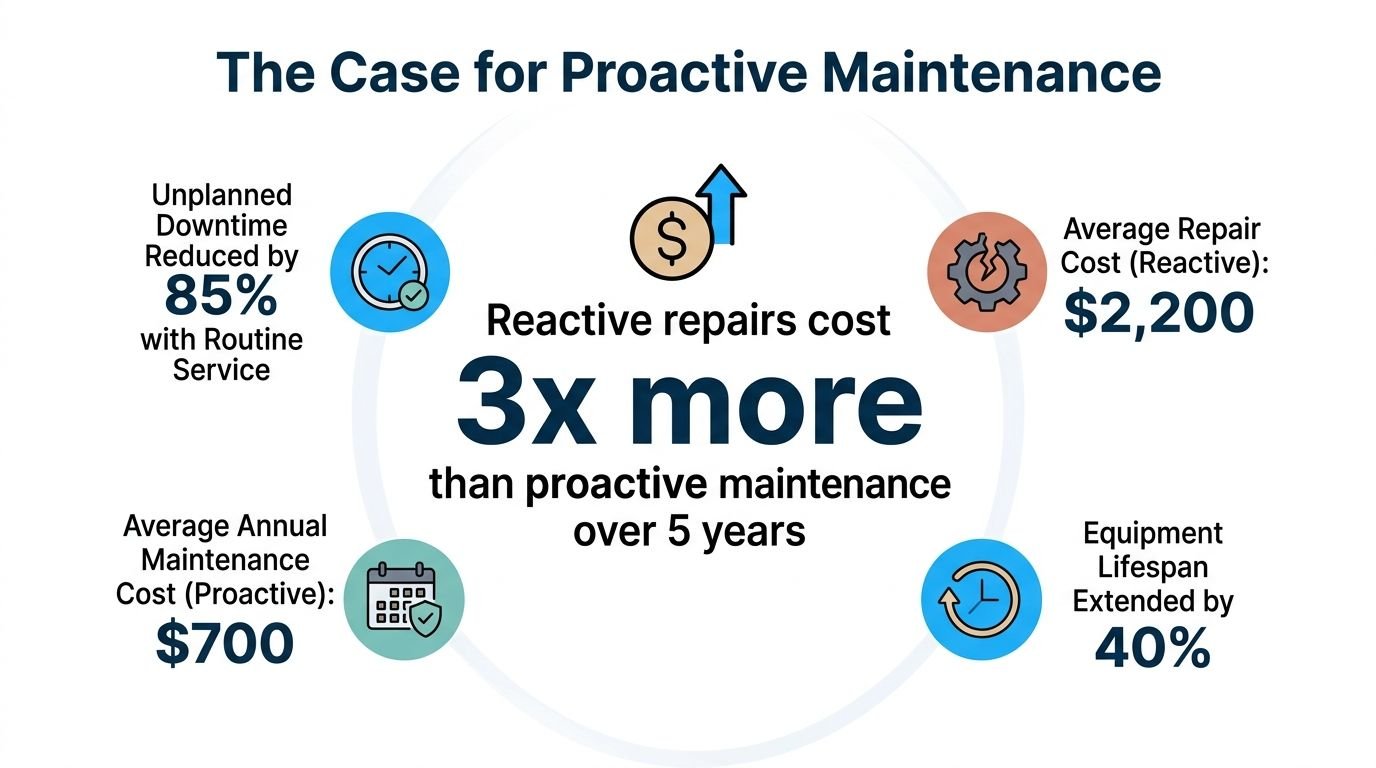
Reactive repair is expensive in ways that don't appear on the parts invoice. A restaurant loses service capacity, a healthcare facility reroutes supplies, and a school or municipal building may have to create a manual transport workaround. The disruption can also occur at the worst time, when staff are already responding to a separate operational problem.
A sound maintenance program looks for small changes before they become safety-related failures. The technician monitors door locks, checks travel and leveling, tests safety devices, lubricates and adjusts the equipment where appropriate, cleans contamination from working areas, and records conditions that need follow-up. That record gives the owner a clearer basis for repair planning and inspection preparation.
What effective service includes
A meaningful visit isn't just a quick visual check. It should address the components that determine whether the dumbwaiter operates predictably and whether its protective circuits remain effective.
- Door and lock monitoring: Check door alignment, lock engagement, contacts, closing action, and evidence of tampering or wear.
- Safety-device testing: Verify emergency stops, limits, interlocks, and other protective functions according to the equipment and applicable code.
- Mechanical care: Inspect guide shoes, rails, pulleys, ropes or chains, fasteners, bearings, and lubrication points.
- Control review: Look for loose connections, damaged wiring, failing relays, error conditions, and signs of heat or contamination.
- Housekeeping and records: Clean relevant areas, identify leaks or debris, document findings, and separate immediate corrections from planned work.
The owner should receive more than a generic “serviced” notation. Good documentation identifies what the technician inspected, what was adjusted, what remains defective, and whether the equipment was returned to service or left secured.
Maintenance needs a clear service standard
A program also needs accountability. The provider should arrive prepared, follow the agreed scope, and communicate when the unit's condition changes. Crane Elevator Company's published maintenance approach includes a No Show, No Pay policy, full clean-downs of machine rooms, pits, and car tops, and COP/PI bulb replacements. Those details matter because neglected housekeeping and small electrical or lighting problems can obscure developing equipment issues.
The practical goal is not to eliminate every repair. No maintenance program can do that. The goal is to catch predictable wear, preserve safety functions, reduce emergency decisions, and give the owner enough information to plan a repair or modernization before the failure disrupts the building. Facility managers can review the scope of dumbwaiter maintenance service against those standards when comparing proposals.
Planning Your Next Steps
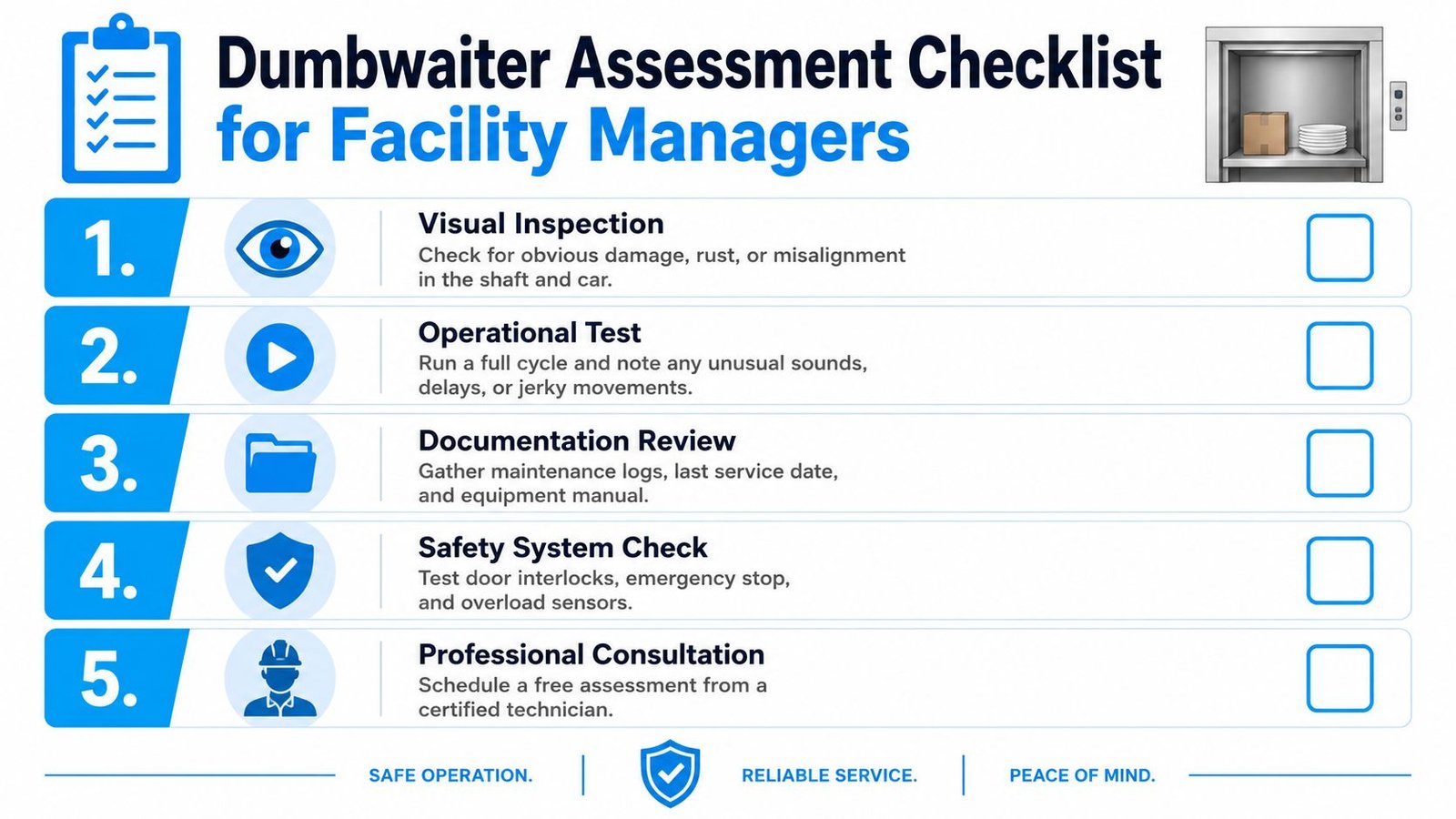
Start with a controlled assessment, not a reset button. Keep the dumbwaiter out of service if a door, safety device, rope, chain, limit, control circuit, or access condition appears unsafe. Then assemble the records a contractor needs to make a useful recommendation.
Prepare before requesting a proposal
Give the contractor the building address, equipment location, manufacturer and model if known, number of landings, last inspection date, current violation notices, recent symptoms, and photographs of accessible areas. Include maintenance logs and any record of water intrusion, construction, electrical changes, or previous attempts to correct the failure.
Ask each bidder to separate immediate safety corrections, recommended repairs, code or inspection work, and longer-term modernization options. A second opinion is worthwhile when the recommendation is a full replacement, when the unit has a disputed classification, or when two contractors propose very different scopes. Competitive quotes are useful only when the scopes are comparable.
Use this field checklist
- Secure the equipment: Post the out-of-service condition and prevent unauthorized use.
- Record the symptom: Note the floor, sound, door behavior, leveling, error indication, and time of failure.
- Review compliance records: Locate inspection certificates, violations, test reports, and maintenance entries.
- Ask about return-to-service testing: Confirm which repairs require functional tests, inspector involvement, or reinspection.
- Compare the whole scope: Check labor, parts, access, electrical work, permits, testing, documentation, and cleanup.
- Plan the next decision: Decide whether the evidence supports a repair, a monitored maintenance plan, or modernization.
Crane Elevator Company provides maintenance, repair, modernization, code-required inspections, testing, and non-proprietary solutions for vertical transportation equipment in Michigan and Ohio. Service coverage includes Detroit, Toledo, Ann Arbor, Lansing, Perrysburg, Flint, Kalamazoo, and surrounding communities, with free second opinions, competitive quotes, a price-beat guarantee, and commercial financing options for qualifying modernization projects.
If your dumbwaiter is stuck, unreliable, or showing a safety-related fault, contact Crane Elevator Company for a professional assessment, repair plan, or modernization evaluation. Our team serves Michigan and Ohio, including Toledo and surrounding cities, and can help you return the equipment to compliant, dependable service.