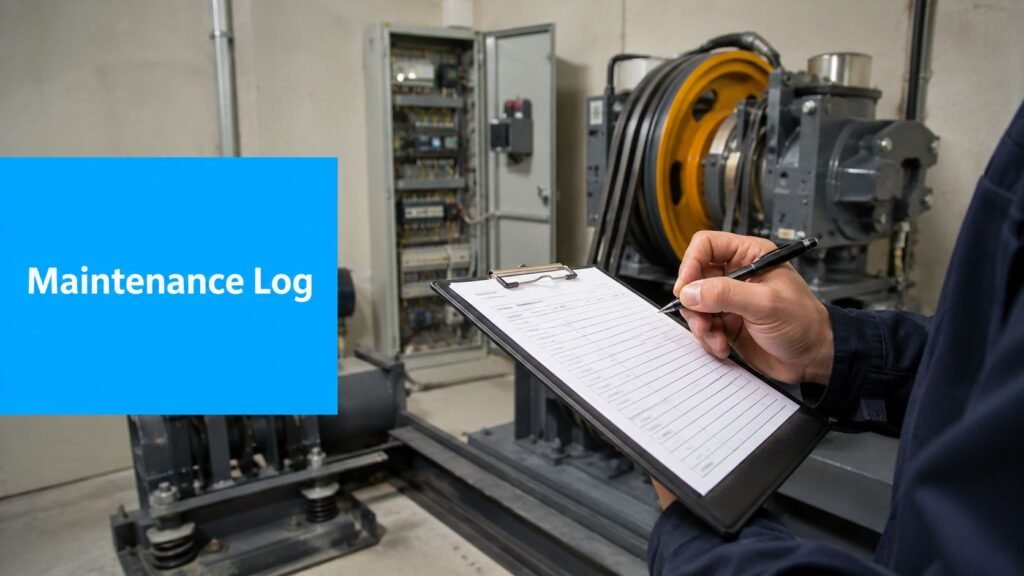
The elevator is running, but the inspection is approaching and nobody can immediately produce the service history. A technician remembers correcting a door problem. The building team remembers a callback. The inspector needs more than memory. They need records showing what was reported, when it happened, what work was completed, and whether required testing was performed.
That gap between a maintenance visit and inspection readiness creates avoidable exposure for facility managers. A sound elevator maintenance Ohio program must protect passengers, preserve equipment, and create a reliable compliance trail. Ohio's rules require recurring inspections, periodic safety tests, and on-site maintenance records, so a service binder or digital log should be treated as part of the elevator system itself.
What Ohio Inspectors Actually Look For in Maintenance Records
An Ohio inspector may begin with a simple request: “Show me the maintenance records.” A log that contains only technician initials and a checkmark won't answer the questions that follow. Ohio rules require on-site records covering maintenance, repair, cleaning, lubrication, replacement, and callback corrections, along with the trouble description, dates, times, and corrective actions taken. Those requirements are described by the Ohio Department of Commerce Elevator Section.
The practical standard is traceability. An entry should allow another person to understand the equipment's condition without calling the technician who performed the work.
What belongs in every entry
A useful record identifies the elevator and captures the service event in enough detail to connect the reported condition with the completed correction. At minimum, include:
- Equipment identification: Record the elevator number, location, type, and any identifying information used by the property.
- Service date and time: Note when the technician arrived, when work occurred, and when the equipment was returned to service.
- Trouble description: Describe the actual condition, not "checked elevator." For example, identify a door-reopening complaint, an oil leak, an emergency phone issue, or a failed light.
- Corrective action: State what the technician adjusted, cleaned, lubricated, repaired, replaced, tested, or left for follow-up.
- Callback documentation: Record the complaint, response, diagnosis, and final operating status, even when no part was replaced.
- Outstanding work: Identify unsafe conditions, parts on order, access limitations, or items requiring a return visit.
A record that says “routine PM complete” may reflect real work, but it doesn't demonstrate that the required work occurred. A stronger entry explains the tasks performed and documents the condition left behind.
Housekeeping is part of compliance
Ohio administrative rules require hoistways and pits to remain clean and free of rubbish. Pits can't accumulate water, machine room floors must be free of oil or grease, and nonessential materials can't be stored in machine rooms. Lighting and communication systems in machine rooms, pits, and on car tops must remain operational. The Ohio housekeeping and equipment requirements make these conditions part of the maintenance responsibility, not optional cleanup.
Every visit should therefore end with a documented housekeeping check. Record whether the pit was dry, whether floors were free of oil, whether the machine room was clear, and whether car-top lighting and communication equipment worked. Hydraulic equipment also requires attention to packing and leakage control, so the log should identify any fluid condition observed and the action taken.
Practical rule: If a technician checked it, cleaned it, tested it, or found a problem with it, the log should say so.
A well-maintained elevator can still create an inspection problem if the records are vague or missing. Building managers can use a structured passenger elevator maintenance program as a model for connecting field work with inspection readiness. The record is not paperwork after the job. It is evidence that the job was controlled.
Ohio Inspection and Testing Frequencies Explained
Ohio's compliance calendar has separate tracks for inspection, certificate status, and periodic safety testing. Facility managers who combine them into one recurring service date often discover the gap when an inspection is due or a five-year test is overdue.
For most elevators serving commercial and public settings, Ohio requires inspection twice every 12 months. Power dumb-waiters, hoists, and similar permanently installed lifting devices require inspection at least once every 12 months, while private residences are exempt from this stated frequency rule. The inspection schedule is established in Ohio Revised Code Section 4105.10.
Ohio's Elevator Section handles new acceptance and alteration inspections, then conducts recurring inspections on most elevators and other vertical public transportation devices. Cincinnati and Cleveland run their own inspection programs, so facilities in those cities must verify the local process instead of applying the state workflow automatically. Ohio issues over 32,000 certificates of operation, according to the state elevator program. That volume makes advance scheduling and controlled records practical requirements, not administrative preferences. Building owners can review Ohio elevator services when coordinating service, testing, and inspection preparation.
Keep the calendar in two columns
The first column tracks inspections and certificate activity. The second tracks safety tests, including the required full-load cycle. Keep both columns visible to the person responsible for the building, because a current inspection date does not prove that the next safety test is complete.
| Equipment Type | Inspection Frequency | Safety Test Requirement | Certificate Renewal |
|---|---|---|---|
| Passenger and freight elevators in commercial or public settings | Twice every 12 months | Periodic testing under ASME A17.1 and A17.2, including at least one full-load safety test every five years | Maintain a valid certificate of operation before the elevator runs |
| Power dumb-waiters, hoists, and similar permanently installed lifting devices | At least once every 12 months | Apply the periodic testing requirements that govern the equipment | Track the applicable operating authorization |
| Private-residence elevators | Exempt from the stated commercial and public inspection frequency rule | Confirm equipment-specific obligations with the applicable authority | Confirm the applicable residential requirements |
Ohio Administrative Code requires periodic safety tests under ASME A17.1 and A17.2, including at least one full-load safety test every five years, as specified in Rule 1301:3-6-04. A routine maintenance visit does not satisfy that load-based performance test. The log should show the test date, result, deficiencies, corrective work, and next due date.
Only certified inspectors may perform elevator inspections in Ohio. Maintenance personnel may perform service and testing within their authorization, while the official inspection and compliance sign-off must follow Ohio's credentialing rules. Ohio also established licensing requirements for elevator contractors and mechanics in 2024, with licensing required by Nov. 1, 2025, according to Ohio's elevator licensing information. Record who performed each task and who held responsibility for the official inspection.
A current valid certificate is required before an elevator can legally operate. Ohio also charges fees for attempted inspections that cannot be completed, so unavailable keys, unsafe access, building conditions, or missing records can create consequences before a technical deficiency is reviewed. Keep inspection dates, test due dates, certificate status, open corrections, and assigned parties in one calendar. Properties in Toledo and nearby communities should distinguish state requirements from any local authority process that applies to the building.
Building a Compliant Maintenance Log Structure
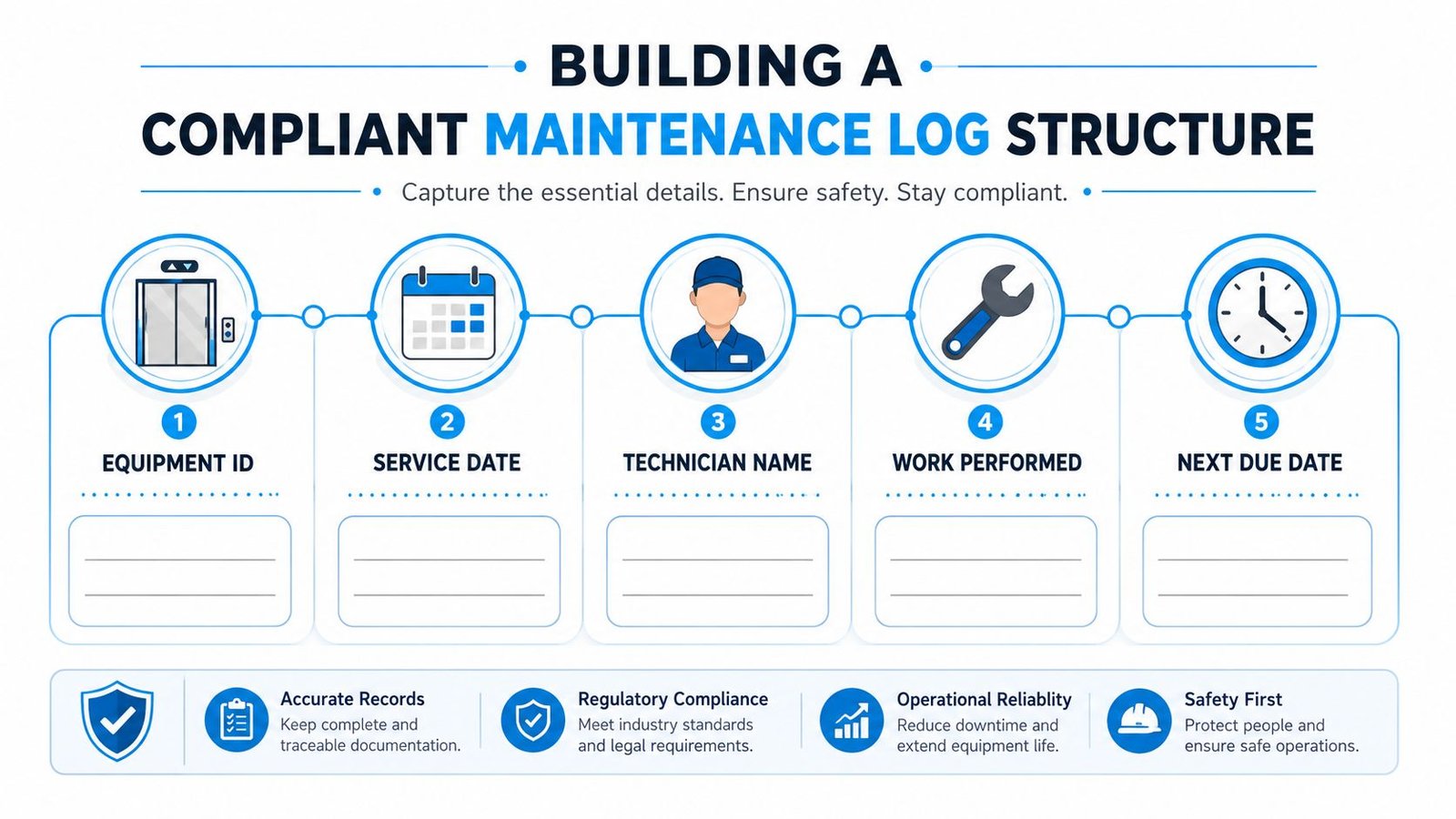
A maintenance log should function as both a legal record and a troubleshooting history. The best structure is simple enough for a technician to use during a busy service call, yet detailed enough for a facility manager to retrieve the facts during an inspection or incident review.
Start with equipment identity
Give every unit a permanent record. Use the building address, elevator designation, equipment type, manufacturer, and any state or property identification number available to the team. If a building has multiple cars, “elevator serviced” is not enough. The entry must establish which unit received the work.
The next fields establish when and by whom the work occurred:
- Date and time: Capture the service date and the relevant arrival or completion time.
- Technician identity: Record the technician's name and applicable credential or license information.
- Service category: Mark the visit as preventive maintenance, callback, repair, safety test, inspection correction, or modernization.
- Operating status: State whether the unit was returned to normal operation, placed out of service, or left with a documented restriction.
Describe the condition and the correction
A compliant entry needs two connected statements. The first describes the problem or observed condition. The second describes the action taken.
For a door issue, the entry might identify door lock monitoring work, adjustments, cleaning, testing, and the final result. For hydraulic equipment, record packing condition, leakage observations, and any repair or follow-up. For an emergency phone, state that communication was tested and whether the system passed or required correction. These examples aren't substitutes for the applicable code process, but they show the level of specificity that makes a record useful.
Record parts replaced, measurements or test results required by the service procedure, and any materials left for a later visit. If a correction couldn't be completed, explain why. “Needs part” leaves too many unanswered questions. Identify the part, the reason it was needed, the temporary operating decision, and the next action.
Close the visit with a verification block
The final portion of the entry should confirm the condition of the work area and the equipment:
- Pit and hoistway: Document cleanliness, water condition, rubbish removal, and visible concerns.
- Machine room: Confirm access, floor condition, oil or grease control, and removal of nonessential storage.
- Car top: Record lighting, communication, cleanliness, and observed equipment conditions.
- Safety functions: Note emergency signals, communication systems, door-locking devices, and required test activity.
- Follow-up: Assign the next action, responsible person, and due date.
Field standard: Never document only the task. Document the condition found, the action taken, and the condition left behind.
A signature or authenticated technician entry closes the chain of responsibility. Facility staff should review callback entries and open work before the next inspection cycle, not wait until an inspector identifies the gap.
Paper Versus Digital Logging Systems
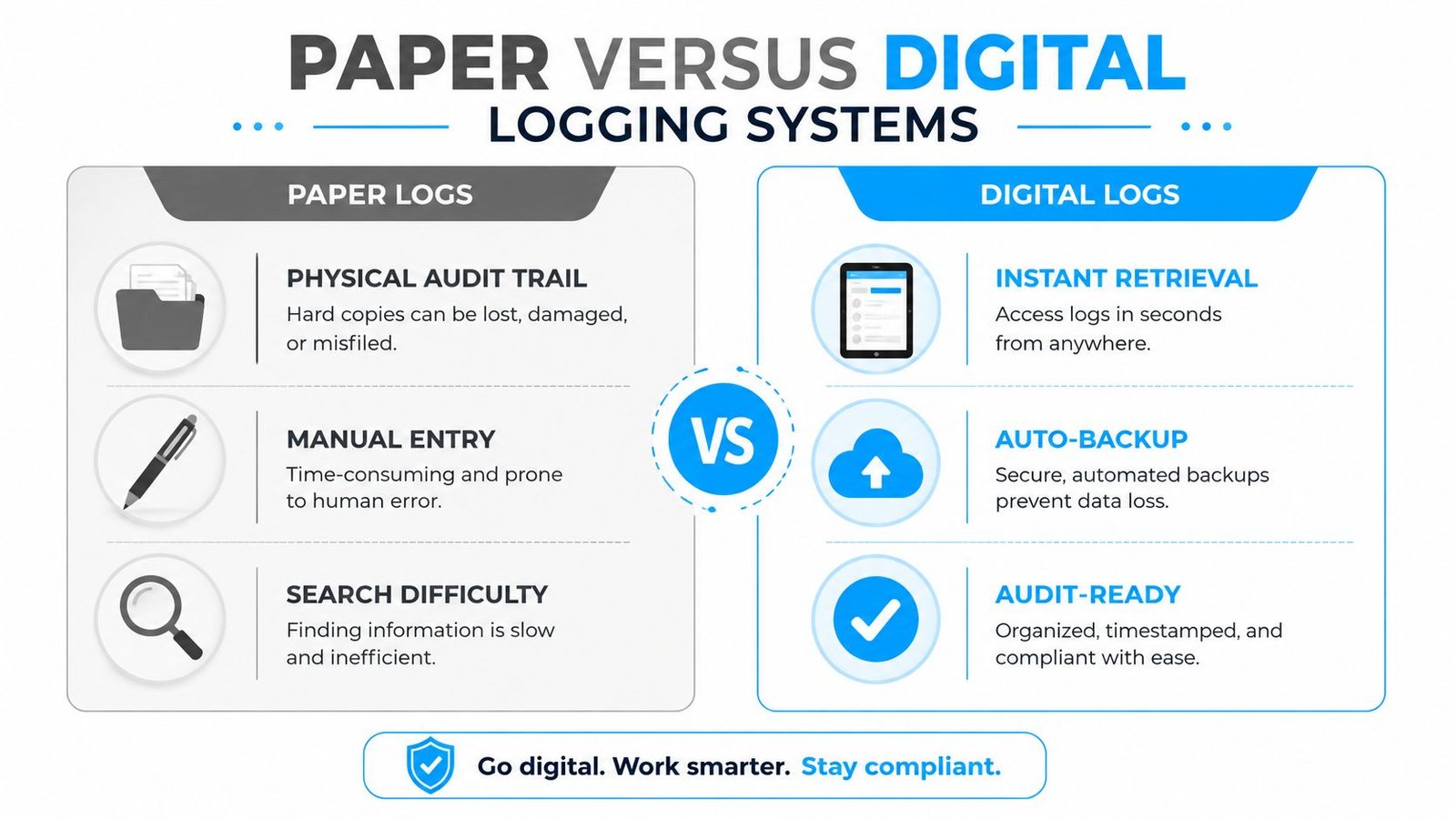
Paper and digital logs can both support a compliant program. The better choice depends on the building's staffing, equipment count, inspection exposure, and ability to control records.
A paper binder works when one small property has a single elevator, a consistent service provider, and a secure location near the equipment. Its advantages are obvious. An inspector can hold the record, technicians can write directly into it, and the building doesn't depend on a device or network connection during the visit.
The weaknesses appear as activity increases. Handwriting may be difficult to read, older entries take time to locate, and a misplaced binder can remove the property's entire maintenance history from immediate reach. Paper also makes it harder to compare recurring callbacks, identify unresolved conditions, or coordinate records across several buildings.
Choose the system that matches the risk
| Need | Paper Log | Digital Log |
|---|---|---|
| On-site inspector access | Strong when stored at the elevator or office | Strong when the platform supports on-site access |
| Search during an incident | Slow, especially across old binders | Fast when entries are indexed and organized |
| Backup | Requires copying or scanning | Can support controlled backups and permissions |
| Multiple properties | Difficult to standardize | Easier to manage across Toledo, Ann Arbor, Lansing, and other locations |
| Modernization planning | Requires manual review | Makes recurring repairs and open work easier to identify |
A digital platform becomes more useful when a portfolio includes commercial, healthcare, education, industrial, or municipal buildings. Managers can search by equipment, date, issue, or service type and attach inspection reports, photographs, test records, and invoices. That improves retrieval, but only if technicians enter complete information. Digital systems don't correct vague entries. They preserve vague entries more efficiently.
Ohio requires maintenance records to be available on-site, so cloud storage alone isn't enough if the inspector can't access the records at the property. A practical hybrid approach keeps an accessible on-site record while scanning legacy binders and maintaining a controlled digital copy. Set permissions so technicians can enter work, managers can review it, and the organization can preserve records when personnel change.
Paper remains workable for a simple property. Digital logging earns its place when the cost of searching, losing, or separating records exceeds the effort of maintaining the platform.
Common Documentation Mistakes That Fail Inspections
The most damaging recordkeeping failures are usually ordinary. A technician may have performed competent work, but the entry doesn't show it. Inspectors and investigators evaluate the evidence available to them, not the work someone remembers completing.
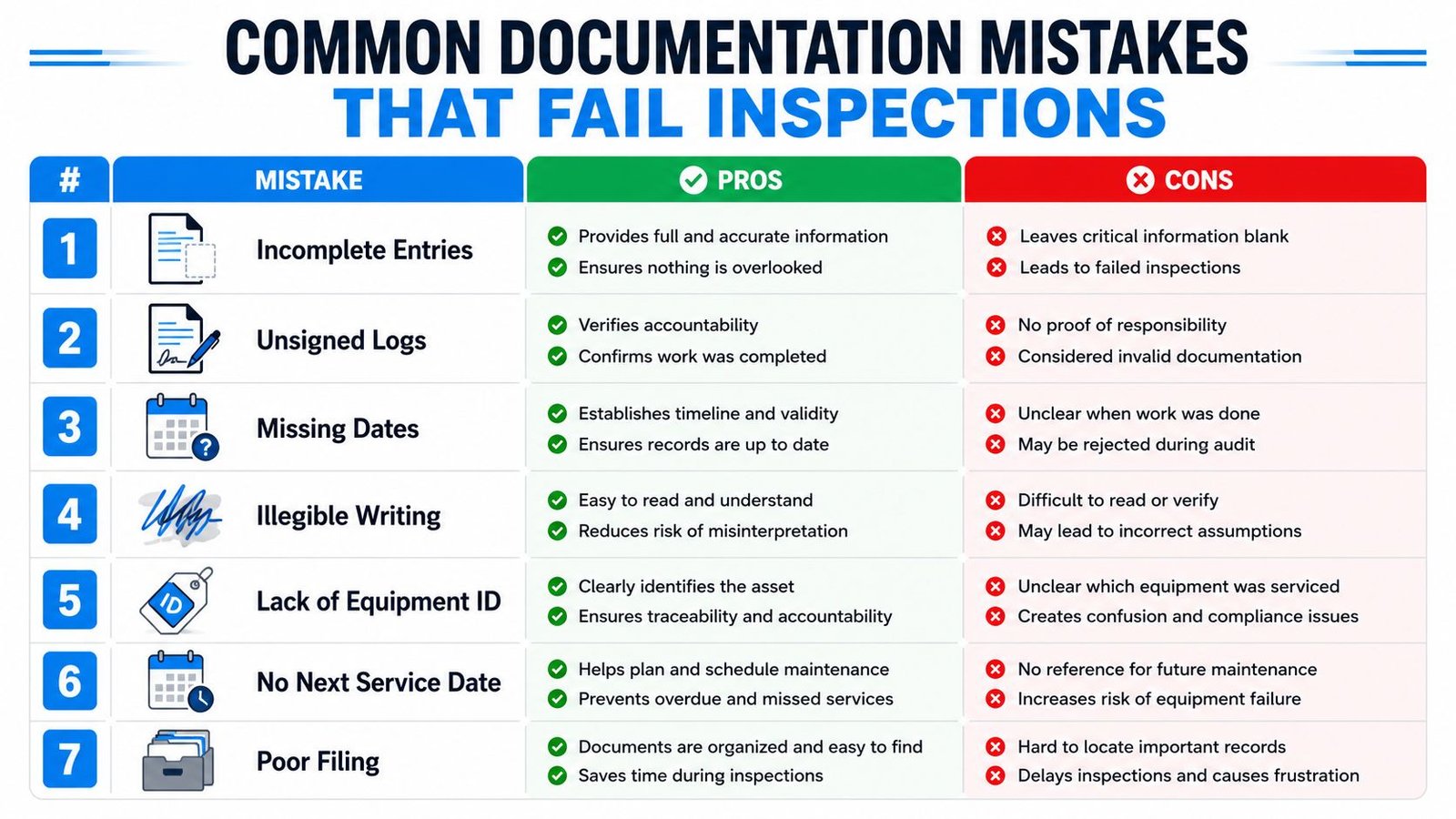
Seven gaps that create trouble
- Incomplete callback entries: “Reset elevator” doesn't explain the complaint, diagnosis, corrective action, or operating result. Write the trouble and the resolution.
- Missing housekeeping verification: A clean pit or machine room may still be undocumented. Add a closing check for water, rubbish, oil, grease, lighting, and communication equipment.
- Vague trouble descriptions: “Door issue” isn't enough. Identify the observed behavior and the component or condition investigated.
- Unsigned or unauthenticated entries: A record without a responsible technician is difficult to verify. Include the technician's name and required credential information.
- Gaps in service dates: A blank period raises questions about whether service was missed or not recorded. Reconcile calendar entries, invoices, callbacks, and technician reports.
- No safety test result: “Tested” doesn't identify what was tested or what happened. Record the applicable test, result, deficiencies, and corrective action.
- Weak modernization records: Replacing a controller, motor, machine, door equipment, or other major component without preserving the scope, parts, tests, and closeout documents leaves the future maintenance team without a baseline.
A common assumption is that a failed inspection is caused only by a defective component. In practice, an inspector may also be unable to complete the inspection because the equipment isn't accessible, the area is unsafe, required records are unavailable, or the responsible people aren't prepared. Ohio's law addresses fees for attempted inspections that can't be completed, which makes access and preparation part of the compliance process.
Fix the record before the next visit
Use a supervisor review for every callback and every safety-related entry. The reviewer should ask whether a person unfamiliar with the event could identify the equipment, understand the problem, confirm the action, and determine whether anything remains open.
For healthcare and industrial properties, connect the elevator log with the facility's work-order system, but don't let a generic work-order number replace the elevator record. Residential managers and HOAs should keep a clear unit history even when the equipment has fewer service events. During an incident investigation, missing documentation can make it harder to demonstrate maintenance control, even where the equipment was serviced.
A complete record doesn't guarantee a clean inspection, but an incomplete record makes a defensible inspection process much harder.
Using Maintenance Logs for Audit Preparation and Modernization Planning
A unit can pass every service visit and still arrive at inspection day with an incomplete record. Build the audit package while work is happening, so the facility manager can verify readiness without reconstructing months of emails, invoices, and technician notes.
Prepare an inspection package
Organize these materials by equipment identification:
- Current certificate information and inspection reports.
- Maintenance, callback, and repair entries.
- Safety test records, including full-load test documentation.
- Open violation corrections and completion evidence.
- Modernization scopes, equipment lists, drawings, permits, and closeout records.
- Photographs and supporting documents for conditions requiring follow-up.
Use consistent file names, retain backups, and record the responsible technician or contractor for each entry. For a property sale, insurance renewal, financing discussion, or ownership transition, this package demonstrates control of the equipment history and reduces the chance that an unresolved item is overlooked.
Turn recurring repairs into planning evidence
A thorough maintenance history reveals recurring door problems, hydraulic leakage, communication failures, lighting issues, repeat callbacks, and unresolved code-related work. Those patterns support a practical choice between another repair, a broader modernization, or an independent technical opinion.
Repeated repairs do not by themselves establish that modernization is required. They give owners a factual basis for comparing repair costs, downtime risk, parts availability, code requirements, and the building's operational needs. Any proposal should connect the documented condition to a defined scope, equipment list, schedule, and closeout process rather than relying on a generic recommendation.
Ohio and Michigan owners also need to separate inspection readiness from long-term planning. A log should show when a problem was found, what action was taken, whether testing followed, and who closed the item. That sequence helps establish reasonable maintenance control if an incident, insurance review, or compliance dispute occurs.
Michigan properties require an additional standards review. Michigan's Elevator Section enforces the Michigan Elevator Code through inspections of installations, alterations, and annual safety inspections. A Michigan LARA communication states that updated standards began taking effect in stages on January 1, 2025, with the final phase taking effect on January 1, 2028, according to that guidance. Owners should identify affected work before an inspection exposes a gap.
For Ohio and Michigan owners, modernizing elevator systems should begin with service records, a condition review, and code coordination. The log gives contractors a reliable starting point and gives owners a stronger basis for scheduling, budgeting, and comparing proposals.
Crane Elevator Company provides preventative maintenance, repairs, safety testing, violation corrections, and full Non-Proprietary modernization services for elevators, wheelchair lifts, material lifts, and dumbwaiters across Michigan and Ohio, including Toledo and surrounding cities. Visit Crane Elevator Company to request service, a free second opinion, or a competitive modernization quote.