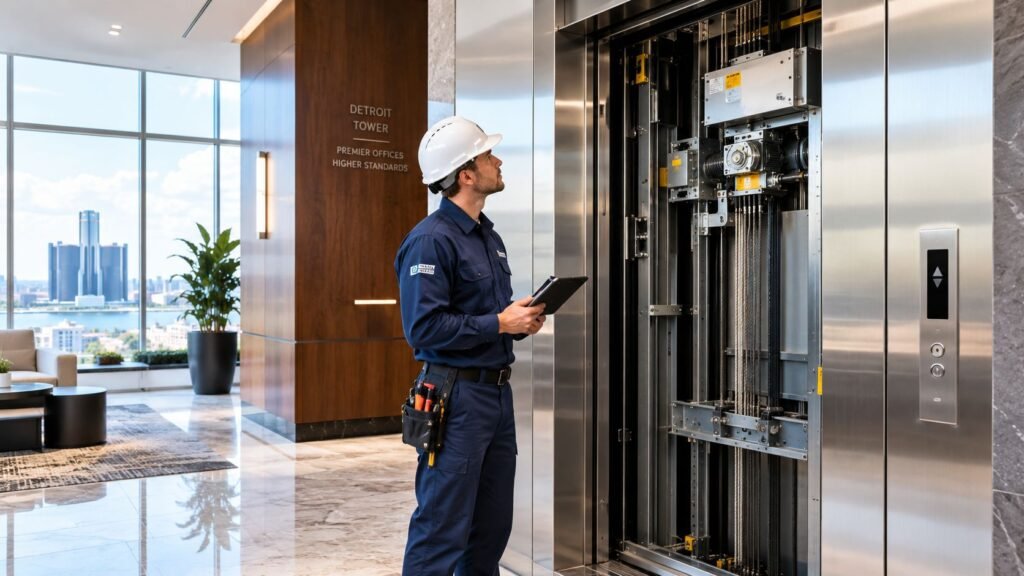
The elevator is down just before the morning rush. Tenants are waiting in the lobby, a delivery crew is holding freight on the loading dock, and the next compliance inspection is already on the calendar. For a building manager, that combination turns a mechanical problem into an access problem, an operations problem, and potentially a legal problem.
Commercial elevator service is the ongoing system that keeps equipment safe, available, documented, and ready for inspection. It includes preventive maintenance, repairs, testing, emergency response, and long-term modernization. A Michigan facility manager also has to think about geography, equipment age, state requirements, and whether the service provider can work on the installed equipment without locking the building into one manufacturer's service channel.
Crane Elevator Company provides one Michigan-focused example of that approach. The practical questions remain the same for any provider: What does the contract cover? Are inspections and filings managed properly? Can technicians service different makes and models? Does the maintenance plan address repeat faults instead of just recording another visit?
Introduction Why Reliable Elevator Service Matters
A commercial elevator rarely fails at a convenient time. In a healthcare building, a shutdown can complicate patient and equipment movement. In an office tower, people may queue in the lobby while staff members answer the same question repeatedly. In a municipal or education building, accessibility and scheduled operations can be affected immediately.
The first response should always be safety. Staff should secure the area, communicate that the elevator is out of service, and contact the service provider. They should also record warning signs, such as inconsistent leveling, unusual vibration, repeated door reopening, or intermittent service, because those details help a technician distinguish an isolated fault from a recurring pattern.
Service is more than a repair call
A repair restores operation after a problem appears. A complete service program also looks for the conditions that create the next problem. Technicians inspect door equipment, safety circuits, controls, machine-room conditions, pits, car tops, emergency communication, and other components that work together during every trip.
The installed base makes this work continuous. One industry fact sheet reports that the United States had more than 1.03 million elevators, up from about 900,000 in 2007, while 590,000 elevators were installed globally in 2016, including 40,000 in North America. The same source reports that California alone had over 145,000 elevators, which illustrates how much recurring maintenance, inspection, repair, and modernization work can concentrate in major markets. View the installed elevator base data.
Practical rule: Treat every elevator as a life-safety system with a service history, not as a machine that only needs attention after it stops.
What this guide helps you decide
The sections that follow explain what service includes, how schedules are layered, why inspection dates matter, and how modernization affects future reliability. They also compare proprietary and non-proprietary service, then apply those ideas to Michigan communities from Detroit to Grand Rapids.
The central lesson is simple. A reliable elevator depends on the quality of the maintenance plan, the accuracy of the records, the speed of the response, and the building owner's willingness to address aging or repeatedly failing equipment before a minor fault becomes a major outage.
Understanding What Commercial Elevator Service Includes
Start with the equipment. A traction elevator uses a motor, cables, and a counterweight, and it commonly serves taller or busier buildings. A hydraulic elevator uses a piston and fluid system and often appears in lower-rise commercial properties. Freight elevators move heavier loads, while passenger elevators are designed around people flow, comfort, and accessibility.
Residential elevators, wheelchair lifts, material lifts, and dumbwaiters are different systems, but they still require planned maintenance, safety checks, repairs, and records. The right provider should understand the application and the equipment, not just the brand name on the controller.
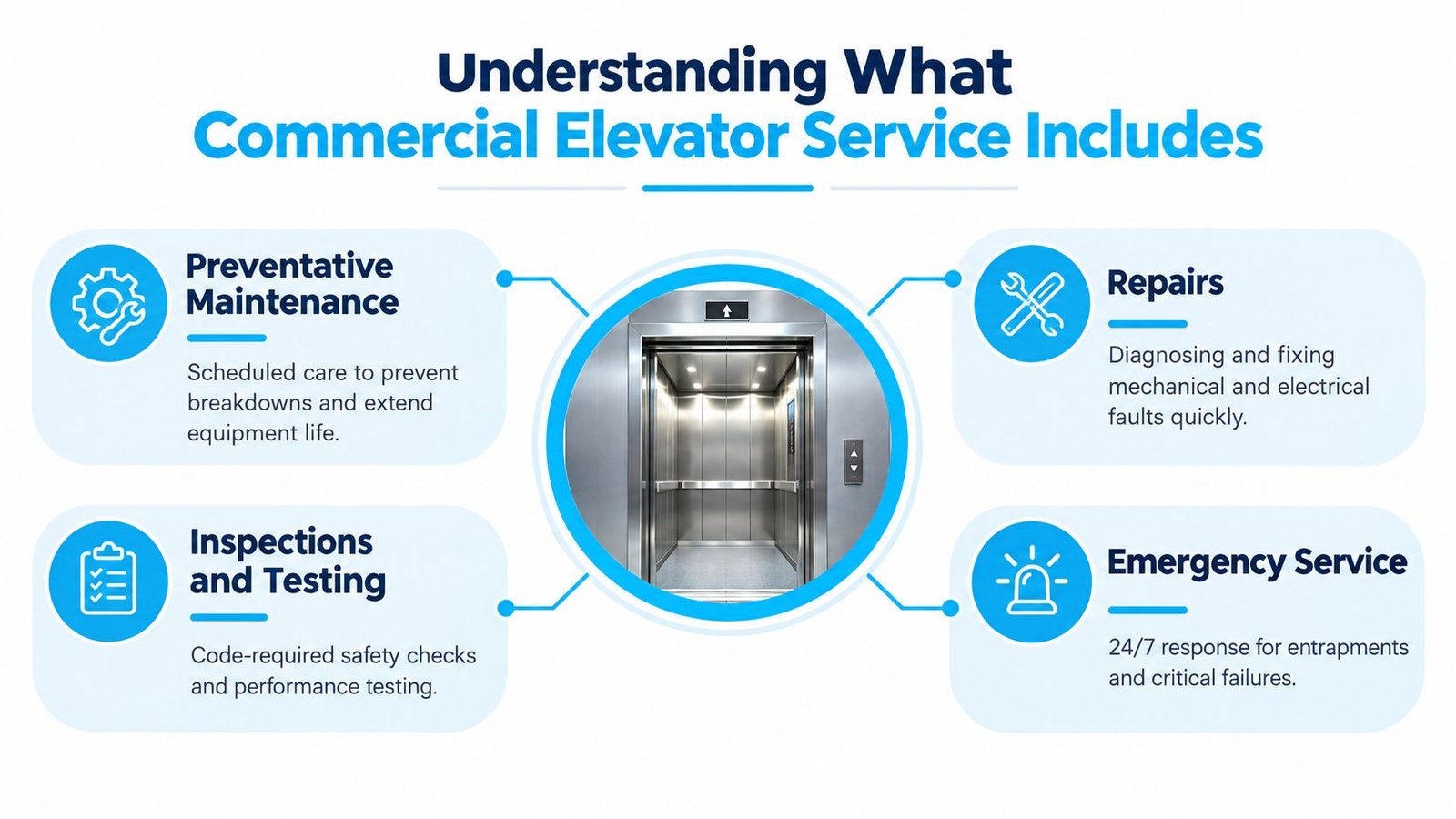
The four working parts of service
Preventive maintenance is the routine care that keeps small defects from becoming shutdowns. A technician may clean equipment, lubricate approved components, check door operation, review leveling, inspect safety circuits, and make adjustments. The purpose isn't to create paperwork. It's to catch wear while the correction is still manageable.
Repairs begin with diagnosis. A door operator, sensor, relay, controller, motor, cable, sheave, hydraulic component, or safety device may cause similar symptoms from the user's point of view. A qualified technician traces the fault, confirms the cause, replaces or adjusts the affected part, and verifies operation before returning the unit to service.
Inspections and testing confirm that safety devices and operating functions meet applicable requirements. They also create a documented record that facility managers may need for regulators, owners, tenants, insurers, and future service decisions.
Emergency response covers situations such as entrapments, critical failures, unsafe operation, and unexpected shutdowns. A strong plan tells building staff whom to call, what information to provide, how the area will be secured, and how the provider will communicate status updates.
Why non-proprietary capability matters
Think of service like automotive care. You don't want a mechanic who only knows one color or badge of vehicle. You want someone who can identify the system, use the correct procedure, and source appropriate parts. Non-proprietary elevator service follows the same principle. Any qualified provider should be able to evaluate and service the installed make or model rather than treating the manufacturer's service channel as the only path.
For a mixed Michigan portfolio, that flexibility can simplify scheduling and second opinions. It can also help a manager compare repair and modernization options based on the equipment's condition instead of accepting a single prescribed solution.
Maintenance Schedules Costs and What to Expect
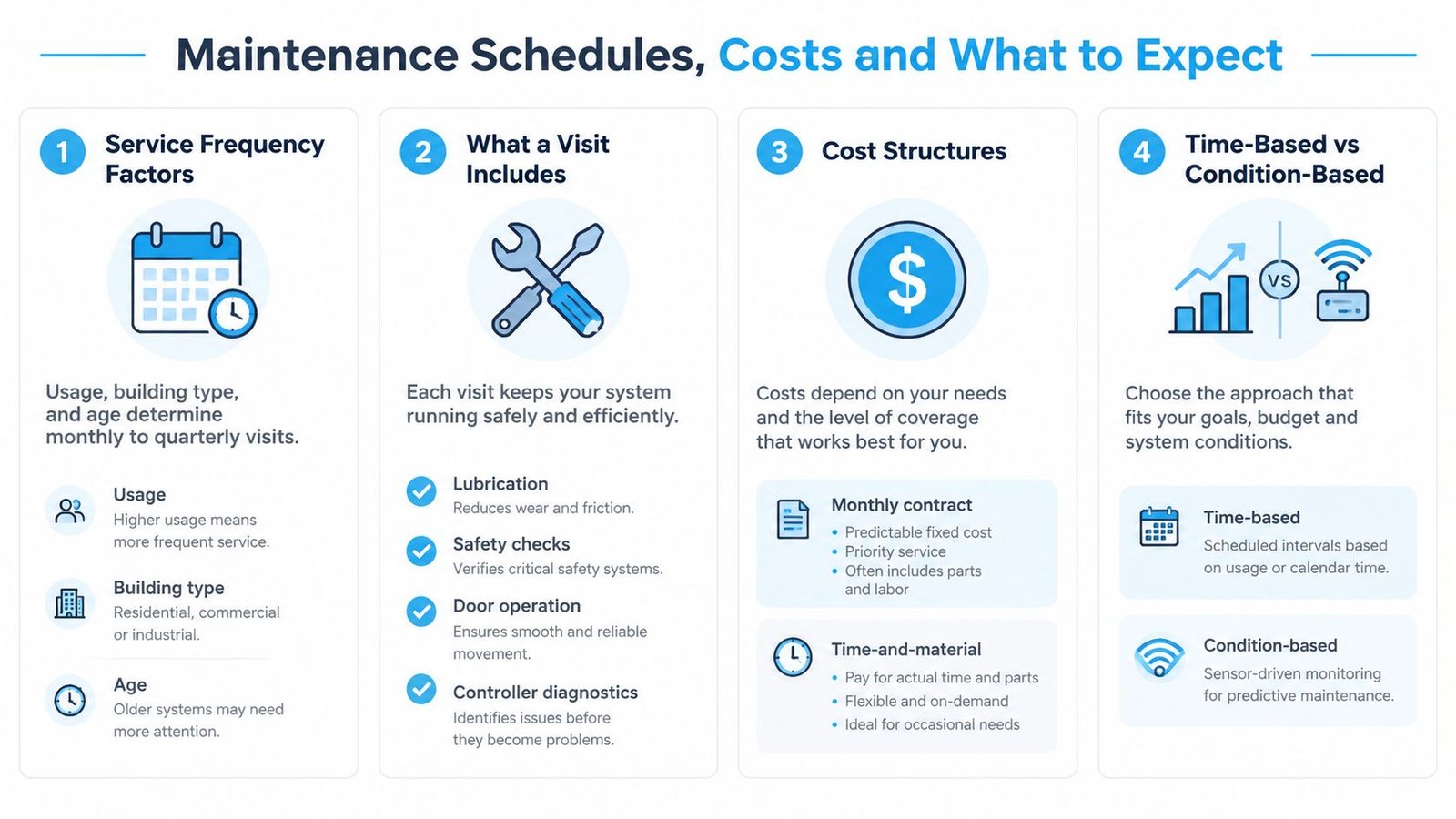
A useful schedule has layers. The technician's visit frequency should reflect the elevator's type, age, traffic, building use, environment, and service history. A lightly used office unit and a heavily used hospital or industrial elevator shouldn't receive identical attention just because they share a calendar month.
Monthly service commonly focuses on routine cleaning, lubrication where appropriate, door operation, leveling, visible wear, and basic safety observations. Quarterly attention may involve deeper adjustments, component review, controller diagnostics, and trend checks. Annual planning should coordinate maintenance records with inspections, testing, repairs, and the building's operating calendar.
What a productive visit looks like
A technician shouldn't sign in and leave a generic checklist behind. A thorough visit may include:
- Machine-room care: Remove accumulated dirt and inspect equipment access, lighting, ventilation, and visible conditions.
- Pit and car-top inspection: Look for housekeeping issues, leaks, unusual wear, and conditions that could affect safe service.
- Door review: Check tracks, rollers, sensors, operators, reopening behavior, and alignment.
- Operational checks: Observe starting, stopping, leveling, ride quality, and unusual sounds.
- Documentation: Record adjustments, deficiencies, parts recommended, callbacks, and unresolved issues.
Small details matter. Clean machine rooms and pits help technicians see developing problems. Car-top housekeeping improves working conditions. Replacing failed COP and PI bulbs helps preserve clear communication and status information. A service report should tell the manager what was checked, what changed, and what needs a decision.
Time-based versus condition-based care
Time-based maintenance schedules work from planned intervals. Condition-based maintenance uses observed equipment condition, service history, and, where suitable, sensor or remote-monitoring data to decide when attention is needed. Independent market research describes the industry as moving toward risk-based and condition-based programs that combine maintenance, inspection, repairs, replacement planning, emergency response, and modernization. It also identifies predictive and remote maintenance as fast-growing segments. Review the elevator maintenance services market discussion.
That doesn't mean every building needs a sensor on every component. A manager should first ask whether the team logs repeat faults, tracks outage patterns, identifies aging safety-critical parts, and reviews recommendations. If the answer is no, better records may provide more value than new technology.
Contract pricing can be monthly, time-and-material, or a hybrid. Compare included labor, parts, callbacks, testing, emergency hours, exclusions, travel, and documentation before comparing the headline price. Crane's commercial elevator maintenance cost guide can be used as one reference point when preparing those questions.
Safety Inspections and Regulatory Requirements Explained
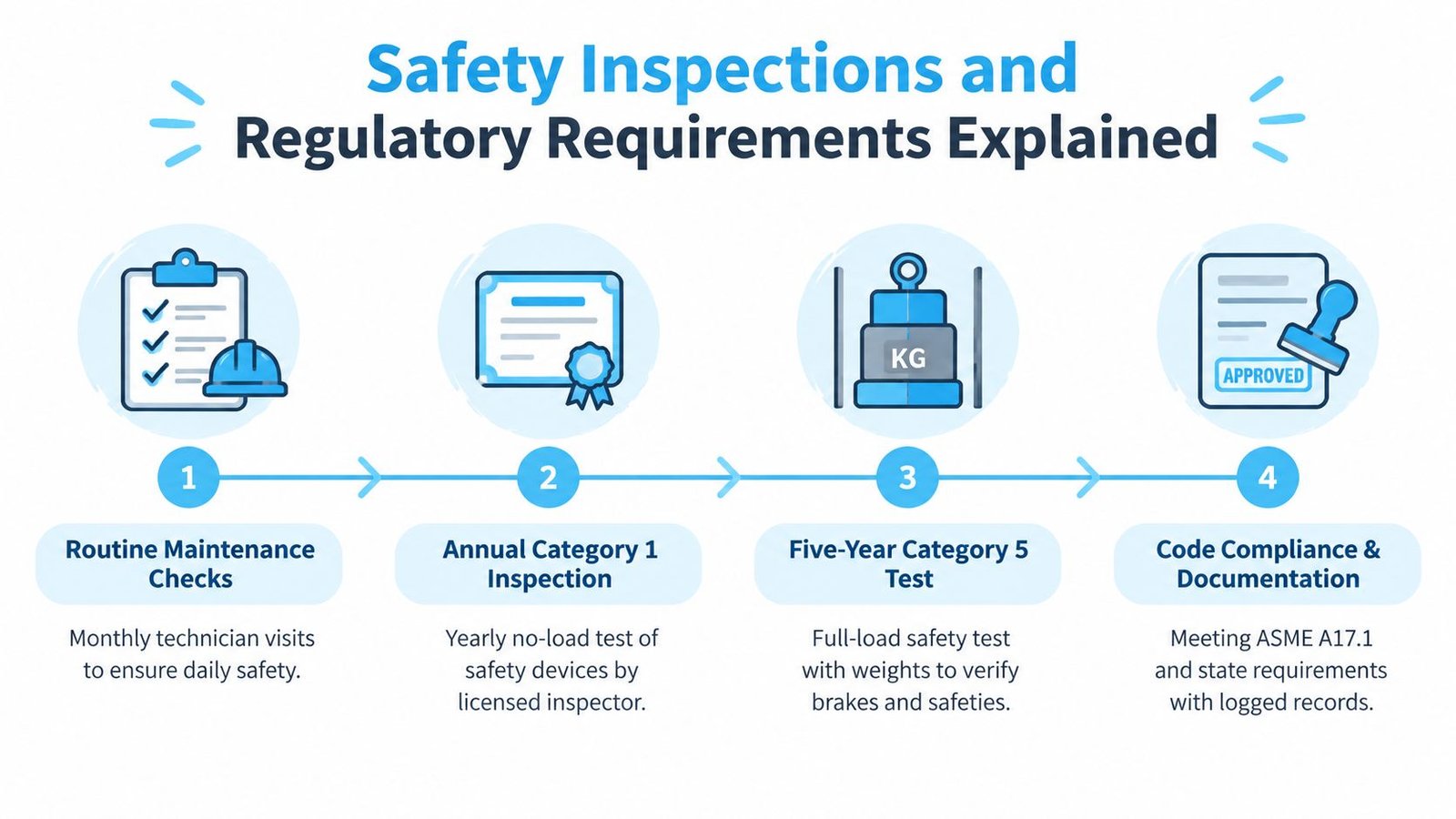
A commercial elevator can pass its routine service visit and still miss a required inspection. Treat compliance like a second maintenance track, with its own dates, records, responsible authority, and follow-up work. In the United States, the common baseline includes an annual Category 1 inspection and a five-year Category 5 test. Category 1 reviews safety devices, doors, controls, and machine-room conditions. Category 5 is a full-load safety evaluation covering the governor trip, buffers, and car and counterweight safeties. Michigan managers can use Crane Elevator's code requirements guide for a state-focused starting point.
Requirements and filing steps vary by jurisdiction. Confirm the current process with the responsible authority, then keep an asset-level schedule for every elevator. A missed test can stop legal operation, delay occupancy approval, and leave the owner with corrective work after a failed inspection. The schedule should show the due date, inspector, report status, deficiencies, and closure evidence.
Why the safety focus is so specific
The CPWR report, based on U.S. government data, says elevator and escalator incidents kill about 31 people and seriously injure about 17,000 people each year in the United States. It reports an estimated rate of 0.015 accidents per elevator annually and counted 263 elevator-related workplace and shaft deaths from 1992 to 2009, averaging about 15 deaths per year. A CDC-hosted summary states that elevators account for almost 90% of deaths and 60% of serious injuries among elevator and escalator incidents. Review the CPWR elevator and escalator safety report.
Those findings explain the inspection focus on door locks, safety circuits, emergency phones, fire service operation, emergency lighting, machine-room conditions, and records. A service visit should verify these functions, not only apply lubrication. For a Michigan property, that same discipline should apply whether the elevator is in Detroit, Grand Rapids, or a smaller community. Statewide coverage can affect response time, travel planning, repair coordination, and the speed at which a deficiency is closed.
This video provides another visual resource for understanding elevator safety and service considerations:
Door lock monitoring as a practical retrofit
Door lock monitoring, often discussed under ASME A17.1 and A17.3-based requirements, checks the relationship between power-operated car doors and landing doors. It prevents automatic operation when the car door is not closed and limits power closing during automatic operation when the car door is fully open under defined conditions.
Several U.S. states have required this retrofit for existing elevators. On an older commercial unit, DLM can address recurring door-circuit deficiencies, support inspection readiness, and reduce risk from unintended motion caused by bypassed or failed interlock circuits. A manager facing repeated door faults should ask whether adjustment is enough or whether the legacy system needs a documented DLM solution.
Florida shows why recordkeeping needs a defined process. The state requires annual elevator inspections, owner verification of the service maintenance contract, and inspection-report submission within 5 days. Beginning January 1, 2026, Florida stopped accepting scantron reports and required electronic TXT or CSV e-filing. Check Florida's elevator inspection requirements. New York City's DOB NOW Elevator Safety Compliance dataset also tracks inspection dates, filing dates, device status, and location data. Documentation is part of compliance management, not an afterthought.
Benefits of Non Proprietary Service and Modernization Options
A proprietary arrangement may limit access to manufacturer-specific tools, parts, software, or service procedures. A non-proprietary approach gives the owner more freedom to obtain qualified evaluations, compare proposals, request a second opinion, and select a repair or modernization path that fits the building.
That doesn't mean every non-proprietary provider can service every system effectively. The owner still needs to verify technician experience, parts strategy, safety procedures, documentation, and the provider's ability to support the specific controller, drive, door equipment, hydraulic system, or traction equipment installed at the property.
A direct comparison
| Feature | Proprietary Service | Non Proprietary Service |
|---|---|---|
| Provider choice | Often centered on the original manufacturer or its authorized channel | Qualified independent providers may compete for the work |
| Parts access | May rely on manufacturer-specific parts and availability | May support approved alternatives and broader sourcing |
| Second opinions | Can be more limited when one channel controls diagnosis | Easier to compare technical recommendations |
| Repair planning | May follow a prescribed platform or replacement path | Can compare repair, open-protocol, and modernization options |
| Portfolio flexibility | More difficult when buildings use different manufacturers | One capable provider may support mixed equipment |
| Long-term control | Owner may have less influence over service dependence | Owner can prioritize maintainability and future choice |
Crane's non-proprietary elevator service information describes this model in the context of service and modernization for different equipment.
Repair or modernization
Use repair when the problem is isolated, the equipment remains supportable, and the repair restores dependable operation. Consider modernization when the same component keeps failing, parts are difficult to source, the controller is outdated, or repairs no longer improve reliability.
Common modernization scopes include door lock monitoring, controller upgrades, hydraulic packing, jack replacement, cable replacement, and replacement of tanks, power units, motors, sheaves, or machines. Financing can make a larger upgrade easier to forecast, but the proposal should still identify the scope, exclusions, testing, shutdown plan, and expected maintenance implications.
Owner's decision test: If the building keeps paying for the same failure without gaining dependable operation, ask for a modernization assessment rather than another isolated repair.
How Crane Elevator Serves Michigan Communities
Michigan geography changes the service conversation. Detroit is the state's largest city, with 639,111 residents at the 2020 census and a 2024 estimate of 645,705. Lansing, the state capital, had 112,644 residents at the 2020 census and a 2024 estimate of 114,336. Those markets include office, government, healthcare, education, retail, residential, and industrial properties that depend on working vertical transportation. Review Detroit and Lansing population details.
Ann Arbor brings a major university and medical presence. Grand Rapids is one of Michigan's largest cities and an important institutional and commercial market. A statewide contractor also needs to reach communities beyond the largest metros, including Flint, Kalamazoo, Perrysburg, Toledo, Holland, Jackson, Battle Creek, Traverse City, and surrounding towns. See the regional Michigan city context.
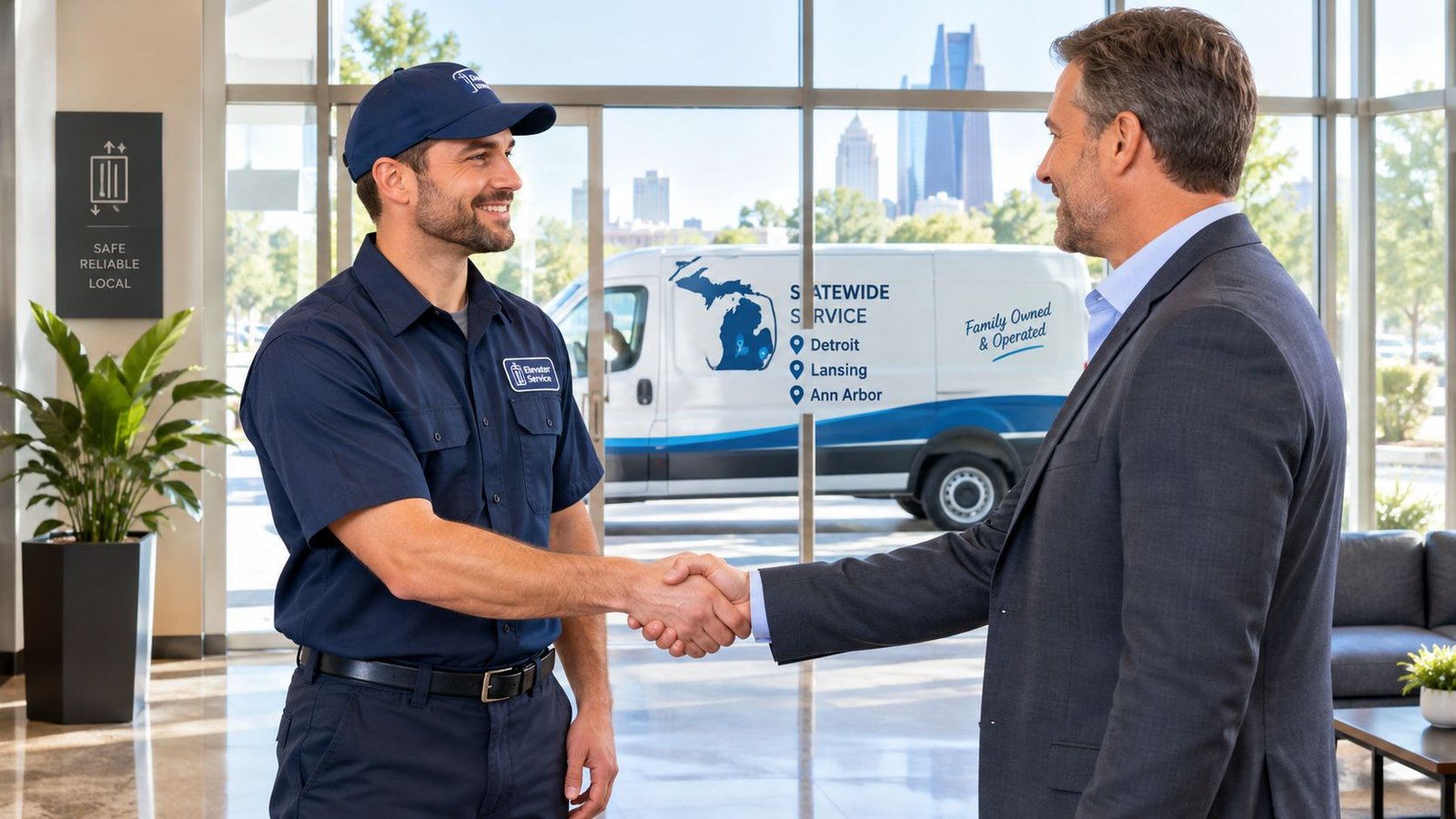
Crane Elevator Company is a family-owned contractor serving Michigan and Ohio with over 25 years of hands-on experience. Its service offering covers preventive maintenance, repairs, state testing and inspections, emergency response, and non-proprietary modernization for all makes and models of vertical transportation. That includes century-old freight cars, passenger elevators, residential elevators, wheelchair and material lifts, and dumbwaiters.
The company operates 24/7/365 and lists practical service policies and options such as No Show, No Pay, full clean-downs of machine rooms, pits, and car tops, included COP and PI bulb replacements, free second opinions, competitive quotes, and a price-beat guarantee. Its modernization work includes door lock monitoring, hydraulic packing, jack, cable, tank and power-unit, motor, sheave, and machine replacement, along with safety tests, emergency phones, fire service, generator testing, and violation corrections.
For a building manager, regional coverage isn't just a map claim. It can affect emergency coordination, inspection preparation, travel planning, and continuity across urban and suburban assets. Michigan's largest cities are spread across different regions, so a provider serving Detroit, Lansing, Ann Arbor, Grand Rapids, and nearby communities can support a broader portfolio rather than one isolated metro. Check statewide city and geographic information.
How to Choose the Right Commercial Elevator Service Provider
Start with the building's evidence, not the provider's sales language. Gather service records, inspection dates, violations, repeat callback notes, equipment types, modernization history, and known accessibility or emergency-communication issues. A provider should be able to walk the site, identify risks, and explain priorities in plain language.
Ask each bidder:
- Coverage: Can the team service every make, model, and lift type in the portfolio?
- Compliance: Who tracks Category 1 and Category 5 dates, test results, corrections, and filings?
- Scope: Are lubrication, clean-downs, bulbs, callbacks, parts, testing, and after-hours response included?
- Documentation: Will reports identify measurements, adjustments, unresolved deficiencies, and recommended dates?
- Parts: Does the provider have a clear plan for legacy and safety-critical components?
- Modernization: Will the proposal compare repair, targeted replacement, and full modernization?
- Response: What happens during an entrapment, shutdown, or inspection failure?
Reject vague proposals. “Routine service” isn't enough unless the contract defines what technicians inspect and what the owner receives afterward. A low monthly price can become expensive if major parts, emergency labor, tests, travel, or re-inspections sit outside the agreement.
The right provider should also respect the owner's long-term choices. Non-proprietary capability, transparent records, practical recommendations, and a willingness to provide a second opinion give the building manager more control over compliance and lifecycle planning. Request a site assessment, compare a second opinion, and align the service calendar with every inspection and test date before signing.
Crane Elevator Company provides preventive maintenance, repairs, inspections, emergency response, and non-proprietary modernization for commercial elevators, residential elevators, wheelchair lifts, material lifts, and dumbwaiters across Michigan and Ohio. Visit Crane Elevator Company to request a site assessment, compare service options, or discuss a code-focused maintenance and modernization plan.