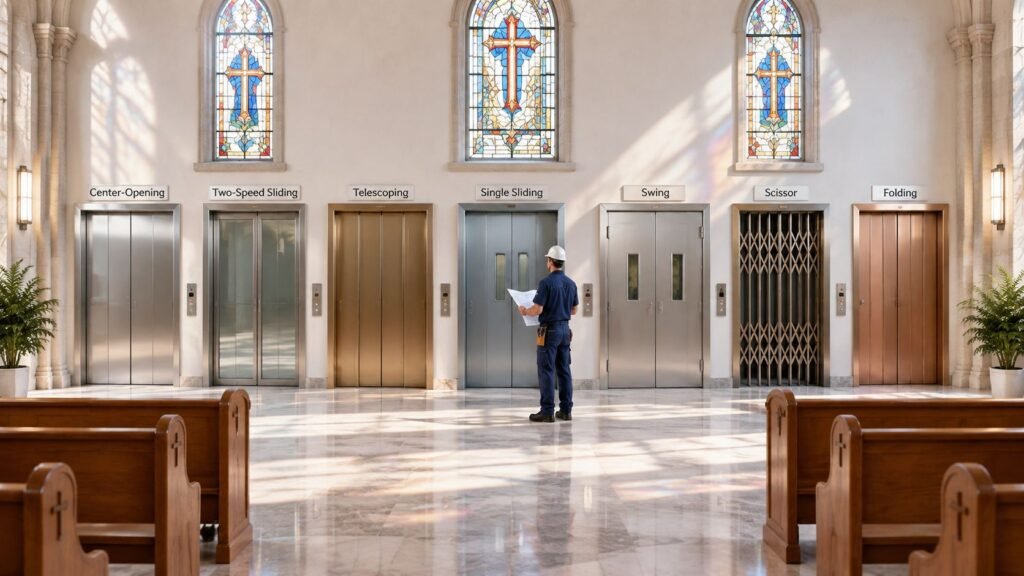
A church elevator that sticks at the sanctuary level, moves slowly, or refuses to close can look like a simple door problem. Often, the visible symptom points to deeper trouble involving the door configuration, clearances, interlocks, controls, sensors, or aging components. The right repair depends on understanding how the doors were designed and how the building uses the elevator.
This guide compares seven elevator door types and service approaches, with practical attention to churches, residential buildings, commercial properties, parish halls, and other existing structures. It also explains how door selection and retrofit decisions affect accessibility, maintenance access, downtime, inspection readiness, and long-term serviceability. For Michigan and Ohio owners, Crane Elevator Company provides 24/7/365 service for elevators, lifts, dumbwaiters, and related equipment across Detroit, Lansing, Ann Arbor, Grand Rapids, Flint, Kalamazoo, Toledo, Perrysburg, Monroe, and surrounding communities.
1. Crane Elevator Company
Crane Elevator Company is the strongest all-around fit for a church that needs more than a one-time door adjustment. It's a family-owned Michigan and Ohio contractor with over 25 years of hands-on experience, and its work spans century-old freight cars, modern passenger elevators, residential units, wheelchair lifts, material lifts, and dumbwaiters. That range matters in churches, where a sanctuary elevator may share a property with an older service lift or a wheelchair platform lift installed during a later accessibility project.
Crane's preventative maintenance program is designed to find problems before a sticking door becomes a Sunday-morning shutdown. The program includes a No Show, No Pay policy, complete clean-downs of machine rooms, pits, and car tops, and COP and PI bulb replacements. Those details are practical rather than cosmetic. Dirt, loose debris, poor lighting, and overlooked door equipment can make troubleshooting slower and increase the chance that a small defect becomes a repeat service call.
The company also handles door lock monitoring, hydraulic packing, emergency phones, fire service testing, generator testing, safety tests, code inspections, violation corrections, and major replacements involving jacks, cables, tanks or power units, motors, sheaves, and machines. Its church-specific service information is available through church elevator maintenance services.
Where Crane stands apart
Crane's non-proprietary modernization approach is especially useful when an older controller, operator, or door system has become difficult to support. A modernization can update traction or hydraulic equipment while avoiding vendor lock-in, allowing any qualified provider to service the resulting system. That doesn't remove the need to review compatibility, warranty terms, and local inspection requirements, but it gives an owner more control over future repairs.
Practical rule: Don't approve a door modernization until the contractor explains how replacement parts, controls, locks, sensors, and service access will be handled after installation.
Crane offers free second opinions, competitive quotes, a price-beat guarantee, and financing for commercial projects and modernizations. The trade-off is that its coverage is concentrated in Michigan and Ohio, so it isn't the right provider for owners outside that region. Pricing isn't posted as a fixed online rate, which means you'll need to request a quote, but that also allows the estimate to account for the building, equipment condition, and required scope.
2. MEI, Total Elevator Solutions
MEI, Total Elevator Solutions, is a sensible option for a church in the Detroit area that wants local dispatch backed by a larger manufacturing and service operation. Its Detroit-area branch is in Livonia, and the company offers emergency response, preventative maintenance, repairs, modernization, and code-required testing for major elevator brands through MEI, Total Elevator Solutions.
The local branch structure provides a clear point of contact, which helps when a volunteer property committee or facilities manager needs to coordinate access around worship services, funerals, community programs, and school activities. A contractor that understands the building's schedule can reduce unnecessary disruption, particularly when technicians need access to the machine room, pit, car top, or controller cabinet.
MEI also brings in-house manufacturing resources to parts and equipment solutions. That may help when a church is dealing with an aging door operator, obsolete control equipment, or a repair that needs more than a standard adjustment. Its service offering includes maintenance plans intended to reduce unplanned downtime, along with familiarity with State of Michigan and City of Detroit testing and compliance requirements.
Trade-offs for church owners
The main advantage is scale. A congregation may get local accountability while still having access to broader technical and manufacturing resources. That can be valuable for a passenger elevator serving several levels, rather than a small accessibility lift with limited controls.
The main limitation is predictability. Pricing isn't published online, and a broad commercial portfolio may mean lead times vary during busy periods. Before signing, ask who handles emergency calls, whether the same local team performs scheduled maintenance, how door faults are documented, and what testing paperwork the church receives after service.
For Detroit congregations, the Detroit elevator company service option provides another local comparison point when evaluating response time, modernization philosophy, and maintenance scope.
3. Premier Elevator & Lift
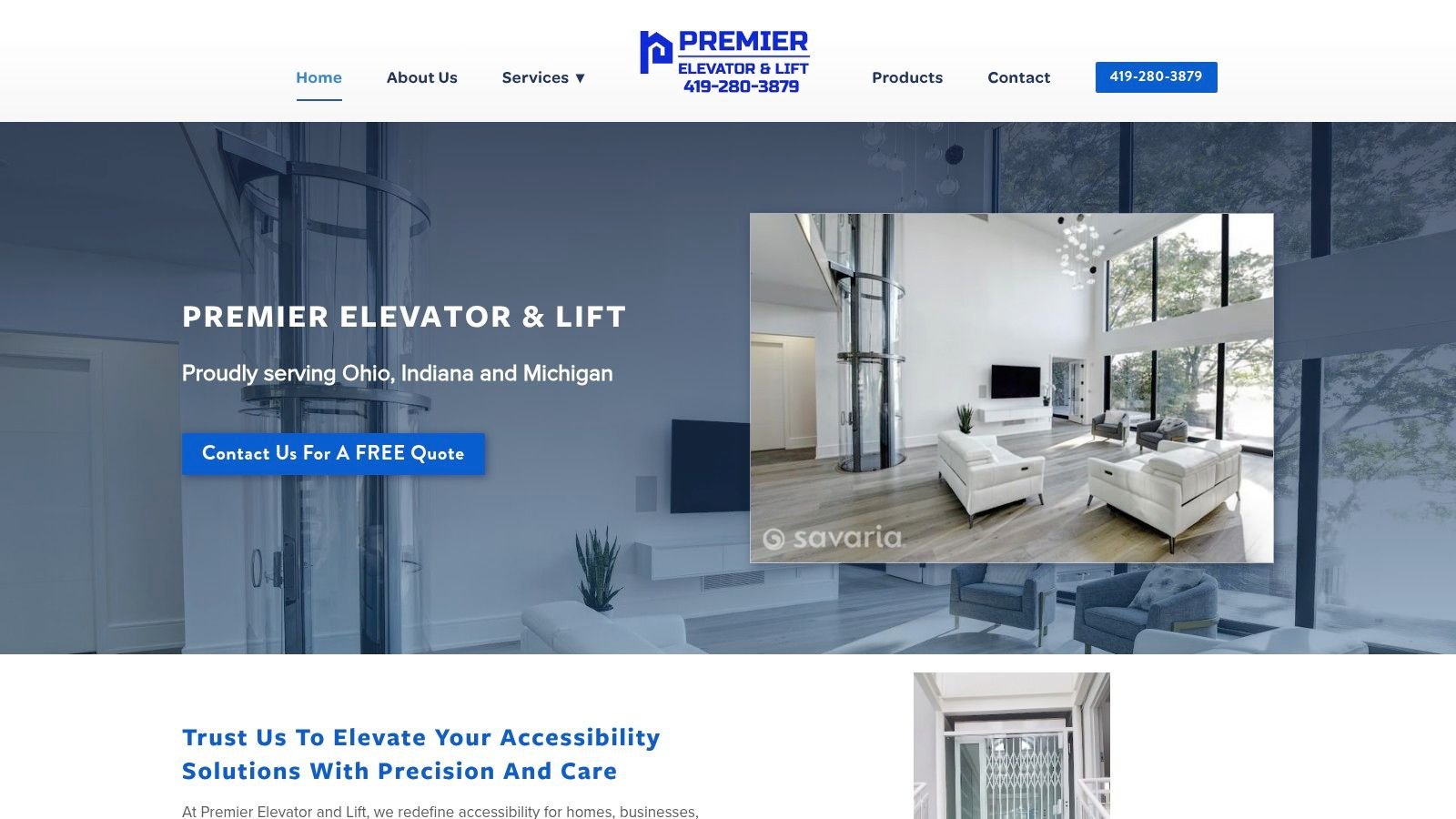
Premier Elevator & Lift is particularly relevant when the church's access problem involves a LULA elevator or vertical platform lift rather than a conventional passenger elevator. LULA means Limited Use, Limited Application. These systems can fit buildings where a full commercial elevator would require more space, structural work, or architectural changes, making them attractive for sanctuaries, parish halls, and older buildings with tight layouts.
Premier explicitly markets church lifts and works with elevators, LULA units, and vertical platform lifts. Its service footprint includes Ohio, Indiana, and Michigan, with listed city coverage through Premier Elevator & Lift. That regional reach can suit a congregation operating multiple buildings or a denominational organization managing properties across state lines.
Why the equipment type matters
LULA and platform lift doors often need a different service conversation than full-size passenger elevator doors. The technician must evaluate gate or door operation, interlocks, controls, landing access, platform clearance, and the route used by wheelchair users. A unit can run mechanically while still creating an access problem if the controls, signage, audible signals, or landing arrangement no longer work as expected.
Premier offers new installations alongside ongoing maintenance and repair, which creates continuity for a church planning an accessibility project. Its church-oriented product focus is a clear strength where aesthetics, limited space, and mobility access all matter.
The limitation is scope verification. The company's public material emphasizes accessibility and lift applications, so a church with a larger passenger elevator, complex traction system, or extensive modernization should confirm the provider's experience with that exact equipment before proceeding. Pricing also requires a quote rather than a published rate.
4. A4 Access
A4 Access is a Michigan-headquartered provider for buildings that combine several types of accessibility equipment. Its portfolio includes commercial elevators, residential elevators, vertical platform lifts, and stairlifts, making it a practical candidate for an older church with a passenger elevator at one entrance, a platform lift at another, and a stairlift serving a smaller level.
The company highlights a large in-house team of licensed elevator journeymen and serves Michigan, with coverage extending into Northern Ohio and Indiana through A4 Access. That combination can simplify vendor management for a multi-site parish or organization that wants one contractor familiar with mixed equipment rather than separate companies for each lift type.
A4 Access makes sense when the church's needs are broader than door repair alone. A technician may need to review the door operator, landing access, lift controls, stairlift charging equipment, and the building's overall accessible route. Coordinating those systems through one provider can make communication easier during inspection corrections or renovation work.
A lift that works in isolation isn't enough if the accessible route to the sanctuary still fails.
The trade-off is that the website doesn't publish detailed response-time service-level agreements. Churches should ask how emergency calls are prioritized, whether after-hours coverage comes from an in-house team, and which counties in Ohio are actively served. The company primarily highlights Michigan, so specific coverage should be confirmed before a congregation outside the state commits to a maintenance plan.
5. Lardner Elevator Company
Lardner Elevator Company is a Detroit-based contractor with a useful combination of emergency service, modernization, testing, and retrofit capability. Its in-house pit upgrade work is particularly relevant to churches with older basements, small shafts, or equipment spaces that need code-related improvements before the elevator can be kept in service.
A pit upgrade can involve more than replacing a worn component. Technicians may need to address access, lighting, clearances, water exposure, safety equipment, or other conditions that affect inspection and maintenance. For a church in an older building, that integrated approach can be more practical than hiring one company for the elevator and another for the surrounding infrastructure.
Lardner provides 24-hour service response and works on commercial and residential projects through Lardner Elevator Company. It also handles non-elevator hoisting equipment such as dumbwaiters and material lifts. That broader experience suits historic churches, where a service lift may support kitchens, archives, classrooms, or event spaces.
Questions to ask before hiring
Online service details are concise, so the owner should verify brand coverage, parts availability, and the contractor's reach beyond Metro Detroit. Ask whether the company routinely supports LULA and vertical platform lifts if the church has one, and whether its maintenance agreement includes door equipment, safety devices, emergency phones, and required testing.
Lardner is a strong local comparison for urgent Detroit-area work and older-building retrofits. It may be less suitable for an owner seeking statewide coverage without confirming the service territory first.
6. Toledo Elevator Company, an Elevator Service Inc. company
Toledo Elevator Company fits congregations in Toledo, northwest Ohio, southeast Michigan, and the Monroe corridor. The company provides maintenance, repair, installation, and modernization, with experience relevant to legacy hydraulic and traction equipment in older churches and parish halls. Its relationship with the Elevator Service Inc. network adds broader resources while preserving a regional service identity through Toledo Elevator Company.
The company's long local history is useful when an elevator sits inside a building with outdated wiring, unusual shaft dimensions, restricted equipment access, or previous alterations that aren't fully documented. Those conditions are common in older religious properties. A repair provider needs to understand not only the elevator, but also how the building's construction affects removal paths, shutdown planning, and inspection work.
Best fit and limitations
Toledo Elevator Company is a practical choice for a congregation that needs service near Toledo or Monroe and wants a contractor familiar with older building systems. Its full-service offering can support repairs and modernization rather than forcing the owner to change vendors when the equipment reaches the end of its useful service life.
The public information doesn't fully detail brand coverage, LULA or vertical platform lift capabilities, or maintenance-plan terms. A church with a small accessibility unit should confirm that scope before signing. Pricing also isn't posted publicly, so the facilities committee should request a written proposal that separates immediate repairs, recommended work, testing, and long-term modernization.
For Toledo-area owners comparing options, Toledo elevator repair services offer another basis for evaluating emergency response, parts strategy, and non-proprietary modernization.
7. Ohio Elevator & Lift
Ohio Elevator & Lift is a family-owned, independent contractor serving elevators, LULA elevators, and lifts across Ohio. Its emphasis on troubleshooting, diagnostics, repairs, required testing, maintenance contracts, and violation clearing makes it a natural candidate for churches with limited-use units or vertical platform lifts. The company states that it services most manufacturers through Ohio Elevator & Lift.
That independent model may give a congregation more flexibility when a repair involves an older controller, a nonstandard door operator, or parts that need to be sourced carefully. A useful diagnostic visit should identify whether the failure comes from the operator, lock circuit, sensor, landing equipment, control system, or a mechanical obstruction. Replacing a visible door component without finding the underlying fault usually creates repeat service calls.
Ohio Elevator & Lift is well suited to a church seeking a maintenance contract for a lightly used LULA or lift. Low traffic doesn't eliminate maintenance needs. Door locks, controls, batteries, safety devices, and accessible operating features still need attention, even when the unit runs only during services and community events.
The limitation is equipment scale. Its website gives strong attention to residential applications, so a church with a larger passenger elevator should confirm experience with that unit before requesting a modernization proposal. Pricing requires an inquiry, and there's no public rate card. Ask for a clear division between scheduled maintenance, emergency response, testing, violation corrections, and billable repair work.
Church Elevator Repair: 7-Company Comparison
| Provider | Implementation complexity | Resource requirements | Expected outcomes | Ideal use cases | Key advantages |
|---|---|---|---|---|---|
| Crane Elevator Company | Moderate–High (full modernizations and varied equipment) | Local 24/7 field crews, parts inventory, quote-based financing options | Reduced downtime and lifetime repair costs; vendor‑agnostic modernizations (MI/OH region; quote required) | Facility managers, HOAs, churches needing preventative programs and non‑proprietary upgrades | Proactive preventative program (No Show, No Pay), non‑proprietary modernizations, 24/7 service, 25+ years local experience |
| MEI – Total Elevator Solutions (Detroit) | Variable (factory-backed modernizations to routine service) | Regional branch + in‑house manufacturing and factory support; 24/7 dispatch | Scalable, factory‑quality repairs and compliant inspections; predictable accountability (quote required) | Churches needing strong manufacturer support and Michigan/Detroit compliance familiarity | In‑house parts/manufacturing, 24/7 emergency service, regional branch accountability |
| Premier Elevator & Lift | Low–Moderate (focus on LULA/platform lifts and installations) | Accessibility-focused inventory and installers across OH/IN/MI | Space-efficient accessibility installs and ongoing service for lifts (quote required) | Churches with limited space needing LULA or vertical platform lifts | Church-oriented product set, listed regional footprint, single provider for lifts and elevators |
| A4 Access | Moderate (mixed equipment types, code compliance work) | Large team of licensed journeymen and regional service coverage | Comprehensive mixed-equipment maintenance and code-compliant service; good multi-site support | Multi-site parishes or churches with combined elevators, VPLs, and stairlifts | Large in‑house technical bench, one‑stop provider for accessibility equipment |
| Lardner Elevator Company | Moderate (retrofits, pit upgrades, emergency response) | Local emergency crews, in‑house pit/retrofit capabilities | Faster local emergency response and code-compliant retrofits (Metro Detroit focus) | Older churches needing pit upgrades or shaft retrofits in Detroit area | Quick local support, retrofit and hoisting-device expertise |
| Toledo Elevator Company (ESI network) | Moderate (legacy system repair & modernization) | Regional technicians backed by ESI network and institutional knowledge | Reliable service for legacy hydraulic/traction systems; good local responsiveness | Congregations in Toledo/Monroe corridor with older elevators or small LULA units | Century-plus local heritage, ESI network resources for added capacity |
| Ohio Elevator & Lift | Low–Moderate (LULA/VPL emphasis, troubleshooting) | Independent local staff, flexible scheduling; maintenance contracts by inquiry | Budget-conscious maintenance, focused diagnostics and testing (confirm larger passenger capability) | Churches with LULA or vertical platform lifts seeking economical contracts | LULA-specific expertise, independent/flexible service options |
Choose the Door Around the Building
The right church elevator repair decision starts with documentation, not a preferred door style. Record the existing configuration, the recurring symptom, the floors served, and the conditions under which the failure occurs. A door that sticks only when the car is heavily loaded suggests a different investigation from a door that reverses repeatedly, fails to lock, or stops responding after a power interruption.
Identify the building's role in the congregation's life. A sanctuary elevator may need dependable service around worship and funeral schedules. A parish hall lift may face intermittent use and long idle periods. A residential elevator may serve a caretaker's apartment, while a commercial or community-use elevator may operate throughout the week. Each setting changes the acceptable downtime, access plan, and maintenance schedule.
Request a condition assessment before approving a major repair. The contractor should inspect the door panels, tracks, rollers, operator, restrictor, landing doors, interlocks, sensors, clearances, controls, and related safety circuits. The proposal should also state whether parts remain available and whether the recommended repair preserves the building's inspection and accessibility requirements.
Ask for two paths: a repair plan that restores safe service now, and a modernization plan that addresses obsolete controls, repeated door faults, accessibility features, and future parts support.
Compliance paperwork matters as much as mechanical work. In Illinois, a 2011 amendment created a special path for certain religious worship buildings. When the building has only one conveyance, that conveyance serves two levels, and the congregation completes an annual maintenance examination while keeping category-test records on site, the certificate of operation can be renewed every three years instead of annually. The same guidance requires on-site witnessing of category tests every three years, as described in Illinois elevator inspection and test interval guidance. The specific requirements depend on the jurisdiction, but the lesson applies broadly: maintenance records and inspection timing must be part of the repair plan.
Accessibility should receive equal attention. A 2024 national survey examined accessibility features across 127 U.S. churches, while a separate report found that 40% of churches needed minor to major improvements or additions for accessible lifts and 56% needed minor to major improvements or additions for ramps, according to the 2024 church accessibility report. Those findings reinforce why a repair proposal should address usable controls, audible announcements, Braille signage, clearances, and the complete route to the destination, not just whether the car moves.
Crane Elevator Company provides every type of elevator service, including preventative maintenance, repairs, inspections, safety testing, violation corrections, emergency response, and modernization. Its Michigan service area includes Detroit, Lansing, Ann Arbor, Grand Rapids, Flint, Kalamazoo, and surrounding communities, with additional coverage across Ohio. Owners can compare a standard repair with a non-proprietary modernization, ask about financing, and choose the path that best protects access, reliability, and long-term serviceability.
Visit Crane Elevator Company for church elevator repair, preventative maintenance, inspections, safety testing, violation corrections, and non-proprietary modernization. Request a condition assessment or second opinion for your church, lift, dumbwaiter, or passenger elevator in Detroit, Lansing, Ann Arbor, Grand Rapids, and surrounding Michigan and Ohio communities.