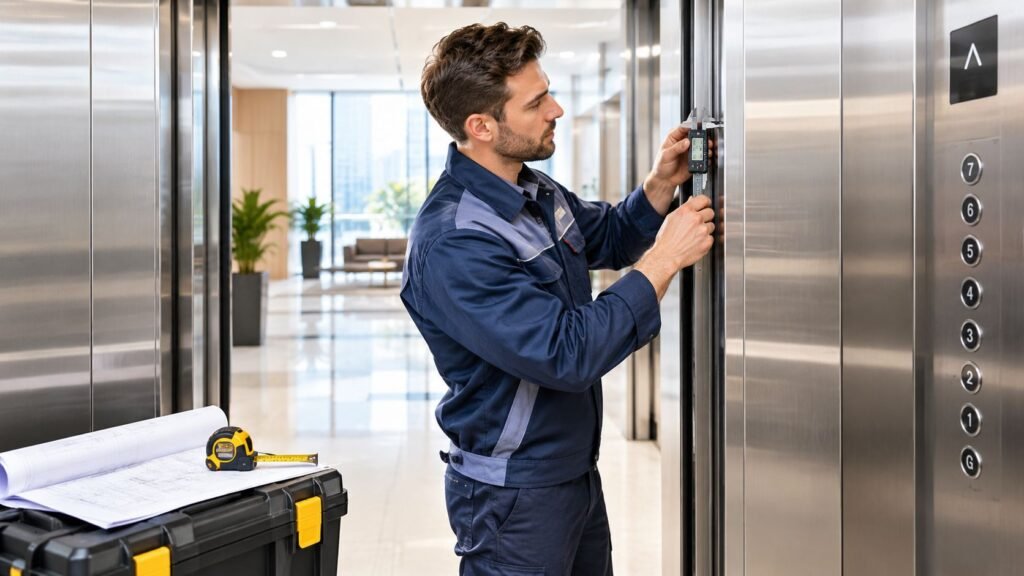
At 8:45 on a Monday morning, an office elevator is more than a convenience. It's the route employees take to work, the first impression a leasing prospect gets, and the system that keeps deliveries, accessibility, and tenant schedules moving. When a car stops between floors or refuses to open at the lobby, the property manager becomes the first person everyone calls.
That's why office building elevator maintenance should be managed as a business-continuity program, not a checklist of occasional repairs. In Michigan, the schedule also has to account for state inspection rules, Detroit's local code, equipment age, traffic, and the practical needs of buildings in Detroit, Lansing, Ann Arbor, Grand Rapids, Holland, Traverse City, Marquette, and surrounding communities.
When an Office Elevator Fails on a Monday Morning
A twelve-story office tower on Woodward Avenue can fill quickly before 9 a.m. Two cars may be sitting at the top landing while a technician works through a conference call with the property manager, trying to determine whether the problem is in the door operator, controller, or safety circuit. Tenants wait in the lobby, employees arrive late to client meetings, and the building's COO wants a recovery time that nobody can responsibly promise yet.
The fault might be a stuck relay, a worn contactor, a hoistway door interlock that shifted out of alignment over the weekend, or a controller fault that never made it into the building's service history. Each possibility requires a different diagnostic path. Resetting the car may restore service temporarily, but a reset doesn't explain why the fault occurred or whether it will return during the next traffic peak.
A manager dealing with an elevator out of service also has to coordinate tenant notices, accessibility needs, deliveries, fire-service considerations, and a realistic repair window. Leasing prospects may see the shutdown before they hear the explanation. Existing tenants may not distinguish between an isolated component failure and a neglected maintenance program.
The disruption spreads beyond the elevator
In Lansing, a professional office building may have limited alternate routes. In Ann Arbor, healthcare, research, and education tenants may depend on reliable access for patients, visitors, equipment, and staff. In Grand Rapids, a property with several offices may shift traffic to one remaining car, increasing waits and placing additional operating pressure on that equipment.
Smaller properties in Holland, Traverse City, and Marquette face the same basic problem, even when their equipment serves fewer floors. A single-car building has no redundancy. When that car is unavailable, the entire vertical-transport system is unavailable.
Practical rule: A maintenance plan should answer what happens before the first Monday-morning failure, not just who gets called after it.
Planned service doesn't eliminate every failure. It does give technicians a chance to identify recurring door faults, worn electrical components, poor leveling, brake concerns, and incomplete service records before those problems become a tenant-facing emergency. The objective is simple: keep the elevator available when the building needs it, and make the remaining failures easier to diagnose and resolve.
What an Office Elevator Maintenance Program Actually Covers
A properly scoped contract starts with the equipment, building use, and compliance obligations. It shouldn't describe maintenance as a generic visit. The written scope should identify the elevator type, controller, drive, door equipment, safety devices, emergency systems, and areas the mechanic will inspect.
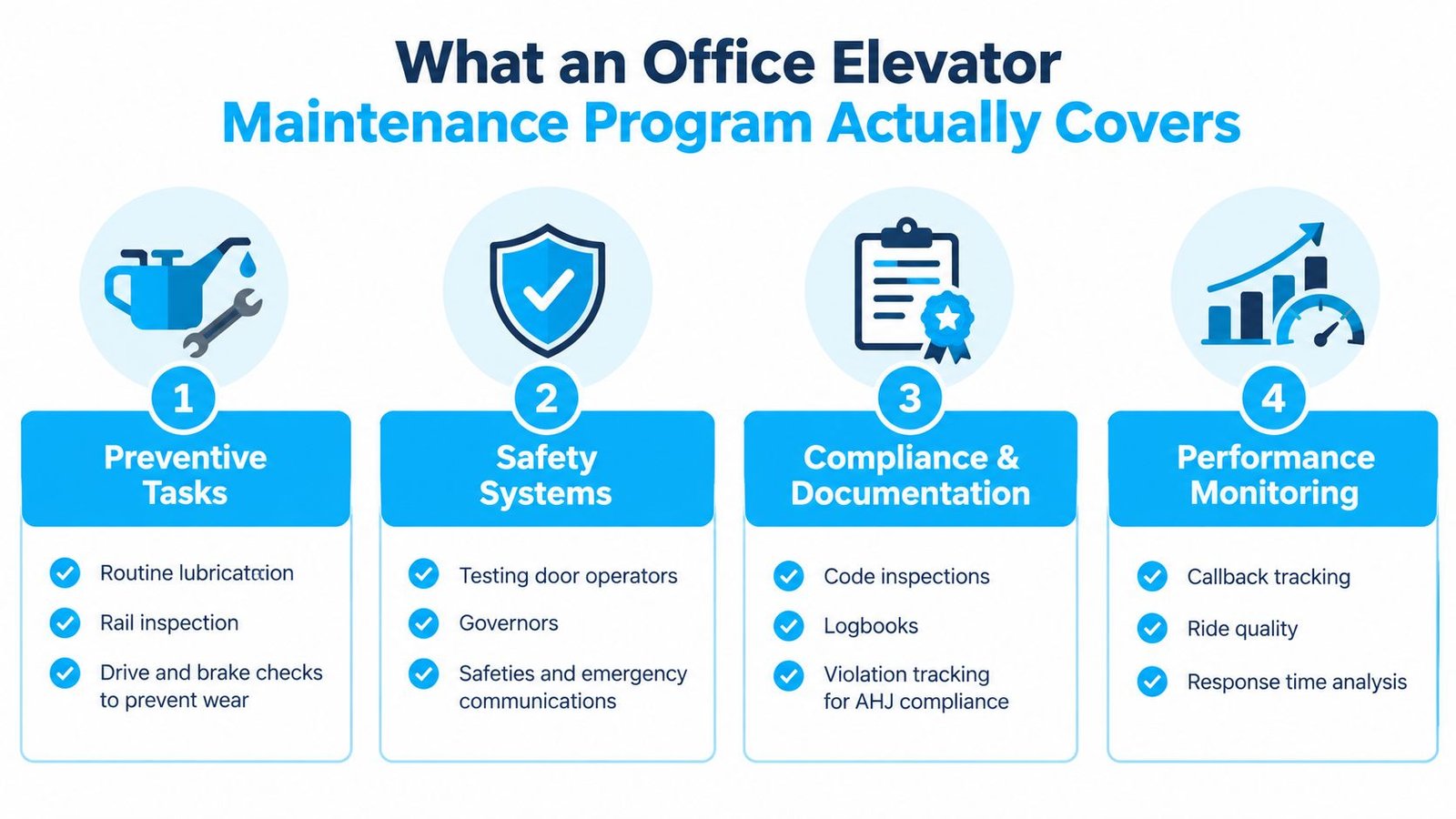
Four parts of a defensible program
Routine preventive work includes lubrication where appropriate, rail and guide inspection, drive cleaning, brake adjustment, door equipment checks, and examination of machine-room, hoistway, pit, and car-top conditions. Cleaning matters because accumulated debris and contamination can hide leaks, interfere with components, and make small defects harder to see.
Parts replacement should follow observed wear, equipment condition, manufacturer guidance, and operating history. Cycle counts and controller fault logs can help identify components that are approaching the end of useful service. Replacing a worn roller or door component during planned work is generally easier to schedule than waiting for the same part to cause a shutdown.
Safety testing covers systems such as buffers, governors, safeties, leveling, braking, door locks, emergency communications, and fire-service functions. The exact test responsibility and witnessing requirements depend on the adopted code and authority having jurisdiction.
Documentation protects the owner as much as the machinery. A Michigan facility should retain maintenance logs, inspection certificates, violation records, test results, repair recommendations, and controller fault history in a location that the property team can access during an audit or service transition.
What should happen on each visit
The mechanic should review the elevator's current condition, perform the tasks listed in the contract, record defects, and identify anything that needs a separate repair authorization. A signed work ticket should state what was completed, what was found, and whether the car was returned to service.
A written condition report is more useful than a note that says “checked elevator.” It should distinguish an immediate safety concern from a developing reliability issue and from a recommendation that can be planned with future capital work.
The people performing the work matter. Use a Michigan-licensed elevator contractor and confirm that the assigned mechanics hold credentials appropriate to the equipment and testing work, including ASME QEI-1 certification where qualified inspection responsibilities apply. The maintenance file should survive a personnel change, vendor change, or ownership review without relying on one mechanic's memory.
ASME A17.1 and Michigan Code Requirements Explained
A failed inspection can keep an office elevator out of service after the repair itself is complete. Facility managers do not need to become elevator engineers, but they do need to know which authority controls the work and which deadlines can affect tenant access.
ASME A17.1/CSA B44 sets the North American safety framework for elevator design, construction, installation, operation, testing, inspection, maintenance, alteration, and repair. It also covers escalators, moving walks, dumbwaiters, and material lifts. The ASME A17 elevator and escalator resources explain how the code supports maintenance control and safe operating practices. For a plain-language overview, review these Michigan elevator code requirements before approving repair or modernization work.
Michigan rules apply that baseline at the state level. Many conveyance types, including passenger and freight elevators, escalators, moving walks, material lifts, and special elevating devices, require inspection at least once every 12 months. Other equipment, including dumbwaiters, stairway chairlifts, and certain one-person or platform lifts, follows a 24-month inspection interval under the state rule. Confirm the equipment category instead of applying one calendar cycle to every device. Michigan's elevator inspection rule lists the classifications and intervals.
Detroit adds a local layer. The city's 2019 City of Detroit Elevator Code took effect on October 1, 2019, and addresses design, installation, registration, maintenance, alteration, inspection, testing, repair, operation, and decommissioning. A Detroit building may therefore need coordination with the city's requirements even when the state inspection date is current. The Detroit elevator inspection information provides the city's code context.
For buildings in Lansing, Ann Arbor, Grand Rapids, Holland, Traverse City, or Marquette, the state cycle still drives much of the planning. Detroit properties require an added local check. In every market, schedule inspections early enough to allow access, testing, corrective work, permits, and any required follow-up before the certificate deadline.
Compliance snapshot
| Requirement | Authority | Cycle | Owner action |
|---|---|---|---|
| Maintenance Control Program | ASME A17.1/CSA B44 and adopted local requirements | Ongoing | Keep a documented program for each conveyance |
| Routine state inspection for many elevator types | Michigan Elevator Rules | At least every 12 months | Track the certificate and schedule before expiration |
| Certain lifts and dumbwaiters | Michigan Elevator Rules | At least every 24 months | Confirm the equipment classification and due date |
| Category 1 testing | Industry guidance tied to ASME A17.1 | Every 12 months | Coordinate testing, inspection, records, and corrections |
| Category 5 testing | Industry guidance tied to ASME A17.1 | Every five years | Plan witnessed testing and any shutdown requirements |
| Detroit local compliance | 2019 City of Detroit Elevator Code | Based on adopted requirements | Confirm permits, inspections, alterations, and records with the AHJ |
Missed tests or unresolved violations can remove a car from service. Unapproved equipment changes can also create liability and delay occupancy or tenant operations. After modernization, plan acceptance testing and documentation before work starts, so compliance does not become a last-minute cause of downtime.
Choosing the Right Maintenance Schedule for Your Building
A twelve-story Detroit office tower with several cars and heavy daily traffic shouldn't receive the same service plan as a two-stop professional building in Holland. The correct cadence reflects usage, equipment age, environmental conditions, redundancy, tenant needs, and the time required to complete Michigan inspections and corrective work.
Compare the operating models
Monthly preventive service is the normal starting point for many commercial offices. Regular visits give the mechanic repeated opportunities to examine door operators, rollers, hoist motors, brakes, guides, lubrication points, and controller conditions before minor wear becomes a shutdown.
Bi-monthly service can fit a lower-traffic building or a small bank with limited operating demand, but only after reviewing the manufacturer's requirements, service history, and risk profile. Fewer visits may reduce scheduled cost while increasing the chance that a developing fault remains unresolved longer.
Predictive maintenance adds condition information to the calendar. Door cycle counts, brake-cycle data, controller logs, temperature readings, and remote diagnostic alerts can help prioritize service and schedule work during lower-impact periods. Predictive tools support hands-on maintenance. They don't replace physical inspection, cleaning, adjustment, or code-required testing. The predictive elevator maintenance approach is most useful when the building has compatible monitoring and a team that reviews the data instead of merely collecting it.
| Building profile | Recommended cadence | Best for | Annual visit count |
|---|---|---|---|
| High-traffic office tower | Monthly, with condition-based review | Multiple cars, older equipment, demanding tenant schedules | Determined by the written contract |
| Mid-size professional building | Monthly or bi-monthly after assessment | Moderate traffic and usable backup capacity | Determined by usage and manufacturer guidance |
| Small or low-traffic office | Bi-monthly only when justified | Limited stops, light demand, stable service history | Determined by equipment classification |
| Portfolio with connected equipment | Hybrid calendar and predictive program | Managers comparing faults across Detroit, Lansing, Ann Arbor, or Grand Rapids | Calendar visits remain necessary |
Don't cut service below manufacturer recommendations to win an annual budget discussion. Warranty terms may require scheduled maintenance, and a claim review after an entrapment or serious outage will examine whether the owner followed the documented program. Align planned visits with inspection preparation, certificate deadlines, tenant schedules, and parts lead times.
Why Downtime Costs More Than the Cheapest Contract
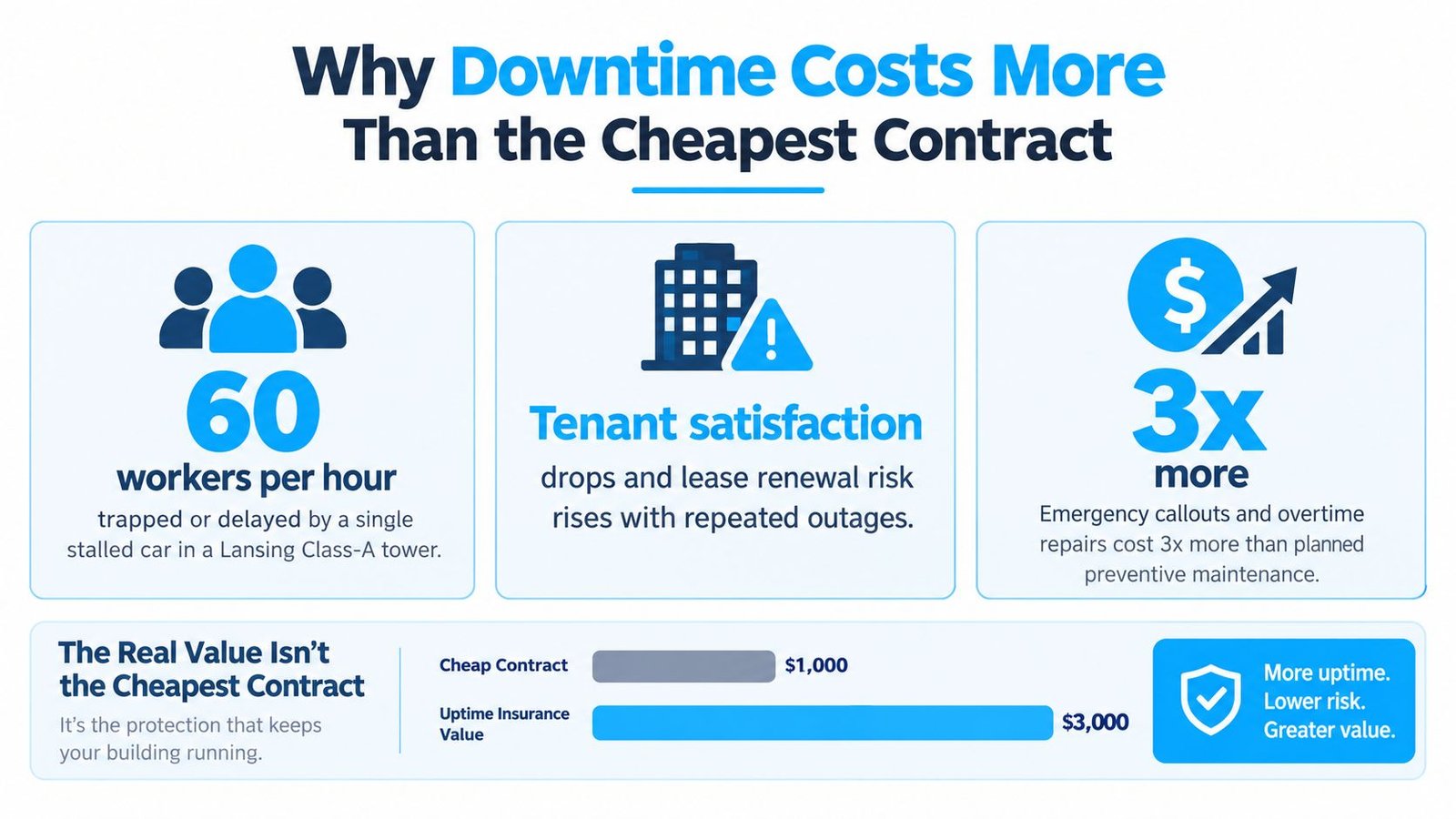
A low monthly price can look responsible until the first recurring failure. The comparison is between the contract price and the building's total exposure, including emergency labor, tenant disruption, accessibility complaints, staff time, missed deliveries, and deferred repairs.
In a Lansing Class-A tower, one stalled car can delay dozens of workers during a busy period. The exact impact depends on the number of cars, floors, tenant schedules, and available alternatives, but the business effect is immediate. A building with two cars may keep operating with one, yet the remaining car can develop long waits and crowding while the failed unit is down.
Look beyond the monthly invoice
A stripped-down contract may exclude important work or define it narrowly. Review whether the scope addresses door lock inspection, governor work, brake adjustment, roller condition, emergency phones, fire service, troubleshooting, cleanup, and response expectations. A cheap contract that generates repeated callbacks can cost more than a broader plan that identifies the underlying pattern.
The Ontario availability study found that most repaired devices were restored within 24 hours, while about 1% of devices experienced outages longer than a week in a given year. The same study reported that service calls fell 15% over three years and entrapments dropped 18% to 20%, findings associated with disciplined preventive maintenance and response workflows. Read the Ontario elevator availability study for the full context.
A controller failure that removes one of two cars for an extended repair can force the property team to rearrange freight movement, deliveries, accessibility accommodations, and tenant communication. Ann Arbor and Detroit tenants also notice repeated reliability problems through daily experience, not just through an accounting report.
A maintenance contract is an uptime decision. Compare providers by repeat-fault reduction, documentation, parts planning, and response performance, not by price alone.
Modernization and Targeted Upgrades That Cut Repeat Calls
Repeated callbacks often mean the building needs a component strategy, not another year of identical service visits. A targeted modernization can address the part of the system causing the disruption while preserving equipment that remains safe, serviceable, and economical to keep.
Door equipment is a common starting point. A modern door operator, properly matched sensors, accurate alignment, and reliable lock monitoring can correct recurring reopen, leveling, and door-fault patterns. Controller and drive upgrades may improve troubleshooting and parts availability, but the owner should review proprietary limitations, future service access, and compatibility before approving a package.
Machine-room-less traction equipment can be appropriate in some older properties, but it isn't an automatic answer for every building. The decision depends on shaft dimensions, overhead and pit conditions, structural requirements, electrical service, traffic, fire-service needs, local approvals, and the disruption created during construction.
A Grand Rapids example
Consider a composite Grand Rapids professional building with recurring door-related shutdowns. The service history showed that technicians were repeatedly restoring the car, but the same operating pattern returned because the underlying door equipment and sensing arrangement remained unchanged.
The building team commissioned a condition assessment, reviewed the controller history, and scoped a targeted upgrade to the door operator and door-edge sensing system. Work was sequenced so one car remained available while the other was upgraded, and the owner tied the capital plan to lease timing rather than waiting for a major failure.
That approach is more credible than claiming every modernization produces the same outcome. Results depend on diagnosis, equipment condition, installation quality, tenant behavior, and follow-up maintenance. The useful lesson is that repeat calls should trigger trend analysis, not automatic replacement of the entire elevator.
Plan the capital work
Ask an independent Michigan elevator consultant or qualified specialist to document the equipment condition, obsolescence risks, safety concerns, and modernization alternatives. Build a five-year capital outlook around lease cycles, funding, parts availability, and the possibility of keeping one car in service during the work.
For buildings in Ann Arbor, Lansing, Holland, Traverse City, Marquette, and other Michigan communities, also confirm local permitting, inspection, acceptance testing, and authority-having-jurisdiction requirements before scheduling shutdowns. A phased project with a clear tenant communication plan is usually easier to manage than an emergency replacement forced by an unavailable controller or failed drive.
Practical Next Steps for Michigan Building Owners
A facility manager can improve the maintenance program this week without waiting for a major capital approval. Start with the records, then compare the contractor's documented work against the building's actual operating experience.
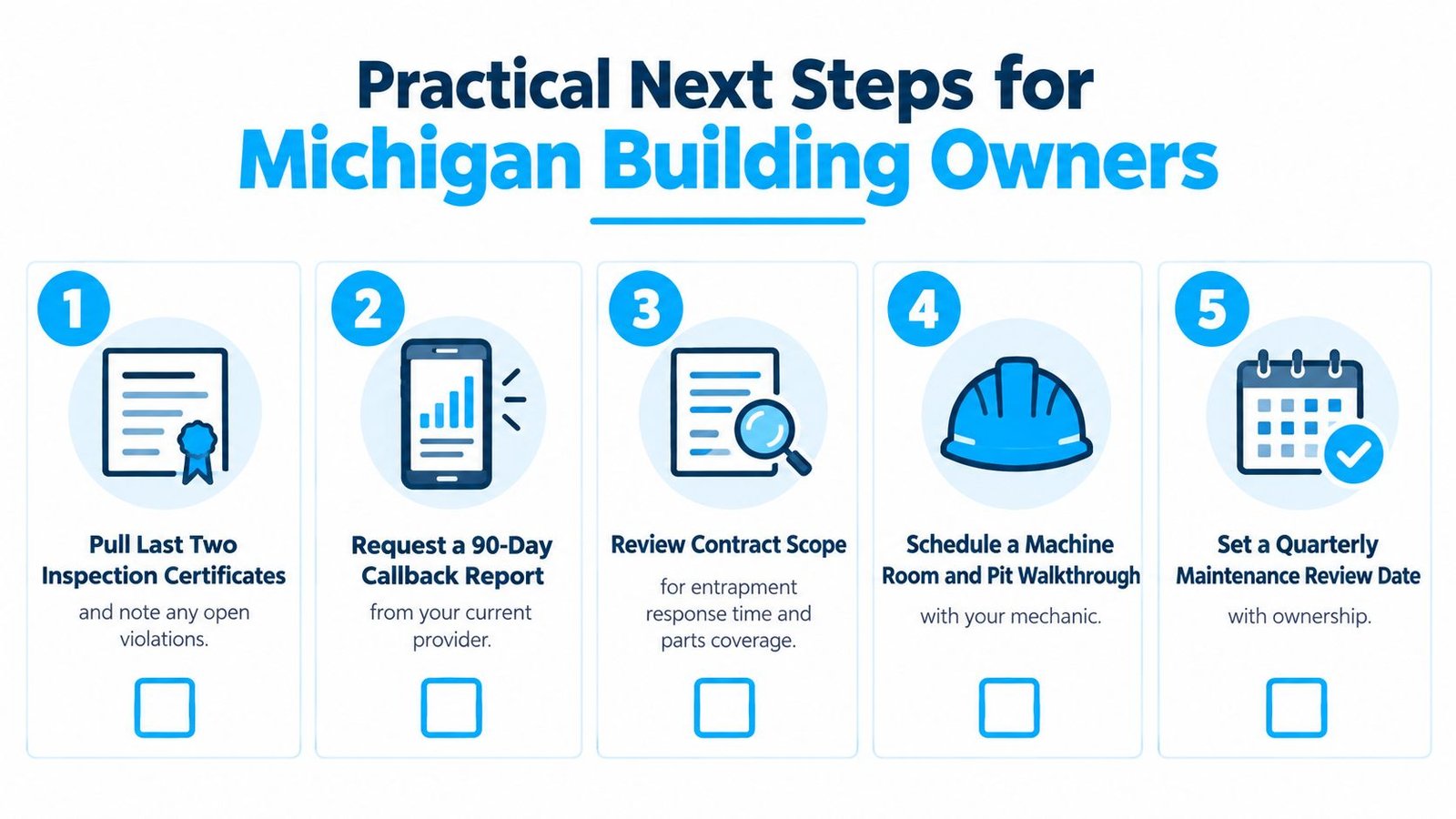
Five actions to take now
Pull the last two inspection certificates. Note the expiration dates, open violations, test results, and any restrictions placed on the equipment. Confirm that the certificates match the cars physically operating in the building.
Request a 90-day callback report. Ask for every service call, fault description, time of arrival, repair performed, parts used, and whether the same issue returned. Repeated door, leveling, controller, or safety-circuit calls deserve a pattern review.
Review the contract line by line. Check preventive tasks, entrapment response, emergency coverage, parts responsibility, testing support, cleanup, documentation, and exclusions. Confirm that the contractor carries the required Michigan license and that mechanics have credentials appropriate to the equipment.
Schedule a second-opinion walkthrough. Have the reviewer examine pit depth, overhead clearance, machine-room ventilation, controller nameplate data, door equipment, hydraulic components where applicable, and the condition of machine-room, pit, and car-top areas. Request findings in writing rather than accepting only a verbal recommendation.
Set a recurring ownership review. Track entrapments, door faults, repeat callbacks, inspection status, outstanding violations, average response experience, and modernization recommendations. Give ownership a concise report that connects each issue to operational risk and planned cost.
Schedule the next state inspection early enough to correct findings without forcing a rushed shutdown. Many facility teams choose to plan at least 30 days ahead, but the right lead time depends on the equipment, inspector availability, permits, parts, and the scope of corrections. Document tenant shutdown procedures, accessibility arrangements, emergency contacts, and communication responsibilities before work starts.
Finally, verify insurance certificates, parts availability for older controllers, and the written emergency protocol. Include the local authority having jurisdiction in that process, especially for Detroit properties with city-specific requirements. A complete maintenance file should tell the next mechanic what happened, what was tested, what remains open, and what the owner should budget for next.
Crane Elevator Company provides preventive maintenance, repairs, code-required testing, violation corrections, and non-proprietary modernization for commercial elevators, freight cars, lifts, dumbwaiters, and other vertical-transport equipment across Detroit, Lansing, Ann Arbor, Grand Rapids, Holland, Traverse City, Marquette, and surrounding Michigan communities. Review your inspection records and callback history with the team, then visit Crane Elevator Company to request a second opinion or service discussion.