
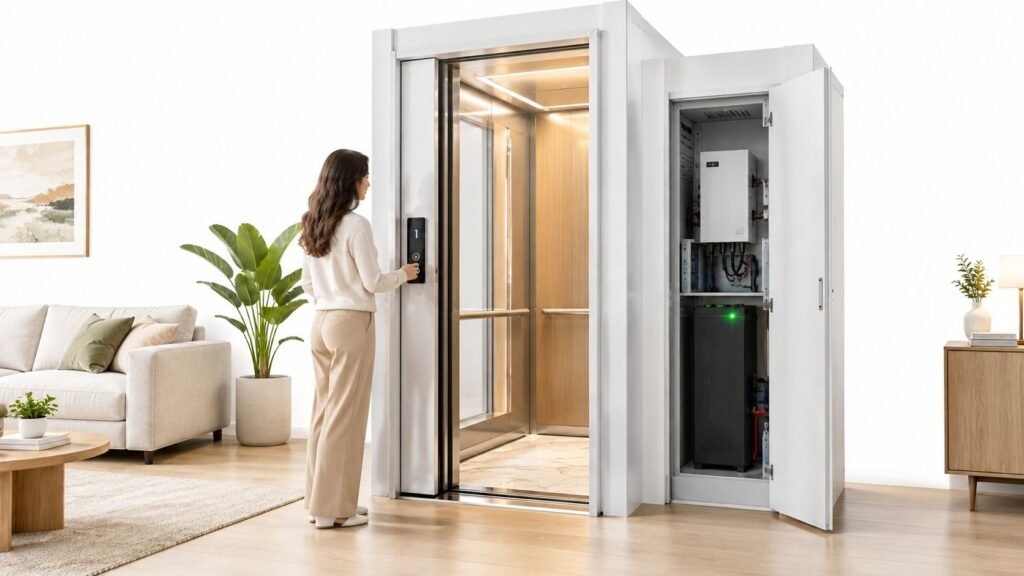
A home elevator usually earns attention only after it stops working. In Lansing, that often means a family member is between floors during a winter outage, a wheelchair user can’t reach a bedroom, or a property manager discovers that the inspection certificate is no longer current. The right response isn’t to wait for the next failure. It’s to understand the equipment, the inspection schedule, the backup-power limits, and the service plan before a small defect becomes an expensive interruption.
This guide focuses on residential elevators and small properties, while also covering the broader needs Crane Elevator serves in Detroit, Lansing, Ann Arbor, Grand Rapids, and surrounding Michigan communities. Whether the property is in East Lansing, Okemos, DeWitt, Holt, Haslett, Flint, Kalamazoo, or another Michigan town, the practical standard is the same: every type of elevator service should be planned around safe operation, documented maintenance, responsive repairs, inspections, testing, and modernization when the existing equipment no longer makes financial sense.
Why Lansing Building Owners Are Asking About Elevator Backup Power
A Lansing Resident is riding home after dinner on a Tuesday evening. The lights flicker, the cab shudders, and the indicator panel goes dark before the elevator reaches the next landing. The car stops between floors. The emergency phone has no dial tone, and the family waits while a Consumers Energy outage continues through the night.
That situation turns a convenience into a safety problem quickly. A trapped rider may be an older adult, someone using a wheelchair, or a child who can’t operate the doors or alarm without help. Owners planning to age in place also need to consider how a stalled elevator affects access to bedrooms, bathrooms, and food storage. For a small multifamily property, a failed elevator can create tenant complaints, accessibility concerns, and questions about whether the owner maintained the equipment properly.
What backup power can and can’t solve
A battery system gives the elevator a controlled response when utility power disappears. Depending on the design, it may lower the car to a landing, open the doors, operate emergency lighting, and keep communication or alarm functions available. It doesn’t restore normal building power, and it usually won’t support unlimited trips or other household loads.
That distinction matters. Homeowners sometimes ask for a battery that will run the elevator throughout a long outage, but residential systems are commonly designed for emergency evacuation rather than ordinary daily service. The contractor must match the backup equipment to the elevator controller, motor, cab load, travel height, door operator, and expected use.
Practical rule: A backup battery should give riders a predictable way out. It shouldn’t be treated as a substitute for a generator, a maintenance program, or a working emergency communication system.
Michigan’s inspection framework reinforces the need for planned service. The state’s current elevator rules became effective on June 27, 2023, and distinguish between devices inspected on annual and biennial schedules. The state also requires maintenance inspections and safety testing for elevator installations, so a battery decision belongs in the broader compliance file, not in an isolated equipment closet. Michigan’s current elevator rules announcement
Homeowners in East Lansing, Okemos, DeWitt, and Holt should ask three direct questions during a service visit: How does the elevator respond to a power loss? Is the emergency phone independent of household power? What record proves the battery and lowering function were tested? Those answers reveal more than a sales brochure.
What a Residential Elevator Backup Battery Actually Does
A residential elevator battery works much like a UPS that keeps a computer operating during a blackout. The difference is that the battery is wired into the elevator controller, emergency circuits, and switching equipment rather than a desktop computer.
When utility power drops, the controller detects the loss and transfers selected functions to the battery system. The relay changes the source of power, the controller follows its programmed emergency sequence, and the elevator either lowers to a designated landing or performs a limited emergency ride. The exact sequence depends on the elevator design and the equipment installed.
The emergency sequence
A typical system follows a sequence like this:
- Utility power fails. The controller registers the loss of normal AC power.
- The transfer relay changes sources. The battery becomes available to the circuits designed for emergency operation.
- The controller limits the operation. It may command automatic lowering, reduced-speed travel, door opening, lighting, alarm, or communication functions.
- The rider exits. The system’s purpose is to bring the cab to a safe landing, not to provide indefinite service.
- The charger restores capacity. Once normal power returns, the charging circuit replenishes the battery under the controller’s supervision.
For most homes, emergency lowering is more practical than full-power ride-through. Full ride-through requires a larger power source and may involve additional engineering, space, heat, and cost. A lowering-only system can be smaller because it’s designed to complete a controlled evacuation rather than support normal passenger traffic.
The battery also has a finite operating window. Runtime varies with cab weight, motor demand, travel distance, door cycles, battery condition, and temperature. A homeowner may hear an estimate of roughly 5 to 30 trips, but that range is a qualitative planning guide, not a guaranteed result. A technician should verify the actual sequence under load instead of relying on the battery label.
For a practical overview of the equipment and applications, review residential elevator backup power systems. The charging circuit, source-transfer relay, emergency alarm, strobe, controller, and communication system all need to work together. Replacing batteries without checking those related components often leaves the failure untouched.
Common Battery Types and How Long They Last
Residential elevator owners are generally comparing sealed lead-acid, AGM, and lithium iron phosphate batteries. The choice shouldn’t be made on chemistry alone. Cabinet dimensions, charger compatibility, cold-weather exposure, controller requirements, service access, and replacement planning matter just as much.
| Battery Type | Typical Runtime | Service Life | Cold-Weather Performance | Relative Cost |
|---|---|---|---|---|
| Sealed lead-acid | Depends on load and system design | Shorter service life than newer alternatives | Performance can decline in cold, poorly conditioned spaces | Lower upfront cost |
| AGM | Depends on load, charge condition, and temperature | Moderate service life | Generally practical for existing Michigan retrofits | Moderate |
| LiFePO4 | Depends on controller programming and battery capacity | Often planned as a longer-life option | Requires careful temperature and charger compatibility review | Higher upfront cost |
Sealed lead-acid
Sealed lead-acid batteries remain attractive when the priority is a lower initial replacement price. They’re also familiar to many technicians and may fit older cabinets without major changes. The trade-off is weight, shorter useful life, and greater sensitivity to poor charging conditions or cold equipment rooms.
They can make sense for a small residential elevator with limited emergency use, especially when the existing charger and enclosure were designed around that chemistry. They make less sense when repeated replacement labor, difficult access, or an aging controller already makes service expensive.
AGM
AGM batteries are a common retrofit choice because they’re sealed, widely available, and often compatible with existing battery boxes. They can handle a Michigan installation reasonably well when the equipment area is protected from freezing temperatures and the charging system is correctly configured.
AGM is often the practical middle ground for an older Lansing home. It avoids the higher entry price of lithium while offering a cleaner retrofit than conventional flooded batteries. The owner should still ask how the service provider will perform capacity testing and how the replacement date will be recorded.
LiFePO4
Lithium iron phosphate batteries weigh less and can offer a longer planned service life. Newer non-proprietary controllers may be designed with lithium options in mind, but the battery isn’t a drop-in replacement for every older installation. The charger, battery-management system, disconnects, enclosure, and emergency controller logic must be compatible.
For a small Okemos ranch, AGM may be adequate if the system is lightly used and the cabinet is accessible. For a three-story East Lansing colonial, a LiFePO4 retrofit may deserve closer review if the owner wants reduced cabinet weight, longer replacement intervals, and a modernization path that includes the controller. The right question is total serviceability, not just which battery costs less today.
Sizing, Placement, and Runtime for Your Home
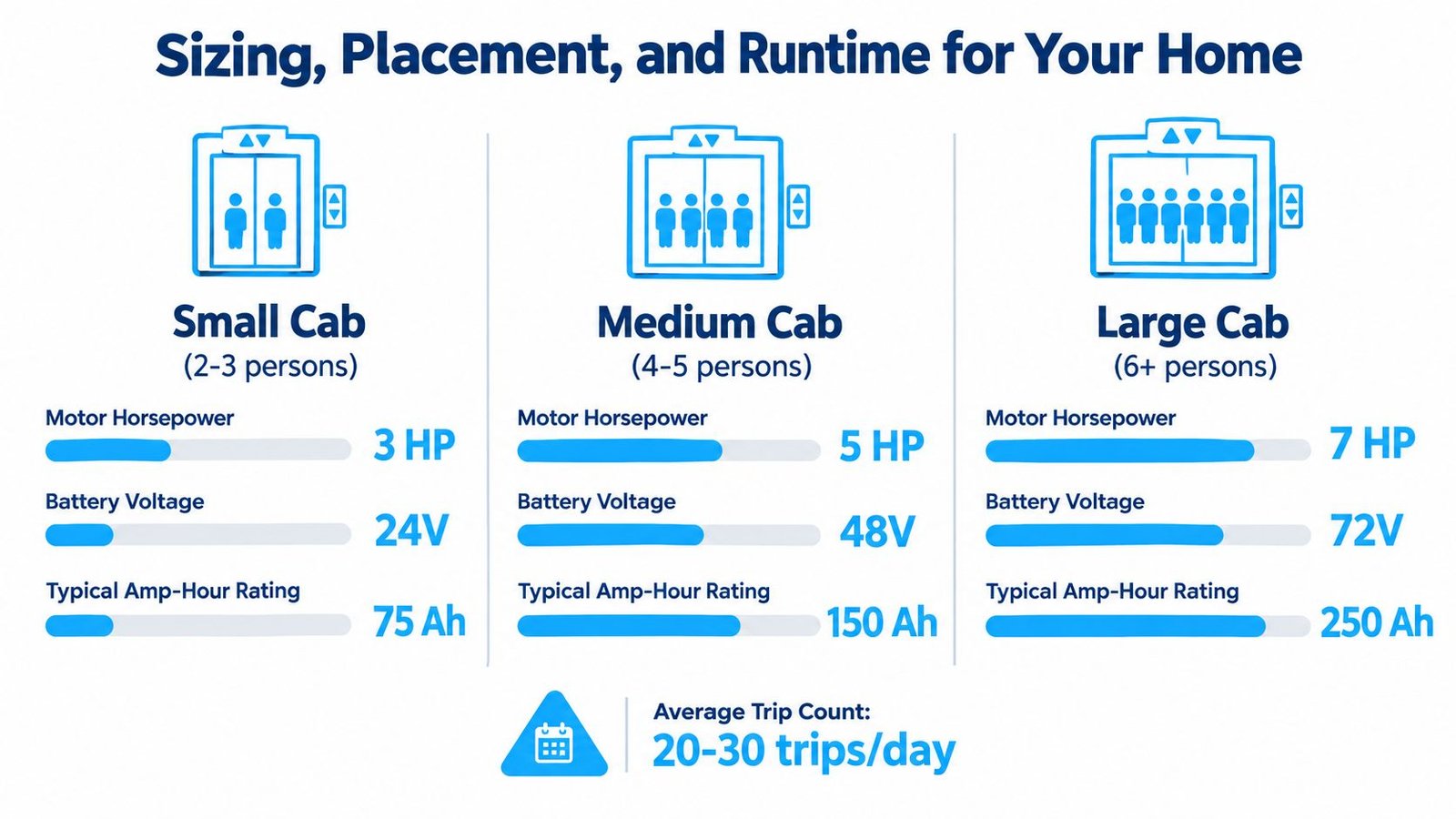
Battery sizing starts with the elevator, not the square footage of the house. A technician reviews motor horsepower, cab weight, rated load, travel height, door operation, control voltage, expected trip frequency, and the emergency sequence. The result is an amp-hour requirement that must support the intended function without forcing the battery to operate at the edge of its capacity.
A small cab may need a very different system from a large custom-home elevator. The infographic below illustrates sample specifications for different cab categories, but those values should not be treated as a quotation or a code requirement.
Three Lansing-area examples
A 1,200-square-foot ranch in East Lansing may have a compact cab, short travel, and limited daily use. The battery may be physically small, but the contractor still needs to account for door cycles, emergency lighting, communication, and the motor’s starting demand.
A two-story Okemos colonial may have more frequent trips, a heavier cab, and greater travel distance. The owner may need a larger cabinet or a remote battery location, particularly if the original equipment closet has little service clearance.
A four-stop custom home in Haslett creates a different calculation. More landings mean more door operations and potentially more travel during an emergency sequence. A system that appears adequate during a brief demonstration may perform poorly if the technician never measures voltage under the actual load.
Runtime estimates can swing from 5 to 40 trips depending on configuration, battery condition, and the selected emergency operation. That range comes from the scenario planning described here, not a universal guarantee. A responsible quote identifies the assumptions and states what the system is designed to do.
Placement matters as much as capacity. Inside the equipment closet keeps wiring short but can make battery replacement difficult. An adjacent utility room improves access but may require longer wiring runs and protected routing. A remote machine room may provide better working space, yet the contractor must verify temperature, ventilation, moisture exposure, clearances, and service access.
An oversized battery isn’t automatically safer. If the charger, transfer equipment, and controller aren’t matched to it, the owner may pay for capacity the elevator can’t use.
Undersizing creates a different problem. The battery may pass a quick voltage check but fail when the motor, door operator, and emergency circuits draw power together. Proper sizing includes a documented load test, not just a visual inspection.
Michigan Code and Inspection Implications
Michigan doesn’t use one inspection interval for every elevating device. Under the current rules, passenger and freight elevators, material lifts, platform-related lifting devices, escalators, moving walks, and several other device categories require inspection at least every 12 months. Dumbwaiters, stairway chairlifts, one-person elevators, platform lifts, and certain other listed devices follow a 24-month inspection schedule. Michigan’s inspection frequency rules
That schedule creates an important distinction for residential owners. The equipment’s classification determines the formal inspection cadence, while the manufacturer’s instructions, service history, usage, and local conditions determine how often the owner should maintain and test the system.
| Inspection Type | Frequency | Battery Checkpoint | Inspector Focus |
|---|---|---|---|
| Annual device inspection | At least every 12 months for listed device classes | Emergency operation, visible condition, records, and test results | Safe operation, required tests, certificate status |
| Biennial device inspection | At least every 24 months for listed device classes | Battery condition and emergency function where applicable | Device-specific compliance and documented results |
| Maintenance service | Based on equipment needs and applicable Michigan requirements | Charging, connections, alarms, capacity, and fault history | Preventive work and written records |
Michigan oversight data also show why owners shouldn’t treat the inspection date as a casual reminder. As of May 31, 2020, 73% of elevating devices were between 26 days and more than 5 years overdue for routine inspections, according to the Michigan Office of the Auditor General report. That finding concerns statewide compliance, not a prediction about a particular Lansing home, but it demonstrates the operational risk created by weak scheduling and incomplete records.
East Lansing certificate requirements
East Lansing requires elevators, dumbwaiters, and escalators to be kept free from physical and fire hazards and to display the current certificate of inspection. That local obligation means a property manager should know where the certificate is displayed, when it expires, and whether a service visit produced the documentation needed to support renewal.
Inspectors and service technicians may review battery age, charging condition, wiring, emergency lowering, alarm operation, and test records. Not every advisory observation creates an immediate shutdown, but a failed safety function, unsafe wiring condition, or inability to complete required testing can prevent approval or require the device to remain out of service until corrected.
Michigan rules also require written records covering maintenance, repairs, replacements, callbacks, and testing. A provider that leaves no useful record creates avoidable uncertainty at the next inspection. Owners needing to coordinate building power and elevator emergency operation can also review generator testing requirements for elevators, while keeping generator work and elevator battery work clearly separated in the maintenance file.
Maintenance, Testing, and Modernization Planning
A weak battery often reveals more than a battery problem. It may point to a charger that isn’t maintaining the correct condition, corroded terminals, a controller fault, poor temperature control, or a maintenance history that has relied on visual checks instead of measured performance.
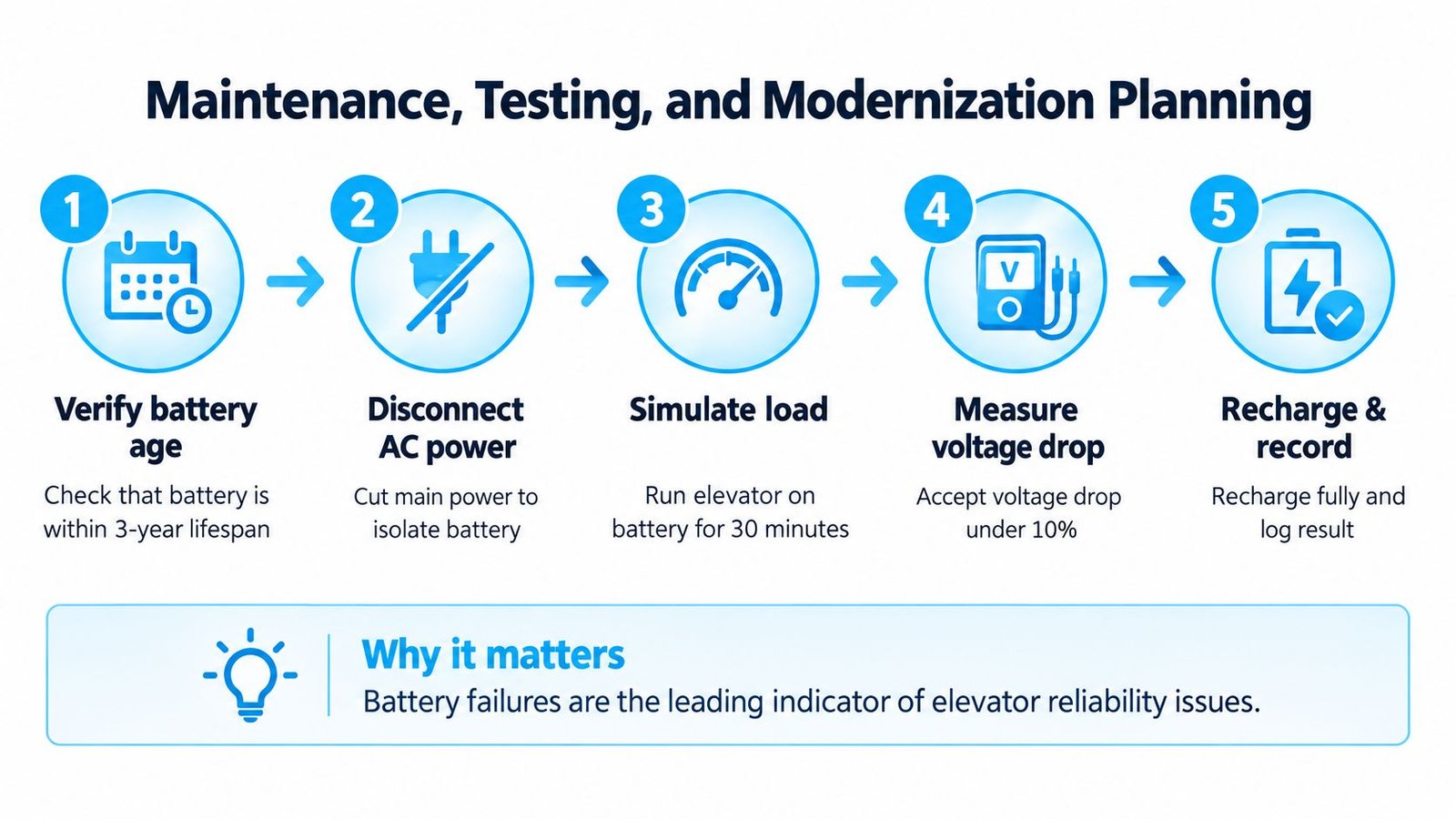
A quarterly load test can be useful in a residential service agreement, particularly for equipment serving an aging-in-place homeowner or a small building with no practical alternative route between floors. Michigan’s rules require power elevators to be maintained at least every 90 days by a licensed elevator journeyperson, as described in the Michigan maintenance recordkeeping and service rule. The exact maintenance plan should still reflect the device type and manufacturer’s requirements.
A technician may simulate power loss, observe the emergency sequence, measure voltage behavior, verify the recharge cycle, and record fault codes. A load test should answer a practical question: does the elevator complete its intended emergency function with stable voltage and reliable door, alarm, and communication operation?
Repair or modernize
Battery replacement alone may be appropriate when the charger, controller, wiring, emergency lowering sequence, and safety devices remain serviceable. A lithium retrofit may be reasonable when the existing cabinet and controller can support it without creating compatibility problems.
Modernization deserves consideration when the battery repeatedly fails, replacement parts are difficult to source, fault codes recur, or the controller and door equipment require frequent intervention. A non-proprietary modernization can give the owner more flexibility across makes and models, but it still needs a written scope, code review, shutdown plan, testing plan, and clear statement of which components are being retained.
Crane Elevator Company provides maintenance, repair, inspections, emergency response, backup-power work, and non-proprietary modernization across Lansing, Ann Arbor, Grand Rapids, Detroit, and surrounding areas. For an owner comparing repair with modernization, a second opinion should identify the immediate defect, the likely recurring risks, and the cost of keeping the existing architecture in service.
For a visual explanation of battery testing and modernization planning, use the following video as a supplement to an on-site evaluation:
Your Next Steps for Reliable Lansing Elevator Services
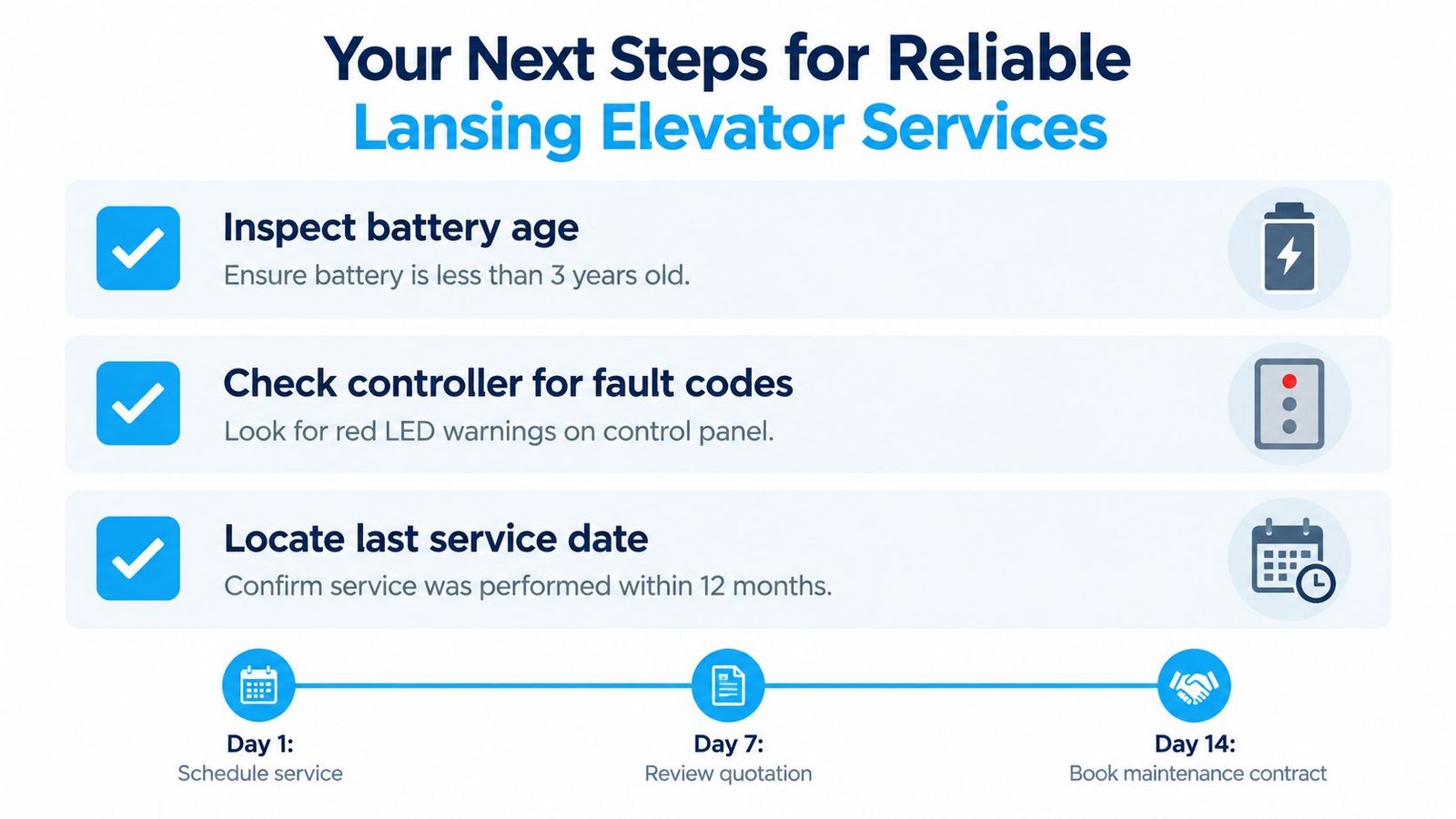
Start with the records, then inspect the equipment. A homeowner or property manager can gather useful information this week without opening the controller or touching battery terminals.
- Check the battery label. Record the installation date, chemistry, model, and cabinet location. Don’t assume a battery is healthy because the cabinet light is on.
- Look for controller fault codes. Photograph warning lights or displayed codes, but leave adjustments and electrical testing to a qualified elevator professional.
- Locate the inspection certificate. Confirm that the certificate is current and displayed where the municipality requires it.
- Confirm the device category. Ask whether the elevator falls under Michigan’s 12-month or 24-month inspection schedule.
- Review the service record. Look for documented maintenance, callbacks, repairs, battery testing, emergency lowering tests, and recharge verification.
Choosing the right service response
A service call may be enough when the elevator has one isolated fault, the battery passes its capacity test, and the controller and safety circuits remain reliable. Battery replacement alone may solve the problem when the battery has reached the end of its useful life but the charger, transfer relay, and emergency sequence perform correctly.
A broader modernization becomes more sensible when the owner is paying for repeated callbacks, the controller is obsolete, the door system causes recurring shutdowns, or the equipment can’t be supported with practical non-proprietary parts. The quote should separate immediate repairs from optional upgrades so the owner can make a decision based on risk, downtime, and long-term serviceability.
For homeowners comparing providers, residential elevator companies near me should be evaluated by more than response time. Ask whether the provider performs the required testing, documents results, handles emergency phones and generator interfaces, supports all makes and models, and can explain the difference between a battery repair and a modernization project.
Have the elevator make and model, number of stops, approximate installation date, battery label, latest inspection certificate, fault-code photos, and recent service invoices ready before the visit. That information lets a technician arrive prepared and produce useful answers instead of guessing from a brief conversation. Crane Elevator supports residential elevators, wheelchair lifts, material lifts, dumbwaiters, commercial systems, inspections, repairs, preventative maintenance, and non-proprietary modernization throughout Lansing and Michigan communities including East Lansing, Okemos, DeWitt, Holt, Haslett, Detroit, Ann Arbor, Grand Rapids, Flint, and Kalamazoo.
If your Lansing-area elevator needs a battery evaluation, documented inspection preparation, repair, or a non-proprietary modernization opinion, contact Crane Elevator Company to schedule a free second opinion. Share your service records and equipment details so the team can help you choose between a targeted repair, battery replacement, or a broader reliability plan.