A lot of building owners start looking for a Kalamazoo elevator company only after a bad week. A car is dropping calls, tenants are complaining, and the maintenance vendor keeps saying the mechanic is coming. By the time someone realizes nobody is on the way, the issue isn’t just the elevator. It’s the lost time, the upset occupants, and the fact that nobody can tell you what happens next.
That’s where the comparison starts. Not with the sales sheet, and not with the monthly line item. It starts with how an elevator contractor handles missed callbacks, mixed equipment, code testing, and the daily realities of keeping Michigan buildings moving in Kalamazoo, Detroit, Lansing, Ann Arbor, Grand Rapids, and the smaller towns in between.
When the Elevator Tech Does Not Show Up
It’s Tuesday in a Kalamazoo office building. The property manager called in a callback on Friday after tenants reported rough leveling and a door that hesitated on closing. They were given a service window. Monday passed. Tuesday afternoon arrives, and the elevator still hasn’t been touched.
By 2 p.m., the front office is fielding complaints from every floor. One tenant asks whether the car is safe to use. Another wants to know why visitors are climbing stairs. If the building has only one passenger unit, the pressure gets worse fast. If someone becomes trapped, the same manager who placed the original call is now scrambling for emergency help, documentation, and a clear answer.
That’s the hidden cost of a no-show. The missed visit is only the first failure.
Where no-shows usually break down
In the field, no-shows rarely happen because a mechanic forgot the address. They usually happen earlier in the chain:
- Dispatch never confirmed parts status. The call was accepted, but no one checked whether the truck carried the relay, door lock contact, or hydraulic seal needed to finish the repair.
- The callback got downgraded. A building reports an intermittent issue, dispatch treats it like a routine nuisance, and higher-pressure calls push it back.
- Nobody closed the loop with the customer. The contractor knows the route changed, but the property manager doesn’t hear about it until after tenants start calling.
Practical rule: If a company can’t tell you who owns the callback from dispatch to closeout, it can’t give you reliable service.
That’s why accountability language matters so much when you’re comparing a Kalamazoo elevator company. A written No Show, No Pay policy changes behavior because it puts consequences on missed appointments. It forces dispatch to schedule accurately, route technicians realistically, and communicate before a building loses half a day waiting.
Emergency work is where this matters most. If you’re dealing with entrapments, shutdowns, or a unit that can’t be left out of service, you need a contractor with a clear emergency elevator service process and a dispatch team that treats communication as part of the job, not an extra courtesy.
What an Elevator Company Actually Does
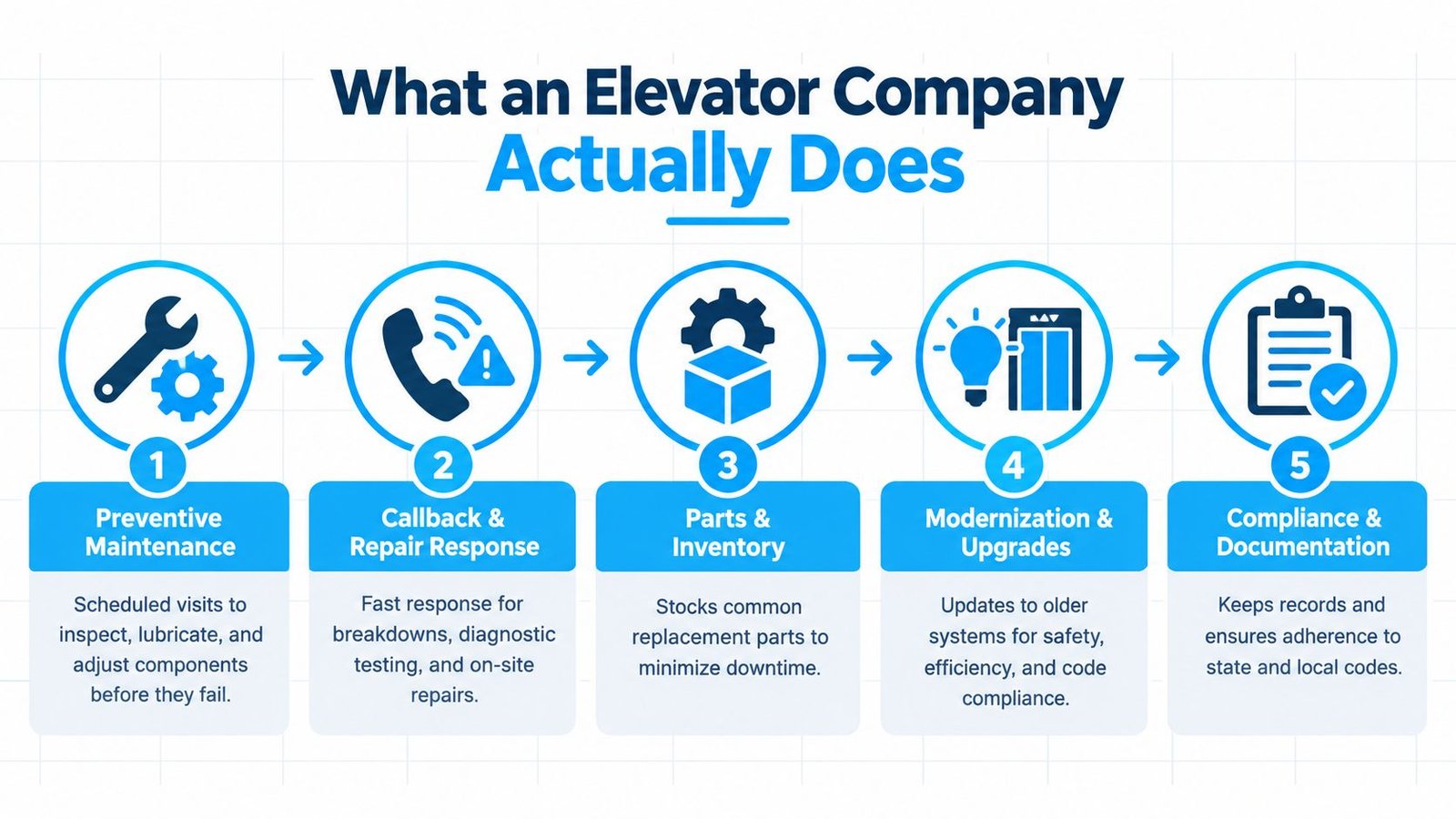
A building owner pays for far more than emergency repairs. The job is to keep the equipment running, document its condition, prepare it for required testing, and give the owner a clear path when old components stop making financial sense to keep.
The day-to-day work owners buy
For a facility manager comparing companies in Kalamazoo, Detroit, Lansing, Ann Arbor, or Grand Rapids, the question is simple. What work will this contractor perform with its own people, and what gets pushed off to someone else?
A service company’s work usually falls into five buckets.
- Preventive maintenance: Scheduled visits to clean, inspect, lubricate, adjust, and catch wear before it turns into downtime.
- Callback and repair response: Trouble calls, entrapments, nuisance shutdowns, fault tracing, and return visits when a unit still is not running right.
- Parts sourcing: Stocking common wear items and tracking down harder-to-find boards, selectors, door equipment, pumps, valves, and fixtures.
- Modernization: Replacing aging controllers, machines, door operators, fixtures, and related components when repeat repairs keep draining the budget.
- Compliance support: Coordinating inspections, safety tests, records, and correction work after violations or failed tests.
On a non-proprietary program, that scope matters even more. If a contractor services every make and model, the owner is not boxed into one manufacturer for diagnostics, parts strategy, or future upgrades. That gives a property team more room to compare repair versus modernization costs instead of being told there is only one approved path.
Family-owned crews also tend to be more direct about trade-offs. In-house mechanics should handle maintenance, troubleshooting, adjustments, and most repair labor. Specialty machining, some fabrication, and certain component rebuilds may still be subcontracted. There is nothing wrong with that, but an owner should know it before signing, because outsourced steps affect schedule, markup, and accountability.
The roles people confuse
Three roles get blurred together all the time, and that confusion causes bad scheduling.
A mechanic maintains and repairs the elevator. An adjuster handles setup, performance tuning, and technical system behavior after major repair or modernization. An inspector performs the formal code inspection and oversees required testing for the state or local authority.
Those are different jobs with different responsibilities. If a property manager asks for an inspection but dispatch sends a service mechanic, the visit does not solve the problem. If a modernization wraps up and no qualified adjuster finishes the tuning, the elevator may run, but not the way it should.
For owners, this comes down to one practical standard. The contractor should be able to say who is coming, what that person is qualified to do, and what outcome the visit is supposed to produce.
That is the difference between a vendor that sells labor by the hour and a Michigan service partner that runs a disciplined maintenance program, supports mixed equipment without locking the building into a proprietary model, and backs scheduled visits with clear accountability.
The Five Service Types Every Building Owner Should Know
Owners usually call for service before they’ve identified what kind of service they need. That’s how quotes get skewed. A repair issue gets priced like a modernization. A code problem gets buried inside a maintenance conversation. A new installation gets compared to a callback vendor.
Five Elevator Service Types Compared
| Service Type | Typical Trigger | Scope of Work | Owner Decision Point |
|---|---|---|---|
| Preventive maintenance contract | Repeated minor issues, aging equipment, tenant complaints | Scheduled visits, cleaning, adjustments, documentation, wear checks | Do you want predictable upkeep or are you still operating reactively? |
| On-demand callback and repair | Shutdown, entrapment, rough ride, door faults, leaks | Diagnostic visit, repair labor, return trips, parts replacement | Is this a one-off failure or the sign of a deeper system problem? |
| Modernization and code upgrades | Obsolete controls, recurring callbacks, inspection failures | Controller, operator, fixture, machine, or safety upgrades | Are you spending too much to keep old equipment alive? |
| Full replacement or new installation | Major redevelopment, severe equipment condition, changed building use | New elevator system, planning, permitting, installation, turnover | Does repair still make sense, or has the asset reached end-of-life value? |
| Inspection and witness testing coordination | Annual or required code cycle, post-repair testing, compliance notices | Scheduling, preparation, test support, corrections, paperwork | Is the unit ready to pass, and who owns the correction list if it doesn't? |
What each category looks like in practice
Preventive maintenance is where smart owners save themselves headaches. In older downtown West Michigan buildings, hydraulic units often run for years with only reactive service until a leak, valve issue, or door problem finally forces attention. A proper maintenance contract isn’t just a grease-and-go visit. It should include cleaning of critical spaces, operating checks, and written notes detailed enough that the next mechanic can see the pattern.
On-demand repair is what comes to mind first. The elevator is down, someone calls, a mechanic shows up. That works fine for isolated failures, but it gets expensive when the same issue repeats because nobody addressed the root cause. If a contractor doesn’t ask about prior callbacks, controller history, or environmental conditions in the machine room, they’re probably treating symptoms.
When modernization is the better answer
Modernization sits in the middle ground between patchwork repairs and total replacement. That’s common in Michigan properties with mixed-age equipment. A Lansing office or institutional building might still have a sound hoistway and cab but need a controller upgrade or door operator replacement because the old system no longer supports dependable service.
Michigan’s code framework also pushes owners toward a broader view of maintenance. The state requires many elevator types, including passenger and freight elevators, escalators, moving walks, belt manlifts, and special elevating devices, to be inspected at least once every 12 months under the Michigan elevator code inspection rules. If an older controller or safety circuit keeps creating compliance trouble, modernization can be the cheaper long-term decision even when the unit still technically runs.
Full replacement or new installation is the least common option, but sometimes it’s the honest one. If a building changes use, adds accessibility requirements, or has equipment that no longer suits the traffic pattern, replacing the system may make more sense than rebuilding it one subsystem at a time.
Inspection and witness testing coordination catches owners off guard more than it should. A good contractor asks early: What type of unit is it? What happened on the last inspection? Are there open violations? Has anyone tested safeties recently? Those questions usually tell you which service category you really need.
Proprietary Versus Non-Proprietary Service Explained
This is one of the most important distinctions in the business, and a lot of owners don’t hear about it until they’re already boxed in by a contract.
The basic difference
Proprietary service ties the equipment closely to the original manufacturer’s parts, software, and diagnostic tools. In that model, service often depends on access controlled by the OEM. That can work well on newer systems still under warranty or on buildings that want factory-directed support on a single brand.
Non-proprietary service is different. The contractor works on every make and model using industry-sourced parts, open-service components where available, and third-party diagnostics where appropriate. For owners with mixed fleets, older elevators, or multiple buildings, that flexibility matters.
Here’s the side-by-side view.
Proprietary vs. Non-Proprietary Elevator Service
| Factor | Proprietary Service | Non-Proprietary Service |
|---|---|---|
| Parts access | Often controlled by original manufacturer | Broader sourcing through industry channels |
| Software and diagnostics | May require OEM-specific access | Uses non-proprietary tools where supported |
| Best fit | Newer systems, warranty-sensitive equipment | Mixed fleets, older units, cost-conscious ownership |
| Vendor flexibility | Limited if system lock-in is high | Easier to switch providers |
| Response options | Depends on local branch bandwidth | Wider pool of service-capable contractors |
Where the trade-offs are real
Proprietary service isn’t automatically bad. If you just installed a new system and the warranty structure depends on OEM procedures, staying inside that lane may be the right move for a while.
But lock-in becomes a problem when a building can’t get timely support, or when changing vendors would require replacing major controls just to restore service freedom. That’s why owners looking at a Kalamazoo elevator company should ask whether the system can remain serviceable by qualified independents later. A useful starting point is understanding how non-proprietary elevator service works before the contract gets signed.
If your building needs permission from one manufacturer every time a software issue appears, you don’t have much negotiating leverage when service slows down.
For many Michigan properties, non-proprietary service makes the most sense where the fleet includes older hydraulics, different controller brands, and buildings spread across several cities. It won’t fit every situation, but it gives owners more room to control response, contract terms, and future budgeting.
Michigan Code Requirements and Inspection Cycles
An elevator can run for months without a visible problem, then fail inspection over a governor test, missing records, or a door protection issue that should have been caught on routine service. For owners, that usually means one thing. The shutdown starts before the budgeting conversation does.
What Michigan requires
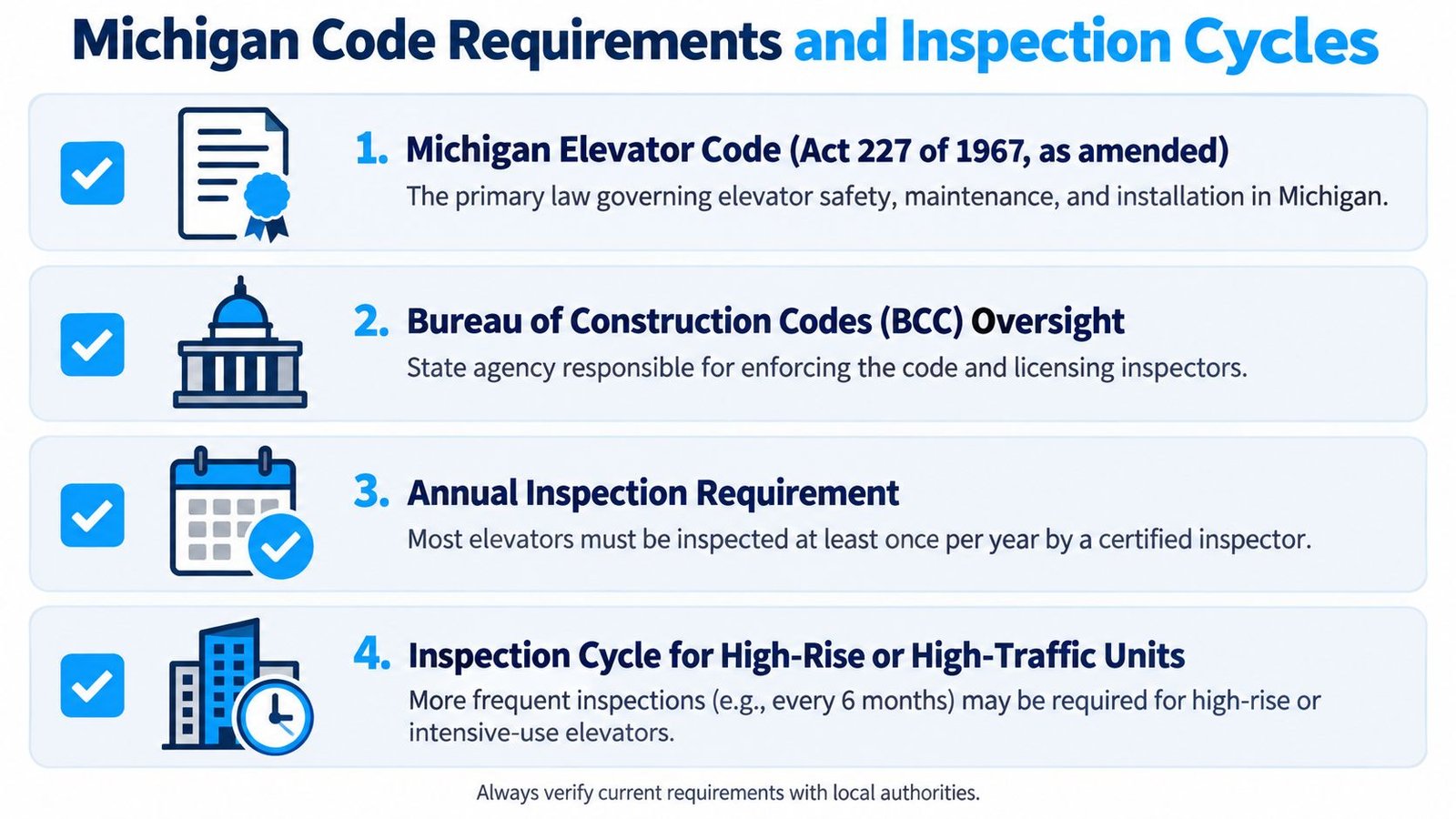
Michigan sets inspection and testing intervals by equipment type, and the details matter. Under the state’s current elevator code rules, passenger elevators, freight elevators, inclined elevators, escalators, moving walks, and special elevating devices are generally inspected at least once every 12 months. Smaller devices such as dumbwaiters, stage lifts, stairway chairlifts, and platform lifts can fall on different cycles, so owners should confirm the schedule against the exact equipment in the building.
The same rule set also covers required maintenance inspections and safety testing after equipment is placed in service. That includes recurring tests for safeties and governors. If the records are incomplete or the test is overdue, “it’s been running fine” does not help much on inspection day.
For a plain-English breakdown of the state rules, permit questions, and common inspection triggers, review these Michigan elevator code requirements.
What your elevator contractor should be doing before the inspector arrives
A maintenance visit keeps the unit operating. A code inspection confirms the unit meets the legal standard. Good contractors treat those as related jobs, not the same job.
Before a scheduled inspection, the mechanic should check door operation, emergency communication, pit condition, machine space access, ride quality, and any device the inspector is likely to witness during testing. On older mixed-brand equipment, this prep work matters even more because nuisance issues stack up fast. One weak door clutch, one bad phone line, and one missing log entry can turn a routine visit into a correction list.
A non-proprietary service program has practical value for facility managers with buildings in Kalamazoo, Detroit, Lansing, Ann Arbor, or Grand Rapids. A family-owned Michigan crew that services every make and model can prep the whole fleet the same way, instead of splitting responsibility by manufacturer. That gives owners one record trail, one service standard, and fewer gaps when inspection dates come due.
Owners should expect the file to include:
- Maintenance records: Service dates, callback history, recurring faults, and replaced parts
- Test documentation: Safety test results, witness paperwork, and completed correction records
- Violation tracking: Open items, assigned responsibility, and target completion dates
Detroit has an extra local layer
Detroit adds a stricter operating expectation than the state baseline alone. The city ordinance requires power elevators, escalators, and moving walks to be inspected and serviced at least once every 30 days by a licensed unlimited-elevator journeyperson, with an extension up to 90 days only by special permission when use is unusually low under Detroit’s elevator service ordinance. The ordinance also requires at least one passenger elevator in occupied buildings to remain in operation at all times.
That changes how service has to be scheduled. In Detroit, missed maintenance is not just a contract problem. It can create a compliance problem fast, especially in buildings that cannot afford to lose their last available passenger car. For facility managers comparing elevator companies, this is one of the practical questions that separates a real regional service partner from a sales promise. If a contractor misses the visit, the code calendar does not care why.
Crane Elevator Across Detroit, Lansing, Ann Arbor, and Grand Rapids
Regional service sounds simple on a website. In practice, it’s a routing problem. A Kalamazoo-based team has to think in truck paths, overlapping calls, and how to cover a shutdown in one city without leaving another customer exposed.
The geography matters because the Michigan markets are spread out. The state’s major population and commercial centers include Detroit at 650,499, Grand Rapids at 201,357, Ann Arbor at 121,651, and Lansing at 114,024, based on 2026 estimates from Michigan city population data. For a family-run contractor, those cities aren’t just dots on a map. They’re the places where multi-site owners expect one service relationship to cover several buildings.
What the building mix looks like
Detroit brings high-rise office towers, multifamily properties, parking structures, and older commercial cores where uptime pressure is constant.
Lansing often means state-related facilities, municipal properties, and office buildings where traction units, public traffic, and compliance oversight demand disciplined maintenance.
Ann Arbor has its own profile. More mixed residential properties, academic buildings, healthcare-related traffic, and accessibility equipment all push service teams to be comfortable with more than one equipment type.
Grand Rapids combines medical, hospitality, commercial, and convention-related elevator work. The service rhythm is different there because traffic patterns can change fast based on building use.
How surrounding towns fit the route
Family-owned coverage can work well if it’s managed responsibly. A contractor that serves Detroit, Lansing, Ann Arbor, Grand Rapids, and surrounding areas also has to account for places like Battle Creek, Jackson, Holland, Portage, Marshall, Albion, and Coldwater. Those towns often sit inside the same route logic as the larger cities.
Good regional service doesn’t mean promising the same arrival time to every zip code. It means building enough route overlap that a missed appointment isn’t shrugged off as “distance.”
That’s where a No Show, No Pay commitment has teeth. It forces the company to match promises to actual route capacity, not just take calls and sort them out later.
How to Evaluate a Kalamazoo Elevator Company
If you compare bidders by monthly price alone, you’ll miss the part that hurts later. The test is accountability.
Use a scorecard, not a gut feeling
Start with response language in writing. Ask whether the contract names emergency response expectations, callback handling, and what happens if a scheduled visit is missed. Then ask for a sample maintenance ticket. If the notes are vague, the service probably is too.
Here’s the short list I’d use when evaluating any Kalamazoo elevator company:
- Written guarantees: Does the contractor spell out response commitments and appointment accountability?
- Service flexibility: Can they work on every make and model you own, or only selected equipment?
- Documentation quality: Are maintenance logs detailed enough to show patterns and pending risks?
- Second-opinion willingness: Will they review another contractor’s recommendation without forcing a replacement sale?
- Coverage reality: Do they serve your city and nearby properties on a regular route?
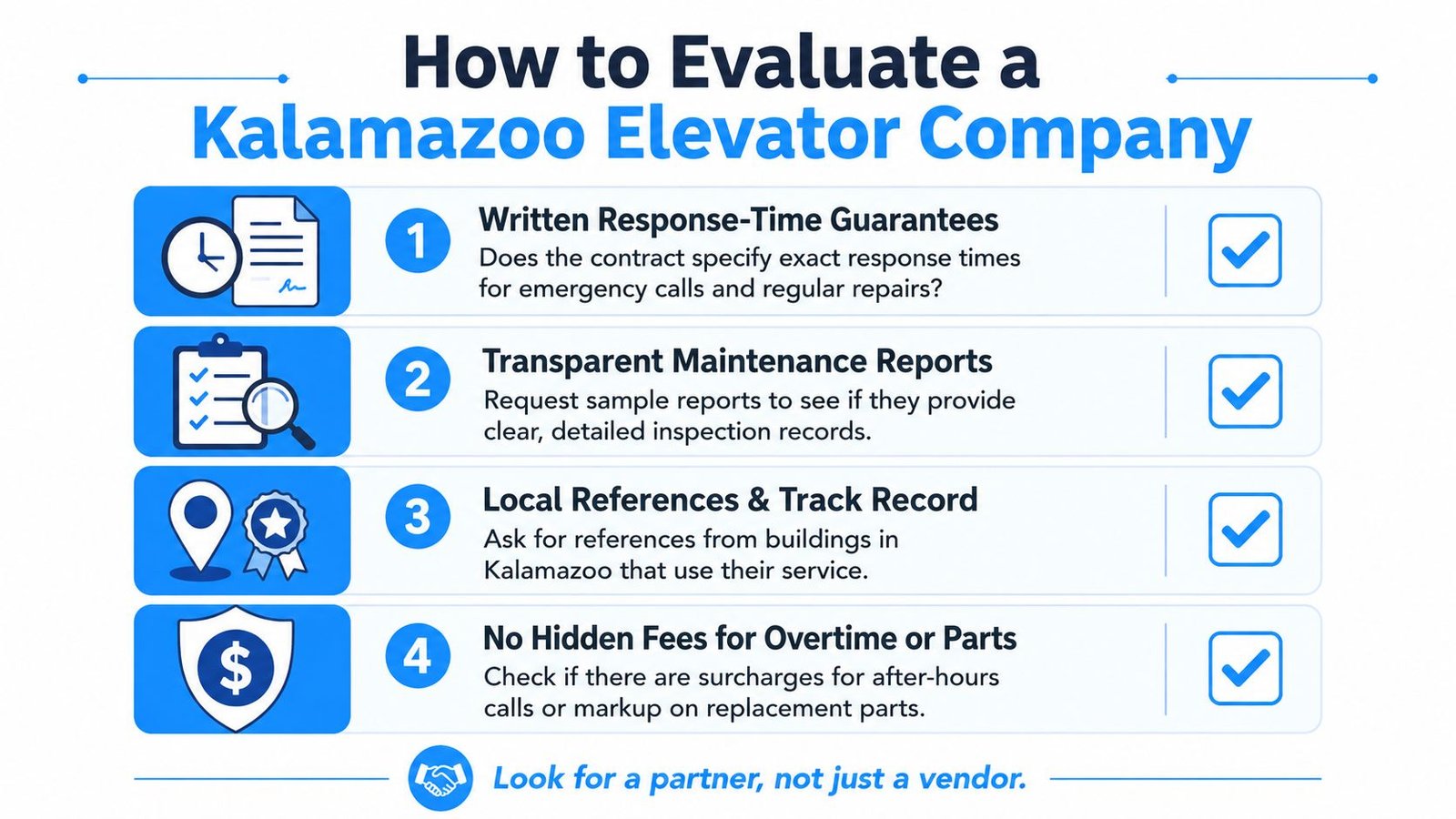
A quick visual overview helps, but the phone call tells you plenty too. If the office takes hours to return a sales inquiry, that same communication pattern usually shows up during a shutdown.
This video is worth watching if you’re comparing service expectations and contractor fit:
Ask direct questions. Who answers after hours? Who owns inspection corrections? What gets subcontracted? Who signs off when a callback is completed? Those answers tell you more than a polished brochure ever will.
Crane Elevator Company offers family-owned elevator maintenance, repairs, inspections, modernization, and non-proprietary service for buildings across Michigan and surrounding areas, including the kinds of mixed fleets and route-driven coverage challenges described here. If you’re weighing options for a Kalamazoo elevator company and want a contractor that works on every make and model with a No Show, No Pay approach, visit Crane Elevator Company.