
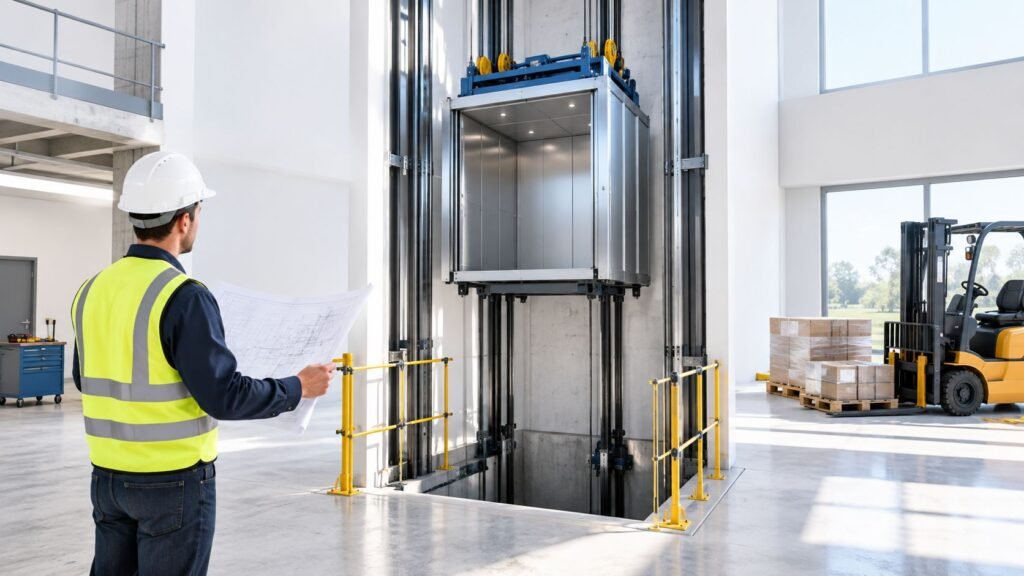
A production manager calls at 6:15 a.m. because the freight elevator stopped between the loading dock and the warehouse floor. The first shipment is waiting, the maintenance team needs access to equipment upstairs, and everyone wants to know whether the problem is a failed component, an overdue inspection, or a service decision that was postponed too long.
That confusion is common because freight elevator service covers two different responsibilities. Inspections establish a legal safety baseline, while proactive service keeps the equipment dependable between inspections. A sound plan also considers the elevator's capacity, duty cycle, site conditions, documentation, and whether the system can be repaired by qualified technicians without proprietary restrictions.
Assessing Capacity and Service Requirements
A freight elevator should be specified around the work it performs, not around a convenient catalog rating. Before concrete is poured or steel is ordered, walk the material path from the receiving area to every intended landing. Record the heaviest load, the widest pallet, the tallest equipment, the turning radius for carts, and whether a forklift or powered pallet truck will enter the car. The installed capacity plate and manufacturer documentation must control the final rating, but the planning team has to define the actual loading pattern first.
A pallet may fit by weight but fail by geometry. A machine may fit inside the car but impose a concentrated wheel load that affects the platform, sill, or structural support. Medical equipment and maintenance machinery can create similar problems because their dimensions and handling requirements often differ from ordinary warehouse cargo.
Start with the operating profile
Use a practical assessment rather than a single maximum-load assumption:
- Rated load: Establish the heaviest complete load, including pallets, carts, tools, operators, and any vehicle entering the car.
- Car dimensions: Check clear width, depth, height, door opening, landing approach, and the space needed to align loads safely.
- Traffic pattern: Identify whether the elevator supports occasional deliveries, continuous production, hospital logistics, school operations, or distribution activity.
- Loading conditions: Account for rolling loads, impact from pallet trucks, uneven placement, moisture, dust, temperature, and corrosive materials.
- User classification: Confirm whether the equipment is intended for goods only, attendant operation, or any permitted human transport. A goods-only elevator mustn't become an improvised passenger elevator.
Facility managers should review freight elevator dimensions and planning considerations before the design is fixed. A late change to the car envelope or door arrangement can affect the shaft, structure, electrical work, and material-flow plan.
Separate inspection from service
Michigan's inspection requirement is not the same thing as a preventive maintenance schedule. The legal inspection checks whether the conveyance meets the applicable safety requirements at the required interval. Service work examines wear, contamination, lubrication, door operation, controls, hydraulic components, safety devices, and other conditions that can cause a shutdown before the next inspection.
Michigan's 2026 draft code distinguishes those responsibilities. It states that passenger and freight elevators must be inspected at least once every 12 months, while temporary construction-use freight elevators require maintenance every 30 calendar days and inspections every 90 calendar days. The same draft calls for an inspection report within 2 business days after the inspection. These requirements should be confirmed with the authority having jurisdiction for the specific project and equipment.
A regular service cadence should reflect duty cycle and system type. Modern traction units are commonly serviced quarterly or semi-annually, with rope replacement often falling in the 8 to 12 year range depending on duty cycle and corrosion exposure. Hydraulic freight elevators typically need service every 2 to 3 months because fluid degradation and seal wear can raise reliability risk. These planning benchmarks are described in freight elevator maintenance lifecycle guidance.
Practical rule: An inspection can identify an unsafe condition. Preventive service is what gives your team a better chance of finding that condition before it interrupts production.
Navigating Michigan Codes and Permitting
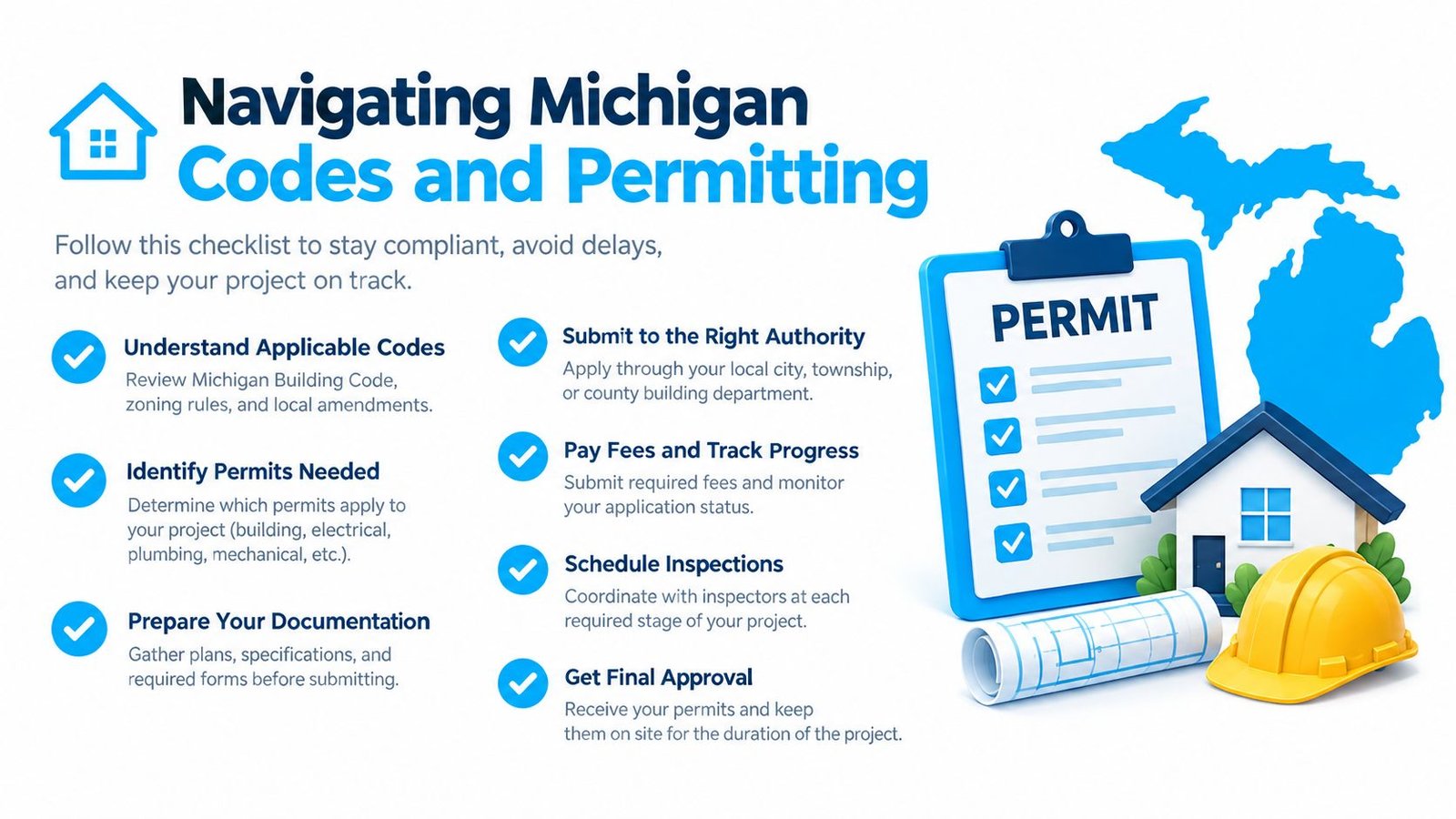
Michigan elevator work involves more than selecting equipment and hiring an installer. New installations, alterations, repairs, testing, and modernization work must be coordinated with the applicable state requirements, adopted ASME standards, permit processes, and local oversight. The authority having jurisdiction may require drawings, equipment information, test results, contractor documentation, and correction records before the elevator can be placed into service.
The most effective approach is to establish the compliance path before ordering equipment. Ask the contractor which code edition applies, who will pull the permit, which party will schedule the inspection, and what records will be delivered at closeout. If those answers are vague, the project has a documentation risk even if the mechanical installation is sound.
Know the legal baseline
A useful distinction appears in neutral government guidance for owners. Periodic service isn't directly required by code in every situation, but the conveyance still must be maintained and serviced as necessary for safe operation. Permit renewal depends on inspections for code compliance, so a service contract doesn't replace the inspection process, and an inspection certificate doesn't replace day-to-day maintenance.
Michigan's 2026 draft code provides the clearest operational example for standard and temporary equipment. Standard passenger and freight elevators must be inspected at least once every 12 months. Temporary construction-use passenger or freight elevators require maintenance every 30 calendar days, inspections every 90 calendar days, and an inspection report within 2 business days. The more demanding schedule reflects a different operating environment, where equipment is exposed to construction traffic, changing landings, dust, impact, and temporary electrical or structural conditions.
Owners can use Michigan elevator code requirements as a starting point, but the project team should still verify the current requirements with the responsible state or municipal authority. A code summary on a website isn't a substitute for a permit review.
Treat records as part of the equipment
Documentation failures regularly create avoidable delays. Inspection forms may require full-load speed verification, one-hour run tests, maintenance-control-program records, monthly fire-service logs, and performance checks for safety components. For hydraulic units, testing may include overspeed or rupture-valve performance at 10% above contract speed, as specified in the applicable inspection procedure.
The code data plate also matters. State and federal facility guidance indicates that it should identify the code edition used for inspections. A missing, damaged, or outdated plate can force additional review even when the elevator runs properly.
Keep a project file with:
- Permit records: Include approved drawings, alteration descriptions, equipment data, and inspection scheduling.
- Maintenance-control-program documents: Preserve the procedures and records that show how maintenance responsibilities are managed.
- Test results: File full-load tests, safety tests, fire-service verification, emergency communication checks, and corrective actions.
- Monthly logs: Keep fire-service and other required operational records in a location available to the facility team and inspector.
- Violation closeout: Document each correction, the date completed, and the evidence submitted for re-inspection.
The federal hydraulic elevator inspection report illustrates how procedural these inspections can be. Hardware and paperwork have to agree.
Design Choices and Site Preparation
Hydraulic and traction systems can both serve freight applications, but they solve different building problems. Choosing between them on purchase price alone usually creates trouble later. The better decision weighs travel height, duty cycle, speed expectations, pit and overhead conditions, energy use, service access, and the consequences of a shutdown.
A hydraulic system is often a sensible choice for lower-rise, heavy-duty work where speed isn't the main objective. It can deliver strong lifting performance and a straightforward arrangement, but the owner must plan for fluid condition, seals, packing, jack access, and the environmental consequences of a leak. A traction system can suit greater travel heights and demanding operating patterns, though it brings more equipment coordination around the motor, traction sheave, suspension means, controls, and machine-room or machine-room-less arrangement.
Compare the drive systems
| Feature | Hydraulic Systems | Traction Systems |
|---|---|---|
| Typical fit | Lower-rise, heavy-duty applications where speed is secondary | Greater travel heights and varied speed requirements |
| Main service focus | Fluid condition, seals, packing, jack, tank, and power unit | Ropes, sheave, motor, brake, controller, and suspension system |
| Site implications | Requires suitable pit and hydraulic equipment planning | Requires coordinated overhead, machine-space, and structural planning |
| Operating trade-off | Strong heavy-load capability with more attention to fluid and seal wear | Efficient fit for taller travel and demanding duty profiles |
| Common selection error | Treating hydraulic equipment as maintenance-free | Underestimating rope, brake, and control-system service needs |
Make the shaft ready before delivery
The installation crew shouldn't arrive to discover that the hoistway is out of plumb, the pit is flooded, or the electrical service can't support the controller. Before equipment delivery, the general contractor and elevator contractor should verify:
- Hoistway enclosure and dimensions: Confirm shaft dimensions, plumbness, landing openings, sill locations, overhead clearance, and required fire-rated construction.
- Pit condition: Remove debris, control water intrusion, provide approved access, and verify pit depth against the selected equipment.
- Structural support: Complete rail brackets, divider beams, machine supports, landing entrances, and any reinforcement required for concentrated loads.
- Electrical readiness: Provide the correct disconnects, feeders, grounding, lighting, receptacles, emergency power interfaces, and controller space.
- Machine-room planning: Protect clear working areas, ventilation, access, lighting, and equipment handling routes. Machine-room-less designs still need service clearances and safe access.
- Door and landing coordination: Set rough openings and finished-floor elevations accurately. A small mismatch at a freight sill can become a daily loading hazard.
- Environmental controls: Address water, dust, extreme temperatures, washdown practices, and corrosive exposure before the equipment is energized.
The right design also allows technicians to reach components without dismantling unrelated building systems. That access decision affects future downtime as much as the original drive selection.
The following video provides useful visual context for freight elevator equipment and installation planning.
Don't accept a design that hides service access behind permanent walls or treats the pit as leftover space. A freight elevator earns its value through years of loading cycles, and every inaccessible component makes future repairs slower and more disruptive.
The Installation Timeline and Commissioning
Once the shaft, pit, power, and structural supports are ready, installation becomes a sequence of coordinated activities rather than a single delivery event. A typical project begins with receiving and inspecting the equipment, then progresses through the guide rails, car structure, hoisting equipment, entrances, wiring, controls, and testing. The exact order varies by system, but the handoffs between the elevator crew and general contractor must be explicit.
The crew first verifies the hoistway and establishes reference lines. Guide rails are installed and aligned, brackets are secured, and the car sling and platform are assembled. For a freight elevator, platform construction and loading surfaces deserve careful attention because the equipment must tolerate the actual loading method, not merely an unloaded demonstration run.
From steel to operating equipment
The next phases bring the mechanical and electrical systems together. The team installs the hoisting or hydraulic equipment, car and counterweight components where applicable, landing entrances, car doors or gates, buffers, safeties, limit devices, controller, wiring, and operating fixtures. Door locks and interlocks receive special scrutiny because freight traffic often introduces impact, dirt, and misalignment.
Fire service and emergency communication can't be left for the final hour. The installation plan should identify the fire alarm interface, emergency phone or communication system, generator connection where provided, firefighter operation, and the person responsible for integrated testing. The facility's electrical and life-safety teams need to participate before the final inspection.
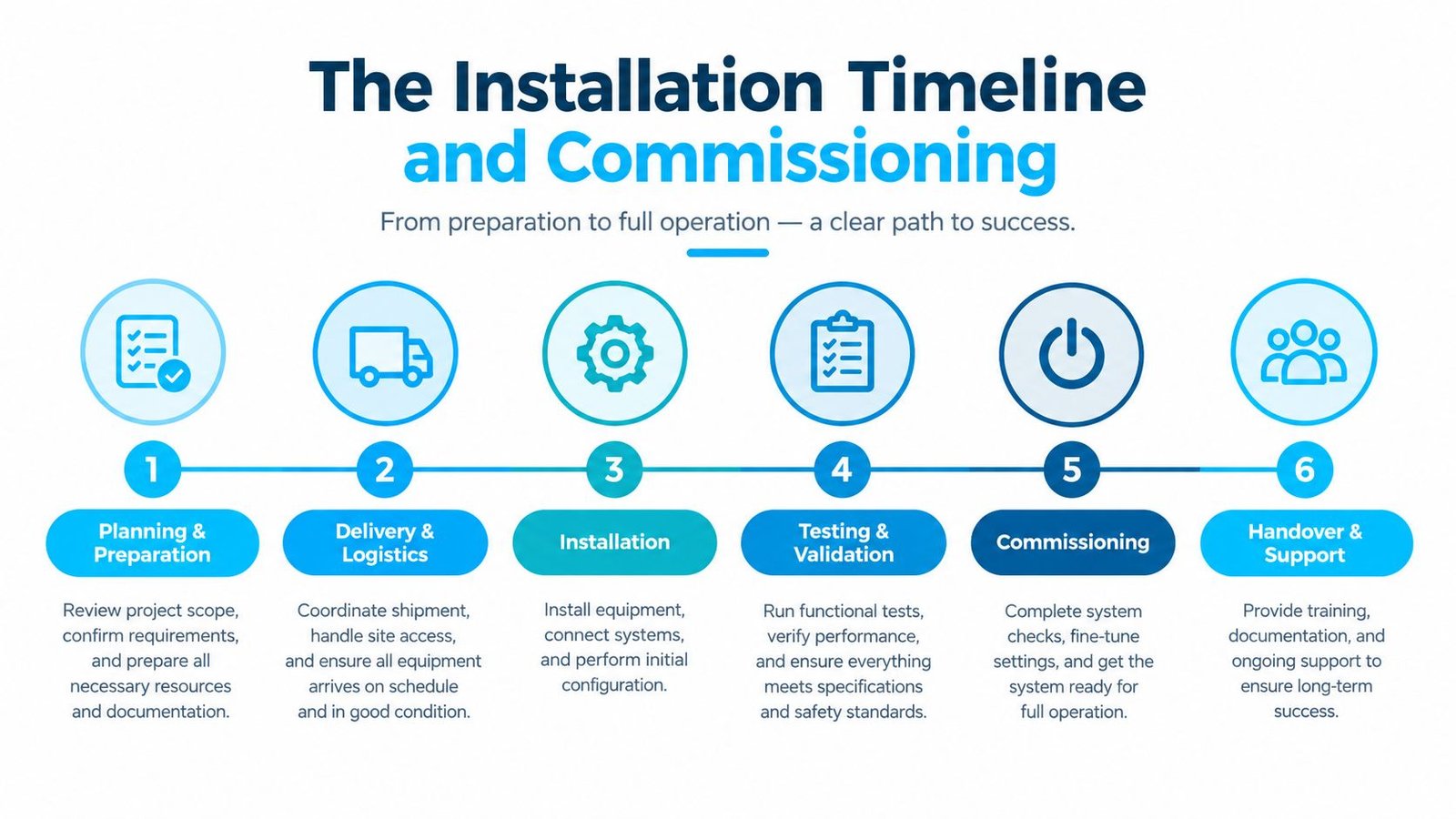
Commissioning starts with controlled movement at low speed and progresses to operational testing. Technicians verify leveling, door operation, stopping accuracy, controls, alarms, emergency communication, and safety circuits before applying the required loads.
Testing is a separate project phase
A rushed turnover creates problems that surface after the contractor leaves. Build time into the schedule for:
- Full-load speed testing: Verify operation against the required contract speed and the inspection procedure.
- Safety-device testing: Confirm overspeed, rupture-valve, governor, brake, limit, and related protective functions as applicable to the system.
- Run testing: Inspection procedures may require a one-hour run test, with results recorded rather than assumed.
- Fire-service operation: Test recall, firefighter controls, power interfaces, and monthly fire-service log procedures.
- Emergency communication: Confirm the phone or communication device reaches the designated response point and that staff know how to answer it.
- Documentation review: Assemble permits, test results, maintenance-control-program records, code data-plate information, manuals, and correction reports.
A final state inspection is easier when the equipment is clean, accessible, labeled, and supported by complete records. The owner should receive an operating orientation, a service contact procedure, a list of excluded uses, and a clear explanation of who maintains the monthly logs.
Commissioning principle: A freight elevator isn't ready because the car moves. It's ready when the car, controls, safety systems, building interfaces, records, and trained operators work together.
Lifecycle Costs and Non-Proprietary Maintenance
The purchase order is only the beginning of a freight elevator's financial life. Owners pay through service calls, worn doors, hydraulic leaks, rope and sheave work, controller failures, inspection corrections, lost production, and modernization decisions. A low initial price can become expensive if the design makes ordinary repairs difficult or restricts the owner to one source for critical parts and programming.
Maintenance contracts should be treated as a core operating expense. Industrial lifecycle planning places maintenance contracts at about 22% to 25% of total lifecycle cost, which is why owners should budget service from the beginning rather than treat it as an occasional repair line. The benchmark is cited in freight elevator lifecycle cost guidance, and the actual cost for a facility will depend on equipment, use, environment, parts, labor, and modernization choices.
Buy flexibility into the specification
A non-proprietary elevator system gives the building owner greater freedom to select qualified service and modernization providers over the equipment's useful life. That doesn't mean every technician can work on every system without training. It means the design, controller, documentation, tools, and replacement components aren't intentionally structured to prevent competent third-party service.
Specify accessible documentation, standard interfaces where available, serviceable controls, and a clear parts strategy. Ask who owns the software and diagnostic access, whether replacement components can be sourced through qualified channels, and what happens if the original installer no longer supports the equipment. Those questions belong in the purchase specification, not in an emergency meeting years later.
The financial logic is straightforward. Competition can improve procurement options, while open technical information can make modernization planning less dependent on a single vendor. A non-proprietary approach also supports phased work, such as replacing a worn power unit while preserving usable portions of the existing installation.
Preventive work targets predictable failures
Good maintenance is not a generic visit marked “checked.” The technician should clean the machine room, pit, and car top; monitor door locks and interlocks; inspect wiring and terminals; check lubrication; evaluate hydraulic packing and fluid condition; review ropes, sheaves, brakes, guides, safeties, and controls; and record findings that need planned correction.
For hydraulic equipment, packing, jack condition, tank and power-unit performance, fluid contamination, and leaks deserve consistent attention. For traction equipment, rope condition, sheave wear, brake adjustment, motor performance, controller health, and alignment deserve equal focus. Freight doors and thresholds need special care because repeated pallet and cart contact can accelerate wear.
A useful contract defines response procedures, included inspections, documentation, emergency coverage, exclusions, and modernization planning. It should also explain whether clean-downs, bulb replacements, testing, violation corrections, and follow-up visits are included or billed separately.
Review non-proprietary elevator options before approving a new installation or major modernization. The decision protects more than today's budget. It preserves repair choices for the years when the building's operating needs, service provider, and equipment technology have changed.
Choosing the Right Michigan Elevator Partner
A freight elevator contractor has to understand both the equipment and the building's consequences when it stops. An industrial plant may lose production access. A hospital may lose a material route. A school or municipal facility may face an accessibility or logistics problem. The right partner connects inspections, repairs, modernization, emergency response, documentation, and long-term parts strategy instead of treating each request as an isolated transaction.
Crane Elevator Company is a family-owned Michigan and Ohio elevator contractor with over 25 years of hands-on experience. Its stated service model includes preventative maintenance, repairs, code-required inspections, testing, new installations, and non-proprietary modernization for freight, passenger, residential, accessibility, and material-lift equipment. That breadth matters when a facility has mixed equipment or needs one team to evaluate whether an aging freight car should be repaired, modernized, or replaced.
Test the contractor before the emergency
Ask direct questions before signing a service agreement:
- Coverage: Can the contractor support Detroit, Lansing, Ann Arbor, Grand Rapids, and surrounding areas with an actual field-response plan?
- Technical range: Does the team work on hydraulic and traction equipment, older freight cars, passenger elevators, wheelchair lifts, dumbwaiters, and material lifts?
- Compliance support: Will the contractor help organize inspection records, fire-service logs, maintenance-control-program documentation, permits, and violation corrections?
- Emergency response: Is emergency coverage available outside normal business hours, and who receives the call when the elevator affects production?
- Modernization flexibility: Can the contractor recommend a non-proprietary solution instead of forcing a complete replacement?
- Commercial terms: Are financing options, second opinions, competitive quotes, and clearly defined service inclusions available?
- Maintenance detail: Does the program include meaningful clean-downs and component monitoring, or only a brief visual visit?
Statewide coverage should include more than the largest metros. A practical Michigan service territory can reach Brighton, Chelsea, Holland, Howell, Jackson, Muskegon, Rockford, Saugatuck, South Haven, and St. Johns, along with communities near Detroit, Lansing, Ann Arbor, and Grand Rapids. Crane's published Michigan service information also describes support for freight, passenger, residential, and accessibility-related elevator work, with responsive emergency field operations.
Choose uptime over paperwork theater
The best agreement is the one that makes the elevator easier to operate, inspect, document, and repair over time. A contractor should tell you what the equipment needs, what the code requires, what can wait, and what failure could stop the building. Those answers should appear in service reports that a facility manager can use for budgeting and compliance, not just in a technician's memory.
Freight elevator service works when it combines a realistic duty-cycle plan, correctly scheduled inspections, disciplined preventive maintenance, accessible equipment, complete records, and a non-proprietary lifecycle strategy. It fails when owners confuse an inspection sticker with maintenance, defer small door or hydraulic problems, or approve equipment that locks future repairs to one source.
Crane Elevator Company provides freight elevator installation, preventative maintenance, repairs, code-required inspections, emergency response, and non-proprietary modernization across Michigan and Ohio. Visit Crane Elevator Company to discuss your equipment, service cadence, documentation needs, and long-term uptime plan.