
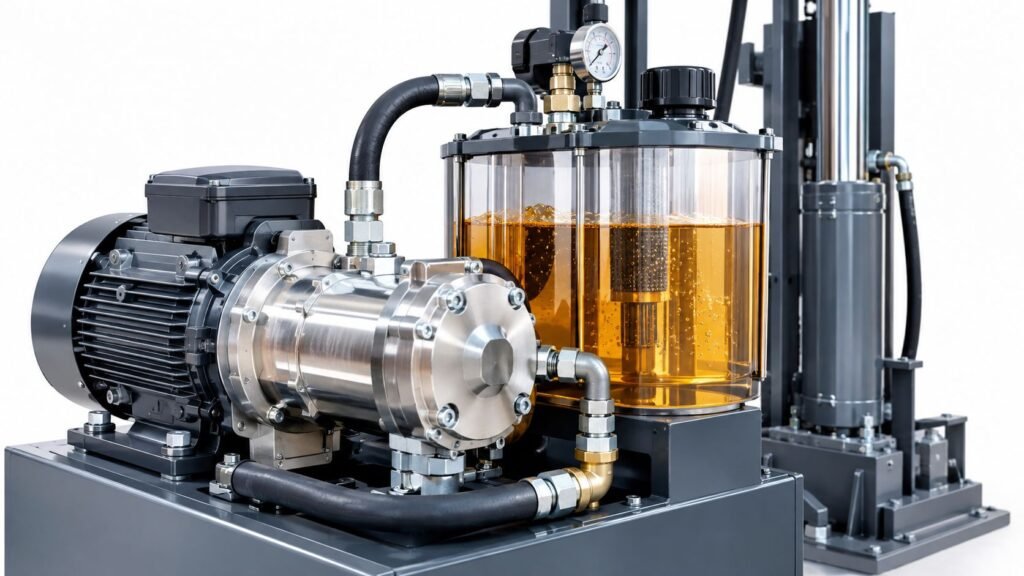
A hydraulic elevator can become sluggish, noisy, or inconsistent long before its main motor shows an obvious fault. A facility manager may see rising oil temperature, unexplained fluid movement, or a pump that sounds rough during operation, then assume the control cabinet or primary hydraulic pump is responsible. In many systems, the trouble starts on the return side, where aerated oil must be recovered, separated, and moved without starving the pump inlet.
Oil scavenge pumps are often overlooked because they don't attract attention when they work properly. Yet their condition affects drainage, lubrication, fluid stability, and the reliability of equipment that moves people, freight, and critical materials. The same mechanical principles also matter when technicians maintain hydraulic elevator power units, tanks, coolers, suction lines, and reservoirs in Michigan buildings.
The Hidden Heart of Hydraulic Elevator Systems
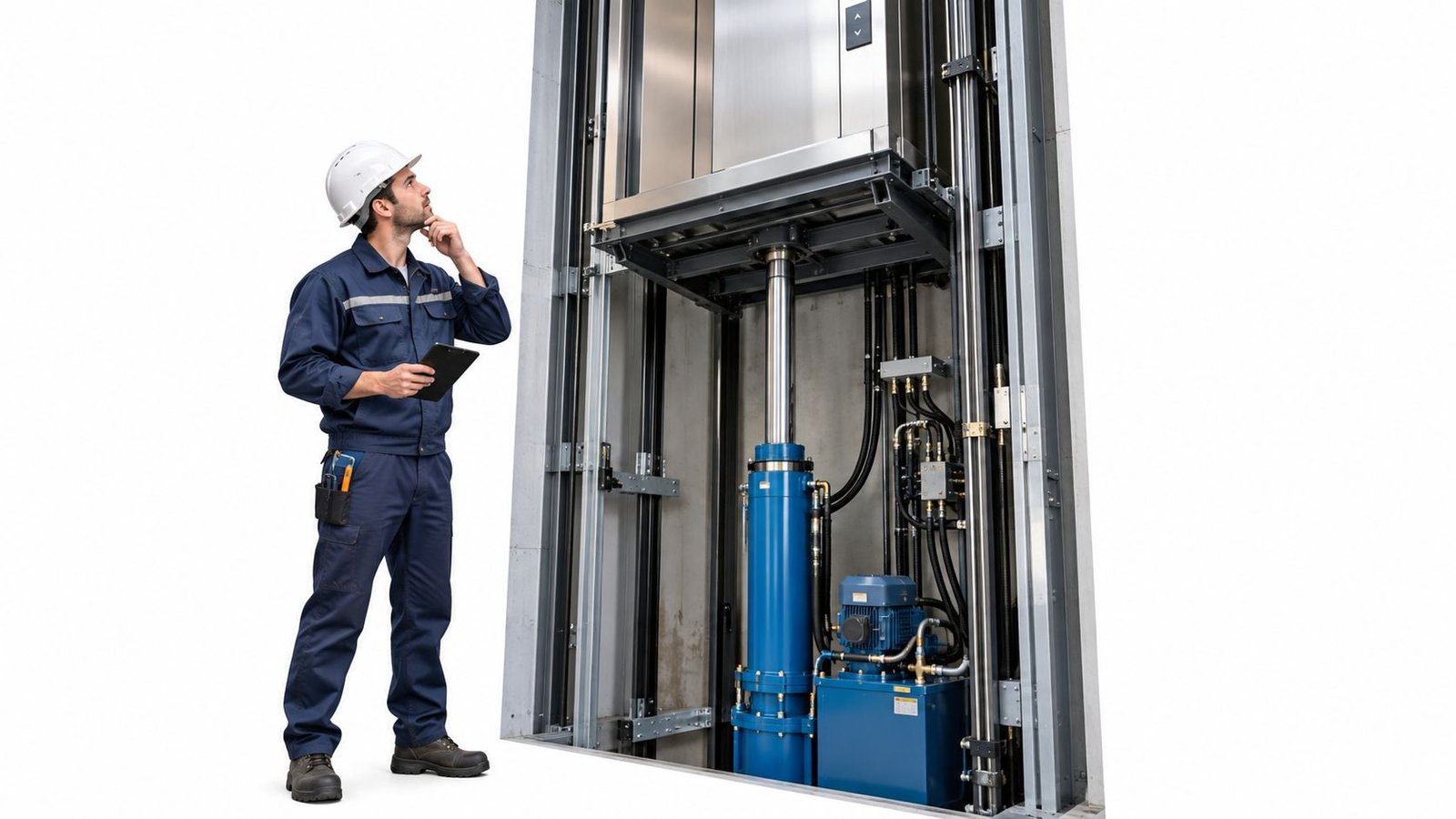
A facility manager usually encounters the symptom first. The elevator takes longer to reach its landing, the hydraulic unit produces an unfamiliar growl, or the oil level behaves differently after repeated trips. The immediate instinct is to investigate the drive motor, controller, valve block, or cylinder. Those components may be involved, but a return-flow problem can create similar symptoms while the supply side still appears normal.
An oil scavenge pump removes oil and entrained air from areas where fluid collects, including bearing chambers, accessory gearboxes, and related reservoirs, then returns the recovered mixture to the main tank. In aircraft-engine lubrication systems, that function protects bearing compartments and gearboxes from flooding and helps maintain a stable oil circuit. In practical hydraulic equipment maintenance, the same underlying lesson applies: fluid recovery is an active mechanical function, not passive drainage.
Why the return path matters
Scavenge pumps don't handle clean, perfectly settled oil. Sealing air, turbulence, temperature changes, and retained fluid introduce gas into the return stream. That mixture occupies more volume than the liquid alone, so a pump selected only for nominal oil flow can lose its practical recovery margin. If the pump can't clear the sump or reservoir as conditions change, oil can accumulate, carry over into unwanted areas, or drain inadequately.
The 2016 experimental study of a gas-turbine-engine demonstration lubrication system measured supply-pump flow at 10 to 20 L/min, while scavenge pumps handled less than 60 L/min. The study also reported scavenge capacity at approximately 2 to 4 times supply-pump capacity, with gas-volume content in the pumped mixture ranging from 0.2 to 0.5. These values illustrate why return pumps need substantial volumetric reserve, rather than being matched to the supply pump on a simple one-to-one basis. The ICAS 2016 lubrication-system study provides the engineering context for that relationship.
For a facility manager, the practical question is not whether a pump spins. It's whether the complete circuit keeps the fluid where it belongs under startup, sustained operation, heat, load, and changing inlet conditions. A clean suction path, sound venting, suitable fluid, and correctly maintained pump are part of the same reliability system. Guidance on hydraulic elevator pumps and their supporting equipment helps connect that principle to the components found in vertical transportation systems.
Understanding Two-Phase Flow and Aeration
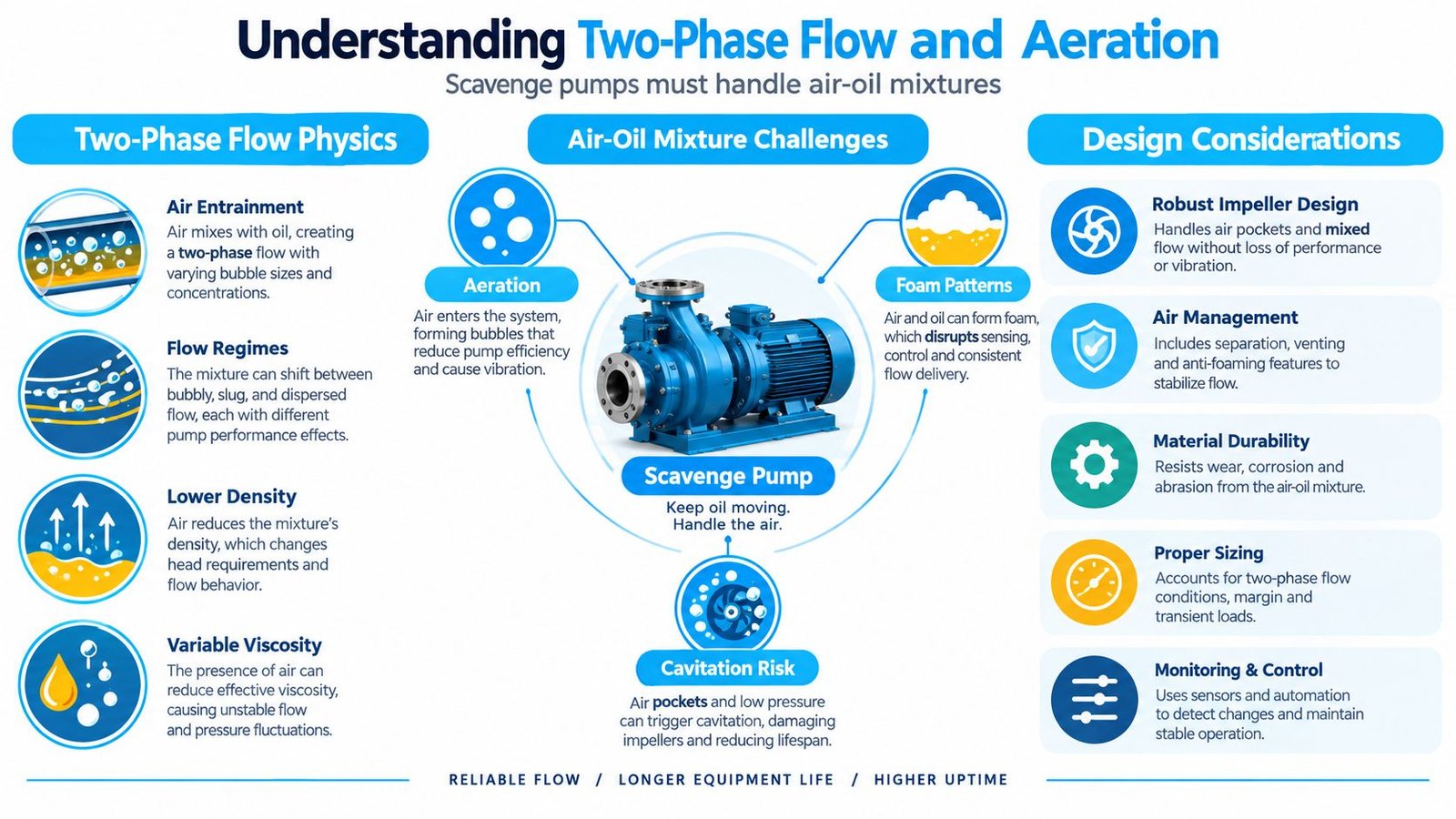
A supply pump generally receives a relatively continuous liquid and adds pressure to move it through the circuit. A scavenge pump faces a less cooperative job. It pulls a mixture of oil and air from a low-pressure space, fills its pumping chambers with a fluid whose density and compressibility are changing, and tries to deliver useful liquid back to the tank.
That is two-phase flow. The gas isn't merely an impurity in the oil. It changes how the pump fills, how much liquid each displacement event moves, and how stable the flow remains. Bubbles can expand as pressure falls, occupy chamber volume, and leave less space for the oil that the system needs to recover.
Why nominal flow is an incomplete specification
The 2024 numerical investigation of a two-stage aircraft-engine scavenge pump modeled inlet gas content rising from 0% to 90%. Across that range, oil flow in the two stages fell by 33.45 L/min and 33.34 L/min, while oil volumetric efficiency dropped by 77.42% and 77.17%, respectively. The pump could continue moving a mixture, but its effective oil-delivery performance deteriorated sharply as air entrainment increased. The 2024 two-stage scavenge-pump investigation shows why a running pump isn't necessarily recovering enough usable oil.
The implication is straightforward. Engineers and maintenance teams must evaluate gas fraction, pressure, temperature, rotational speed, oil aeration, sump shape, and inlet geometry, not just the nameplate liquid-flow requirement. A pump may appear adequately sized during a clean, cool test and still struggle when the return stream becomes heavily aerated.
In the earlier lubrication-system study, supply-pump outlet pressure measured 0.3 to 0.5 MPa, bearing-chamber excess pressure measured 0.01 to 0.03 MPa, and oil-air-mixture temperature ranged from 20 to 70 °C. Those conditions demonstrate how different the supply and scavenge sides can be. The supply pump develops pressure, while the scavenge pump needs capacity to remove both liquid and gas from a low-pressure collection space.
What maintenance teams should account for
Excess scavenge capacity accommodates aeration, thermal expansion, oil held in seals and de-oilers, and changing sump inflow. It doesn't mean that installing the biggest possible pump is always the right answer. Excess displacement can increase suction demand, parasitic load, and the risk of filling loss when the inlet can't supply the pump chambers.
Practical rule: Size and assess the return circuit for usable liquid recovery under realistic aeration, not for ideal single-phase oil flow.
Oil condition matters just as much. A maintenance team that checks only pressure can miss a return-side problem, because the supply gauge may remain within its expected range while aerated oil accumulates elsewhere. Fluid selection, cleanliness, reservoir design, and temperature control all influence how reliably the pump fills and clears the system. For elevator applications, hydraulic elevator fluid guidance provides a useful starting point for discussing fluid compatibility and service conditions with a qualified technician.
Cavitation and Operating Envelope Failures
A pump can become noisy or lose output while the underlying fault sits upstream. Replacing it before checking inlet conditions often leaves the restriction, aeration, or pressure loss unchanged. The replacement may produce the same noise and fail at the same point in the operating cycle.
Cavitation and filling loss are operating-envelope problems. A constant-displacement pump can remove more volume than the sump supplies continuously, particularly when the return stream carries substantial air. If inlet absolute pressure falls far enough, vapor forms or the pump chambers stop filling completely. Flow then becomes unstable, with noise, vibration, and possible damage to gerotor components or bearings.
The conditions that pull inlet pressure down
Several faults can act together:
- Restricted suction inlets limit the volume reaching the pump.
- Blocked screens or filters increase pressure loss before the inlet.
- Poor tank or sump venting prevents pressure equalization.
- High oil temperature changes viscosity and can promote vapor formation.
- Excessive seal-air leakage raises the gas fraction in the return stream.
- Long or undersized suction lines consume available inlet head.
Army technical guidance notes that scavenge pumps may draw air from sumps when their capacity exceeds actual oil inflow. Under unfavorable conditions, that action can lower sump pressure enough to cavitate the pump or collapse the sump. Flow fluctuation, noise, vibration, and mechanical damage can follow. The aerospace pump guidance and application examples describe application-specific designs, including a two-circuit gerotor pump rated up to 6.25 gal/min at 65 psi and 6,200 rpm, with a maximum speed of 10,900 rpm, and another design listing 3.6 gal/min per scavenge circuit at 40 psi and 11,000 rpm. These figures describe particular aerospace applications, not universal elevator specifications.
Why a larger pump can make the problem worse
A larger displacement pump increases the rate at which the inlet must supply fluid. If the sump, suction line, vent, or separator cannot meet that demand, filling loss can increase. The facility manager then pays for a larger component while the pressure conditions behind the instability remain.
Oil temperature deserves attention during the inspection. Confirming proper oil cooling to prevent cavitation conditions can matter as much as checking pump size, especially in hydraulic elevator service where repeated cycles heat the fluid. The practical sequence is to measure inlet vacuum or pressure, confirm operating speed, check oil temperature and viscosity, inspect the suction path, and verify vent integrity.
Depending on the findings, reducing speed, improving inlet head, shortening the suction route, or improving deaeration may restore performance more effectively than increasing displacement. A code-compliant maintenance program should document the condition found and the corrective action, rather than treating pump replacement as the diagnosis.
The ELUBSYS project reported efficiency of about 80% to 90% in a leak-zone regime, followed by a rapid fall to 60% or less in a cavitation zone marked by low inlet pressure and high rotational speed. It also identified altitude and oil-air ratio as relevant suction factors, with an oil-air ratio below 1:6 potentially compromising suction capacity. The ELUBSYS final reporting summary supports checking inlet conditions before automatically replacing the pump.
Diagnostic Checks for Hydraulic Pump Health
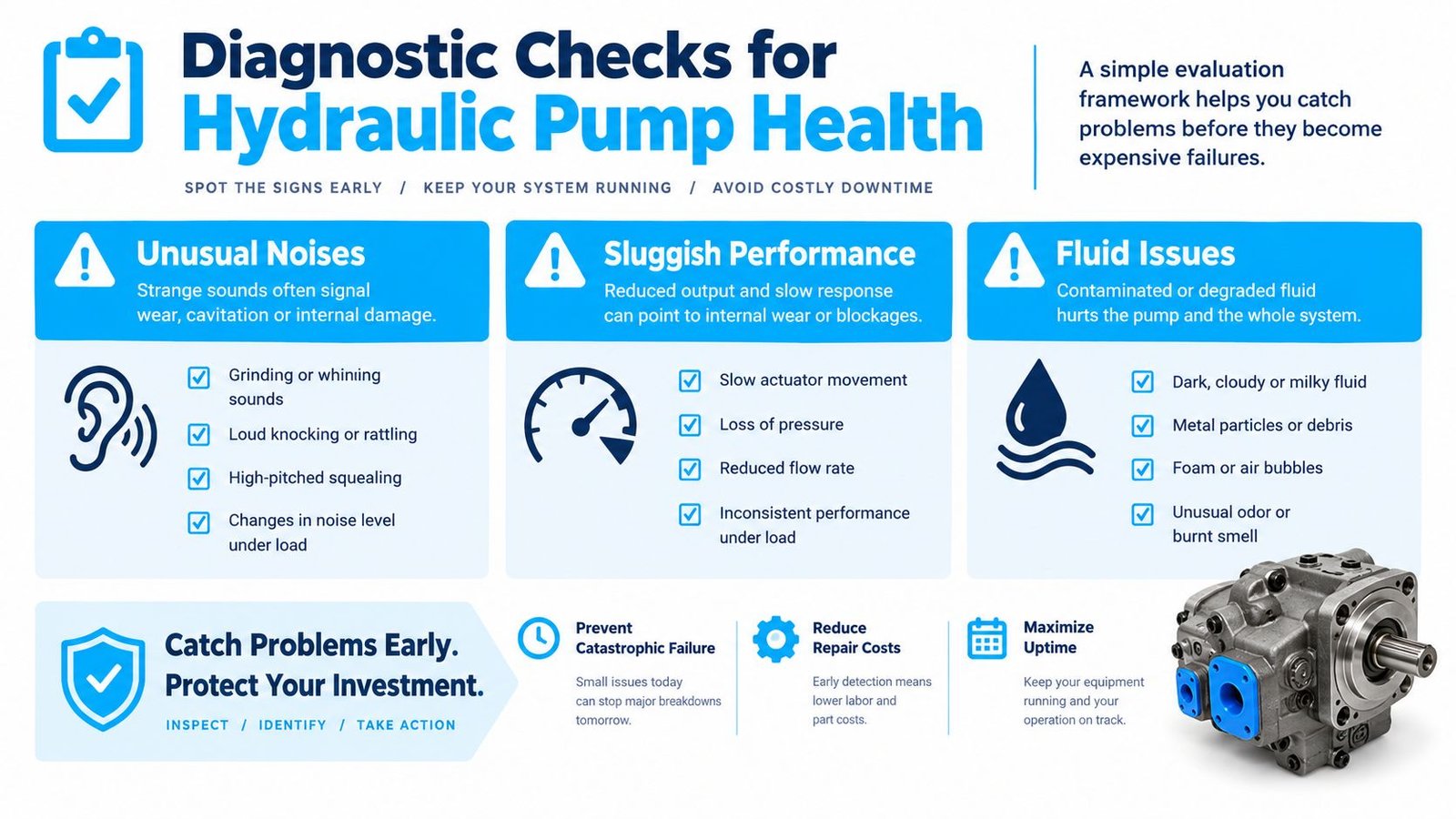
Good troubleshooting starts with the symptom, then follows the fluid path. A pump that sounds rough, moves less usable oil, or leaves a rising sump level is telling you that something changed in the circuit. The change might be wear, but it might also be restriction, aeration, temperature, venting, or speed.
Start with operating symptoms
A falling scavenge-flow margin, rising sump level, oil gulping, smoke, or increased bearing-compartment pressure warrants inspection. Excessive pump noise or instability also matters, particularly when the sound appears during startup, high load, high temperature, or another repeatable operating condition.
A restriction can cause oil accumulation even when supply pressure remains normal. That distinction prevents a common diagnostic mistake: accepting a healthy supply gauge as proof that the whole lubrication or hydraulic circuit is healthy.
Use a measured checklist
-
Measure inlet conditions. Record inlet vacuum or pressure while the pump is operating, not only when it is stopped. A static reading can hide dynamic suction loss.
-
Check oil temperature and viscosity. Compare the observed condition with the fluid specification. Cold, high-viscosity oil increases suction losses, while hot oil can reduce viscosity and alter vapor behavior.
-
Inspect the suction route. Examine the inlet screen, filter, hose, fittings, bends, and internal passages for contamination, collapse, or an undersized path. Look for restrictions before condemning the pump.
-
Verify venting. A reservoir or sump needs a clear, functional vent path. A blocked vent can create a pressure imbalance that reduces available inlet head.
-
Look for air entry. Check seals, hose connections, reservoir levels, and return geometry. Excessive air ingestion reduces effective liquid transport and can make the pump sound unstable even when the motor and drive remain intact.
-
Compare behavior by condition. Note what happens during startup, repeated elevator cycles, high-load operation, and temperature changes. A problem that appears only under one condition often points to an envelope issue rather than uniform mechanical wear.
A pressure reading tells you what the circuit is doing at one point. A trend tells you whether the circuit is losing its margin.
Technicians should document fluid appearance, noise character, vibration, temperature, pressure, and level changes together. Foam, gulping, or intermittent recovery deserves more attention than a simple visual check of the pump housing. Once inlet conditions are known to be sound, the team can evaluate internal clearances, gearotor condition, seals, bearings, and drive alignment with greater confidence.
Navigating Michigan Elevator Code Compliance
Mechanical reliability and regulatory compliance belong in the same maintenance conversation. Michigan's Elevator Code regulates installation, alteration, repair, testing, maintenance, servicing, adjustment, and inspection, and the state's guidance requires this work to be performed by a licensed elevator journeyperson. Michigan's Elevator Section administers and enforces those requirements.
For facility managers, that means a hydraulic elevator repair isn't complete just because the car moves again. The technician must also consider applicable testing, documentation, safety devices, fluid containment, machine-room conditions, and any correction work required by the authority having jurisdiction.
Inspection timing affects planning
Michigan generally requires most passenger, freight, material-lift, limited-use, special-purpose, rooftop, and similar elevating devices to receive a general inspection at least once every 12 months. Dumbwaiters, platform lifts, stairway chairlifts, one-person elevators, and power sidewalk elevators generally require inspection at least once every 24 months, while personnel hoists require inspection every 30 days. The Michigan Elevator Code document gives the applicable schedule and device categories.
These intervals should shape the maintenance calendar, not merely the response after an inspection notice. A facility team that tracks pump condition, oil quality, leakage, safety tests, and code corrections before the inspection window has more control over downtime and budgeting.
Local enforcement adds another layer
Detroit maintains a dedicated Elevator Inspection Team within its Buildings, Safety, Engineering, and Environmental Department. The team examines and licenses elevator journeypersons and contractors, inspects elevators, escalators, dumbwaiters, and wheelchair devices, investigates complaints, reports elevator accidents, registers elevator licenses, and answers code questions. Detroit's Elevator Inspection Team information shows why local knowledge matters.
A contractor who understands both fluid behavior and Michigan elevator requirements can identify the difference between a pump fault, a suction problem, a maintenance deficiency, and a code issue. That combination reduces the chance that a temporary operational fix will create a later inspection problem.
Proactive Elevator Maintenance Across Michigan
The most effective maintenance partnership is proactive, non-proprietary, and comfortable with the entire elevator system. Facility managers shouldn't have to choose between hydraulic packing, power-unit service, safety testing, modernization, and code-violation correction. A qualified provider should evaluate the equipment as a connected system, from the tank and motor to the pump, cylinder, controls, doors, car top, and pit.
Crane Elevator Company serves Detroit, Lansing, Ann Arbor, Grand Rapids, and surrounding areas, including Flint, Kalamazoo, Perrysburg, and Toledo. Its work covers every type of elevator service, including preventative maintenance, repairs, inspections, testing, modernization, hydraulic packing, power-unit maintenance, jack and tank work, motor and machine replacement, door systems, emergency phones, fire service, generator testing, and code-violation corrections.
What a practical maintenance program should include
A serious program should do more than respond after a shutdown:
- Condition-based troubleshooting: Technicians investigate aeration, suction restrictions, temperature, pressure, noise, and fluid behavior before replacing expensive components.
- Complete clean-downs: Machine rooms, pits, and car tops need attention because contamination and overlooked leakage can obscure developing faults.
- Non-proprietary planning: Modernization and replacement work should preserve serviceability for qualified providers rather than create unnecessary dependence on one source.
- Responsive field support: A 24/7/365 operation matters for healthcare, industrial, education, municipal, and residential properties where an unavailable elevator affects safety and access.
- Clear commercial terms: A No Show, No Pay policy, competitive quotes, free second opinions, and modernization financing help building owners make decisions with better cost visibility.
The technical lesson from scavenge systems applies directly to elevator maintenance. A pump can be turning while delivering inadequate usable flow. A supply-pressure reading can look normal while a restriction causes fluid accumulation. A larger component can worsen suction losses if the inlet circuit isn't prepared for it. Good technicians test the conditions around the component before declaring the component failed.
Detroit's dedicated inspection responsibilities make localized, code-aligned support particularly important for area building owners. The same discipline benefits properties in Lansing, Ann Arbor, Grand Rapids, Flint, Kalamazoo, Perrysburg, Toledo, and other Michigan communities. Whether the equipment is a century-old freight car, a modern hydraulic passenger elevator, a wheelchair lift, a material lift, or a dumbwaiter, long-term reliability depends on maintaining the whole system rather than chasing isolated symptoms.
Crane Elevator Company provides proactive maintenance, repairs, inspections, testing, non-proprietary modernization, and hydraulic-system support for elevators and lifting equipment across Michigan and Ohio. If aeration, cavitation, sluggish operation, or recurring fluid problems are affecting your equipment, visit Crane Elevator Company to request service, a competitive quote, or a free second opinion.