You've got an elevator out of service, a repair quote on your desk, and tenants asking when it will run again. The quote says "motor replacement," but you're not sure whether that fixes the problem or connects a new motor to the same troublesome controls. For a building owner in Detroit or Grand Rapids, the useful question isn't just which motor to buy. It's what equipment should stay, what needs modernization, and who will be able to service it afterward.
Why the Motor Decision Matters More Than Ever
A motor quote should explain why the motor needs attention. “It's old” isn't a diagnosis, and “it runs hot” isn't a complete scope of work. Before authorizing replacement, ask the contractor to identify the failure, explain what caused it, and describe what will remain unchanged.
Consider a familiar situation: a Lansing office elevator stops intermittently, then returns to service after a reset. That's an illustrative scenario, not a documented customer case. A replacement proposal that doesn't address the controller's fault history leaves the owner without a clear explanation of whether the proposed work will resolve those interruptions.
Think beyond the replacement part
The motor sits inside a connected system. Your decision affects the drive, brake, mechanical transmission, electrical supply, and inspection acceptance. The ASME A17.1/CSA B44 safety-code framework covers installation, operation, inspection, testing, maintenance, alteration, and repair, including associated rooms, spaces, and hoistways.
That broader scope matters when you compare proposals:
- Reliability: Require an explanation of which existing faults the project addresses.
- Downtime exposure: Ask about procurement, installation, testing, and arrangements while the elevator is unavailable.
- Capital planning: Separate necessary corrective work from optional performance improvements.
- Service continuity: Identify replacement-part sources and the documentation delivered at completion.
Practical rule: Don't approve a motor replacement until the proposal explains what happens to the equipment connected to it.
For facilities in Michigan and Ohio, the strongest proposal is rarely the one with the longest equipment list. It's the one that distinguishes serviceable assets from unsupported components and gives the owner a defensible reason for each decision. A new motor shouldn't become an expensive way to postpone the controller project you already need.
How Elevator Motors Actually Work
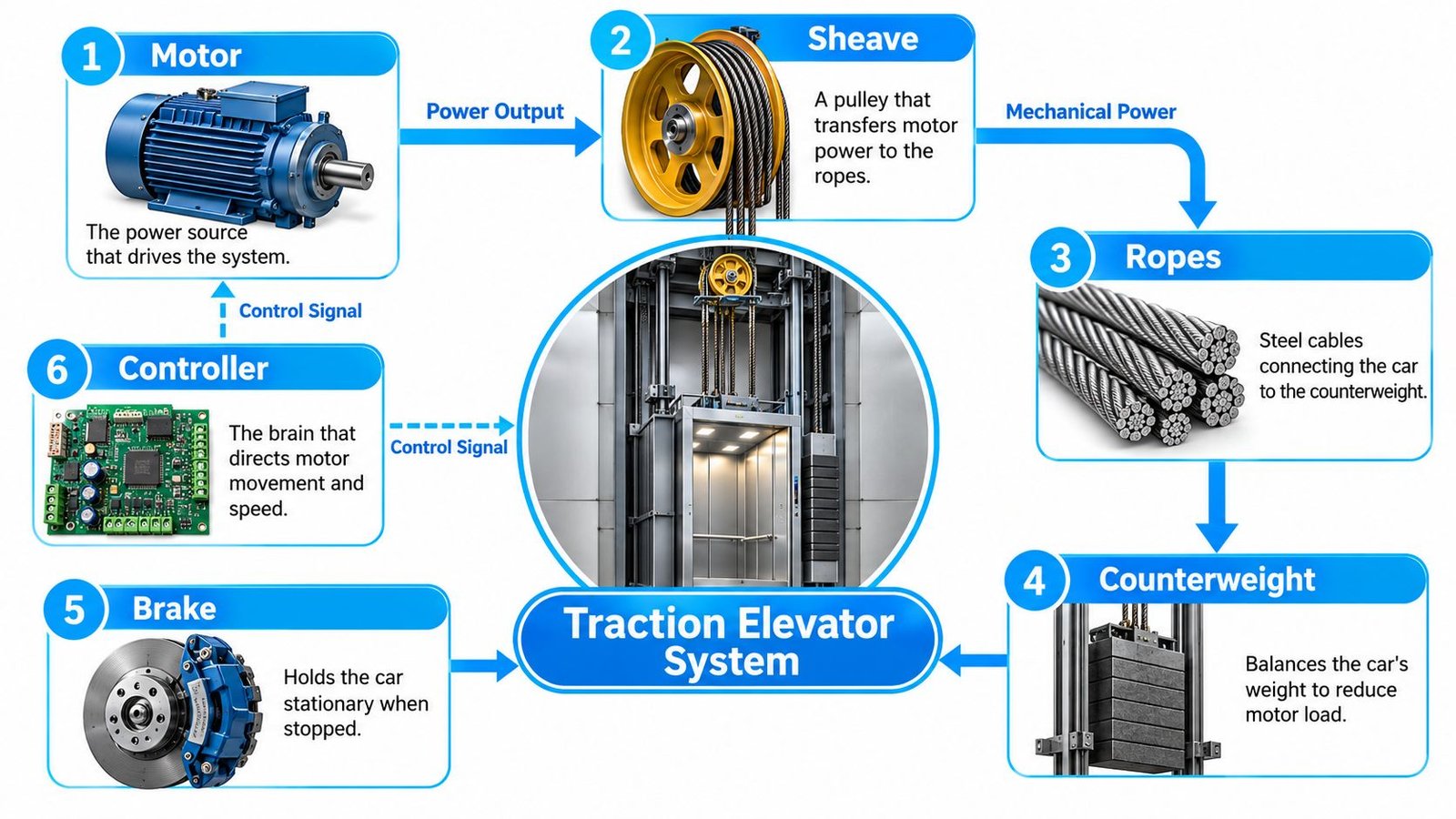
In a traction elevator, the motor turns a grooved wheel called a sheave. Steel ropes connect the elevator car and counterweight, and the sheave moves those ropes. The counterweight reduces the load the motor must move, while the brake holds the machine when the elevator stops.
The controller directs movement and speed. That makes the motor only one part of ride control: the machine must respond correctly to commands, and the brake must operate in coordination with the electrical system. The basic traction architecture is documented in the historical review of elevator drive and control systems, which traces Harry Ward Leonard's variable-speed method to 1891 and Westinghouse's introduction of gearless elevators in Chicago to 1922.
The diagram identifies the components you should recognize during a contractor's survey.
Hydraulic equipment needs a different conversation
For hydraulic equipment, evaluate the motor and power unit together, rather than treating the motor as a substitute for a traction machine. Ask the contractor to distinguish electrical motor trouble from pump, valve, cylinder, or packing work. A proposal should identify which subsystem needs correction instead of grouping every travel complaint under “bad motor.”
Use these questions to establish what you own:
- Machine identification: Is the installation traction or hydraulic, and what does the motor drive?
- Control identification: What controller and drive are installed, and are their records available?
- Mechanical identification: Which brake, sheave, gearbox, or hydraulic components are included in the survey?
The historical progression also explains why equipment identification matters in older properties. Legacy DC machines and Ward-Leonard equipment belong to a different modernization starting point than contemporary permanent-magnet synchronous machines. Don't assume an older Ann Arbor building has its original equipment, or that a recently renovated lobby means the machine room was modernized.
A useful survey begins with nameplates, drawings, maintenance records, and equipment condition. Building age alone won't tell you which motor or control package belongs there.
AC vs DC, Geared vs Gearless, and Hydraulic Power Units
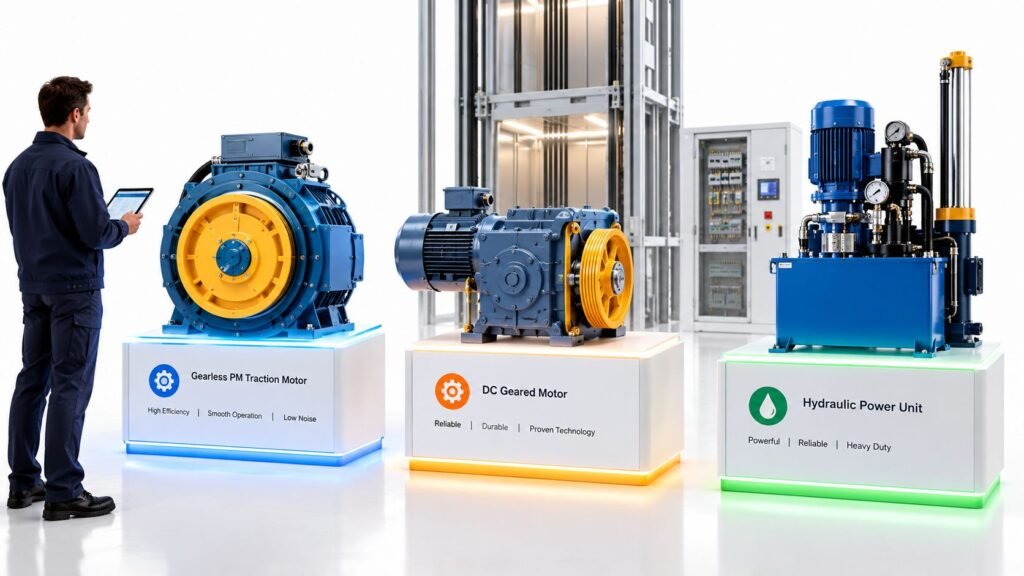
AC versus DC describes the electrical machine. Geared versus gearless describes how the traction machine transmits motion. Those aren't interchangeable categories, and a comparison that mixes them can make a replacement package look simpler than it is.
Elevator Motor Configurations Compared
| Configuration | Typical Speed | Efficiency Range | Best Fit |
|---|---|---|---|
| AC induction traction | Specify for the building's rise and traffic | Require motor and drive data for the proposed package | Traction modernization where compatibility supports the choice |
| Permanent-magnet synchronous gearless traction | Evaluate for higher-rise or demanding service | Require package-specific performance curves | Heavily used passenger installations |
| Legacy DC traction | Confirm existing rated speed and control capability | Measure existing input before comparing replacements | Repair or staged modernization of serviceable equipment |
| Geared traction | Match machine ratio and operating requirements | Include gearbox and drive losses in the assessment | Projects where retaining suitable mechanical equipment is practical |
| Hydraulic power unit | Modest-speed, low-rise applications | Evaluate the motor, pump, and hydraulic system together | Low-rise buildings with modest traffic and rise |
These are selection categories, not universal speed or efficiency ratings. The correct comparison comes from the proposed machine's documentation and the building's operating requirements.
What the table means in procurement
An AC induction replacement can be a sensible choice when the remaining traction equipment is suitable. A permanent-magnet synchronous package deserves consideration where the project calls for a coordinated gearless installation. Neither label proves that the proposed controller, feedback equipment, brake arrangement, and mechanical interfaces will work together.
For a geared machine, require the contractor to assess the gearbox before pricing a motor-only change. For gearless work, ask what mounting, sheave, brake, and control changes are included. A compact machine doesn't automatically produce a compact project once access and associated equipment are considered.
Gearless traction deserves strong consideration for higher-rise, heavily used buildings. Modern hydraulic equipment remains practical where rise, speed, and traffic are modest.
Hydraulic proposals should distinguish submersible and dry power-unit arrangements and show their service-access requirements. If a supplier uses “green” terminology, ask for the actual environmentally acceptable fluid specification and compatibility documentation. A marketing description isn't enough to approve a tank, pump, seals, or replacement motor.
Compare the details that owners eventually have to live with:
- Ride and noise: Require an acceptance plan rather than relying on “smooth” or “quiet” in a brochure.
- Capacity and duty: Have the contractor substantiate the selection for the existing elevator's load and operating pattern.
- Maintenance and parts: Request the recommended tasks, accessible service points, and component availability.
- Code path: Identify required alterations, tests, and inspection coordination before ordering.
The honest comparison is package against package, with retained equipment clearly identified. Comparing only motor purchase prices leaves too much outside the quote.
Matching Motor Type to Building Type and Traffic
A building's use should shape the recommendation before anyone settles on a motor model. A passenger elevator serving office arrivals, a freight elevator moving industrial loads, and a wheelchair lift providing accessible entry don't present the same operating problem.
Treat these Michigan examples as planning situations, not customer case studies. Their value is in the questions they raise about traffic, travel, load, and access.
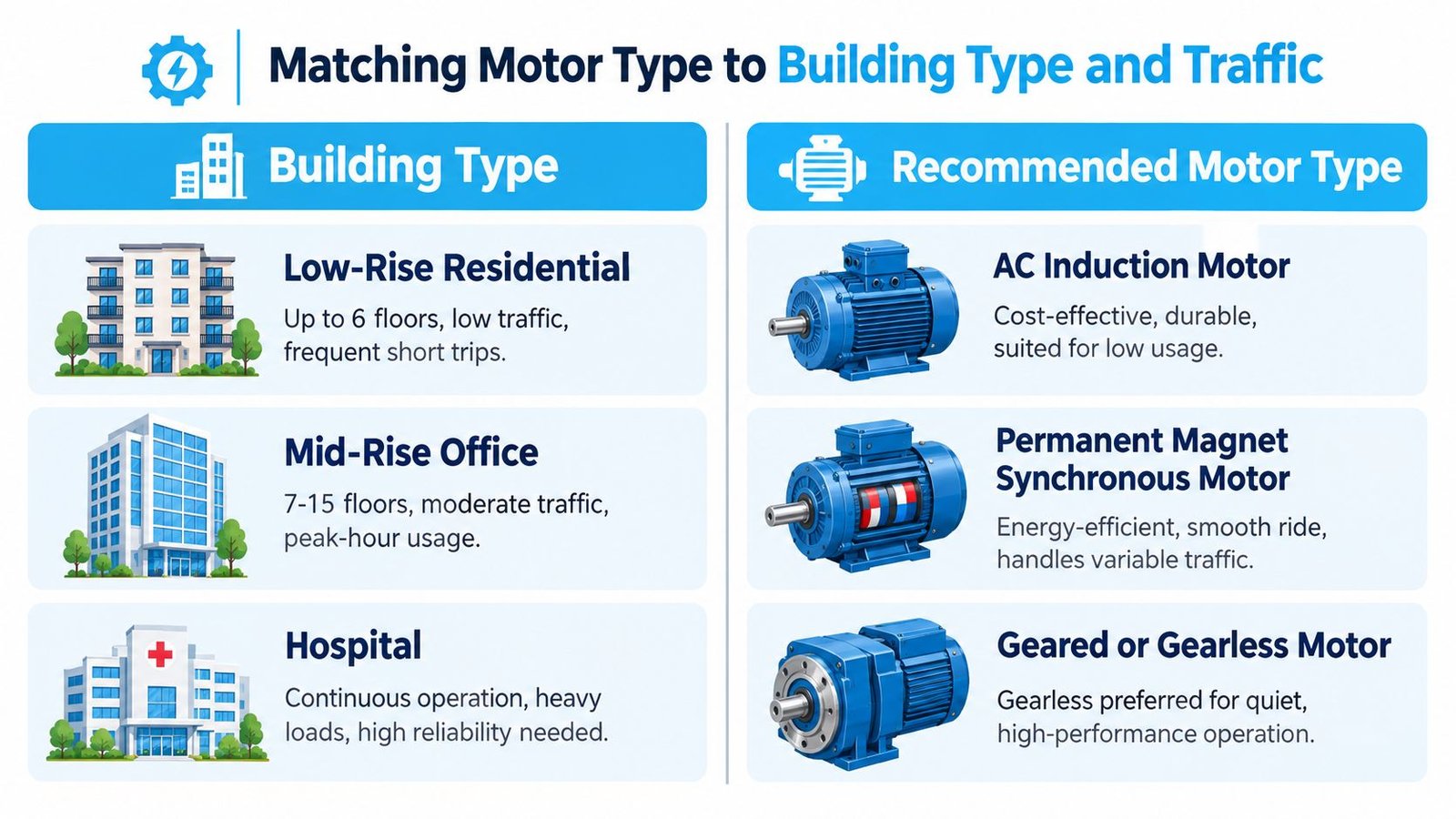
The selection graphic provides a starting point, but it shouldn't replace an equipment survey.
Passenger buildings need a traffic assessment
For a lightly used residential building, first establish whether the existing hydraulic or traction arrangement still meets the property's needs. Avoid paying for a premium package without documenting the problem it solves. Resident accessibility, service interruptions, and maintainability can matter more to the decision than a higher performance specification.
A mid-rise office in Grand Rapids needs a different discussion. Ask how arrivals, departures, and concentrated demand affect the proposed selection. Rated speed alone won't tell the owner whether the complete elevator package suits those operating patterns.
Hospitals, healthcare properties, and university buildings deserve particular attention to sustained use and load distribution. The NREL facility guidance on regenerative traction supports evaluating regeneration against actual dispatch patterns and annual recovered energy, rather than assuming that every installation justifies it.
Freight and accessibility equipment need their own scope
A Flint industrial freight car should be surveyed around its actual load handling and operating duty. Don't substitute a passenger-elevator recommendation without checking whether the machine, controls, and retained equipment suit the freight application.
Other properties require equally specific questions:
- Kalamazoo church: For a wheelchair lift, establish device type, accessibility requirements, and the appropriate repair scope.
- Ypsilanti library: A platform lift needs its own equipment assessment, not a high-rise traction comparison.
- Historic municipal building: Document what can be retained, what access constraints affect installation, and how the work will be accepted.
- Detroit high-rise: Evaluate the complete traction package against passenger demand and travel requirements.
For campuses and municipal portfolios, consistent documentation also deserves attention. Ask whether the proposed equipment can fit the owner's maintenance practices across multiple buildings. Standardizing records and service expectations may be more useful than specifying the same motor everywhere.
Specification Checklist for a Motor Replacement or Modernization
A replacement specification should let another qualified contractor understand what was selected and why. Horsepower and mounting dimensions are necessary, but they aren't a complete purchasing specification.
Start with the existing equipment records, then require the surveyor to verify them. Don't let a quotation rely entirely on an old drawing or an unreadable nameplate.
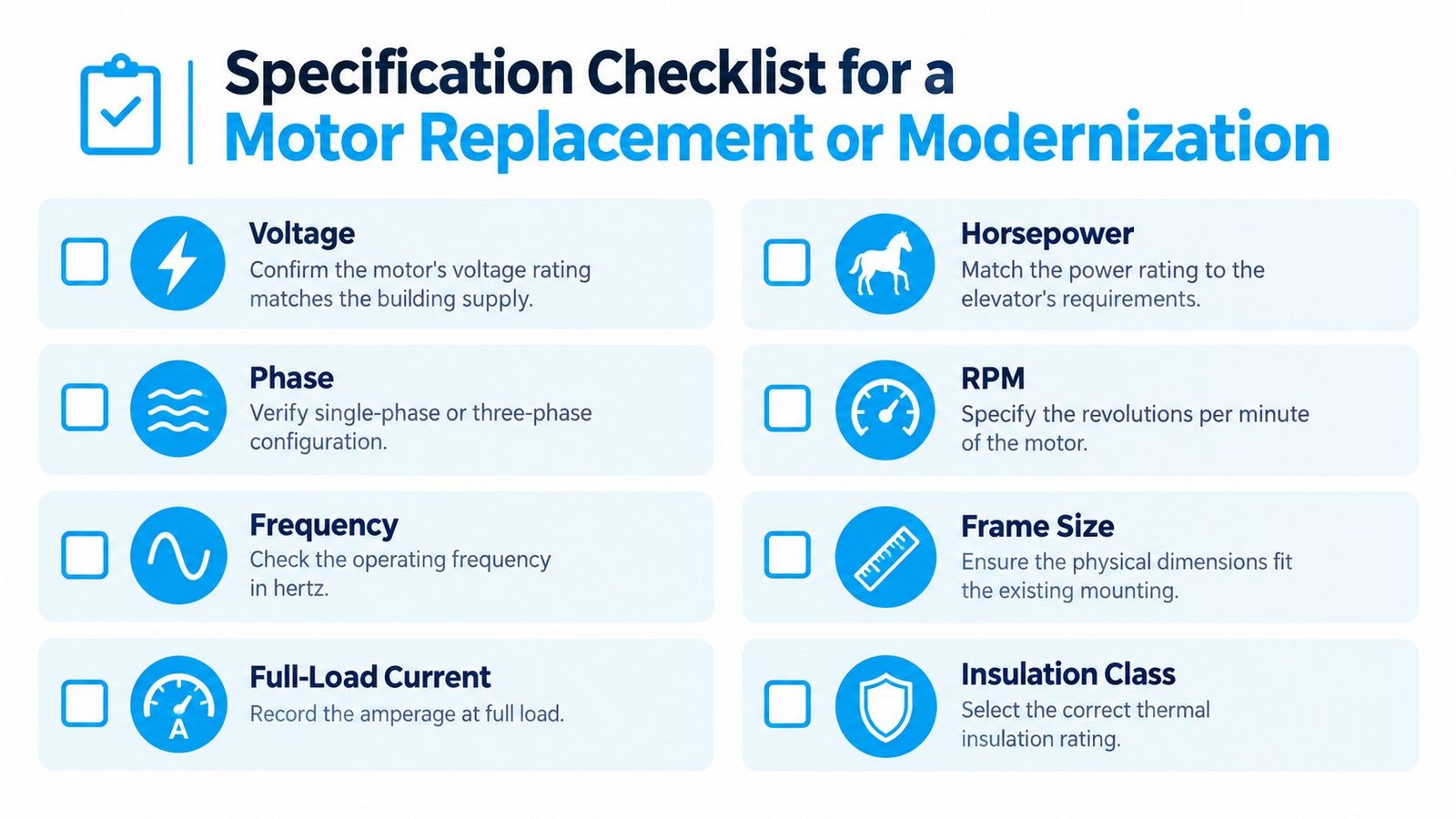
The checklist covers the basic nameplate and physical information to capture.
Require electrical and mechanical compatibility
- Supply and protection: Confirm voltage, phase, frequency, full-load current, and compatibility with the proposed drive.
- Operating duty: Specify horsepower, speed, duty rating, insulation class, and thermal capacity.
- Physical fit: Verify frame size, mounting, shaft arrangement, installation access, and clearances.
- Traction interfaces: Record sheave diameter, groove count, rope compatibility, and gearbox ratio where applicable.
- Brake and feedback: Confirm brake torque, release requirements, encoder type, and controller interface.
The ASHRAE-based COMNET modeling guidance lists traction-motor full-load efficiencies of 82.5% at 1 hp, 87.5% at 3–5 hp, 91.0% at 15–20 hp, 94.1% at 75 hp, and 95.0% at 150–200 hp, alongside mechanical-efficiency assumptions of approximately 64% for counterweighted traction and 58% for hydraulic systems. Those benchmarks aren't whole-elevator energy ratings.
Make the survey part of the deliverable
Request measured input power during loaded and empty-car runs, duty-cycle records, brake-release current, acceleration information, and controller fault history. Require the contractor to explain any measurements that couldn't be obtained and how that uncertainty affects the selection.
The elevator-controls assessment belongs in the motor scope because the proposed machine must operate with the retained or replacement controls. Procurement should identify who is responsible for confirming that interface and demonstrating acceptable operation.
Owner's safeguard: Specify the documentation, diagnostic access, and service tools you'll receive, not just the equipment you'll buy.
For non-proprietary replacement, ask whether qualified providers can obtain parts, access diagnostics, and adjust the equipment without depending on a single service organization. Put those expectations in writing. The label matters less than the actual access the owner receives.
Before procurement, require a written acceptance plan under the applicable elevator code. That should identify responsible parties, required testing, and the documents handed over when the work is complete.
When to Repair the Motor Instead of Replacing It
A noise complaint doesn't establish which component failed. Neither does an overheated machine. The contractor should isolate the cause before presenting replacement as the only responsible choice.
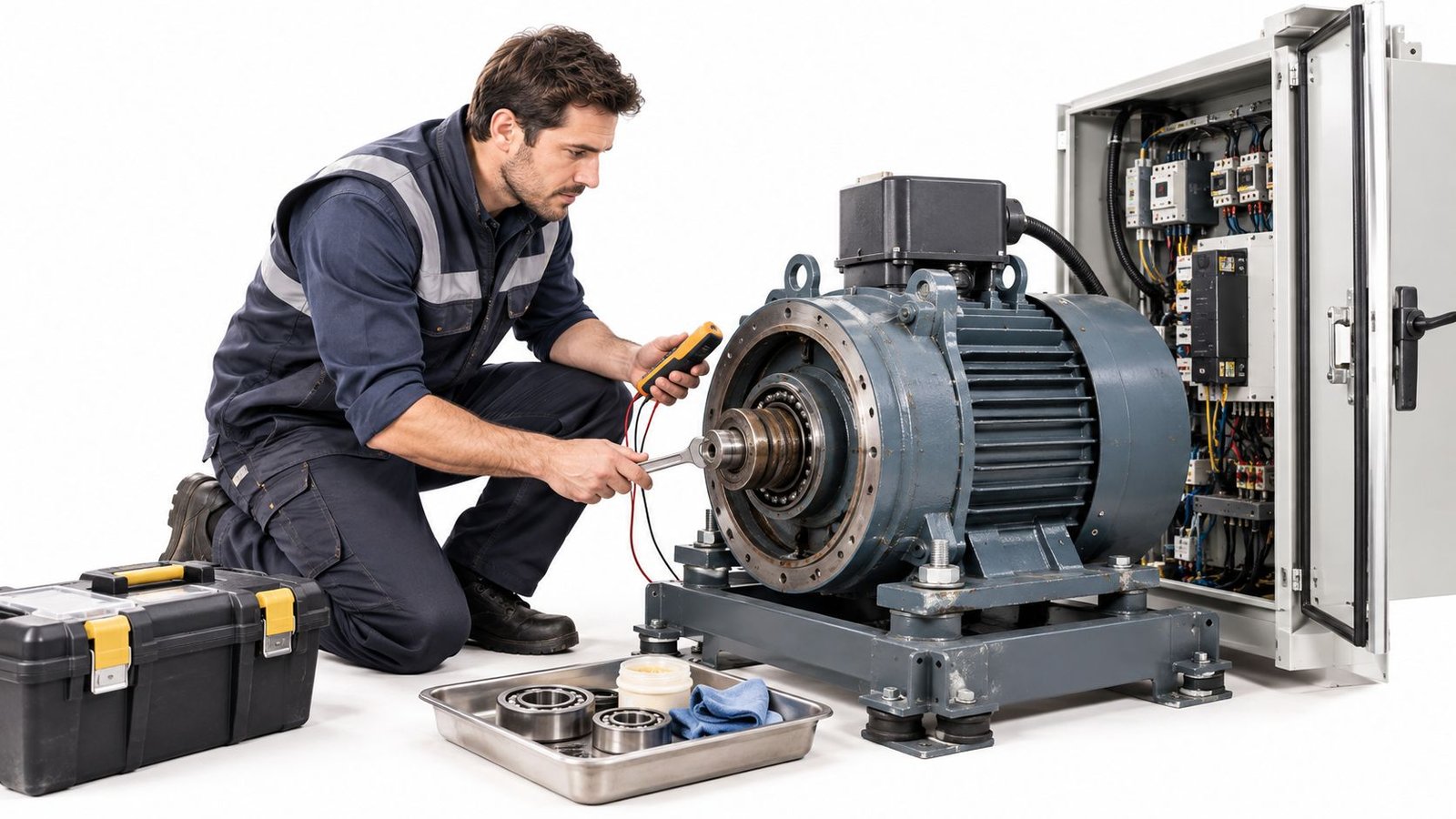
Motor work starts with a qualified technician's assessment, not an owner attempting live electrical checks.
Diagnose the component before choosing the project
Research on permanent-magnet synchronous elevator-motor faults identifies electrical, mechanical, and magnetic fault categories, with stator-winding faults dominant in the reported high-voltage cases and bearing faults largest in low-voltage systems. That supports condition-based diagnosis, not a blanket rule that vibration means replacement.
A useful assessment distinguishes bearing condition, winding health, brake condition, sheave wear, and gearbox condition from drive or control problems. Ask for the findings behind the recommendation, including what tests were performed and what remains uncertain. “Motor-related” is too broad to authorize a capital project.
| Finding | Repair deserves consideration | Replacement or broader modernization deserves consideration |
|---|---|---|
| Isolated component fault | The remaining machine is serviceable | Other major components also need work |
| Winding or bearing condition | A supported repair can address the diagnosed defect | Repair scope remains uncertain or unsuitable |
| Parts availability | Required components and technical support are obtainable | Essential components lack a dependable supply |
| Controls compatibility | Existing controls can support the corrected machine | A motor change leaves unresolved control limitations |
| Operational exposure | Planned repair fits the facility's access needs | Repeated interruptions make isolated repairs difficult to justify |
Compare complete scopes
The elevator pump and motor repair evaluation should separate fault isolation from the final recommendation. Ask for repair, motor replacement, and broader modernization alternatives where each is technically reasonable.
For each alternative, compare warranty coverage, installation access, expected outage, testing responsibilities, and the condition of retained equipment. Include the facility's operational consequences, such as disrupted patient movement or inaccessible occupied space, without assigning invented financial values.
The accompanying video can support a discussion with your service contractor; it isn't a substitute for equipment-specific diagnosis.
Repair makes sense when the defect is identifiable and the rest of the installation supports continued service. Replacement makes sense when the motor itself no longer offers a defensible repair path. Full machine-room modernization deserves consideration when a motor-only project would leave substantial unresolved problems around the new equipment.
Energy Savings That Translate Into Real kWh
Motor efficiency and regenerative energy recovery describe different things. Motor efficiency concerns converting electrical input into mechanical output. Regeneration recovers energy during suitable operating conditions rather than dissipating it as braking heat.
In a documented elevator-energy comparison, Ward-Leonard equipment consumed 18,535 kWh annually, versus 9,996 kWh for a non-regenerative induction system, approximately 46% less; the regenerative induction configuration reduced consumption by about 53%, while separate measured examples recovered about 31% of travel energy in a low-rise installation and 62% in a high-rise installation. These are documented comparisons, not guaranteed results for your building.
Build the calculation around measured use
Ask the contractor to record annual trips, average loading, motor input, travel, operating hours, and standby consumption. The proposed annual estimate should distinguish operating energy from recovered energy and non-travel consumption.
For an owner-facing financial comparison, require:
- Energy value: Estimated annual kWh reduction multiplied by the applicable electricity rate.
- Demand effects: A separate explanation of any demand-charge change.
- Project cost: Installed cost, required electrical work, testing, and associated alterations.
- Maintenance allowance: Documented expected changes, with assumptions clearly identified.
Don't accept an elevator-energy percentage presented as a whole-building saving.
Regeneration can also affect the heat-management discussion. Include elevator machine-room cooling in the scope where braking heat and environmental conditions need evaluation, but don't assign cooling savings without a building-specific assessment.
For a lightly used low-rise installation, ask whether control settings, standby operation, or targeted repairs offer a more defensible investment than a premium motor package. Select a motor for elevator modernization using measured operating needs, not the largest advertised savings figure.
Regional Guidance for Michigan and Ohio Facility Managers
Michigan requires most passenger and freight elevators and the other principal device categories to be inspected at least every 12 months, according to the Michigan elevator inspection rules. The state's elevator permit guidance requires elevating-device installation, alteration, maintenance, repair, servicing, inspection, adjustment, and testing to be performed by a licensed elevator journeyperson.
We serve Detroit, Lansing, Ann Arbor, Grand Rapids, and surrounding areas, including Pontiac, Dearborn, Livonia, Novi, East Lansing, Holland, Saginaw, Battle Creek, Monroe, Mount Pleasant, Traverse City, and Adrian. Our scope covers passenger, freight, residential, wheelchair and material lifts, and dumbwaiters, with maintenance, repairs, testing, violation corrections, and modernization.
Questions to resolve before authorizing work
- How often are inspections required? Follow the schedule for the specific device. Ohio owners should confirm local requirements rather than apply Michigan's schedule.
- Does motor-only work require a permit? Have the contractor confirm the classification and permitting requirements with the authority having jurisdiction before work begins.
- When does non-proprietary replacement matter? When future access to parts, diagnostics, and qualified service is a purchasing priority.
- Is modernization financing available? Commercial elevator and modernization financing can be discussed alongside the proposed scope; request actual terms before budgeting.
Crane Elevator Company offers motor diagnosis and repair, non-proprietary modernization, preventive maintenance, and code-related testing across Michigan and Ohio. Visit Crane Elevator Company to request a free second opinion and compare a targeted repair with a complete modernization scope before approving your motor project.