
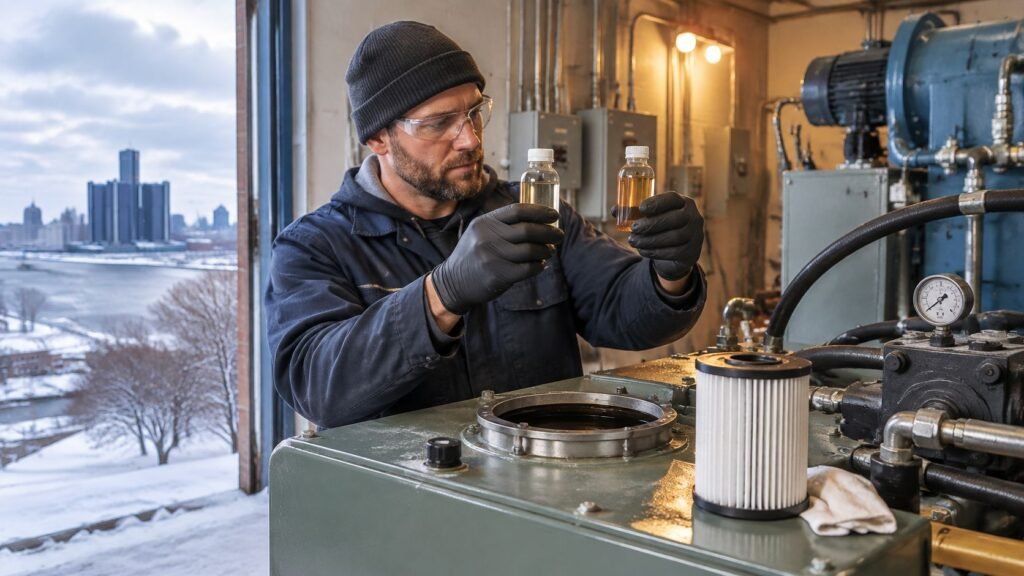
Your elevator is still running, but tenants are complaining about uneven stops, the machine room seems warmer than usual, and the last service ticket says the oil looks dirty. You're considering a hydraulic elevator oil replacement service because it sounds like a straightforward repair. Before you authorize a drain, though, you need to know whether the problem is the fluid, contamination, leakage, or a component that fresh oil won't repair.
A useful service proposal answers that question with measurements. It also tells you what the technician will inspect, what would justify replacement, and how you'll know the work addressed the original complaint.
Why a Hydraulic Elevator Oil Replacement Service Starts With a Question
Consider a Detroit building manager calling about inconsistent leveling. The request is for an oil change, but that's a requested treatment, not a diagnosis. A technician should first ask: What evidence says this oil needs replacing?
The answer might point toward contaminated valve passages, a weeping seal, or fluid that no longer meets the equipment specification. Those are different problems. Pumping out the reservoir before investigating can remove useful diagnostic evidence without correcting the cause.
| Service finding | Question to resolve | Appropriate direction |
|---|---|---|
| Dirty-looking oil | Is the problem particulate contamination or chemical deterioration? | Sample before choosing filtration or replacement |
| Falling reservoir level | Where has the missing oil gone? | Investigate leakage before adding fluid |
| Inconsistent leveling | Does the complaint track with temperature, fluid condition, or component behavior? | Measure and diagnose before adjusting |
| Uncertain service history | What fluid is actually in the system? | Reconcile records and verify suitability |
For a facility manager, the practical starting point is the maintenance file: previous samples, fluid purchases, leakage records, and unresolved callbacks. Ask the technician to establish a comparable level reading and explain what the laboratory will measure before fluid is transferred.
The diagnostic sequence should lead to a defined corrective action.
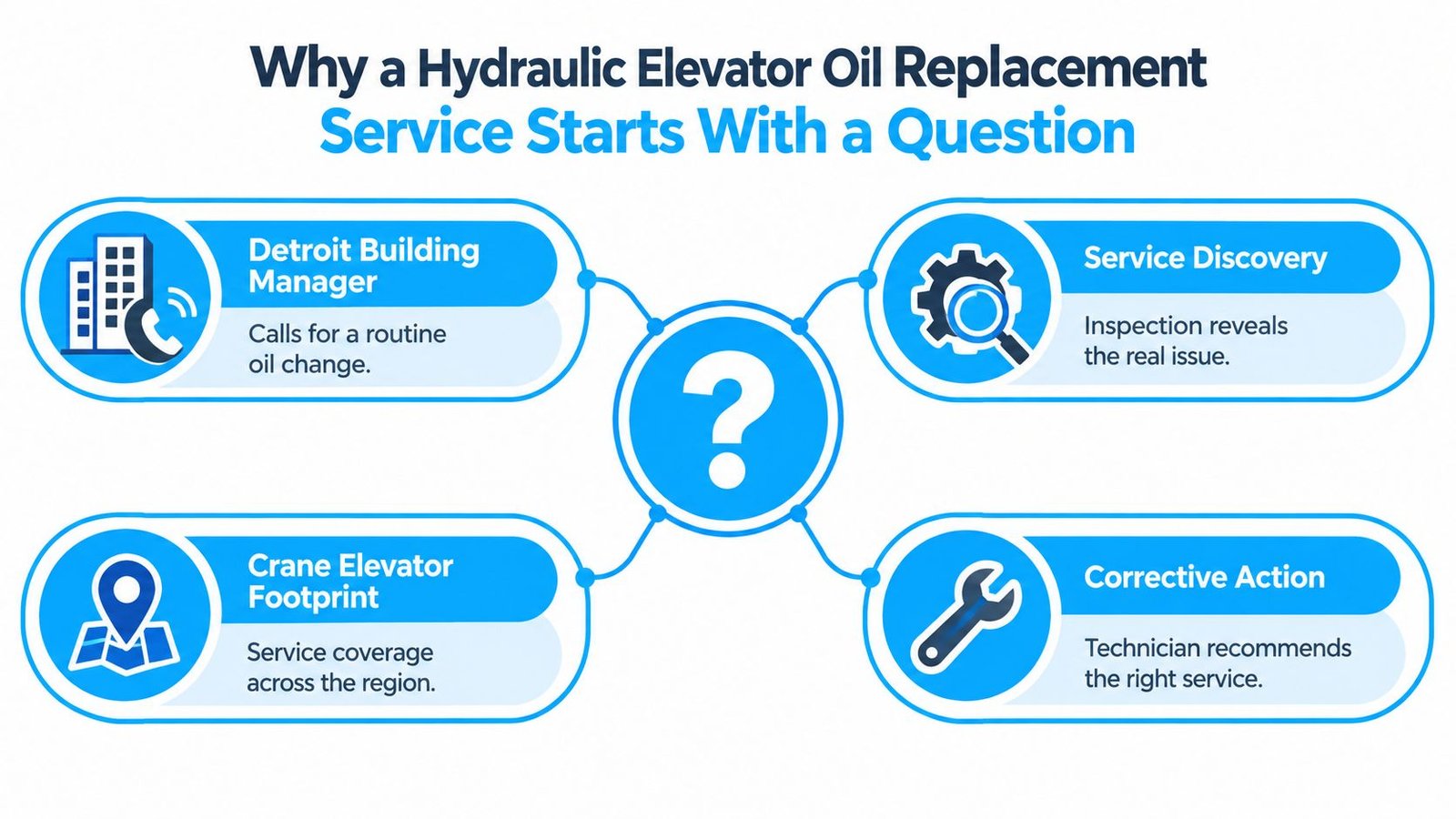
Crane Elevator serves Detroit, Lansing, Ann Arbor, Grand Rapids, and surrounding Michigan communities with maintenance, repairs, testing, inspection support, and modernization. That broader capability matters when the service call turns out to require valve or packing work rather than an oil change alone.
Keep inspection scheduling separate from oil-change scheduling. Michigan's cited inspection rules specify general inspections at least every 12 months for most commercial categories, including passenger, freight, LULA, material lifts, wheelchair-accessible lifting devices, escalators, and moving walks, and generally every 24 months for dumbwaiters, stairway chairlifts, and platform lifts; confirm applicable requirements and the rule's effective status with the authority having jurisdiction (Michigan elevator inspection rule document).
Understanding Hydraulic Elevator Fluid Properties and ISO Grades
Viscosity describes resistance to flow. For an owner reviewing a laboratory report, the important comparison is between the measured viscosity and the equipment's specified fluid grade, not whether the oil merely looks clean.
Pump, valve, seal, and ambient-temperature requirements commonly place usable hydraulic-elevator viscosity around 32–46 cSt, while some institutional specifications require petroleum-based ISO Grade 32 and expressly prohibit vegetable- or water-based fluids (hydraulic-elevator oil selection and maintenance guidance). That range isn't permission to substitute whichever drum is available.
Read the specification before choosing the drum
An oil-analysis report should identify the temperature used for the viscosity measurement. Viscosity at 40°C is a useful reporting reference, but the technician must also consider the actual reservoir-temperature range when assessing suitability (hydraulic-elevator sampling and analysis guidance).
- Manufacturer approval: Verify the required grade against the elevator and hydraulic-component documentation.
- Operating conditions: Review reservoir placement and the temperature conditions during the reported problem.
- Compatibility: Confirm the proposed product against seals, packing, and any fluid remaining in the system.
- Site restrictions: Check environmental requirements and the owner's specifications before ordering.
A Lansing hospital and a newer healthcare addition in Grand Rapids shouldn't receive identical fluid recommendations just because both use hydraulic elevators. The same applies to Michigan and Ohio properties with different machine-room arrangements. Ask for a selection based on each installation, not a regional rule of thumb.
The equipment inspection matters as much as the product label.
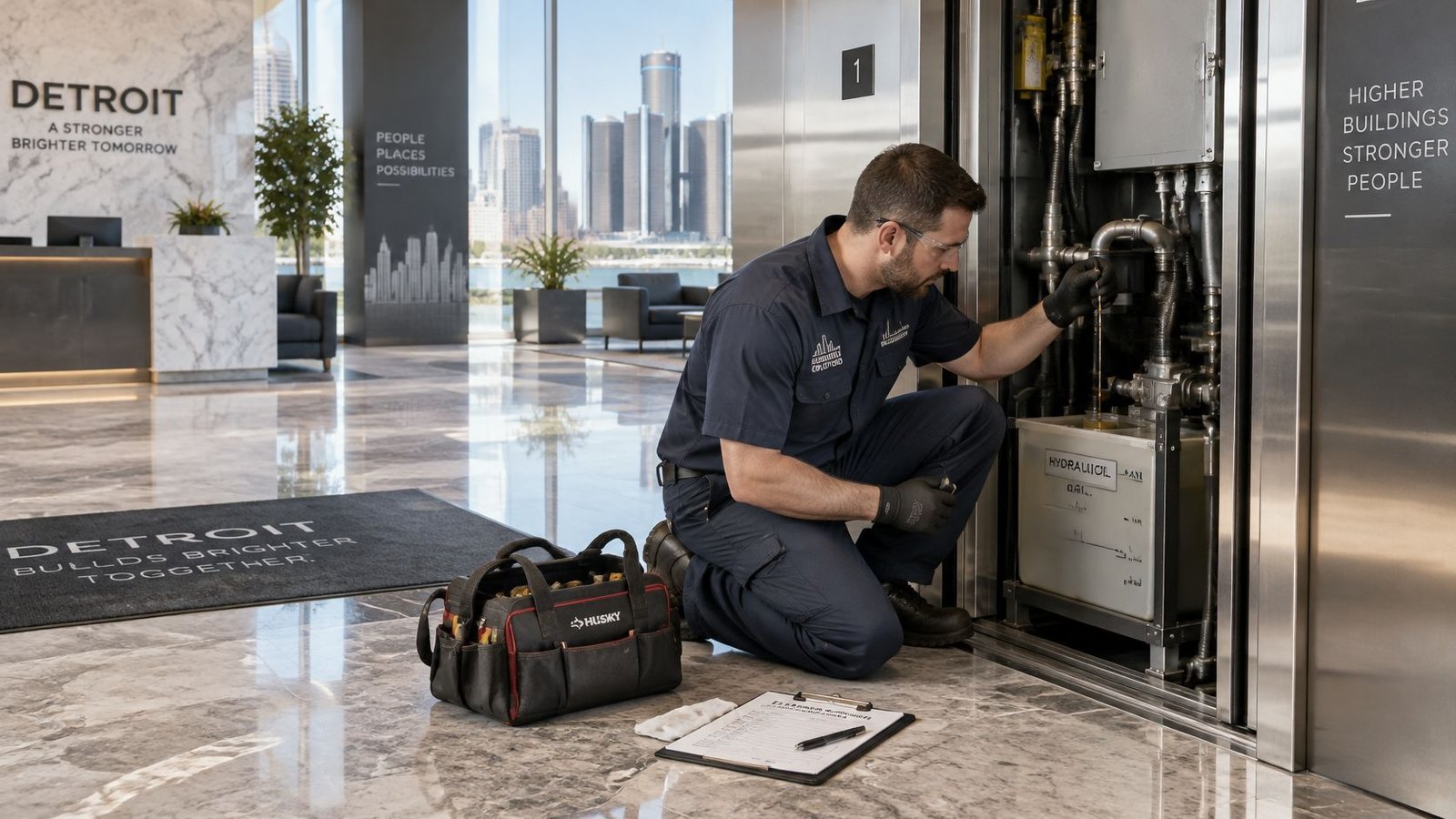
“Hydraulic oil” is too broad a purchase description. The proposal should identify the actual product and its approval basis so a future technician can verify what entered the tank.
Comparing Mineral and Biodegradable Hydraulic Fluids
Mineral oil, HETG vegetable-based fluid, and HEES synthetic ester fluid should be evaluated as equipment-specific choices, not ranked by a marketing label. For procurement purposes, require the supplier to document the proposed product's composition, viscosity designation, compatibility, and environmental characteristics.
A biodegradable designation alone doesn't answer whether a fluid belongs in your elevator. Nor should a familiar mineral-oil label substitute for checking the equipment specification.
Hydraulic elevator fluid types at a glance
| Fluid type | Typical ISO grade | Seal compatibility | Best-fit application |
|---|---|---|---|
| Paraffinic mineral oil | Match the manufacturer-specified grade | Verify against installed seals and packing | Equipment whose documentation calls for petroleum-based fluid |
| HETG vegetable-based fluid | Require product-specific grade verification | Obtain written approval before substitution | Sites evaluating a vegetable-based option where equipment approval permits it |
| HEES synthetic ester fluid | Require product-specific grade verification | Confirm both component compatibility and conversion requirements | Sites evaluating an ester-based option with documented manufacturer acceptance |
The useful comparison covers cold-start behavior, seal compatibility, environmental exposure, and oxidation condition. Ask for product documentation addressing those questions rather than accepting broad claims that one fluid family always performs better.
For example, compare a hypothetical Flint industrial property with an accessible tank against an Ann Arbor medical office with a buried cylinder. The owner should ask different questions about inspection access, containment, and the consequences of unexplained fluid loss. Those site differences belong in the selection discussion, but neither establishes the correct fluid by itself.
Practical rule: Treat a fluid-family change as an engineering decision, not a purchasing substitution.
Make conversion requirements explicit
Before approving a different fluid family, request a written scope covering residual oil, cleaning, compatibility checks, and follow-up sampling. Don't assume draining the reservoir removes everything that matters elsewhere in the hydraulic circuit.
The same discipline applies to indoor and outdoor exposure. Have the contractor document the actual site conditions and applicable environmental requirements. If a supplier can't establish compatibility or the conversion procedure, retain the approved fluid specification while the uncertainty is resolved.
Cleanliness Targets and When Replacement Beats Filtration
Sample first: a particle count and a chemistry panel point to different corrective actions. A count above the cited target with stable viscosity usually points to filtration. A rising acid number with that same count points to replacement.
Appearance clears nothing on its own. Straw-colored oil in the sight glass can still carry a failing acid number, so the decision path begins with a representative sample and a laboratory report.
Use the laboratory result as the decision point
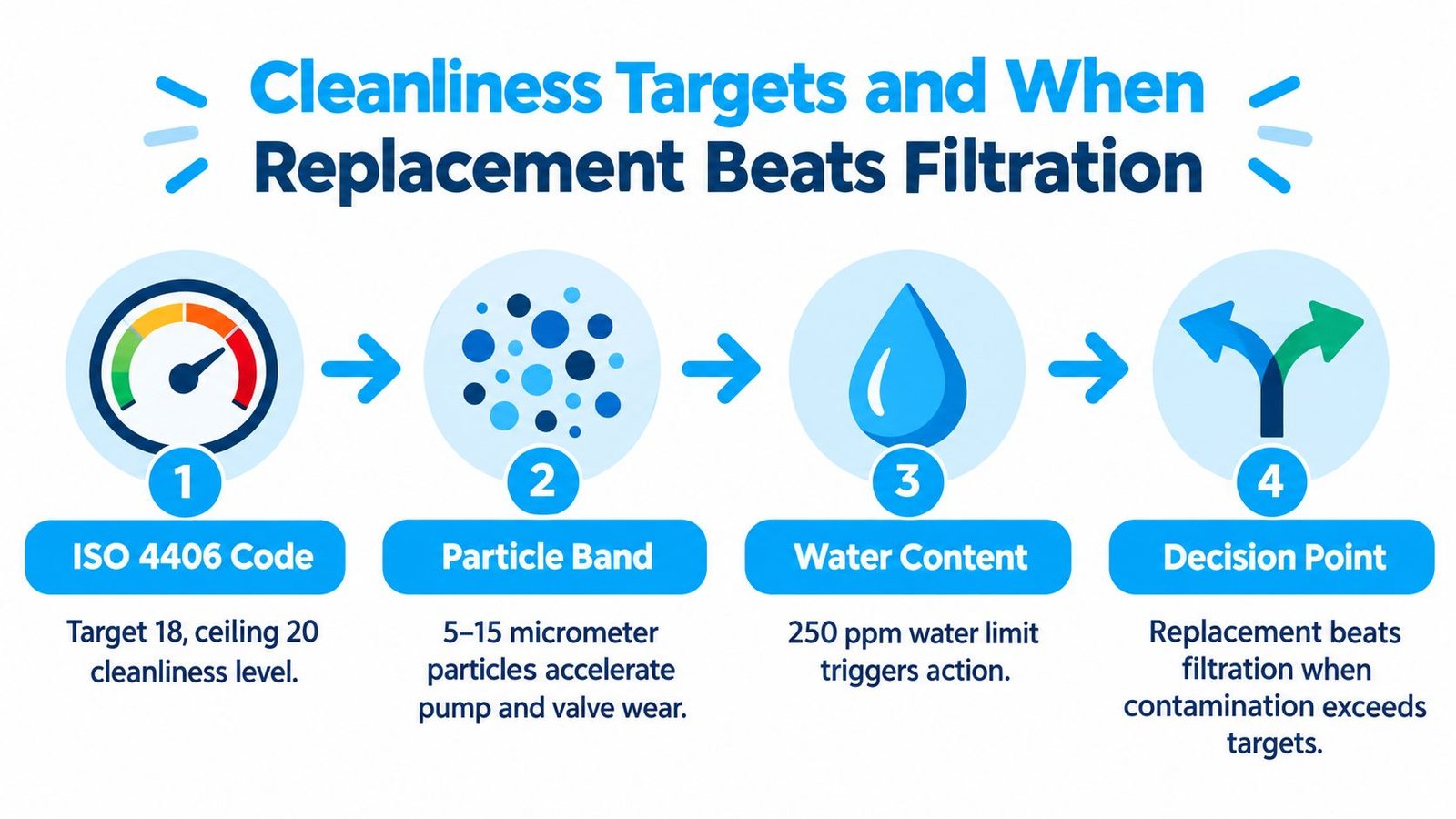
Published elevator filtration guidance recommends an ISO 4406 cleanliness code no higher than 20 and preferably 18, bands corresponding roughly to 5,000–10,000 and 1,300–2,500 particles per milliliter, along with water content below 250 ppm in mineral oil and analysis at least annually where alternative vertical transportation exists or every four to six months where it does not (elevator oil monitoring and filtration guidance). The same source ties particles in the 5 to 15 micrometer range to accelerated pump and valve wear, and links water contamination to leveling problems, transition behavior, heating, and oxidation.
Treat those numbers as filtration benchmarks rather than a universal acceptance limit. Have the laboratory state its reporting convention, then set acceptance criteria for your specific equipment.
Filtration earns its cost when the chemistry panel comes back healthy and particles are the only finding. Replacement earns its cost when the acid number has climbed, oxidation products have accumulated, an incompatible fluid entered the tank, or contamination is severe enough that cleaning the oil in place is impractical. Either way, find the entry point. Polishing oil while a worn packing or a failed breather keeps feeding dirt back into the reservoir pays for the same problem twice.
Fresh oil can loosen existing deposits, so specify a follow-up sample after the system has operated for a period. Keep reservoir filtration distinct from oil scavenge pump service, which handles oil that has already escaped the system instead of oil still circulating in it.
Use the following video as supplemental context alongside the equipment procedure and laboratory findings.
Investigating Oil Loss Before Topping Up the Tank
Missing oil is an unresolved condition, not a low-level reading. Before authorizing replacement, ask the contractor to reconcile what was added, what was collected, and what remains unexplained.
Colorado requires records of fluid added and leakage-container quantities where cylinders or piping aren't fully visible, with unexplained loss triggering applicable ASME A17.1 leakage testing; Alberta guidance calls for monthly checks with the car in the same position, documented losses, and removal from service when unaccountable leakage is confirmed (hydraulic elevator oil-log and leakage guidance).
Those jurisdictions provide useful procedural examples. They aren't a substitute for confirming Michigan requirements with the responsible inspector.
Establish where the oil went
Have a qualified elevator technician inspect the pit, machine room, collection pans, accessible piping, valve connections, and packing area. Compare those findings with the oil log before deciding whether the loss has been explained.
The checklist illustrates the investigation, but level comparisons must use the same documented car position and the manufacturer's procedure, not an assumed universal position.
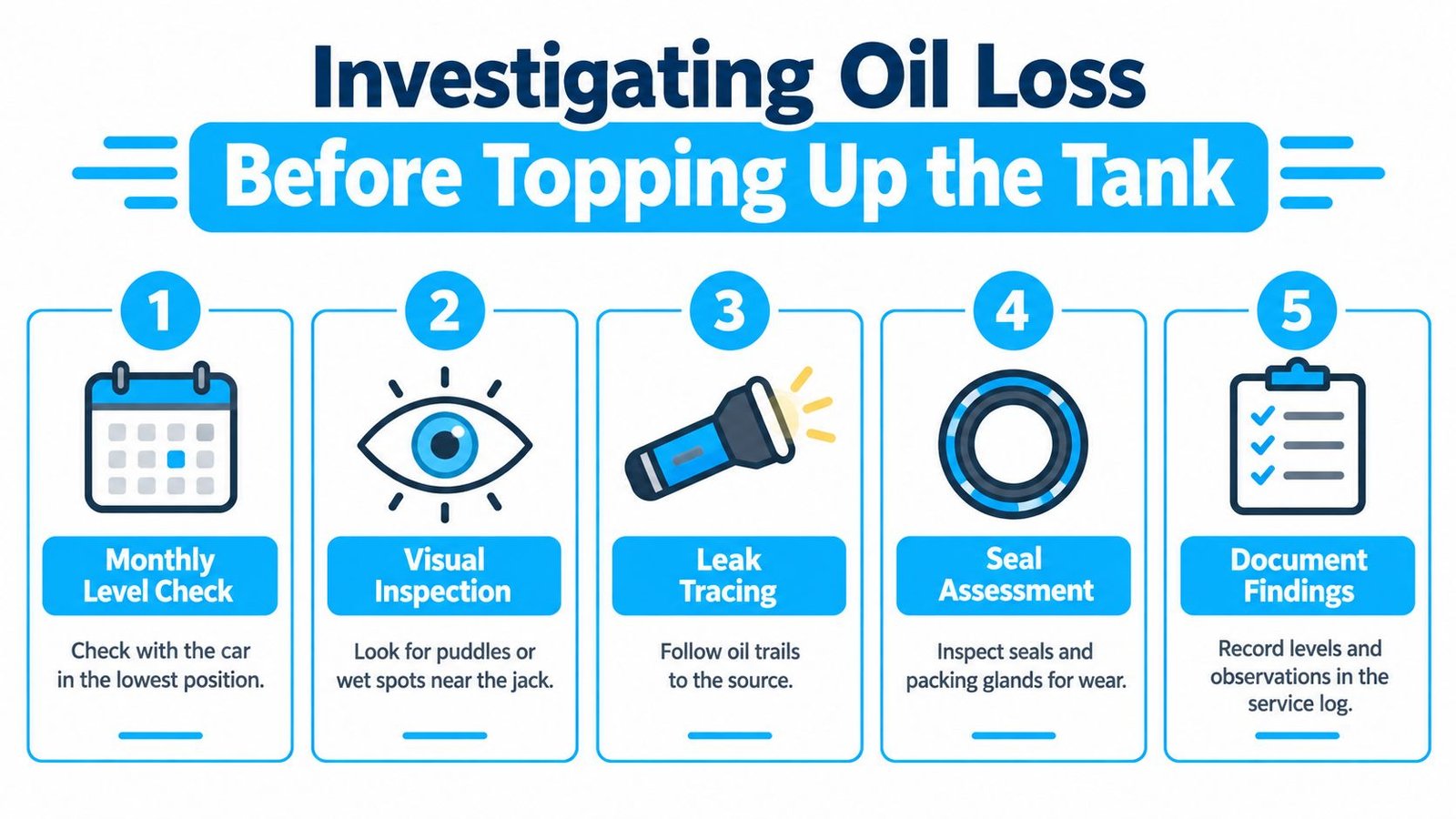
For a buried cylinder in Detroit or a warehouse installation in Toledo, request a specific explanation of what can and can't be inspected directly. An accessible wet fitting and an unexplained underground loss shouldn't receive the same diagnosis.
Adding fluid doesn't establish that the elevator has been repaired.
Require a documented response
The service scope should cover securing the equipment as required, quantifying the discrepancy, performing applicable leakage testing, and recording the findings. Facility staff shouldn't enter the pit or attempt leak testing themselves.
If the investigation identifies packing leakage, discuss hydraulic elevator seal replacement as a defined repair rather than burying it inside an oil-change allowance. Any proposal to return collected oil should also explain how its suitability will be established before reuse.
The Replacement Procedure a Michigan Technician Should Follow
A proper replacement scope describes how contamination will be controlled, not just how oil will be removed. The technician should preserve the pre-service evidence, clean the reservoir appropriately, and verify the operating result.
Before draining
Start with a representative sample, the approved fluid specification, and a documented baseline of the original complaint. Confirm how the equipment will be secured, how the work area will be protected, and how removed fluid will be handled under applicable site requirements.
- Inspect the reservoir: Examine the tank bottom for sludge, water, and debris rather than judging condition only from the surface.
- Service filtration components: Clean or replace suction and return filters as appropriate to the equipment.
- Control the transfer: Use clean transfer equipment and filter the replacement oil before it enters the reservoir.
- Verify operation: Record operating pressure and leveling behavior after filling and completing the applicable return-to-service checks.
New oil shouldn't be assumed clean merely because the container is unopened. Likewise, filling a dirty tank with fresh fluid leaves the owner without a convincing explanation of how the contamination problem was corrected.
Keep a usable acceptance record
Ask for the oil grade, product identification, batch, fill volume, temperature, transfer-filter rating, and final operating observations. Record what the technician found inside the tank and what filters or other components were serviced.
That record should connect the work to the complaint: what was wrong before service, what changed, and what remains to be monitored. A receipt saying “changed hydraulic oil” can't do that.
In Dearborn, Royal Oak, or Perrysburg, the site-specific details may differ, but the owner's acceptance question stays the same: Can another qualified technician understand exactly what was done? Retain the service report with the laboratory results and maintenance records, rather than leaving the information scattered across invoices.
Matching the Service Action to Fluid, Contamination, and Equipment Age
An older hydraulic installation doesn't automatically need new oil, and a newer lift doesn't automatically have healthy fluid. Equipment age provides context; measured condition determines the immediate service decision.
Use the following hypothetical situations to evaluate a recommendation. They're decision examples, not reported customer results.
| Example condition | Service direction | Evidence needed before closing the job |
|---|---|---|
| Older Kalamazoo jack with water contamination | Identify the entry path and assess replacement or recovery | Follow-up laboratory findings and source correction |
| Newer Novi residential lift with elevated particles but suitable chemistry | Evaluate filtration before a full change | Improved cleanliness and stable operation |
| Saginaw healthcare elevator with an undocumented top-up | Establish fluid identity and compatibility | Approved product record and a defined corrective scope |
| Jackson property with recurring heat-related complaints | Investigate operating conditions alongside fluid condition | Temperature observations tied to the complaint |
| Battle Creek installation with repeated component problems | Compare targeted repair with modernization | Component findings and a practical capital plan |
The point isn't to force every problem into “filter” or “replace.” Some conditions call for valve work, seal repair, further leakage investigation, or a broader equipment assessment.
Separate the immediate repair from capital planning
For temperature-related complaints, an elevator oil cooler assessment may belong in the investigation, but it shouldn't be prescribed without checking the actual operating conditions. Changing fluid grade to work around an unexplained temperature problem isn't a documented diagnosis.
Owner's checkpoint: Ask what finding would make the technician change the recommendation.
That question exposes whether the proposal follows evidence or repeats a standard package. A contractor recommending replacement should explain why filtration isn't appropriate; a contractor recommending filtration should explain what would establish that the oil remains suitable.
Keep the inspection calendar alongside this decision, but don't confuse passing a general inspection with proof of fluid health. Preserve the laboratory trend, repair history, and equipment-specific acceptance criteria so the next service decision starts with evidence rather than another guess.
Scheduling a Hydraulic Elevator Oil Replacement Service in Michigan
Request a condition-based quote before anyone commits to dumping the oil. Give the contractor the equipment identification, available maintenance records, descriptions of the complaint, and any known history of water exposure or unexplained fluid additions.
A useful request separates investigation from corrective work. Ask what the initial visit will establish, what laboratory testing is included, and who authorizes a change in scope if the technician finds a leak or incompatible fluid.
Put the scope in writing
- Diagnosis: Sampling, record review, and leak localization appropriate to the complaint.
- Corrective options: Separate recommendations for filtration, replacement, and related component repairs.
- Service controls: Fluid approval, tank cleaning, transfer filtration, and disposal arrangements.
- Closeout: Operating checks, the fill record, follow-up sampling, and responsibility for unresolved findings.
Detroit also has its own administrative coordination needs. The city's Elevator Inspection Team, within the Buildings, Safety, Engineering, and Environmental Department, handles contractor licensing functions, equipment inspections, complaints, accident reporting, elevator-license registration, and code questions (Detroit Elevator Inspection Team responsibilities). Ask whether the proposed work requires inspection coordination, permit review, or related deficiency correction rather than assuming an oil-service invoice covers those obligations.
Crane Elevator's service coverage includes Detroit, Lansing, Ann Arbor, Grand Rapids, Flint, Kalamazoo, and surrounding communities, with Michigan and Ohio support extending to properties around Toledo and Perrysburg. Owners in Livonia, Pontiac, Holland, and Ypsilanti can also discuss maintenance, repairs, safety testing, violation corrections, and non-proprietary modernization across passenger and freight elevators, residential elevators, wheelchair and material lifts, and dumbwaiters.
The right appointment ends with an explained condition and a defensible recommendation. It shouldn't end with fresh oil and the same unanswered question.
Crane Elevator Company offers hydraulic-system maintenance, oil-condition checks, leak investigation, repairs, and inspection support for Michigan and Ohio properties. Visit Crane Elevator Company to request a condition-based assessment and a written scope covering the fluid, related equipment findings, and post-service documentation.