
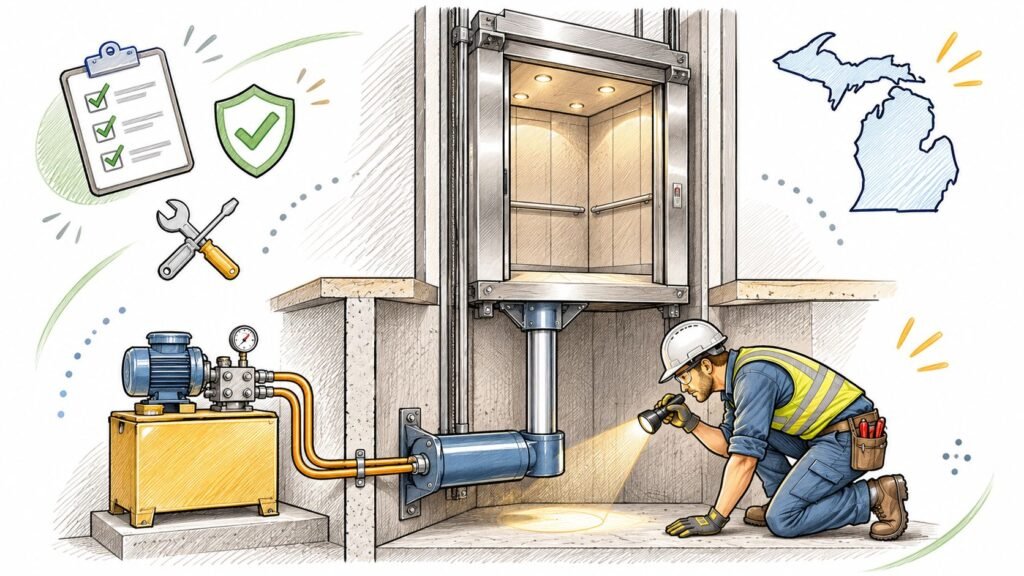
The elevator still runs, but it stops slightly below the landing when the building gets busy. Your maintenance log shows oil added again, yet nobody has explained where it went. You're left deciding whether to approve another adjustment, replace a component, or budget for something larger.
Hydraulic elevator maintenance should produce a condition history, not just a visit history. Oil consumption, tank temperature, fluid condition, and leveling behavior become useful when a technician compares them under similar operating conditions. That's how owners separate a repairable seal problem from a deteriorating jack or an overheating power unit.
How a Holeless Hydraulic Elevator Works
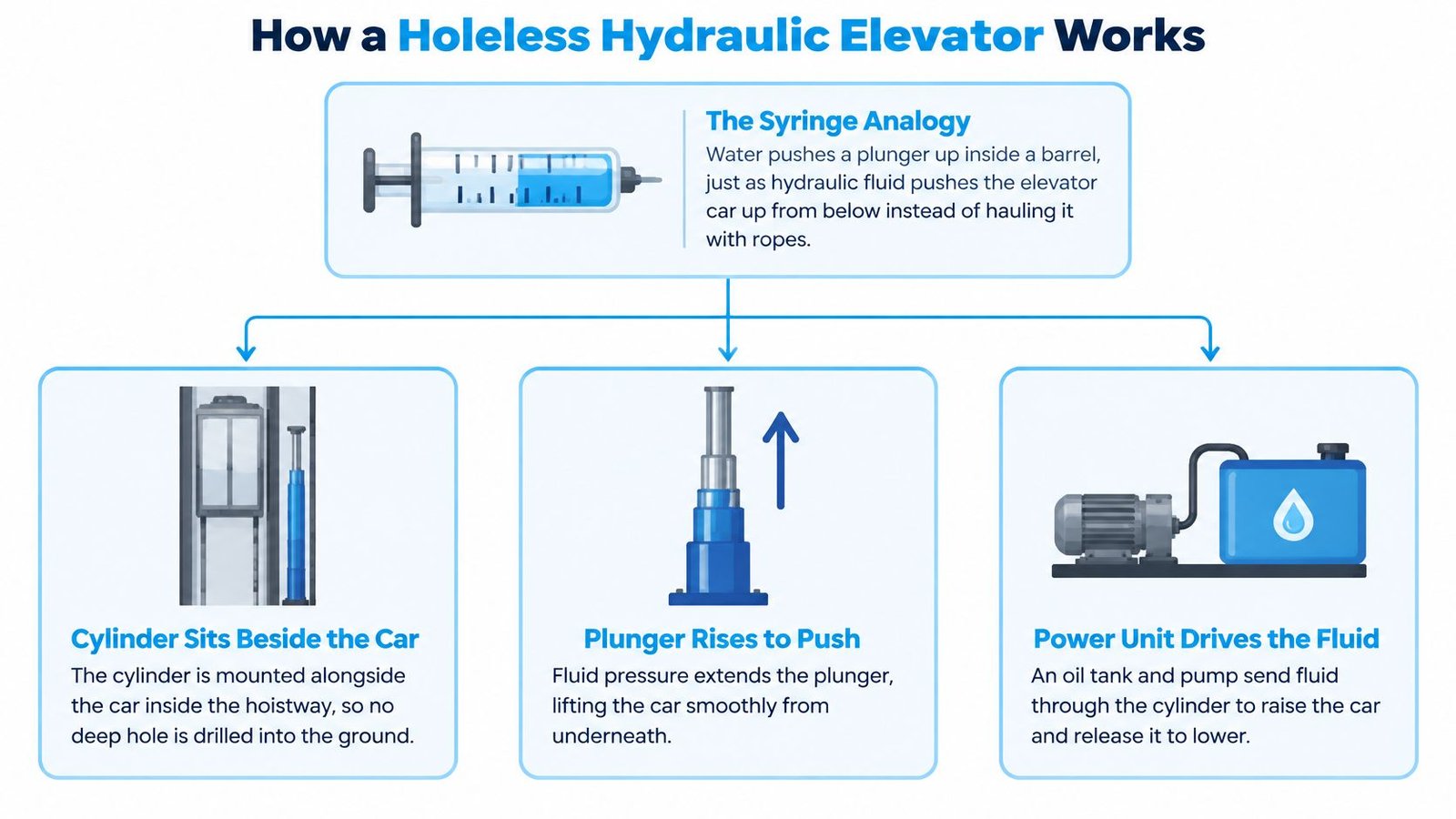
A direct-acting hydraulic elevator pushes its car upward much like liquid pushes a plunger through a syringe. Instead of hauling the car from above, the system develops pressure underneath its supporting plunger.
Holeless means the cylinders sit beside the car inside the hoistway, not in a deep drilled hole beneath it. A buried cylinder belongs to an in-ground hydraulic arrangement, and that distinction matters when investigating hidden oil loss.
The maintenance framework isn't new: Elevator World's history of elevator codes traces the first ASME A17.1 safety code to 1921, establishing a formal foundation for design, installation, inspection, testing, maintenance, and repair.
Follow the oil through the system
Say a passenger selects an upper landing. The controller starts the pumping system, and these components work together:
- Power unit. The motor drives a pump that draws hydraulic fluid from the reservoir and develops the flow needed to lift the car.
- Oil tank. The reservoir holds the working fluid and provides space for returning oil; its filtration arrangements and breather help manage contamination.
- Control valves. The valve assembly directs and meters flow during acceleration, travel, and leveling, while the lowering valve controls oil returning to the tank.
- Jack and plunger. Oil pressure extends the plunger within the cylinder, transmitting lifting force to the car through the system's particular arrangement.
- Packing and seals. These control leakage where the moving plunger exits the jack head and where stationary components join.
- Pressure-relief and safety devices. These protect against specified abnormal conditions and require verification using the equipment's approved procedures.
The diagram shows the basic holeless arrangement.
Why symptoms overlap
During normal descent, gravity lowers the car while the valve meters returning oil. Viscosity, temperature, and valve response therefore affect stopping and leveling, not just upward travel.
A sticking valve can resemble inadequate pump output. Leaking packing can produce a low-oil complaint even though the pump itself remains serviceable.
Start with evidence: Have the technician establish oil level, operating temperature, and conditions around the jack before recommending adjustments or replacement.
Owners can review those findings and observe landing behavior from public areas. Pit entry, jack examination, and equipment adjustments belong to qualified elevator personnel.
Michigan Maintenance Intervals and Inspection Frequency
A hydraulic elevator that starts losing oil or drifting at landings needs closer attention than one with stable readings and no recurring symptoms. Set maintenance frequency from applicable Michigan requirements, equipment use, and the unit's condition over time. A fixed visit count alone can miss a developing problem.
Maintenance intervals by elevator type and use
| Equipment or use | Who must perform the work | Interval | Source |
|---|---|---|---|
| Permanent passenger or freight elevator used temporarily by the public | Licensed elevator journeyperson | Every 30 calendar days | Michigan elevator rules |
| Power elevator covered by the certificate-holder requirement | Licensed elevator journeyperson | At least every 90 days | Michigan elevator rules |
| High-use hydraulic unit in a busy building | Qualified maintenance technician, licensed where required | Monthly check | Industry maintenance guide |
| Lower-use residential hydraulic unit | Qualified maintenance technician, licensed where required | Quarterly check | Industry maintenance guide |
The Michigan elevator rules document specifies every 30 calendar days for permanent passenger or freight elevators used temporarily by the public, and at least every 90 days for covered power elevators. Certain private-residence elevators, platform lifts, and stairway chairlifts are excluded. The temporary-public-use qualification is specific; confirm the applicable rule and equipment classification with the authority having jurisdiction.
Monthly and quarterly checks are planning benchmarks, not replacements for Michigan requirements. Match the schedule to traffic, loading, and the consequences of an outage. A hospital carrying patients, a factory with concentrated shift changes, a school, and a lightly used residential unit have different service demands.
Use the unit's history to adjust the plan. Track oil readings, usage, oil loss, and leveling drift at each visit. A change across consecutive records can signal a developing issue before it becomes a callback. If readings worsen or symptoms persist, shorten the monitoring interval and define what the next visit should measure.
Build the schedule around:
- Traffic and loading. Review operating patterns, including concentrated demand.
- Failure consequences. Establish whether another accessible elevator can serve the building.
- Leak and callback history. Investigate recurring symptoms rather than waiting for the next routine visit.
- Equipment condition. Consider wear, obsolete components, moisture exposure, and ventilation.
A maintenance visit, a safety test, and an authority inspection serve different purposes. Confirm which activities the maintenance agreement includes and who arranges any remaining obligations.
For comparison, Wisconsin's elevator authority requires retention of the most recent five years of maintenance records, quarterly hydraulic oil-level and usage records, and records of applicable annual Category 1 and five-year Category 5 tests. These are Wisconsin recordkeeping requirements, not Michigan maintenance intervals. Confirm testing obligations for a Michigan installation separately.
Use the elevator preventive maintenance scope to assess what a scheduled visit covers. Records should identify the date, tasks, examinations, adjustments, deficiencies, corrective actions, and unresolved work, not just confirm attendance.
How to Run a Hydraulic Maintenance Visit
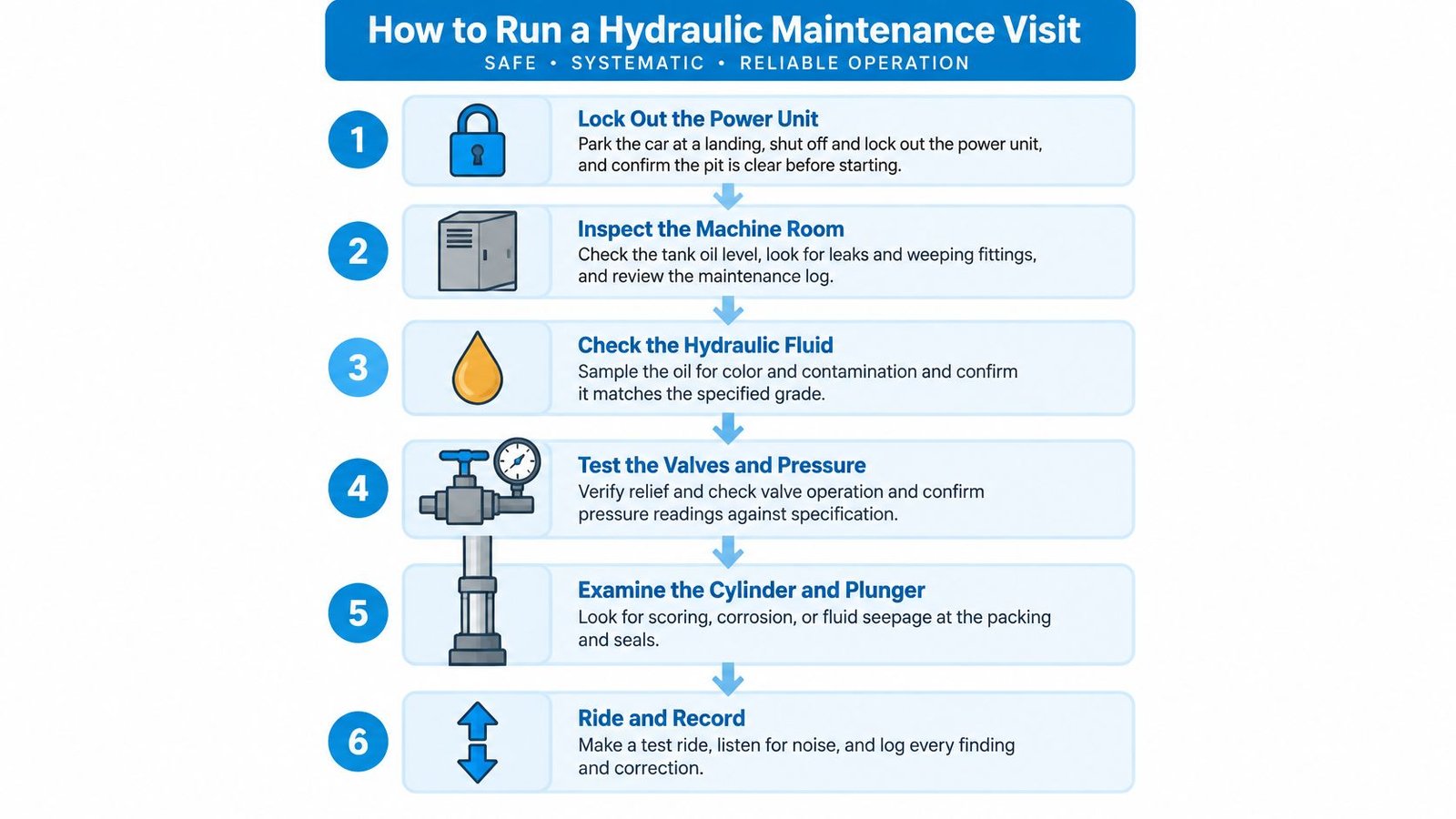
A useful visit starts with the previous findings. Before touching an adjustment, the technician should know whether the complaint occurred with cold oil, after sustained traffic, under load, or after the elevator stood idle.
This is a licensed-technician workflow, not an owner's repair checklist. Lockout protects against electrical hazards but doesn't, by itself, secure a hydraulically supported car against movement.
Work safely, then measure consistently
Plan access and control movement. Review the equipment-specific procedures, secure the elevator against unintended operation, and apply required lockout and mechanical-support measures before entering hazardous areas. Parked-at-a-landing is not proof that pit access is safe.
Establish operating readings. Obtain temperature under representative traffic before shutdown, and measure reservoir level at the manufacturer's specified car position so later comparisons are meaningful. The U.S. Bureau of Reclamation's hydraulic-fluid guidance identifies approximately 100–130°F (37.8–54.4°C) as an effective range for commonly used ISO VG 32 fluid and recommends avoiding temperatures above 130°F (55°C), while the equipment manufacturer's limits govern the installation.
Take a representative sample. Use a clean sampling container and a consistent sampling location, recording the operating condition alongside the sample identification. Compare viscosity, contamination, water, and other specified properties with manufacturer limits rather than replacing fluid solely because it looks old.
Find the contamination route. Inspect for foaming, water intrusion, damaged breathers, restricted filters, and unsuitable storage or filling practices. Replacing contaminated oil without correcting its entry path leaves the next fill exposed to the same problem.
Examine the hydraulic circuit. Inspect accessible piping, fittings, the jack, plunger surface, and packing for leakage, scoring, or corrosion. Distinguish a manufacturer-permitted lubricating film from active leakage, and record where recovered oil accumulated.
Check travel under controlled conditions. After restoring the installation according to procedure, compare empty-car and appropriately loaded travel, stopping, and leveling behavior. Record load condition and temperature so a later technician can reproduce the test instead of guessing what “rough ride” meant.
Verify protective functions. Perform pressure-relief, valve, safety-device, and door-lock checks using the applicable approved procedures and calibrated instruments. Don't improvise pressure settings or bypass protection to make the elevator complete a run.
Clean and inspect exposed areas. Clean the machine room, pit, and car top using safe access procedures, then inspect surfaces previously hidden by dirt or oil. Keep waste oil and oily absorbents contained rather than washing them into a sump.
Close the visit with accountable findings. Record readings, test conditions, corrections, and outstanding deficiencies with an assigned follow-up action. Where a safety defect exists, follow the required removal-from-service and notification procedures rather than leaving an unexplained callback note.
The visual checklist summarizes the workflow; actual access and test procedures remain equipment-specific.
Define healthy operation correctly
Healthy operation means stable temperature under comparable demand, fluid meeting its specification, controlled leakage, and consistent level stops. Clear-looking oil alone doesn't establish cleanliness, and a freshly wiped jack head doesn't establish that a leak has stopped.
Diagnosing Leaks, Drift and Contaminated Oil
A car that gradually settles below a landing needs a controlled diagnosis, not an automatic packing replacement. The technician must separate internal oil bypass from external oil loss and determine whether temperature changes the behavior.
Hydraulic symptoms, likely causes and first checks
| Symptom | Likely cause | Check first | Fix path |
|---|---|---|---|
| Loaded car sinks beyond the applicable descent criterion | Slow valve leakage or packing wear | Valve block and packing at the jack head | Valve or packing repair after isolation testing |
| Oil level drops between comparable readings without a visible drip | Hidden piping leak or buried-cylinder deterioration, including protective-liner concerns where fitted | Pit and sump oil, piping, cylinder construction records | Locate leakage, then review containment and jack condition |
| Oil appears dark, foaming, or milky | Degraded, aerated, contaminated, or water-laden fluid | Representative sample against manufacturer limits | Correct the source, then filter, flush, or replace as appropriate |
| Tank runs above the specified operating limit | Poor cooling, heavy duty cycle, bypassing, or pump deterioration | Ventilation, traffic pattern, and hydraulic performance | Correct cooling or operating faults, then evaluate pump efficiency |
| Oil appears in the pit or sump after rain | Groundwater intrusion carrying existing oil or a compromised sump arrangement | Water entry, sump operation, and containment | Contain contamination, correct water entry, and assess containment needs |
European guidance discussed in Elevator World's technical and environmental literature uses a benchmark under which a loaded elevator should not descend more than 10 millimeters in 10 minutes. That's a diagnostic reference, not a declaration of the Michigan acceptance limit for every installation.
Separate bypass from missing oil
With internal valve leakage, oil can return to the reservoir while the car settles. The building may experience repeated releveling without a corresponding loss of total system oil.
Packing leakage is different. Inspect the jack head, collection arrangements, and any return system before deciding how much oil has escaped.
For concealed loss, compare reservoir readings taken at the same car position. Then examine accessible piping and recovered oil before concluding that a buried cylinder has failed.
A protective liner problem and a leaking steel pressure cylinder aren't interchangeable diagnoses. Construction records and appropriate testing must establish which component is defective and whether containment remains effective.
Treat the pit as environmental evidence
The same industry review describes buried systems containing roughly 200 liters of mineral oil and warns that one liter released into water can contaminate up to one million liters. These are contextual environmental figures, not an estimate of any particular building's spill volume.
Oil mixed with groundwater requires more than sump repair. Stop uncontrolled discharge, isolate the affected area, and involve the appropriate elevator and environmental personnel.
Repeatedly topping off oil can make the reservoir look normal while leaving the actual leak unresolved.
For fluid decisions, the hydraulic elevator fluid guidance is a useful starting point, but laboratory results and the equipment specification should determine treatment. Filtering won't correct every form of degradation, and replacement won't cure a valve defect.
Preserve sample results, photographs, oil-addition records, recovered quantities, and descent-test conditions. Confirm reporting, cleanup, and return-to-service duties with the local authority and applicable environmental regulators before selecting the final repair.
Repair, Replace or Modernize the Jack and Power Unit
The deciding question isn't whether a component is old. It's whether a repair addresses an isolated defect, whether failures recur, and what another failure could do to the building or surrounding environment.
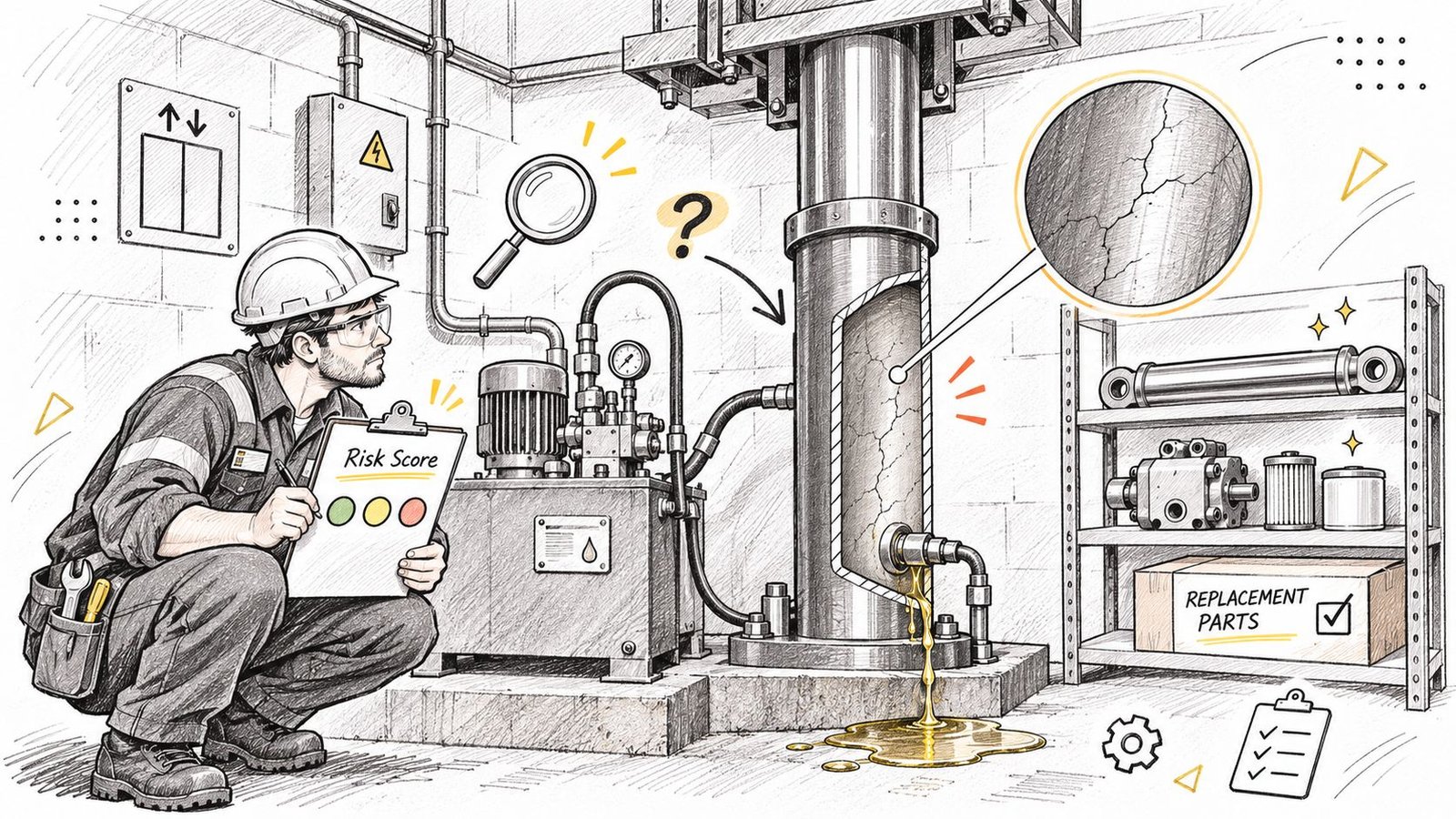
A cylinder assessment should connect visible condition with the operating history.
Rank the risk before choosing the scope
The Oxmaint elevator maintenance guide recommends tailoring maintenance to equipment class and usage, with monthly checks commonly used for high-use hydraulic units and quarterly checks for lower-use residential equipment. Its hydraulic priorities include fluid condition, piston seals, pressure-relief operation, and pit-sump performance.
For an owner's screening assessment, rate traffic, downtime consequence, leak history, equipment condition, and environmental exposure as low, moderate, or high. This is a planning tool, not a code calculation or a substitute for engineering assessment.
A sound cylinder with an isolated seal defect supports targeted repair. An inaccessible buried cylinder with unexplained oil loss and uncertain containment deserves deeper investigation and a capital-replacement review.
More visits don't equal better maintenance when nobody corrects the underlying defect.
Repair or replacement by situation
| Situation | Repair path | Replace or modernize when |
|---|---|---|
| Worn packing, sound cylinder, no buried leak | Repack or replace packing after checking the plunger | Leaks return after repacking and the underlying wear can't be corrected economically |
| Valve or pump fault, sound cylinder | Repair or replace the verified faulty component | Failures recur despite correction of fluid and operating conditions |
| Degraded power unit or tank | Replace the affected tank or power-unit assembly | Records establish recurring contamination, overheating, or structural deterioration |
| Buried jack with suspected liner or cylinder failure | Investigate, identify the failed component, and contain leakage | Cylinder leakage is confirmed, containment is unreliable, or leakage recurs |
| Old controls with a safety or door-lock gap | Correct the specific protection deficiency | A violation or inability to establish safe operation requires broader upgrading |
Compare complete proposals
A hydraulic elevator jack replacement assessment should address cylinder condition, access, containment, related piping, and restoration work. Replacing the jack may be the safer lifecycle choice when the pressure boundary is defective and containment is uncertain, but replacement scope must follow the actual findings.
For additional visual context, the following video accompanies the repair discussion.
Evaluate every quotation against a direct question: Does this scope fix the cause established by the records, or only the symptom visible at the latest visit? A cheaper component replacement isn't good value if the same operating fault will damage it again.
Michigan Code, Licensing and Booking Your Review
Michigan regulates the complete elevator installation, not just its hydraulic equipment. The state's elevator permit guidance covers permits and applicable elevator requirements. Michigan regulations adopt ASME A17.1 and A18.1 standards. Confirm the current requirements for the equipment and work involved before scheduling a repair, alteration, or test.
Door interlocks, controls, emergency communications, fire-service operation, safety devices, and equipment-room conditions all belong in a compliance review. An elevator can travel smoothly and still have a safety deficiency elsewhere.
Michigan's licensing framework requires installation, maintenance, repair, servicing, adjustment, inspection, and testing to be performed by a licensed elevator journeyperson. Crane Elevator Company's Michigan service information describes this licensed-work scope. Owners should distinguish administrative observation and recordkeeping from technical work requiring the appropriate license.
Turn the records into an owner's action plan
Gather the available maintenance history. Collect oil-addition entries, sample reports, leveling complaints, callbacks, repair invoices, test reports, and open violations. Arrange them chronologically. That makes recurring adjustments easier to identify than reviewing separate invoices in isolation.
Confirm the equipment classification and schedule. Identify the elevator type, use, applicable service requirements, and required tests. Resolve scheduling gaps promptly, then set the review depth according to the equipment's condition and the consequences of downtime.
Obtain an independent review of unresolved problems. Before approving major work, ask for a diagnosis that states the evidence, alternatives, and consequences of deferring action. Crane Elevator Company offers a second opinion on an existing or ongoing problem at no extra charge, including a visit and a solution plan.
Require a written condition trend. Track reservoir level, oil additions, temperature, sample results, and leveling observations consistently. Record the measurement conditions too. Changes in car position or traffic can otherwise look like equipment deterioration.
Assign responsibility for the whole installation. Establish who handles deficiencies, testing coordination, emergency communication faults, and return-to-service decisions. Every open item needs an owner and completion status, not another unexplained maintenance signature.
Quote review: A useful proposal names the failed component, the evidence supporting the diagnosis, the corrective scope, and the verification that will establish successful completion.
Match the work to the equipment
Crane Elevator Company provides preventive maintenance, state testing and inspections, major and minor repairs, and elevator modernization for all makes and models. Maintenance includes full cleaning of machine rooms, pits, and car tops, along with COP and PI bulb replacements.
Hydraulic services include packing, jack, tank, and power-unit replacement. Other work includes cable replacement and shortening, motor, sheave, and machine replacement where applicable, door-lock monitoring, safety-edge door detector replacement, safety tests, emergency phones, fire-service and generator testing, and inspection-violation corrections.
Modernization covers hydraulic and traction equipment, including cab interiors, door equipment, fixtures, and non-proprietary controls that any qualified provider can service. The company works on passenger, service, freight, and residential elevators, drum machines, wheelchair lifts, material lifts, and dumbwaiters. Its residential division maintains and repairs home elevators and wheelchair lifts, with custom maintenance planning.
Crane also offers elevator and modernization financing, plus a free, no-obligation quote for compliance and violation work. Match the proposed scope to the defect: a cab update will not correct an unresolved hydraulic problem, and an isolated packing failure does not by itself justify replacing sound controls.
Confirm coverage and accountability
Crane Elevator Company provides elevator services throughout Birmingham, Michigan. Confirm that the building's location and requested work are covered when booking.
The company's No Show, No Pay Maintenance Policy and maintenance guarantee establish accountability for attendance and execution. Clean machine rooms, pits, and car tops are guaranteed with maintenance.
Field operations are open 24 hours a day, seven days a week, 365 days a year. That does not specify an arrival time. Before signing, confirm response commitments, covered labor and parts, testing responsibilities, exclusions, and after-hours terms in writing.
Crane Elevator Company offers hydraulic elevator maintenance, testing, targeted repairs, and non-proprietary modernization based on equipment condition. Visit Crane Elevator Company to book a review, bring the maintenance records, and request a written plan for unresolved oil loss, overheating, or leveling problems.