
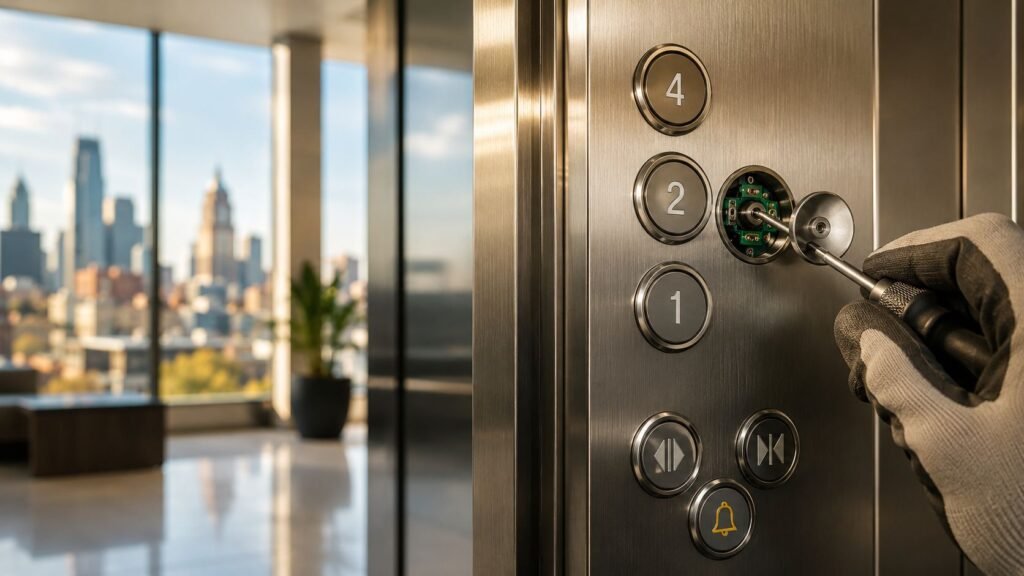
A tenant calls the office and says the third-floor button didn't respond again. Someone else mentions the lobby call station has been acting up for weeks. The elevator still runs, so it's tempting to treat it like a small nuisance and wait for the next service visit.
That's usually the wrong move.
A bad button sits at the point where users judge the whole system. If the push button sticks, doesn't light, or only works after repeated presses, people assume the elevator isn't reliable. In some cases, they're right. What looks like a minor part failure can point to worn contacts, loose wiring, communication faults, or a panel that's aging out as a whole. Elevator button repair isn't just about restoring one floor selection. It's about protecting uptime, maintaining safe operation, and avoiding the cycle of repeated callbacks that drains maintenance budgets.
More Than Just a Stuck Button
Most building managers first hear about button problems as a complaint, not a technical diagnosis. A tenant says the hall call button feels loose. A staff member reports that a car button only responds on the second press. Someone notices the illumination is out and assumes it's just a lamp.
Sometimes it is that simple. Often it isn't.
Elevator buttons are among the most heavily used components in the system. In a market where the global elevator maintenance and repair sector was valued at USD 92.5 billion in 2025, high-contact components like buttons represent a steady repair category because they take constant mechanical use and must remain functional for safe operation.
What building managers miss
A failed button changes more than convenience. It affects user confidence, daily traffic flow, and your ability to keep the equipment in presentable condition for tenants, patients, residents, or visitors.
Three practical issues come up fast:
- User trust drops first: People don't separate a bad button from the rest of the system. If one input looks unreliable, they assume the elevator is unreliable.
- Service calls become repetitive: If the underlying problem is in the panel, wiring, or board, replacing one button can buy only a short window before another fault appears.
- Compliance concerns follow closely: Buttons are part of the operating interface. If the interface is damaged, worn, or not functioning correctly, you're no longer dealing with a cosmetic issue.
Practical rule: Treat a button failure the way you'd treat a warning light on a boiler control. The symptom may be small. The decision to ignore it is what gets expensive.
The asset management view
Good managers don't ask only, “Can this one button be replaced?” They ask, “Why did it fail, and is this the start of a wider panel problem?”
That shift matters. A stuck or dead button can be an isolated wear item. It can also be the first visible sign that the car operating panel or hall station has deeper deterioration. Once you look at it that way, the conversation changes from quick fix to maintenance strategy.
What a Failing Elevator Button Is Telling You
Different button failures point to different root causes. If you can describe the symptom clearly, your technician can narrow the fault faster and decide whether the issue is local to the button or tied to the control system.
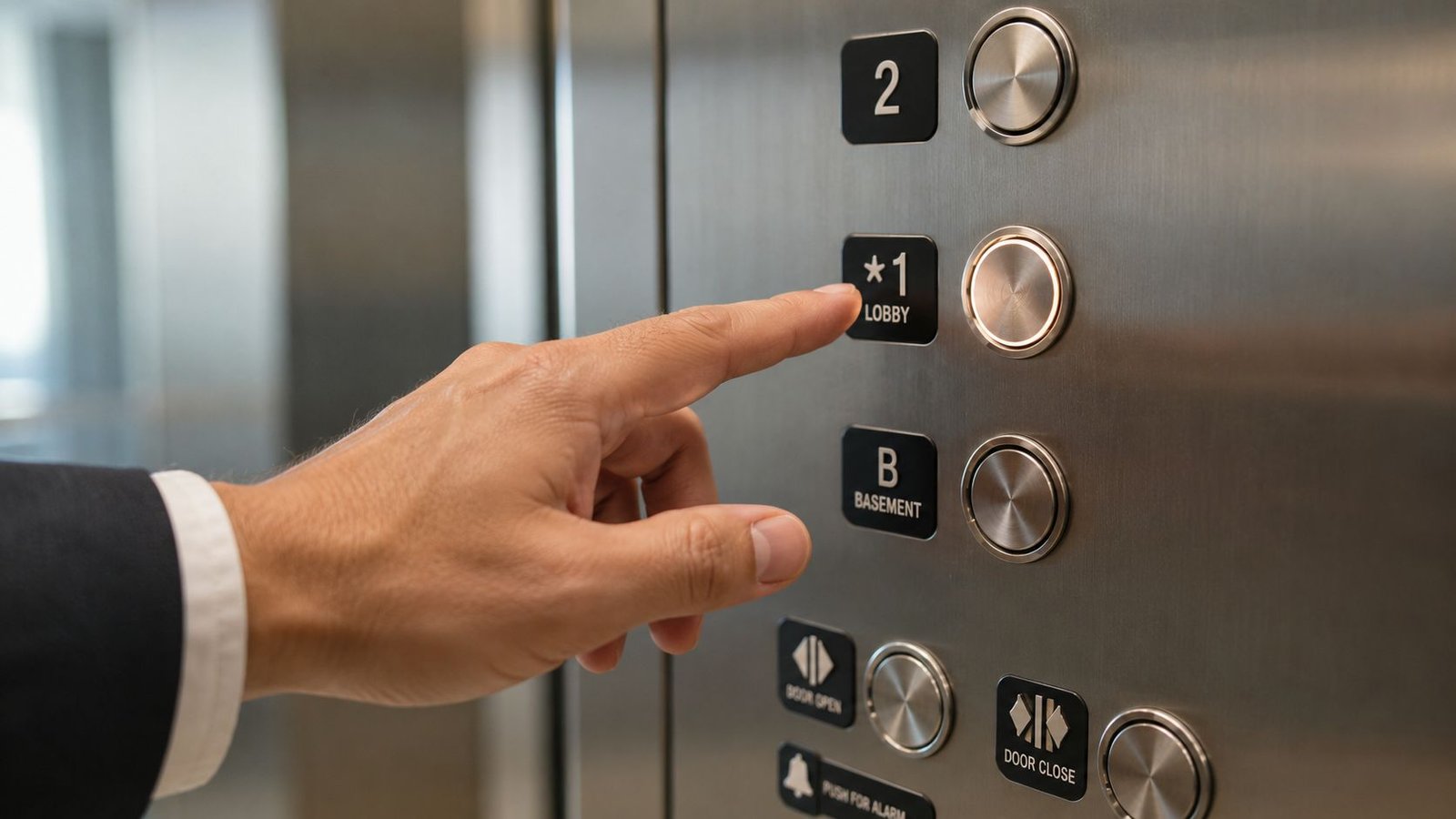
Four common symptom patterns
A physically stuck button usually points to contamination, worn plastic parts, damaged springs, or a button assembly that has reached the end of its service life. In older fixtures, I also look for panel wear around the mounting point. If the faceplate has loosened or warped, the button may bind even after the internal switch is replaced.
A button that doesn't light up but still registers the call deserves more attention than most owners give it. A persistent unlit button can signal controller communication errors or control board faults that may escalate into full system failures if ignored. If you want to understand how those signal paths connect back to the rest of the system, it helps to review the role of elevator controls.
An intermittent button is often the most frustrating fault because it passes a quick test and then fails under normal traffic. That usually means loose terminations, worn contacts, vibration-related wiring issues, or a failing button module.
A completely dead button, especially when paired with other panel oddities, raises the possibility of a larger issue in the panel board, power feed, or controller interface.
A quick symptom-to-cause view
| Symptom | Likely direction to inspect first | What it often means |
|---|---|---|
| Stuck or binding | Mechanical button assembly | Wear, dirt, broken spring, distorted mounting |
| Unlit but functional | Indicator circuit and control communication | Lamp failure, board issue, signal problem |
| Intermittent response | Wiring and contact integrity | Loose connection, vibration, failing switch |
| Dead with no response | Panel, board, or controller path | More than a single button issue |
An unlit button is often the elevator equivalent of a check-engine light. The car may still run, but the system is telling you not to ignore the signal.
What helps before the tech arrives
Building staff shouldn't open fixtures or attempt electrical repairs. They can still collect useful observations:
- Note consistency: Does it fail every time, or only during busy periods?
- Check for patterns: Is it one floor, one car, or several buttons in the same panel?
- Watch related behavior: Does the button fail alone, or do you also see door timing, indicator, or dispatch oddities?
That information helps separate a single worn push button from a broader panel or communication fault.
Patch a Symptom or Cure the Problem
When one button fails, replacing that one device sounds sensible. On the first failure, it often is. The mistake is turning that decision into a habit after the pattern has changed.
If several buttons fail within a short stretch, or if one repair is followed by another in the same panel, you're no longer dealing with isolated parts. You're likely dealing with systemic panel degradation.
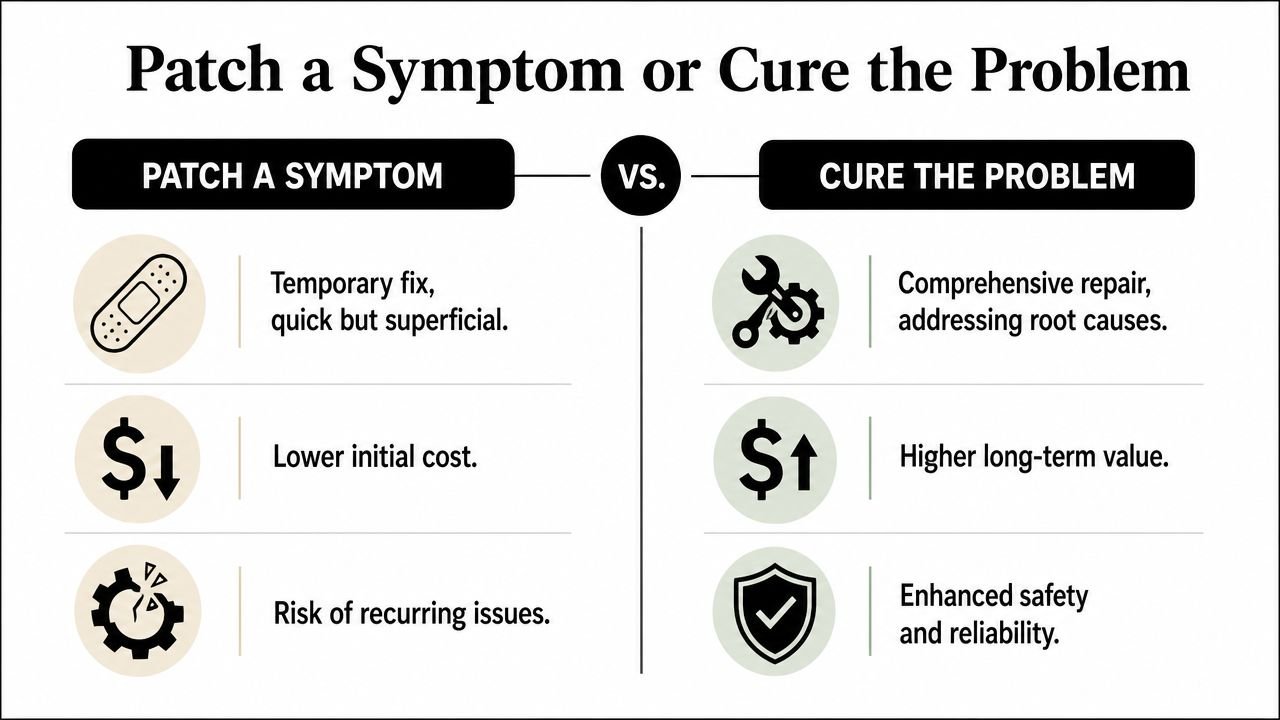
When single-button repair still makes sense
A targeted repair is reasonable when the failure is clearly isolated. Examples include impact damage, a single worn switch, or a recent fault in an otherwise healthy panel. In those cases, replacing the affected component can restore service without overcorrecting.
That approach stops working when the panel starts playing whack-a-mole. One button gets replaced, then another stops responding. Then an indicator goes dark. Then the alarm or door-open input starts feeling inconsistent. At that point, the labor and downtime start repeating even if each individual repair looks modest on paper.
When panel replacement becomes the smarter move
Industry guidance on push-button failures notes that when multiple buttons fail over a short period, replacing the entire COP or HOP panel is more cost-effective and reliable long-term than piecemeal fixes, because the root issue is often systemic panel degradation.
That matches what experienced field technicians see in aging equipment. The button itself may fail first, but the deeper problem often sits in the shared mounting, wiring harness, board, contacts, or the overall condition of the panel assembly.
If you're comparing options, it helps to understand what goes into a proper elevator button replacement versus a broader panel renewal.
Replacing one failed button in a worn-out panel can be like replacing one cracked tile on a floor that's already losing bond underneath. You fix the visible defect, not the condition causing the defects.
A practical decision guide
Use this framework when deciding whether to patch or replace:
- Choose targeted repair if the failure is isolated, the panel is otherwise stable, and the fixture condition is still sound.
- Lean toward panel replacement if multiple buttons have failed, illumination problems are spreading, or the panel shows age, looseness, or recurring wiring faults.
- Prioritize replacement sooner if downtime hits a high-traffic building where repeated callbacks create operational disruption.
The cheapest invoice isn't always the lowest-cost decision. In elevator work, repeated small repairs often become the expensive path.
The Real Cost of Elevator Button Repairs
Owners are often surprised by the price of button work because the part looks small. The part is rarely what drives the bill. The cost comes from skilled labor, access, troubleshooting time, code-aware testing, and the need to match the correct fixture and system.
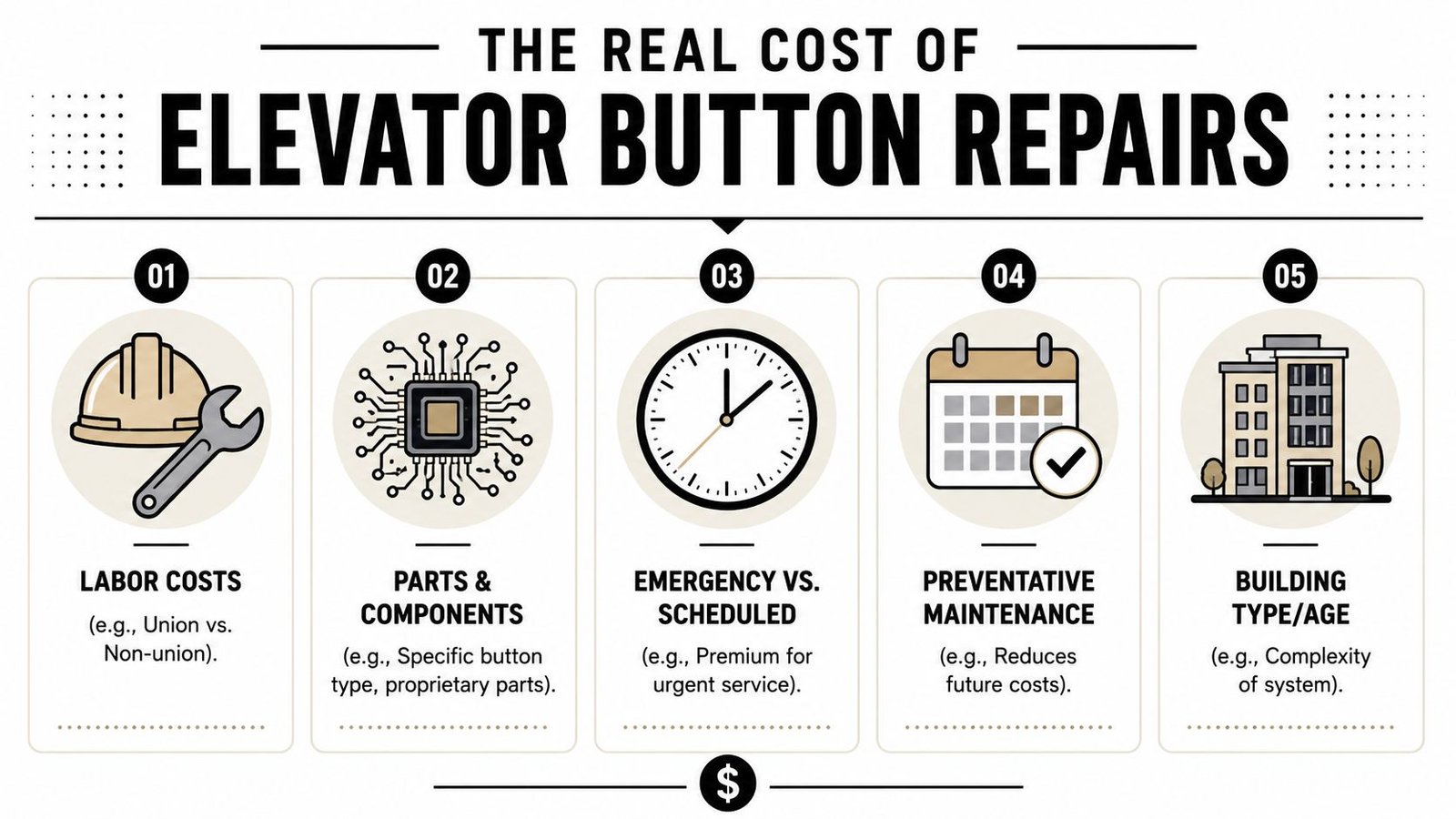
Why button repair can get expensive fast
The labor market explains a lot. The median annual wage for elevator and escalator installers and repairers was $106,580 in May 2024, which reflects how specialized this trade is. The same source notes projected annual openings in the field, much of it tied to replacement demand, which is one reason response times and service pricing stay firm in many markets.
There's also the reality that a “button replacement” isn't always one button and done. The same labor source is associated with the example that replacing 37 elevator buttons can cost as much as $8,400, which shows how quickly this category becomes a meaningful repair item when multiple fixtures are involved.
The cost drivers that matter most
A building manager usually has more control over total repair cost than it first appears. These are the factors that move the number:
- Labor access: A repair during normal scheduled service is different from an after-hours callback with tenants waiting and a car out of service.
- Parts matching: Some fixtures use proprietary-compatible components or older push-button modules that take longer to source and install correctly.
- Diagnostic time: If the failure sits in the board, communication path, or panel wiring, the tech has to prove that before swapping parts.
- Testing after repair: The job isn't complete when the button lights. The interface still needs to be checked for proper operation and safe response.
- Building conditions: Older buildings, customized cabs, vandal-resistant fixtures, and modified panels all add complexity.
Cheap repair versus durable repair
Owners can lose money without realizing it. A low-price button swap that doesn't address loose wiring, failing indicators, or deteriorated panel components may only postpone the next service ticket.
A better way to think about cost is to separate invoice cost from ownership cost.
| Decision | Looks cheaper today | Often costs more over time because |
|---|---|---|
| Replace one button repeatedly | Yes | Repeat labor, repeat downtime, repeat dispatch |
| Repair panel fault correctly | Sometimes | Higher immediate scope, fewer repeat callbacks |
| Replace aging panel assembly | Often not at first | Better reliability when failures are spreading |
The expensive repair is usually the one you pay for twice.
The ROI question owners should ask
Instead of asking only for the price to replace the failed button, ask these questions:
- Is this a single failed device or part of a pattern?
- Is the panel still mechanically and electrically sound?
- Will this repair reduce future callbacks, or just restore service for now?
- Are we preserving tenant confidence and avoiding avoidable downtime?
That's the financial lens that matters. Elevator button repair is a specialty service, and the right scope saves money more often than the lowest short-term quote does.
Keeping Your Elevator Safe and Compliant
A button isn't just a switch. It's part of the passenger interface, and that means safety and code requirements apply to more than whether it technically works.
If a button is damaged, unreliable, missing tactile features, or not functioning as intended, the issue can affect inspection outcomes and create real liability concerns. That's especially true for buildings that serve the public, patients, students, residents, or anyone who relies on accessible vertical transportation every day.
The buttons that can't be treated casually
Some inputs deserve immediate attention because they tie directly to emergency use or essential operation.
- Fire service controls: These must function exactly as intended. There's no room for “mostly working.”
- Emergency call and alarm buttons: If the interface is compromised, the safety issue goes beyond routine inconvenience.
- Door open and door close buttons: Repeated failures here frustrate users and can point to wider control issues.
- Accessible controls: Tactile markings, Braille, and physical usability are part of the interface responsibility.
If your team is reviewing requirements, it helps to stay aligned with elevator code requirements before approving a repair method or fixture change.
What compliance-minded managers do differently
Strong operators don't wait for annual testing or a tenant complaint to look closely at the car operating panel and hall stations. They make button condition part of routine walk-throughs.
Look for these signs:
- Worn legends or damaged faces: If users can't clearly identify controls, the panel is already slipping from acceptable condition.
- Loose mounting or misalignment: A button that rocks in place or binds in the plate often signals more wear behind the face.
- Missing illumination or inconsistent feedback: Users need clear confirmation that the command was received.
- Damaged tactile features: Accessibility details aren't decorative. They're part of proper operation.
A compliant interface needs to be reliable for every user, not just familiar users who already know the building.
The safe approach to repairs
Temporary workarounds create trouble in this category. Swapping in the wrong style of button, forcing compatibility, or reusing worn panel hardware can leave a building with an interface that technically runs but doesn't hold up in service or inspection.
The better standard is simple. Use the right component, verify the full operation of the interface, and evaluate whether the panel itself still deserves confidence. That approach protects users and keeps the owner out of the cycle where one “small” repair keeps turning into the next problem.
Schedule Your Elevator Assessment with Crane Elevator
If your elevator buttons have started failing one by one, don't assume you have a string of unrelated small repairs. In many buildings, that pattern means the panel is aging as a system. The right fix starts with diagnosis, not guesswork.
For owners and managers in Lower Michigan, that matters because downtime affects more than convenience. It affects tenant confidence, staff workflow, and the condition of a critical building asset. A good assessment should tell you whether you're looking at a straightforward button replacement, a panel issue, or a broader control concern that needs attention before it grows.
Crane Elevator Company serves Lower Michigan with hands-on experience across commercial buildings, residential properties, lifts, and modernization work. The company offers 24/7/365 service, focuses on non-proprietary solutions, and provides practical options for owners who want lasting repairs instead of repeat callbacks. That matters whether you manage property in Detroit, Ann Arbor, Lansing, Flint, Kalamazoo, or nearby communities.
If you're deciding between another isolated repair and a more durable fix, a second opinion is often the cheapest step you can take. A thorough assessment can show whether the button is the problem, or just the symptom.
If you need a practical evaluation of recurring button failures, contact Crane Elevator Company for a free second opinion or a full elevator assessment. They can help you determine whether a targeted repair is enough or whether a panel-level solution will save more downtime, frustration, and long-term cost.