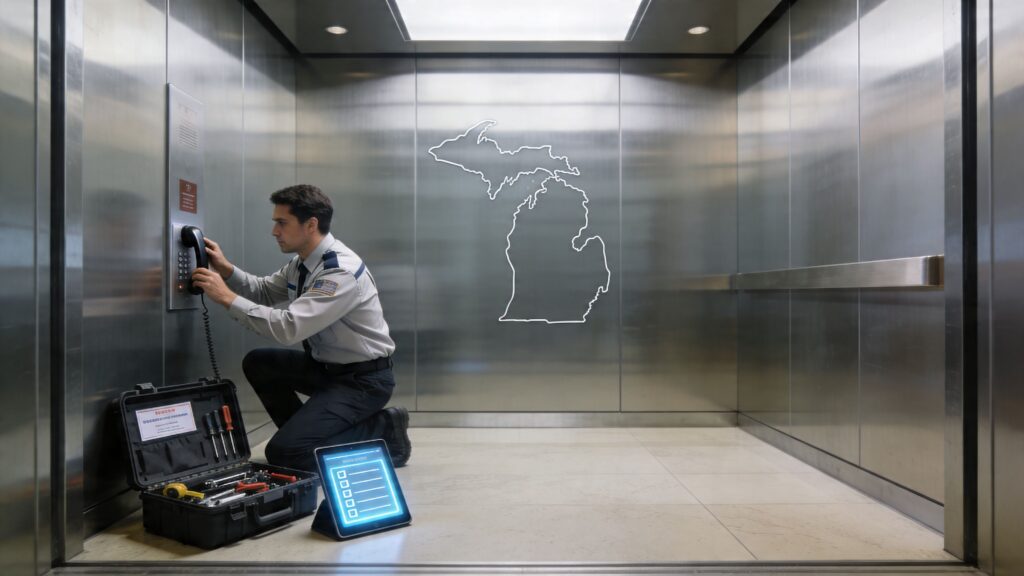
If you're responsible for a building in Ypsilanti or anywhere across Southern Michigan, you may already know the uneasy version of this problem. The elevator runs. Tenants use it every day. Nothing looks wrong from the lobby. Then a state test fails the emergency phone, or worse, someone presses the call button during an entrapment and gets silence.
That’s when elevator phone issues stop being a small maintenance item and become a safety, compliance, and liability problem. Elevator Phone Repair isn't just about restoring dial tone. It’s about making sure trapped passengers can reach help, making sure your building passes inspection, and making sure you’re not paying for the wrong repair because nobody separated a phone fault from a line fault.
The Critical First Call Your Elevator Fails to Make
A tenant gets stuck between floors. The car lights are on, the alarm sounds, and the passenger presses the emergency phone button. Nothing happens.
At that point, the problem isn't just mechanical. The building now has a communication failure during an emergency. The property manager has no easy way to prove the passenger could summon help. The tenant leaves angry, staff lose time managing the incident, and the next question is whether the building was code-compliant before the event happened.
The National Elevator Inspection Bureau receives over 150,000 calls for elevator entrapments annually, with an average of 0.4 entrapments per elevator each year. A malfunctioning emergency phone can turn a 30-minute inconvenience into a prolonged, high-risk event, as noted in this overview of elevator entrapment and emergency phone reliability.
In practice, the fallout reaches beyond the one rider in the cab.
What usually happens next
Property managers deal with several problems at once:
- Immediate occupant safety: Someone in the car may panic, especially if they can't confirm that help is on the way.
- Operational disruption: Staff stop what they’re doing to coordinate responders, calm occupants, and manage other tenants.
- Inspection exposure: If the phone failed because of neglected maintenance or an outdated setup, that issue rarely stays isolated.
- Liability questions: After any event, records matter. Testing logs, repair history, and contractor response all get scrutinized.
A dead elevator phone changes the entire tone of an entrapment. Occupants stop thinking “I’m delayed” and start thinking “nobody knows I’m in here.”
That’s why emergency communication needs to be treated as a core life-safety component, not a side item buried in a maintenance checklist.
For buildings that need an immediate response plan, dedicated emergency elevator service matters because the first priority is getting the system safe, communicating with the passenger, and identifying whether the failure is in the car equipment, the traveling cable path, the machine room connection, or the outside telecom service.
Why Southern Michigan managers can't treat this as optional
In Ypsilanti, Ann Arbor, Detroit, Lansing, Flint, Kalamazoo, and surrounding communities, many properties operate mixed equipment portfolios. Some have modernized controls with older phone hardware. Others still rely on aging analog lines. Some have cellular dialers installed but no one has verified backup power, signal quality, or inspection readiness recently.
That combination causes expensive surprises. The phone may appear to work during a casual test, then fail under outage conditions, fail location identification, or fail accessibility requirements. By the time that happens, the cheapest repair option is usually gone.
Understanding Michigan Elevator Phone Code Compliance
Code issues around elevator phones usually come down to three areas. Can the system communicate during an emergency, can people with disabilities use it, and will it keep working during a power event?
Michigan building owners don't need to become elevator code specialists, but they do need to know what inspectors and contractors are looking for when they evaluate emergency communication.
Four-hour backup isn't negotiable
Per ASME A17.1/CSA B44 Safety Code, elevator phone systems must remain fully operational for a minimum of four hours during a complete building power failure, and that standard can be met with UPS batteries or compliant cellular systems with integrated backup power, as explained in this review of elevator communication power redundancy requirements.
That requirement changes how repairs should be evaluated.
A phone that works during normal building power but drops offline during an outage isn't compliant in any practical sense. If your current setup relies on older infrastructure, a contractor should verify not only the phone circuit itself, but also the backup power path, the communication path, and the duration those systems can stay alive.
Accessibility rules affect repair work too
Emergency communication isn't code-compliant just because the call button lights up.
All elevator emergency communication devices installed after 1991 must comply with ADA accessibility standards, including hands-free operation and controls mounted no higher than 48 inches from the floor. If you're reviewing equipment options, this page on elevator emergency phones reflects the kind of equipment category that should be evaluated for code-fit, not just basic function.
Here’s what that means during service work:
| Compliance item | What a manager should verify |
|---|---|
| Hands-free operation | The system can't depend on an old corded handset. |
| Control height | Buttons and operable controls must remain within accessible reach. |
| Readable instructions | Labels, raised markings, and Braille need to stay legible after repairs. |
| Post-repair testing | The contractor should verify the phone still meets accessibility expectations after maintenance. |
A common mistake is treating accessibility as an installation issue only. It’s also a repair issue. If a panel is replaced, a button shifts, or labels wear away, the system may still place a call but still fail inspection.
Practical rule: Ask your contractor to document both functional testing and accessibility verification after any phone repair or modernization work.
Michigan testing makes weak setups visible
In the field, state testing often exposes problems owners didn't know they had. The car phone may call out, but the backup battery may be weak. The device may dial, but the speaker quality may be poor. The phone may technically function, but the mounting or control arrangement may no longer satisfy current expectations for accessibility.
For property managers, the safest approach is simple:
- Confirm the communication path works
- Confirm it stays live during power loss
- Confirm the device remains ADA-compliant
- Confirm the setup is documented for inspection
If any one of those is missing, the system isn't ready.
Initial Troubleshooting Steps Before You Call for Repair
Not every elevator phone failure starts in the phone. In many buildings, the underlying problem is the communication line feeding it.
Industry field reports show that a significant portion of elevator phone failures stem from deteriorating analog POTS lines, not the phone hardware itself. A simple line quality verification using a butt set at the machine room demarcation point can often identify the fault source before a costly service call is dispatched, according to this field report on emergency elevator phone troubleshooting.
That matters because you may need a telecom provider, an elevator mechanic, or both.
Safe checks a property manager can coordinate
You shouldn't open equipment or perform work that belongs to licensed elevator personnel. But you can still narrow the problem.
- Check whether one car or multiple cars are affected: If every elevator phone in the building is down, the issue may be upstream.
- Review recent utility or telecom changes: Line migrations, carrier changes, and service cancellations often trigger sudden failures.
- Confirm whether the outage is constant or intermittent: A phone that fails only at certain times may point to line instability or power backup trouble.
- Look at monitoring or call logs if available: Missed test calls or failed auto-dial events can reveal when the problem started.
What to ask before dispatching anyone
If your staff or telecom vendor has authorized access to the machine room demarcation point, line quality can sometimes be checked there before an elevator technician is sent. That’s often the fastest way to separate a line issue from a cab device issue.
Use this decision path:
| Symptom | Likely next call |
|---|---|
| No service to multiple phones | Telecom or communication provider |
| Line present at demarcation but cab phone fails | Elevator contractor |
| Intermittent failures after storms or outages | Both may need to coordinate |
| Phone works but audio is weak or distorted | Start with elevator contractor, then evaluate line quality |
If the line is dead before it reaches the elevator equipment, replacing the phone in the cab won't fix the problem.
What not to do
Don't assume the cheapest part is the failed part.
Managers sometimes approve a phone replacement because it feels like action. Then the new device gets installed on the same bad line and fails the same way. Good troubleshooting saves money because it assigns responsibility correctly, especially in older Southern Michigan buildings where analog line quality has become less predictable over time.
How to Find a Qualified Local Elevator Company
Choosing a contractor for Elevator Phone Repair isn't only about who can arrive. It’s about who can diagnose correctly, document the work, and support you through testing and inspection follow-up.
A lot of building owners start with a broad online search, then compare prices. That’s understandable, but phone issues are one of the places where a low quote can become an expensive delay. If the contractor doesn't know local inspection expectations, doesn't support mixed equipment, or only works comfortably on one manufacturer's ecosystem, you may end up paying twice.
What local qualification actually looks like
In Southern Michigan, a useful provider should understand the realities of properties in Ypsilanti, Ann Arbor, Detroit, Lansing, Flint, Kalamazoo, and nearby markets:
- Older buildings with newer add-ons
- Modern controllers paired with legacy communication devices
- Healthcare, education, and municipal sites that can't tolerate extended downtime
- Inspection-driven repair deadlines
- Mixed ownership portfolios where consistency matters
A local contractor also tends to understand the practical side of scheduling. They know that a university building, medical office, apartment tower, and municipal facility don't all operate under the same access rules or urgency.
Don't shop this service on price alone
A low initial repair quote can hide risk if the contractor:
- Works only on proprietary equipment
- Doesn't include testing after repair
- Doesn't coordinate with your telecom vendor
- Treats emergency phones as an afterthought instead of a life-safety device
One of the smarter ways to screen options is to look for companies that already present themselves around local repair needs, such as an elevator repair company near me page focused on regional service rather than generic national dispatch language.
What usually works better than a broad national dispatch model
For elevator phone problems, local service often has three practical advantages:
Faster triage
A nearby team can often determine whether the problem belongs to the elevator system, building wiring, or telecom carrier without days of handoff.
Better code awareness
Providers who regularly work in Michigan are more likely to understand how repair decisions affect state testing and deficiency correction.
More realistic support after the first visit
If the first trip reveals a line issue, battery issue, or accessibility issue, you need someone who can stay engaged through resolution instead of closing the ticket and disappearing.
The right local company doesn't just replace parts. They help the owner get from failure to compliance.
That’s the difference between a vendor and a service partner.
Key Questions to Ask Potential Service Providers
Most property managers ask, “Can you fix it?” That’s too broad.
A better approach is to ask questions that expose how the company handles compliance, documentation, emergency response, and long-term serviceability. Elevator phones touch life safety, ADA requirements, and inspection readiness. Your vetting process should reflect that.
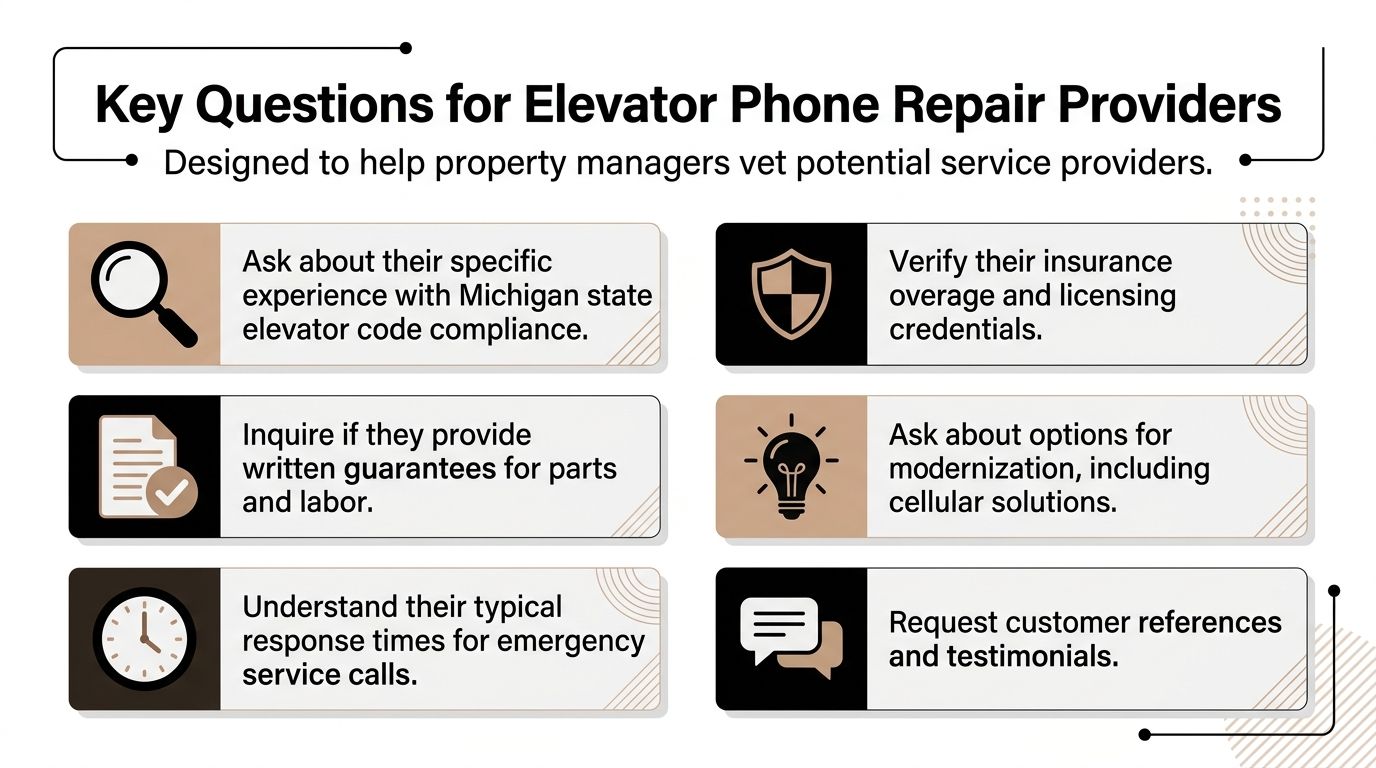
All elevator emergency communication devices installed after 1991 must adhere to ADA standards, requiring hands-free operation with controls mounted no higher than 48 inches from the floor. A key vetting question is whether a contractor's repair and testing protocols include an audit to verify that compliance remains intact, as outlined in this review of ADA elevator phone requirements.
Questions that separate qualified providers from basic dispatchers
Ask these directly and listen for specific answers.
Are your technicians licensed for elevator work in Michigan?
You want a clear answer, not a vague statement about being “experienced.”Do you provide proof of insurance?
That should be routine.When you repair an elevator phone, do you also test code-related function afterward?
If they only say they “get it calling again,” keep digging.How do you determine whether the failure is in the cab phone, traveling cable, machine room connection, or outside telecom service?
Good contractors have a diagnostic process.Do you work on non-proprietary solutions, or will this repair lock us into one vendor?
This question affects your long-term cost and flexibility.Can you support state testing and deficiency correction if the phone issue appears during inspection?
Many managers need the same provider to stay involved through the compliance cycle.
Ask for process, not promises
The strongest answers usually include process details.
For example, a solid contractor should be able to explain how they handle:
| Question area | What a good answer sounds like |
|---|---|
| Emergency response | Clear dispatch procedures and after-hours availability |
| Documentation | Written service records, testing notes, and deficiency follow-up |
| Accessibility | Verification that controls remain hands-free and properly mounted |
| Modernization options | Repair-first when sensible, upgrade recommendations when infrastructure is failing |
Red flags to watch for
Some answers should make you slow down.
“We can probably just swap the phone and see if that fixes it.”
That approach wastes time if the line is the actual problem.
Other warning signs include:
- No mention of ADA or accessibility
- No explanation of backup power testing
- No willingness to coordinate with telecom providers
- Pushes a full replacement before basic fault isolation
- Can't explain what happens after a failed inspection
Property managers don't need a polished sales pitch. They need a provider who can explain the failure path, repair scope, and compliance impact in plain language.
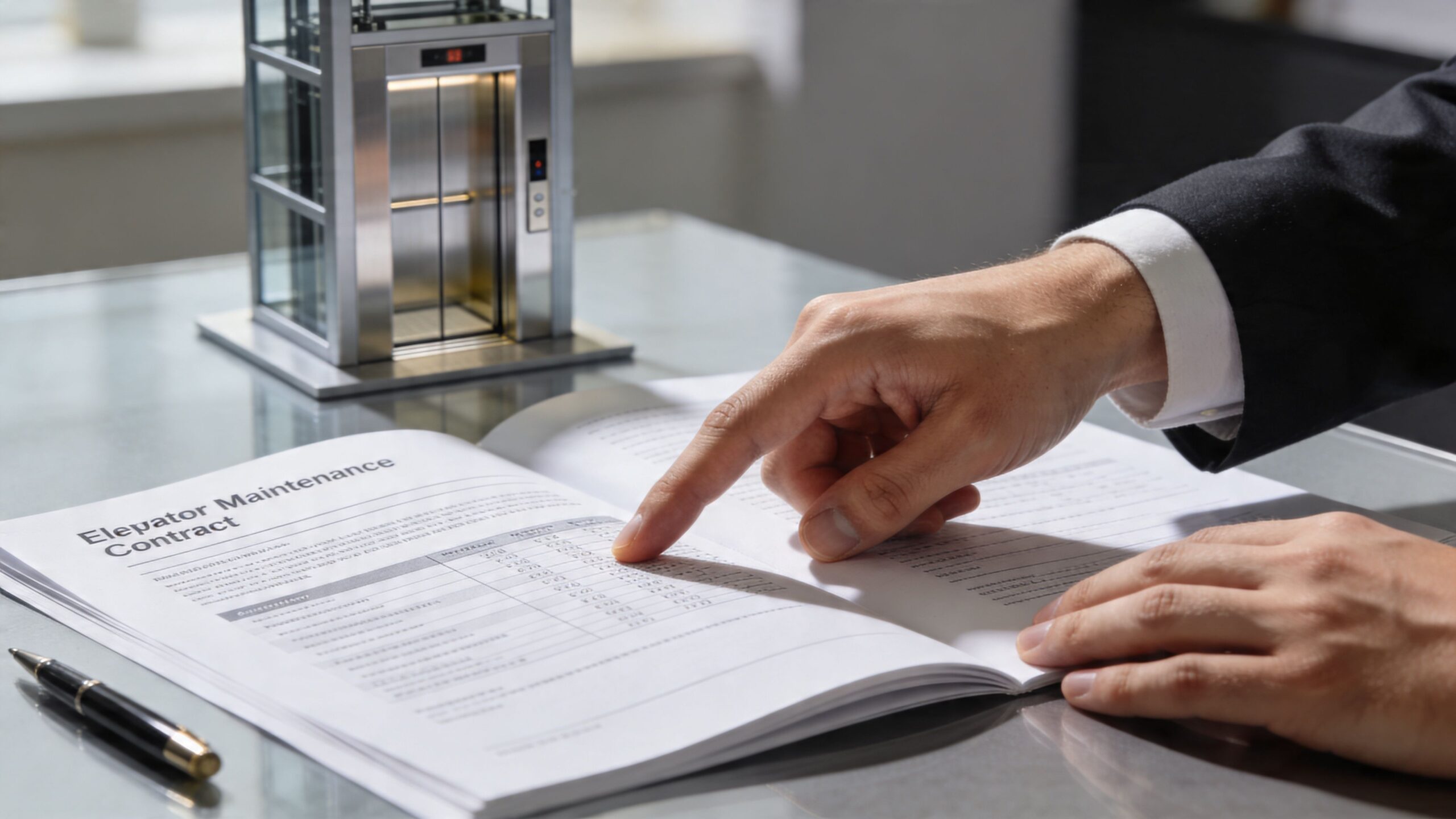
What to Expect in a Maintenance and Repair Contract
A service agreement should reduce risk, not create dependency.
That matters a lot with elevator phones because communication failures often sit at the intersection of elevator equipment, building wiring, backup power, and outside telecom service. If your contract is vague, every future problem becomes an argument over scope.
Proprietary versus non-proprietary service
This is one of the biggest contract issues building owners overlook.
A proprietary arrangement can leave you dependent on one provider for diagnostics, parts access, software access, or communication hardware support. That may seem manageable until response slows down, pricing rises, or a simple phone issue turns into a forced upgrade.
A non-proprietary approach gives you more control. Qualified providers can service the equipment, compare repair options, and keep you from being trapped in one service channel.
For emergency phones, that flexibility matters because communication technology is changing. Buildings may need to maintain analog-compatible devices, transition to cellular gateways, or integrate backup power updates over time. A restrictive contract can make each of those steps harder than it needs to be.
Contract items that should be spelled out
Review the agreement line by line for these points:
- Testing scope: The contract should say whether emergency phones are routinely tested and documented.
- Response expectations: It should define after-hours and entrapment response procedures.
- Exclusions: Batteries, communication hardware, and telecom issues should be clearly identified if excluded.
- Inspection support: The provider should explain how deficiency corrections are handled.
- Cleaning and preventive care: Neglected machine rooms, pits, and car tops often contribute to broader reliability problems.
A well-structured maintenance agreement should also account for the fact that elevator communication failures rarely happen alone. A building with weak maintenance discipline may also have issues with alarm devices, lighting, door equipment, or backup systems.
What practical value looks like in the real world
For property managers in Southern Michigan, a useful contract is one that keeps the elevator serviceable and the paperwork defensible.
That’s where a non-proprietary service model can make sense. Crane Elevator Company provides maintenance, emergency phone service, testing support, and non-proprietary modernization work across Lower Michigan, along with policies such as No Show, No Pay, full clean-downs of machine rooms, pits, and car tops, and COP/PI bulb replacement as part of its maintenance program.
The best contract is the one that keeps a failed phone from becoming a surprise inspection problem six months later.
Read the fine print around upgrades
Some contracts implicitly favor replacement over repair. Others leave the owner responsible for all communication-path issues without saying so clearly.
Before signing, ask for examples of how the provider handles these situations:
- Dead cab phone with active line
- Healthy phone on a failed analog line
- Phone passes normal test but fails outage test
- Device works but no longer meets accessibility expectations
If the answers are vague, the contract probably is too.
Cost Considerations and Modernization Financing
The cheapest elevator phone decision is often the one that costs more over time.
A basic repair can be the right move when the problem is isolated. If the phone hardware failed, wiring is sound, and the communication path is stable, targeted repair usually makes sense. But if the building still depends on aging analog service, repeated repairs can turn into a cycle of service calls, failed tests, and avoidable downtime.
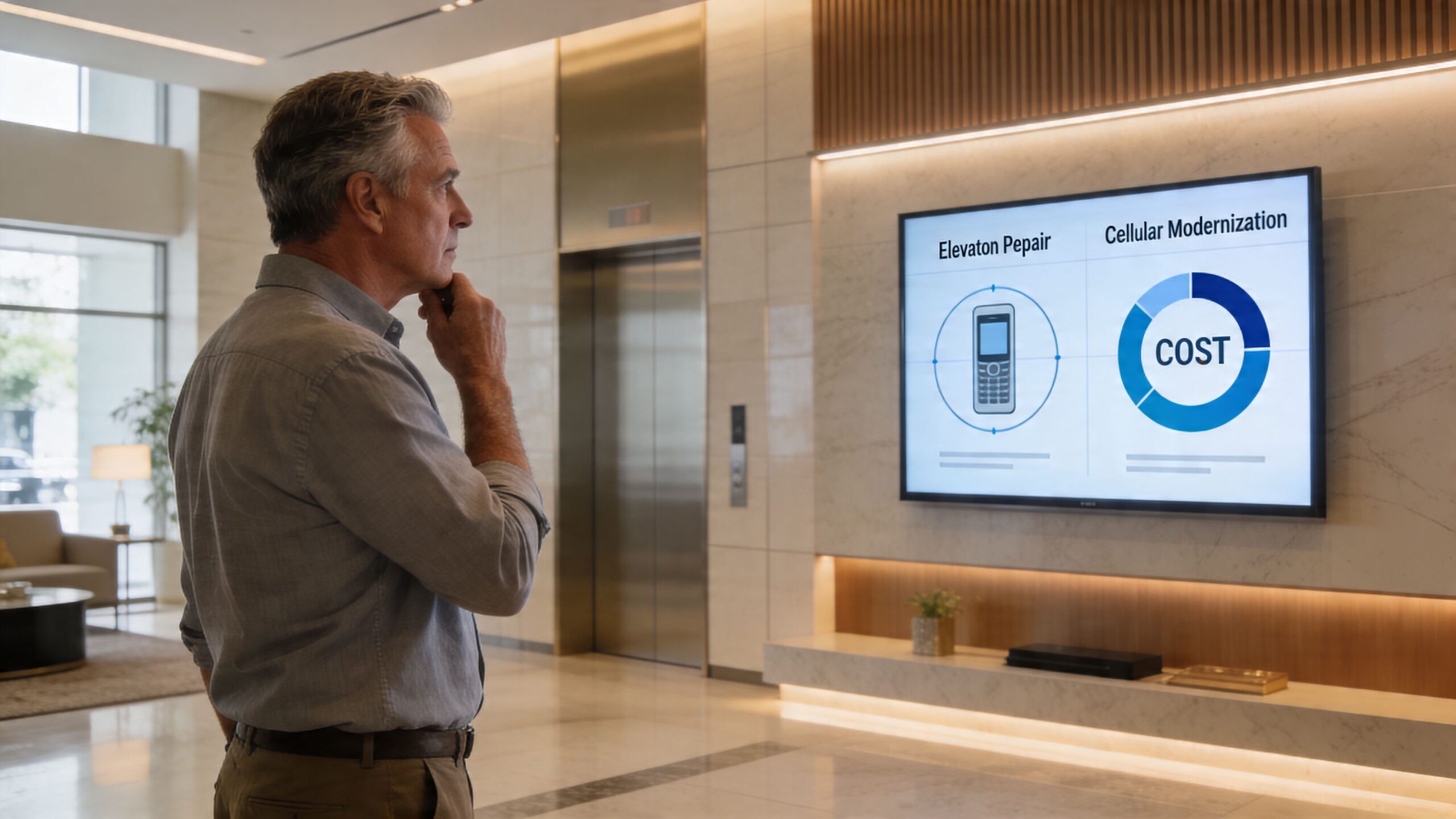
The broader market is moving in that direction too. The global elevator emergency communication system market is projected to grow from USD 15.1 billion in 2024 to USD 24.64 billion by 2033, driven by safety mandates and the shift from failure-prone landlines to more reliable cellular and IoT-based technologies, according to this market report on elevator emergency communication systems.
When repair is the right choice
Repair-first is usually reasonable when:
- The existing system is compliant
- The failure is clearly isolated
- Backup power remains reliable
- Your testing history has been stable
In those cases, replacing a damaged phone, correcting a wiring fault, or restoring a single communication component may be the most sensible use of budget.
When modernization starts to make financial sense
Modernization becomes easier to justify when the building shows recurring trouble in any of these areas:
| Building condition | Financial implication |
|---|---|
| Recurring line failures | You keep paying for diagnosis without solving the root problem |
| Outdated analog dependency | Carrier instability and poor reliability create repeat risk |
| Inspection pressure | Deficiencies often push owners into rushed decisions |
| Portfolio-wide inconsistency | Different setups across buildings increase management overhead |
A cellular or updated communication solution can reduce dependence on fragile legacy infrastructure. It can also make future testing more predictable when the system is designed around current code expectations instead of patched around older limitations.
A short visual overview can help when you’re weighing repair versus upgrade options:
Financing matters because deferred work gets expensive
Many owners know the older setup should be replaced, but they delay it because they don't want a large capital hit all at once. That’s understandable. It’s also how many buildings end up paying for multiple temporary fixes before approving the upgrade they needed from the start.
Financing can smooth that decision. For commercial properties, schools, healthcare sites, HOAs, and municipal buildings, predictable monthly modernization financing can be easier to manage than repeated emergency spending and unplanned inspection correction work.
The smart question isn't just “What does the repair cost today?” It’s “What setup gives this building the most reliable communication path with the least disruption over the next several inspection cycles?”
Why Choose Crane for Your Elevator Needs in Southern Michigan
Property managers in Southern Michigan usually aren't looking for speeches. They want a company that answers the phone, diagnoses the issue correctly, supports code compliance, and doesn't make the building harder to service later.
That’s the practical value of working with a family-owned contractor that focuses on non-proprietary service across Lower Michigan. For buildings in Ypsilanti, Detroit, Ann Arbor, Lansing, Flint, Kalamazoo, and surrounding cities, the work often isn't limited to one issue. A dead phone may sit alongside overdue testing, a pending violation, weak backup power, or a broader modernization decision.
Services that matter when the phone fails
For owners and managers dealing with elevator communication problems, the most useful service relationship usually includes:
- Emergency phone repair
- State-mandated testing support
- Code compliance upgrades
- Violation correction
- Preventive maintenance
- Non-proprietary modernization for all makes and models
That combination matters because elevator phone failures don't happen in isolation. They show up inside a bigger building responsibility. You need the communication restored, but you also need confidence that the next inspection won't expose another unresolved issue tied to the same system.
Why the non-proprietary model matters
A non-proprietary service philosophy gives owners more flexibility. It helps protect you from getting locked into one vendor every time communication equipment, monitoring hardware, or related elevator components need service.
That’s especially important for mixed portfolios. If you manage apartments in Ypsilanti, a healthcare facility near Ann Arbor, a municipal building in Lansing, or an industrial property near Flint or Kalamazoo, you need a service plan that works across different ages and types of equipment.
A good elevator contractor should leave the owner with more options, not fewer.
What building owners should expect
At a minimum, you should expect:
- Straight answers about code risk
- Clear testing and repair documentation
- Responsive emergency support
- Repair recommendations that match the building, not a sales script
- A path forward when the right answer is modernization, not another patch
That’s the standard serious property managers should hold any elevator provider to. For Southern Michigan buildings, it’s also the standard that helps reduce liability, shorten downtime, and keep communication systems ready when someone in the cab needs help.
If your building in Ypsilanti or the surrounding Southern Michigan area needs help with Elevator Phone Repair, code compliance, or elevator testing, contact Crane Elevator Company. They provide 24/7/365 service, free second opinions, competitive quotes, non-proprietary repair and modernization options, and support for commercial, residential, municipal, healthcare, education, and industrial properties across Lower Michigan.