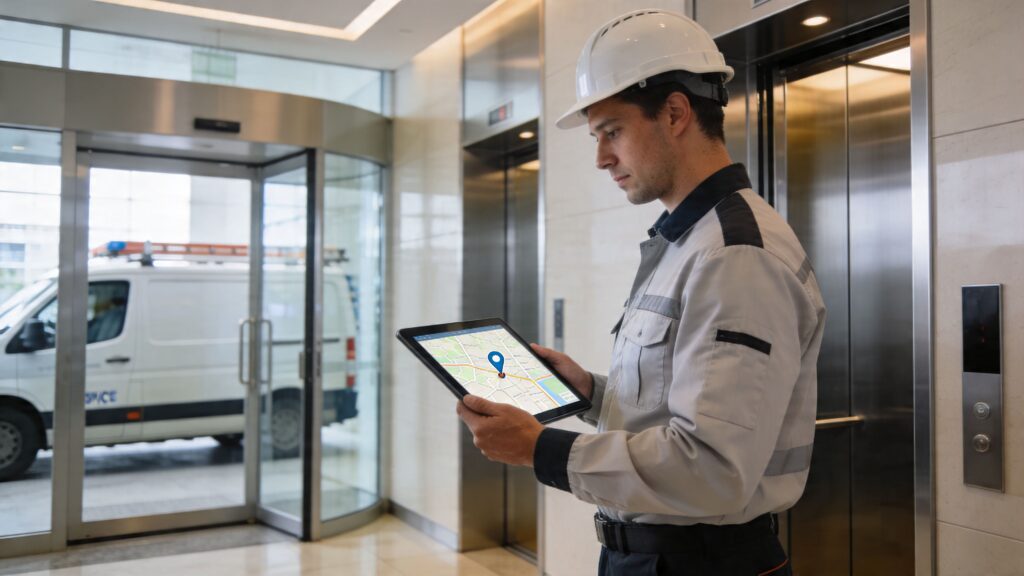
A tenant calls from the third floor in Lansing. The cab stopped level but the doors won’t cycle. In Flint, a freight unit in an older warehouse is limping through starts and stops. In Ann Arbor, a property manager is trying to schedule an inspection, answer accessibility complaints, and figure out whether the current service vendor is preventing breakdowns or just billing for callbacks.
That’s usually when people search commercial elevator service companies near me.
The problem is that search results don’t tell you much about who will show up, whether they know your type of equipment, or whether the contract locks you into expensive parts and future upgrades. For building owners in Michigan, that matters more than the logo on the proposal. Aging equipment, inspection requirements, uptime pressure, tenant complaints, and capital planning all land on the same desk.
A good elevator contractor does more than reset faults and replace rollers. They help you control downtime, stay compliant, and avoid getting trapped in a service model that gets more expensive every year. A bad one gives you a low monthly number, thin maintenance, vague response promises, and surprise repair recommendations when the unit fails.
Your Guide to Finding the Right Elevator Partner
If you manage a building in Dearborn, Jackson, or Battle Creek, you’re not shopping for a commodity. You’re choosing who touches one of the few systems in the building that can create an immediate safety issue, a tenant relations problem, and an access problem on the same day.
That means the right elevator partner has to do three things well.
- Keep the equipment running: Not just respond after a shutdown.
- Handle compliance cleanly: Inspections, testing, violation corrections, and documentation can’t be sloppy.
- Protect your long-term options: If the system needs major repair or modernization later, you don’t want to be boxed into one vendor’s parts and software.
Many owners start with the wrong filter. They compare only monthly maintenance pricing. That’s how they end up with a contract that looks cheap on paper but excludes the work that prevents failures, such as clean-downs, minor adjustments, lamp replacements, and close inspection of wear items.
Practical rule: If a contractor can’t explain exactly how their maintenance visits reduce future callbacks, you’re looking at a reactive vendor, not a service partner.
What building owners in Michigan should focus on
In Southern Michigan, elevator conditions vary a lot. A hospital in Ann Arbor, a municipal building in Detroit, a mixed-use property in Royal Oak, and an industrial site in Kalamazoo don’t have the same operating pattern or risk profile.
Start with these questions:
- How fast can they reach your property with a real technician?
- Can they service all makes and models without brand restrictions?
- Do they have the inspection and modernization depth to support the equipment over its full life cycle?
- Will the contract help you avoid vendor lock-in?
Those four questions usually tell you more than a polished website ever will.
Starting Your Local Search in Southern Michigan
Typing commercial elevator service companies near me into a search engine is fine. Stopping there isn’t. What you need is a short list of companies that work in your part of Michigan, not a list of directories, lead aggregators, or brands with thin local coverage.
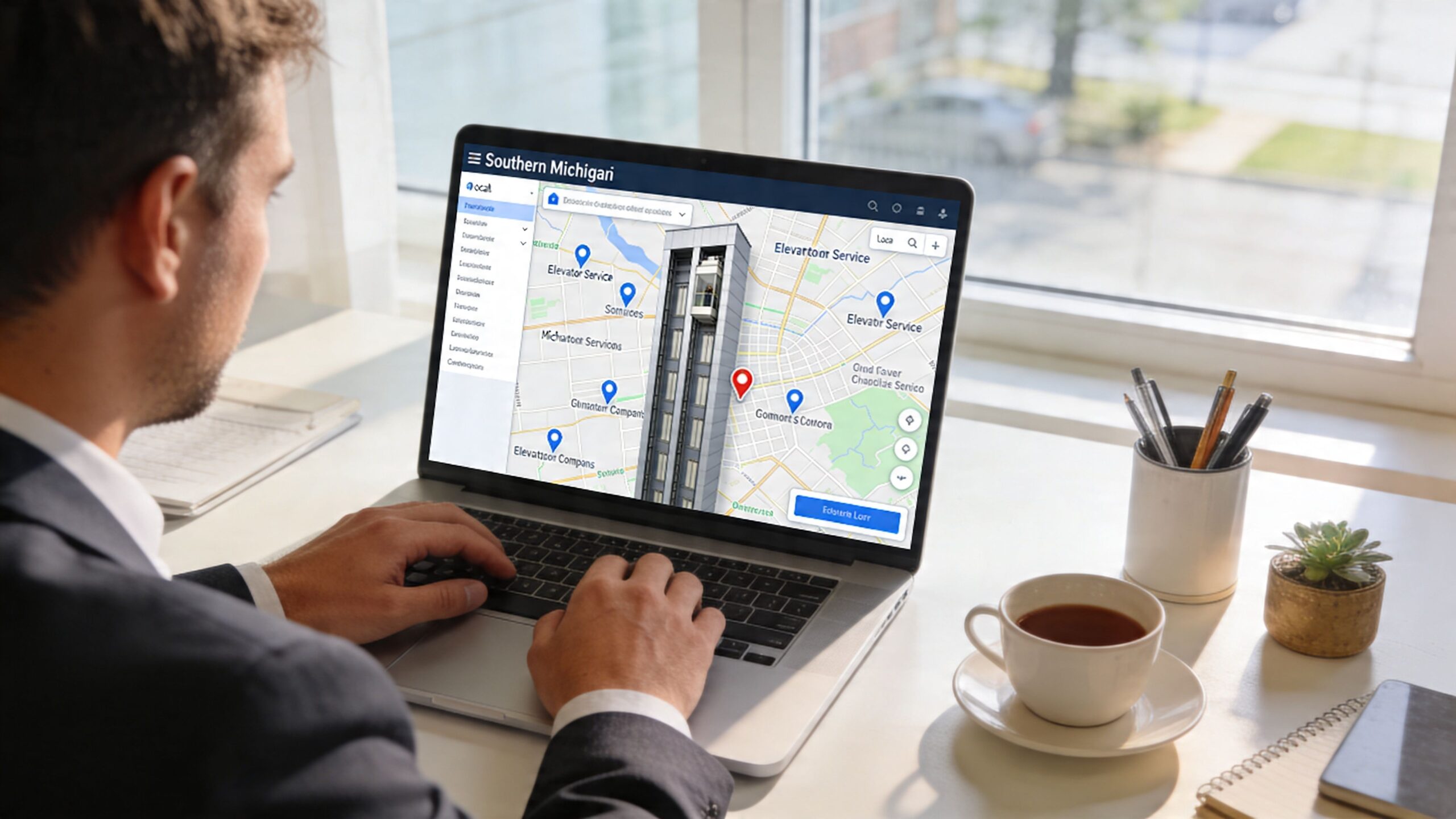
A useful local search starts by narrowing geography. Search by city and equipment type. Use phrases like “commercial elevator repair Detroit,” “freight elevator service Grand Rapids,” or “hospital elevator maintenance Ann Arbor.” Then look for signs that a company operates in your area, not just advertises there.
A competitive market makes this harder. Florida has over 2,400 elevator service businesses, and that scale shows why local filtering matters, as noted in IBISWorld’s Florida elevator installation and service industry snapshot. Michigan owners face a similar practical problem. You need a provider who understands the conditions of the buildings in your region, whether that means Detroit high-rises, older Jackson freight applications, or healthcare properties around Ann Arbor.
How to tell if a company is truly local
Watch for concrete signs of local presence:
- Named service territory: If the site specifically mentions places like Detroit, Ann Arbor, Lansing, Flint, Kalamazoo, or Monroe, that’s better than generic statewide language.
- Real service detail: Look for mentions of equipment types, code work, inspections, and repairs. Thin marketing copy often signals a weak field operation.
- Locally relevant content: Articles like best elevator maintenance company for Michigan properties can help you distinguish contractors who understand regional building conditions from companies that publish generic national copy.
Build a short list the right way
Don’t build a list of ten. Build a list of three to five and go deeper.
Use this quick screen:
| What to check | What you want to see |
|---|---|
| Service area | Specific Michigan cities and towns |
| Equipment coverage | Passenger, freight, hydraulic, traction, lifts, dumbwaiters |
| Field capability | Repairs, maintenance, inspections, modernization |
| Emergency language | Clear after-hours support, not vague claims |
| Contract style | Signs of proactive service, not just callback work |
If a company’s online presence is vague, their service often is too.
Your Essential Vetting Checklist for Elevator Companies
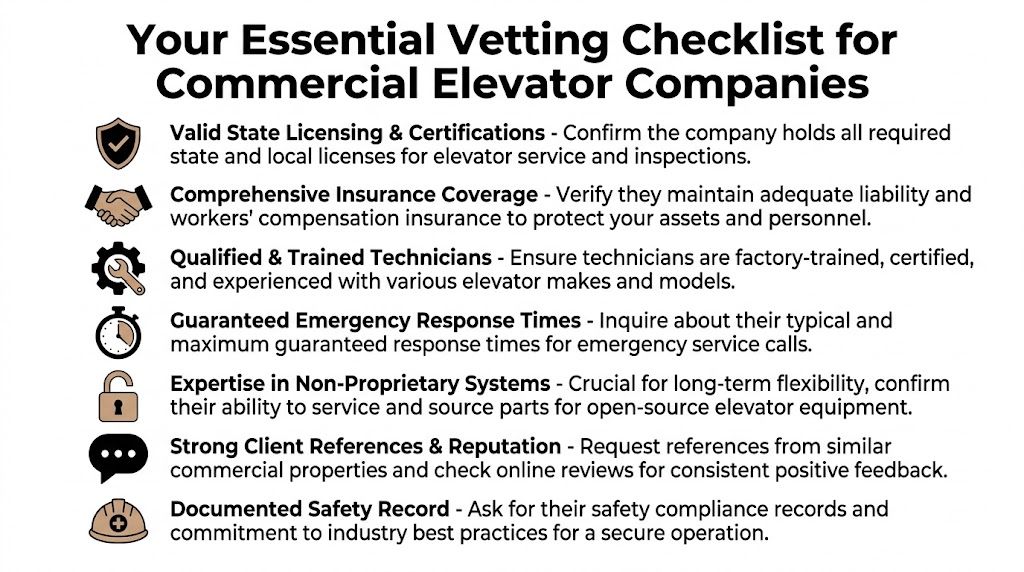
Once you have a short list, stop looking at marketing and start verifying risk. Elevator service is one of those trades where the wrong hire can create legal exposure, recurring downtime, and expensive corrective work.
Credentials that actually matter
Start with the basics, but don’t treat them as paperwork only.
- Licensing and code compliance: Confirm the company can legally perform the work you need in Michigan and handle inspection-related corrections.
- Insurance: Ask for proof of liability and workers’ compensation coverage. If something goes wrong on your property, this isn’t optional.
- Safety program: A contractor should be able to explain how they control lockout, access, fall hazards, and machine room safety.
- Inspection capability: If they can maintain equipment but can’t support code-required work cleanly, you’ll be juggling multiple vendors.
Then go one level deeper. Ask who is coming to your building.
According to Diversified Elevator’s technician training overview, elevator technicians complete a four-year apprenticeship and 30-hour OSHA safety training, and owners should prioritize providers with QEI-certified technicians, since proper inspection and maintenance practices can reduce breakdowns by up to 50% under NAESA guidelines. That matters if you own a school in Ypsilanti, a senior living property in Novi, or a municipal building in Pontiac where uptime and life safety are constantly under scrutiny.
Questions that separate real contractors from sales-first vendors
Use direct questions. Don’t ask, “Are your technicians qualified?” Ask these instead:
- Who performs annual and periodic inspection support?
- Do your technicians regularly work on all makes and models, or mostly one family of equipment?
- What does a standard preventive visit include beyond lubrication and adjustment?
- How do you document deficiencies and recommend repairs?
- Can you provide a sample maintenance report?
The quality of the maintenance report tells you a lot. If the report is vague, the work usually was too.
Quick red-flag checklist
- Unclear technician qualifications
- No sample service documentation
- No straight answer on emergency response
- Heavy push toward branded replacement parts without explanation
- No discussion of long-term modernization planning
A contractor doesn’t need flashy language. They need discipline, documentation, and depth.
Evaluating Experience with Your Elevator's Make and Model
Licensing gets a company in the door. Relevant equipment experience is what keeps your building from becoming their training ground.
Commercial buildings across Michigan run a mix of systems. You may have a hydraulic passenger unit in a low-rise office building in Brighton, a traction elevator in a downtown Detroit mid-rise, an MRL system in newer construction near Ann Arbor, or a freight car in an older industrial property in Taylor. Those are not the same service call.
Why equipment type changes the service decision
Hydraulic units often require attention to packing, leaks, ride quality, valves, and power units. Traction systems bring a different set of issues, including machines, sheaves, ropes, brake performance, and leveling behavior. MRL equipment adds access and control considerations that some contractors handle better than others.
Specialty equipment changes the picture again:
- Freight elevators often take more abuse and need a contractor who understands heavy-duty door equipment and older controls.
- Wheelchair lifts and LULAs require close attention to code compliance and operating reliability in public-facing spaces.
- Dumbwaiters and material lifts are small systems, but they still fail in ways that disrupt building operations.
What to ask about your exact equipment
Ask a contractor to describe how they would approach your unit, not elevator systems in general.
A useful conversation sounds like this:
| Your situation | What the contractor should be able to discuss |
|---|---|
| Older hydraulic elevator in Lansing | Packing condition, tank or power unit issues, door operation, leveling reliability |
| Traction unit in Detroit office building | Machine condition, sheave wear, brake testing, ride quality, controller behavior |
| MRL system in Ann Arbor | Access methods, controller familiarity, space constraints, parts strategy |
| Freight elevator in Kalamazoo warehouse | Door abuse, load handling, obsolete components, modernization path |
If the answer sounds scripted and generic, the technician probably hasn’t spent much time on that type of equipment.
Experience should be broad enough to handle different systems, but specific enough to diagnose yours quickly.
Understanding Service Contracts and Pricing Models
The monthly maintenance number is usually the least important number in the proposal. Owners get burned when they compare contract price without comparing what the contract requires the contractor to do.
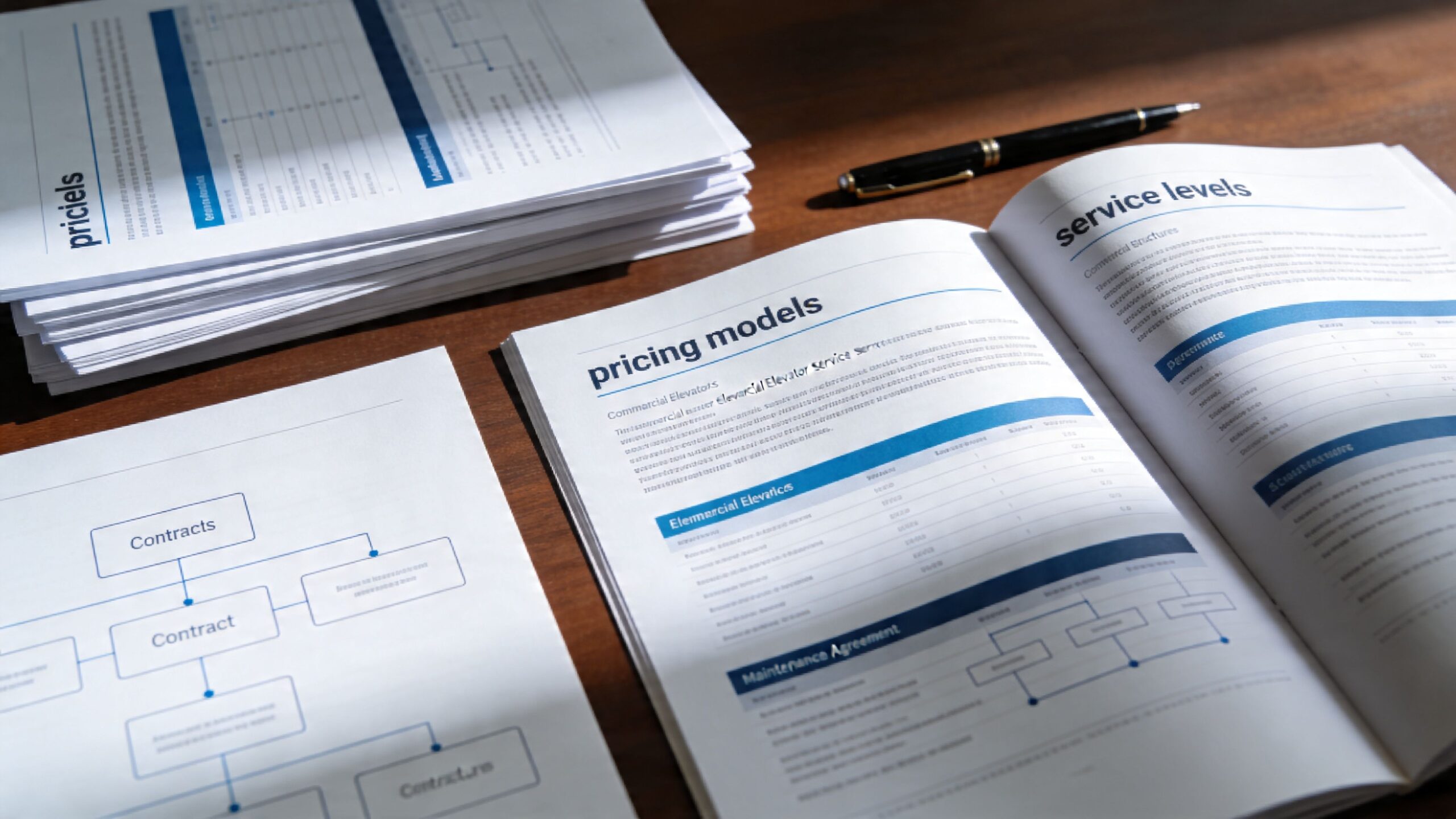
Some agreements are little more than an “oil and grease” program. The technician makes a quick visit, handles obvious adjustments, and leaves. That kind of contract often looks attractive until the unit starts generating callbacks and excluded repair recommendations.
A stronger contract is built around preventive work. It includes the small tasks many low-cost agreements skip, and those details matter. Clean machine rooms, pits, and car tops. Routine checks of door equipment. Lamp replacement. Looking for wear before it turns into a shutdown. You can get a clearer sense of how these line items affect total cost by reviewing elevator maintenance cost factors for Michigan buildings.
What a building owner should compare
Don’t ask only, “What’s included?” Ask, “What’s excluded, and how often do clients end up paying for it anyway?”
Look at proposals through this lens:
- Visit scope: What does the technician inspect, adjust, test, and clean?
- Callback handling: Are minor repairs addressed during maintenance, or turned into billable extras?
- Reporting: Will you get clear documentation of deficiencies and recommended corrections?
- Parts strategy: Does the contractor rely on open-market components when appropriate, or default to locked branded channels?
Why non-proprietary maintenance changes the economics
Many owners save real money over the life of the system. According to Liftech’s discussion of non-proprietary elevator maintenance, non-proprietary maintenance can cut long-term elevator service costs by 20% to 40% over a decade because generic parts are more available and owners can switch service providers without technical barriers.
That doesn’t mean every low-price independent contract is good. Some are under-scoped. The value comes from pairing non-proprietary access with thorough preventive service.
Cheap maintenance often becomes expensive repair work.
A simple contract comparison
| Contract style | Common outcome |
|---|---|
| Low monthly fee, narrow scope | More callbacks, more exclusions, more surprise repairs |
| Preventive maintenance with detailed scope | Better planning, cleaner documentation, fewer avoidable failures |
| Non-proprietary preventive contract | Better long-term flexibility and stronger bidding power later |
A contract should lower your future risk, not just your current invoice.
The Critical Difference Non-Proprietary Solutions Make
Most building owners don’t think about proprietary versus non-proprietary equipment until the first major repair proposal lands on the desk. By then, the problem is already expensive.
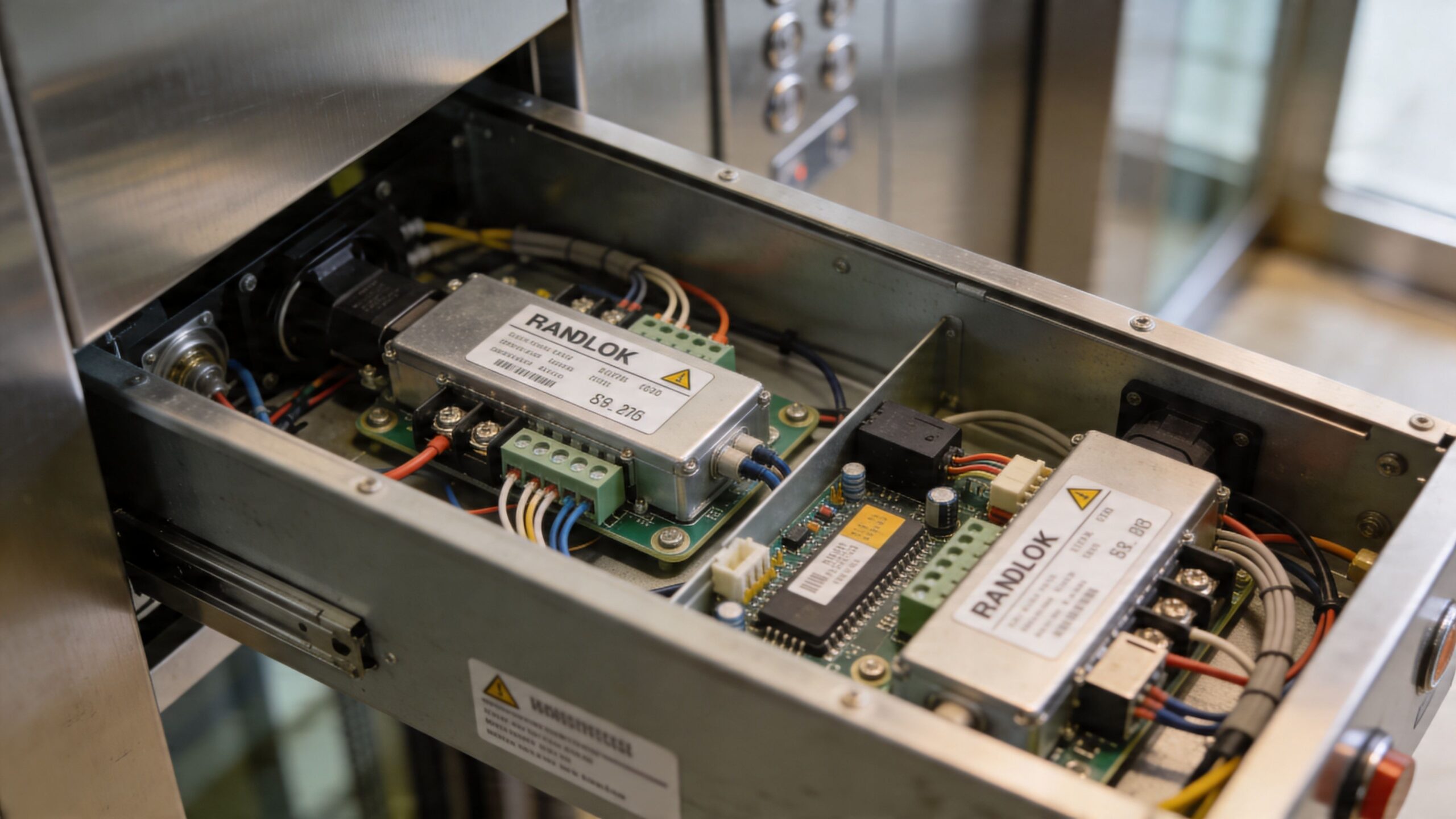
A proprietary system uses branded parts, software, or control architecture that limits who can service it effectively. In practice, that can box the owner into one service path. A non-proprietary system uses components and modernization choices that qualified elevator contractors can support without brand lockout.
That difference affects more than repairs. It changes your negotiating power, your future maintenance options, and your modernization costs.
What vendor lock-in looks like in the field
Here’s the pattern. A building owner accepts a service arrangement tied closely to one manufacturer’s ecosystem. A few years later, a controller issue, major door equipment problem, or modernization recommendation appears. The owner wants competitive bids, but other contractors have limited access to the parts, tools, or software architecture.
Now the owner isn’t choosing from an open market. They’re negotiating from a weak position.
That’s why it’s worth understanding non-proprietary elevator options for Michigan buildings before you sign a maintenance agreement or approve a modernization.
Why non-proprietary modernization is a strategic decision
This isn’t only about today’s repair bill. It’s about the remaining life of the asset.
According to the BBB resource on elevator service and modernization context, non-proprietary elevator modernizations can include universal controllers and standard machine replacements, extend service life beyond 25 years, and avoid the 30% to 40% cost inflation often tied to OEM-mandated upgrades. The same source notes that this approach aligns with ASME A17.1 safety standards and allows future service by any qualified contractor.
For owners in Detroit, Southfield, Livonia, or Adrian, that’s a serious operational advantage. You preserve future bidding competition. You reduce the risk that one vendor controls every next step. You keep the building more marketable because a future buyer or manager won’t inherit a locked service situation.
When proprietary equipment may still be chosen
There are cases where an owner stays with a proprietary path. Sometimes it’s driven by existing installed equipment, warranty conditions, portfolio standards, or internal procurement preferences.
The key is to make that decision knowingly. If you choose a closed system, understand the likely trade-off. You may gain continuity with the original equipment family, but you often lose flexibility later.
Open service architecture gives the owner leverage. Closed architecture gives the vendor leverage.
That’s the core issue.
Assessing Emergency Response and Service Levels
Every elevator company says it offers 24/7 service. That phrase means almost nothing unless the contract defines what happens when a unit is down.
For a trapped passenger, the standard should be immediate dispatch and a clearly stated emergency protocol. For a non-entrapment callback, the response expectation may differ, but it still needs to be defined. “We’ll get someone out as soon as possible” isn’t a service level. It’s a placeholder.
What to pin down before you sign
Ask for response standards by event type.
- Entrapments: Who answers the call, who dispatches, and how are updates communicated?
- Non-critical shutdowns: What is the expected response window during business hours and after hours?
- Repeat callbacks: What happens if the same issue returns within a short period?
- Parts delays: How are temporary operating restrictions or workarounds handled?
Then ask about communication. Good emergency service isn’t only arrival time. It’s also whether your staff gets clear updates, whether the issue is documented, and whether the root cause is pursued after the immediate restart.
Service levels that matter operationally
Use practical benchmarks in conversation, even if the proposal doesn’t present them as a formal SLA.
| Service item | What you should want |
|---|---|
| Emergency dispatch | A live process, not voicemail routing |
| Update cadence | Clear call-backs to building staff during outages |
| Troubleshooting depth | Root-cause repair, not repeated resets |
| Follow-up reporting | Written summary of what failed and next steps |
In cities like Detroit, Flint, or Kalamazoo, traffic, distance, and technician density matter. Ask the vendor how they handle your actual geography, not just metro areas in general.
Planning for Modernization and Major Repairs
Every building owner eventually reaches the point where repair and modernization start competing for the same budget. The hard part is knowing when continued repair is reasonable and when it’s just delaying the inevitable.
Frequent shutdowns are one sign. Obsolete parts are another. So is a growing list of code-related corrections, reliability complaints, or ride-quality issues that never fully go away. An elevator can still run and still be a poor candidate for continued patchwork repair.
Signs you should evaluate modernization
Modernization should move into the conversation when you see patterns like these:
- Recurring failures: The same door issue, controller fault, or leveling problem keeps returning.
- Parts trouble: Lead times are unpredictable or parts are becoming difficult to source.
- Operational complaints: Tenants or staff lose confidence in the equipment.
- Code pressure: Required updates and inspection-related corrections are stacking up.
For older buildings in Detroit, Saginaw, or downtown Jackson, I’d pay close attention to whether you’re spending money on systems that still leave you with obsolete control logic or unsupported components. A major repair can be justified. It just shouldn’t preserve a bad long-term position.
How to plan the project before the failure forces it
Don’t wait for a hard shutdown to build your modernization scope. Start with a condition review and define what you want to solve.
That usually includes:
- Reliability goals: Fewer callbacks, better leveling, stronger door performance.
- Code and testing needs: What corrections are required now, and what standards should the upgraded equipment support?
- Serviceability: Can future contractors work on it without proprietary restrictions?
- Budget structure: Lump-sum capital purchase or financing with predictable payments.
Financing matters because it changes the timing decision. If a needed upgrade can be structured into a manageable payment plan, owners don’t have to keep deferring the work until failure makes the decision for them.
The cheapest year to plan a modernization is usually the year before the elevator forces one on you.
Repair or modernize
| Condition | Better path |
|---|---|
| Isolated component failure on otherwise supportable equipment | Repair may make sense |
| Repeated failures across aging systems | Modernization deserves serious review |
| Code issues plus obsolete controls | Modernization is often cleaner than repeated corrective work |
| Strong equipment mechanically but outdated controls | Partial or phased modernization may work |
A smart modernization plan protects serviceability, not just appearance.
Key Questions to Ask Before Signing a Contract
By the time proposals come in, most owners have enough information to narrow the field. What they need then is a short list of questions that expose how each company operates.
Ask these directly and compare the answers side by side.
Questions worth asking in every bid interview
- Is the equipment or service approach proprietary? If yes, ask what that means for future parts access, repairs, and modernization bids.
- Who will service my building in my city? Ask about your actual location, whether that’s Detroit, Ann Arbor, Kalamazoo, Novi, or Flint.
- Can I see a sample maintenance report? You want to know how clearly they document findings and recommendations.
- What is included in a routine maintenance visit? Listen for specifics, not broad promises.
- How do you handle emergency calls after hours? Ask about the actual dispatch path.
- What happens if a scheduled maintenance visit is missed? A serious contractor should have a clear accountability policy.
- Do you support major repairs and modernization in-house? That matters when the unit ages out of routine service.
- Can you work on all makes and models in my building portfolio? Important for owners with mixed equipment.
What strong answers sound like
A good answer is concrete. It names the process, the technician role, the documentation, and the limits. A weak answer leans on generalities like “full service,” “fast response,” or “we handle everything.”
If two bids are close on price, these answers usually decide the better choice. They reveal whether the contractor is built around preventive maintenance and long-term serviceability, or around selling a contract first and solving the problems later.
The Crane Elevator Company Difference in Michigan
For owners in Lower Michigan who want a contractor aligned with the approach described above, Crane Elevator Company fits the non-proprietary, service-first model.
The practical difference starts with scope. Crane handles preventive maintenance, repairs, code-required inspections, modernization, and service for all makes and models of vertical transportation across Southern Michigan. That matters for portfolios with mixed equipment in places like Detroit, Ann Arbor, Lansing, Flint, and Kalamazoo, where one building may have an older freight car and another a newer passenger unit or lift.
What stands out in day-to-day operations
Several operating details matter because they address the exact weak spots that owners run into with ordinary service contracts:
- No Show, No Pay policy: This creates accountability around scheduled maintenance.
- Full clean-downs: Machine rooms, pits, and car tops are part of the maintenance mindset, not ignored until there’s a problem.
- Included small but important items: COP and PI bulb replacements are handled as part of preventive care rather than turned into recurring nuisance calls.
- Non-proprietary modernization approach: Future service remains open to qualified contractors instead of being boxed into a closed system.
Why that matters for Michigan buildings
For a building owner, those aren’t marketing lines. They translate into fewer avoidable callbacks, better record of care, and stronger long-term control over the asset.
Crane also handles the work that often gets split awkwardly between vendors, including door lock monitoring, hydraulic packing, jack and cable replacements, machine and motor work, safety tests, emergency phones, fire service, generator testing, and violation corrections. When one contractor can support the elevator through maintenance, repair, inspection, and modernization, owners avoid the handoff problems that slow decisions and blur responsibility.
The financing side matters too. Major repairs and modernization can be structured in a way that makes planning easier for commercial properties that need predictable budgeting rather than emergency capital requests.
For owners searching commercial elevator service companies near me, that’s the actual standard to use. Look for local field coverage, technical range, clear accountability, non-proprietary serviceability, and the ability to support the full life of the equipment. If a contractor checks those boxes, you’re likely looking at a partner worth keeping.
If you need a second opinion on an elevator contract, a repair recommendation, or a modernization plan in Lower Michigan, contact Crane Elevator Company to discuss your building, your equipment, and your service options.