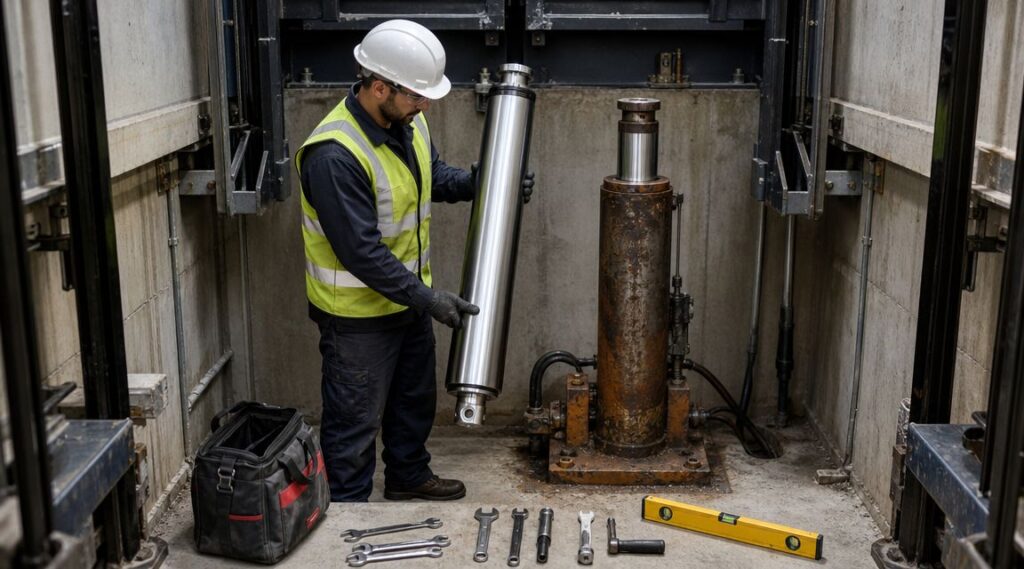
If you're reading this because one of your hydraulic elevators has started landing a little low, making a new noise, or leaving maintenance staff with an uneasy feeling, you're in the right place. Those early signs often get dismissed as a valve issue, a packing issue, or just an old unit showing its age. Sometimes that's true. Sometimes it isn't.
The problem is that the hydraulic jack isn't a minor component. It's the lifting column that carries the car. When it starts failing, you aren't just dealing with ride quality. You're dealing with safety exposure, compliance decisions, tenant disruption, and a project that can affect building operations for a long time if you handle it reactively.
Owners usually ask the same practical questions. How do I know the jack is the problem? Can it be repaired, or does it need full replacement? What does the actual project look like inside an occupied building? How do I avoid overpaying, getting boxed into a proprietary system, or ending up with avoidable downtime?
Those are business questions as much as mechanical ones. A well-run hydraulic elevator jack replacement should be treated like a capital improvement decision, not a last-minute emergency purchase.
Your Guide to Hydraulic Elevator Jack Replacement
A common call starts with something that seems small. The elevator doesn't level cleanly at every floor. The ride feels soft. Staff notice oil in the pit. Tenants mention that the car seems slower than it used to be. None of those symptoms should be ignored, because they point back to the one part of the system that has no room for casual thinking.
In a hydraulic unit, the jack does the lifting. If it has a sealing issue, alignment problem, corrosion risk, or underground leak path, the consequences go beyond inconvenience. An owner can end up dealing with extended shutdowns, environmental questions, expensive mobilizations, and pressure to make a fast decision with limited options.
That's why owners need to separate two very different situations:
- Managed replacement: You assess the condition, compare solutions, budget the work, and schedule it around operations.
- Forced replacement: The jack fails, the elevator is out, and every decision gets made under time pressure.
For a quick refresher on how these systems are built and where the jack fits in, Crane Elevator's overview of hydraulic elevator systems is a useful starting point.
What owners should focus on
Most building owners don't need a mechanic's manual. They need a decision framework.
That framework usually comes down to a few points:
- Recognize the warning signs early. Visible leakage is obvious. Underground loss is harder to spot.
- Determine what type of jack you have. Older in-ground configurations carry different risks than newer protected assemblies.
- Decide whether to replace as a stand-alone project or bundle it into modernization. That choice affects downtime, controls scope, and financing options.
- Choose equipment that doesn't lock you into one vendor. Service flexibility matters long after the install crew leaves.
- Plan around operations. Hospitals, schools, municipal buildings, apartments, and industrial facilities all feel downtime differently.
Practical rule: If the conversation has already reached liability, tenant complaints, or recurring oil concerns, you're no longer deciding whether to pay attention. You're deciding whether to act on your terms or the equipment's terms.
Telltale Signs Your Hydraulic Jack Is Failing
The first signs of jack trouble usually don't look dramatic. That's part of the risk. Owners expect a catastrophic failure to announce itself loudly. In reality, many jack problems show up first as subtle operational changes that maintenance teams can explain away for too long.
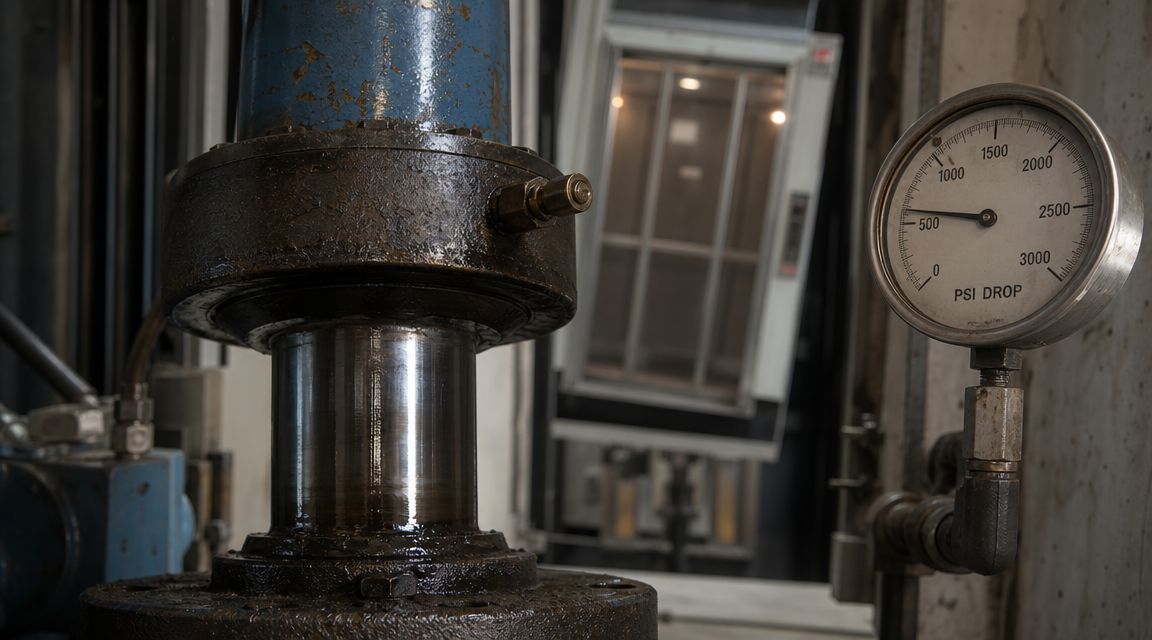
Visible signs inside the building
Start with what your staff can observe without opening up the system.
- Oil in the pit: Hydraulic fluid where it shouldn't be is one of the clearest warning signs.
- Poor leveling: The car stops slightly above or below the landing, then corrects or feels unstable.
- Spongy ride quality: Passengers describe bounce, drift, or a soft feel during travel.
- New noise patterns: Groaning, rubbing, or strained sounds under travel can point to deeper issues.
- Speed changes: A unit that feels slower or less decisive than it used to should be checked.
None of those symptoms automatically prove the cylinder itself is compromised. Valves, packing, piping, and power units can create similar symptoms. But when these signs appear together, a jack assessment moves from optional to necessary.
Hidden signs below grade
The more dangerous condition is the one you don't see.
An in-ground hydraulic jack can leak into surrounding soil without leaving a dramatic puddle in the pit. Owners sometimes assume no visible oil means no active problem. That's a costly assumption. Underground loss can continue unnoticed while the elevator still runs, which means the building stays occupied and the liability keeps growing.
Aging systems are especially vulnerable where corrosion and electrolysis have had years to work on buried components.
Underground leaks are what catch owners off guard. The elevator may still be operating while the real problem sits out of sight.
Why older jacks deserve more scrutiny
A major historical turning point came in 1971, when elevator code changes required in-ground hydraulic cylinders to include a safety bulkhead at the bottom of the cylinder. The purpose was to reduce the most serious failure mode associated with underground jacks, a corrosive hole in the cylinder often linked to electrolysis, as noted in Bagby Elevator's discussion of why hydraulic jack replacement became a safety modernization issue.
For owners, the practical takeaway is simple. If your hydraulic elevator dates back to the era before later protective standards became common, the conversation isn't just about maintenance anymore. It's about exposure. Older buried cylinders deserve a harder look because age, soil conditions, and original design all work against you.
What to do when you spot these symptoms
Use the signs above as a trigger, not a diagnosis. Have a qualified elevator contractor inspect the unit, review service history, and determine whether the issue is in the jack itself, related hydraulic components, or both. Waiting for certainty from the equipment usually means waiting too long.
Proactive Planning and Due Diligence
The biggest difference in outcome usually isn't the brand of jack. It's whether the owner planned the project before the equipment forced the issue.
Reactive replacements are expensive in all the ways owners hate. You lose schedule control. You compress procurement. You communicate bad news instead of a planned outage. You also narrow your contractor options because the building needs the elevator back fast.
Replace on your schedule, not after failure
Industry guidance is clear on two points in Wurtec's explanation of when an elevator jack must be replaced. If a hydraulic jack has failed, it must be replaced. The same guidance also says that if you're already planning a modernization, that's the right time to consider replacing the jack. It further notes that waiting for failure can add months of downtime because testing, bidding, material procurement, and scheduling can all stretch out, and some design and build pipelines are described as “months out.”
That matters because owners often ask whether they can defer the jack while modernizing the rest of the system. Sometimes that saves money in the short term. Often it creates a second outage later, plus duplicate mobilization and a second round of tenant disruption.
The due diligence checklist
Before anyone opens the pit or prepares a proposal, get answers to these questions:
- What jack type is installed: The same industry guidance identifies single-bottom jacks as needing replacement during modernization. It also notes that double-bottom jacks installed before PVC protection are still vulnerable and may merit replacement depending on condition and liability concerns.
- What does the service history show: Repeated packing work, oil additions, leveling complaints, or recurring shutdowns often tell a clearer story than one inspection snapshot.
- What site conditions affect the job: Pit depth, hoistway access, machine room condition, and whether excavation or specialized removal will be needed all affect scope.
- What permits and inspections apply locally: In Michigan, local authority involvement, state inspection requirements, and scheduling windows can shape the project calendar.
- What stays in place and what doesn't: Some jobs are a true jack-only scope. Others should include piping, oil, valve work, or broader modernization items.
How to compare proposals intelligently
A low number on the first page of a quote doesn't mean a low project cost. Owners should compare scope, assumptions, exclusions, and serviceability.
A useful review table looks like this:
| Decision point | What to ask |
|---|---|
| Equipment scope | Is this jack-only, or does it include related hydraulic components that should be addressed now? |
| Access and removal | Who is responsible for pit prep, debris removal, excavation coordination, and restoration if needed? |
| Compliance path | Who handles permits, tests, and final inspection coordination? |
| Future service | Will any qualified elevator contractor be able to maintain this system afterward? |
| Schedule realism | Is the contractor explaining lead times honestly, or just promising what you want to hear? |
Owners get into trouble when they buy a number instead of buying a scope.
Why this belongs in the capital plan
A jack replacement solves an immediate risk, but it also changes the long-term value of the elevator asset. If the unit serves a building with steady traffic and ongoing occupancy, it's often smarter to classify the work as a capital improvement and evaluate financing, bundling, and lifecycle cost at the same time. That approach usually leads to a calmer project and fewer surprises.
The Jack Replacement Process Overview
From an owner's perspective, the replacement job should feel controlled, sequenced, and heavily managed. If it feels improvised, that's a red flag. This work involves hoistway safety, hydraulic disconnection, component removal, alignment, testing, and formal return to service. It isn't a casual repair.
Early in the process, many owners find it helpful to see the sequence visually.
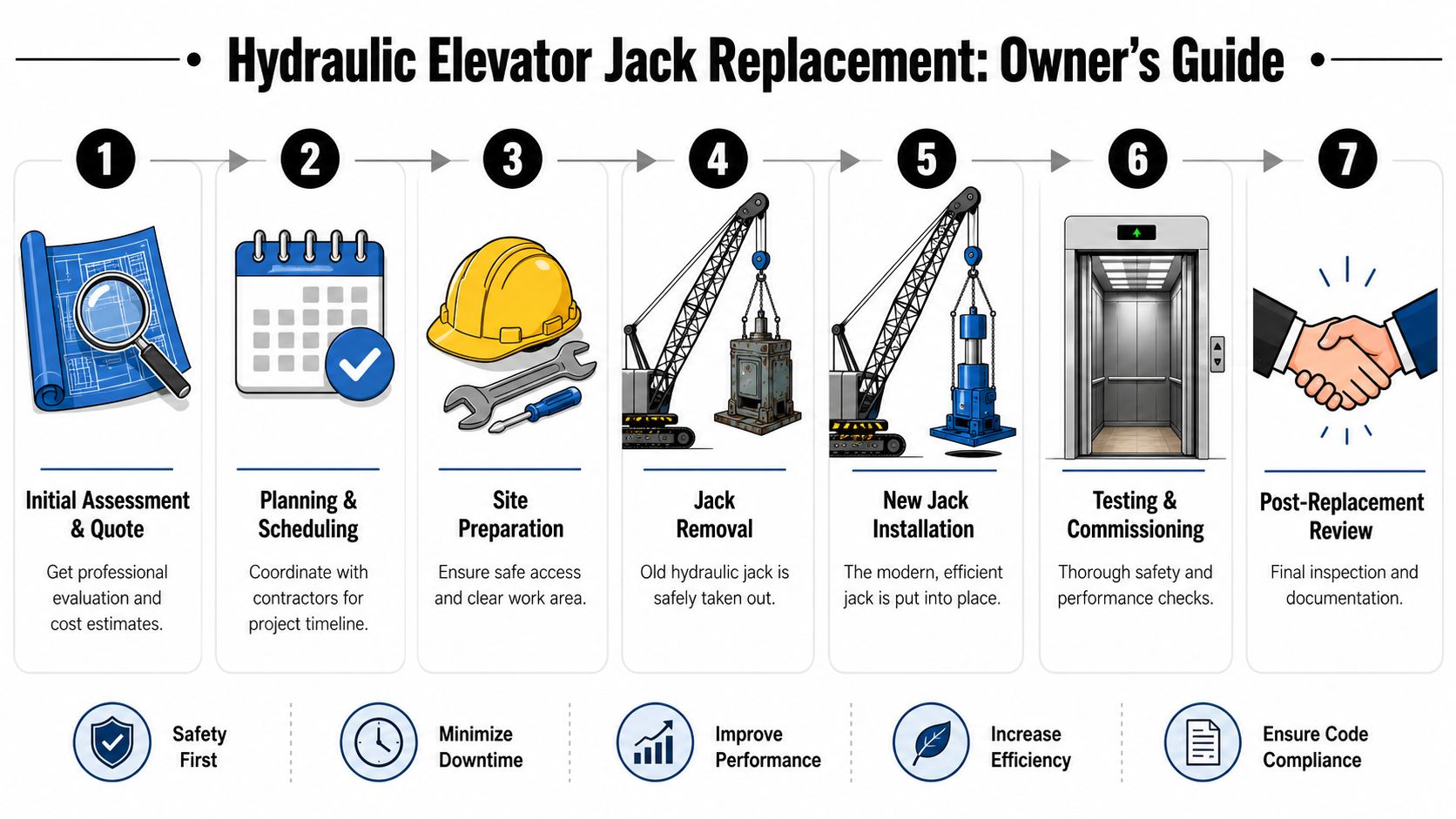
What happens on site
A hydraulic elevator jack replacement is typically staged by first securing the car high in the hoistway, then unfastening the jack assembly from the car, and lowering or removing the cylinder or jack section before the new one goes in, according to Schindler's installation overview for hydraulic jack replacement procedures.
For the building, that usually means the elevator is fully out of service during the core replacement window. Access routes may change. Storage areas may be needed. In some buildings, contractors need very careful material handling just to get components in and out without disrupting adjacent spaces.
The physical sequence often includes:
- Lockout and safety setup. The contractor secures the elevator, isolates the work area, and prepares the site for removal.
- Car securing. The car is held high in the hoistway to create safe access to the jack assembly below.
- Disconnection and removal. The existing jack assembly is detached and removed in sections or as a full assembly, depending on the design.
- New installation. The replacement cylinder and related components are set into position.
- Reconnection and commissioning. Hydraulic, mechanical, and operational systems are put back together for testing.
The step that separates good work from bad work
The most failure-sensitive part of the install is plumbing and alignment. That same installation guidance emphasizes that the cylinder must lift without side-loading the piston, and technicians use a plumbing tool to verify verticality before final backfilling or reassembly.
That's not a small technical detail. It's one of the main reasons a new jack can perform well for the long term or start wearing prematurely. Owners sometimes think a jack replacement is straightforward because the old one comes out and a new one goes in. However, alignment quality affects how the entire system behaves under load.
A new jack installed out of plumb is still a bad installation.
For a visual overview of the work sequence in the field, this video gives owners a useful sense of project flow without turning the article into a mechanic's manual.
What owners should expect during the outage
The on-site phase creates real disruption, but the disruption should be predictable if the job is planned correctly. Expect controlled access, noise during removal and installation, contractor coordination with building management, and regular progress updates.
A good contractor should also define responsibility lines clearly. Who communicates with tenants or staff. Who coordinates inspections. Who restores affected areas. Who documents testing and closeout. Those practical items often matter as much to the owner as the mechanical work itself.
Budgeting Costs Timelines and Financing
Owners want hard numbers. On a project like this, the honest answer is that cost depends heavily on the existing equipment, access conditions, and whether you're doing a jack-only scope or combining it with broader modernization. That's why it helps to budget strategically instead of treating the work as a surprise repair line item.
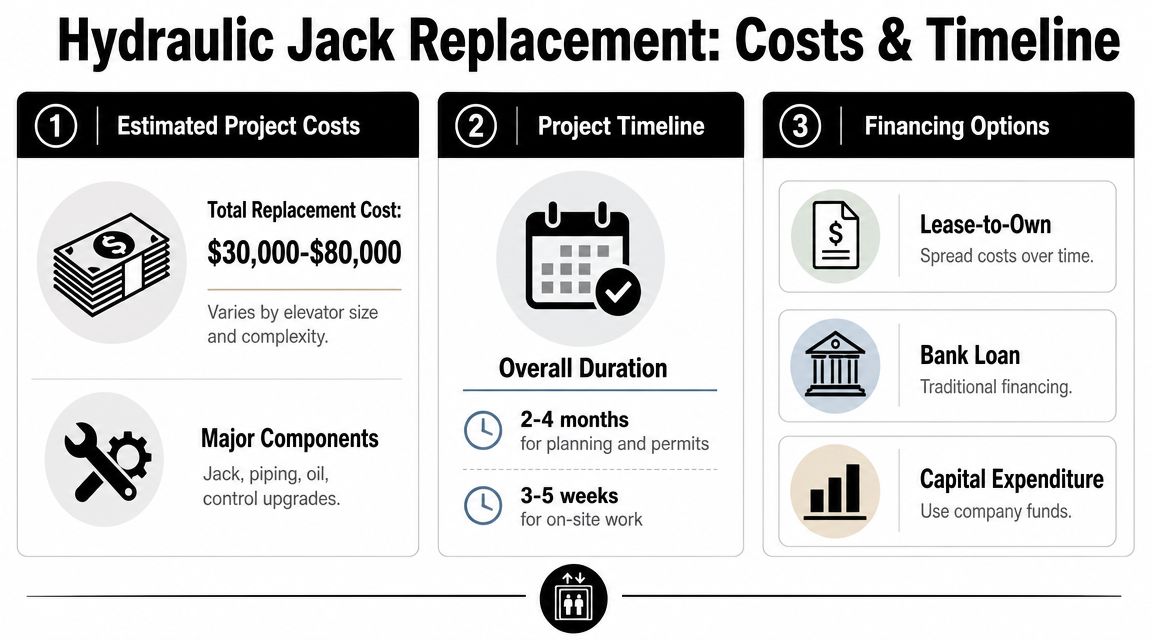
The visual above includes cost and schedule ranges, but those figures aren't supported by the verified source set provided for this article, so they should be treated as illustrative rather than citable. For actual budgeting, owners should rely on project-specific contractor proposals and local permitting realities.
What drives project cost
In practice, the final number usually moves based on a handful of real variables:
- Jack configuration: In-ground replacement isn't priced the same as a simpler accessible setup.
- Building access: Tight machine rooms, finished lobbies, limited staging, and occupied spaces all add labor and coordination.
- Scope decisions: If the building is already considering valve work, piping, controller updates, or cosmetic improvements, bundling can change the economics.
- Inspection and restoration requirements: Permit coordination, testing, and any building restoration after the install can materially affect the budget.
Owners often make the mistake of trying to isolate the cheapest possible jack scope. That can work if the rest of the hydraulic system is in good condition. It can also create a false economy if related components are near the same point of wear and force another outage later.
Think in lifecycle cost, not just contract price
This is where the strategic side matters. A hydraulic elevator jack replacement can be approached as:
| Approach | What it usually means |
|---|---|
| Emergency repair mindset | Fast decision, limited bidding, little leverage, and maximum schedule pressure |
| Capital improvement mindset | Planned scope, better vendor comparison, cleaner budgeting, and room to finance intelligently |
If the elevator is central to building operations, the second approach is usually stronger. It lets you compare ownership cost over time, not just the initial invoice. It also gives you room to evaluate whether the jack should be replaced as part of a broader modernization package.
For owners weighing larger system updates, this breakdown of hydraulic elevator modernization costs is useful context because it frames the jack as one part of a longer asset plan.
Financing changes the decision
A lot of owners know the work needs to happen but still delay because the expense hits in one lump. That's where financing matters. Lease-style structures, traditional lending, or other upgrade financing approaches can turn an unplanned capital shock into a more predictable operating commitment.
That matters most in buildings where elevator uptime directly affects occupancy, accessibility, or revenue. If the unit serves residents, patients, students, or daily staff traffic, the business cost of delay often outweighs the appeal of waiting.
The right financing doesn't make the project cheap. It makes the timing manageable.
Timeline expectations
Avoid any contractor who promises an unrealistically clean schedule before they understand the equipment and local approval path. Planning, permits, procurement, site logistics, installation, testing, and final inspection all have to line up. Owners should communicate conservatively with tenants and internal stakeholders, then tighten the schedule only after material lead times and inspection windows are confirmed.
Choosing a Non-Proprietary Jack and a Qualified Contractor
The replacement itself is only half the decision. The other half is what kind of service future you're buying.
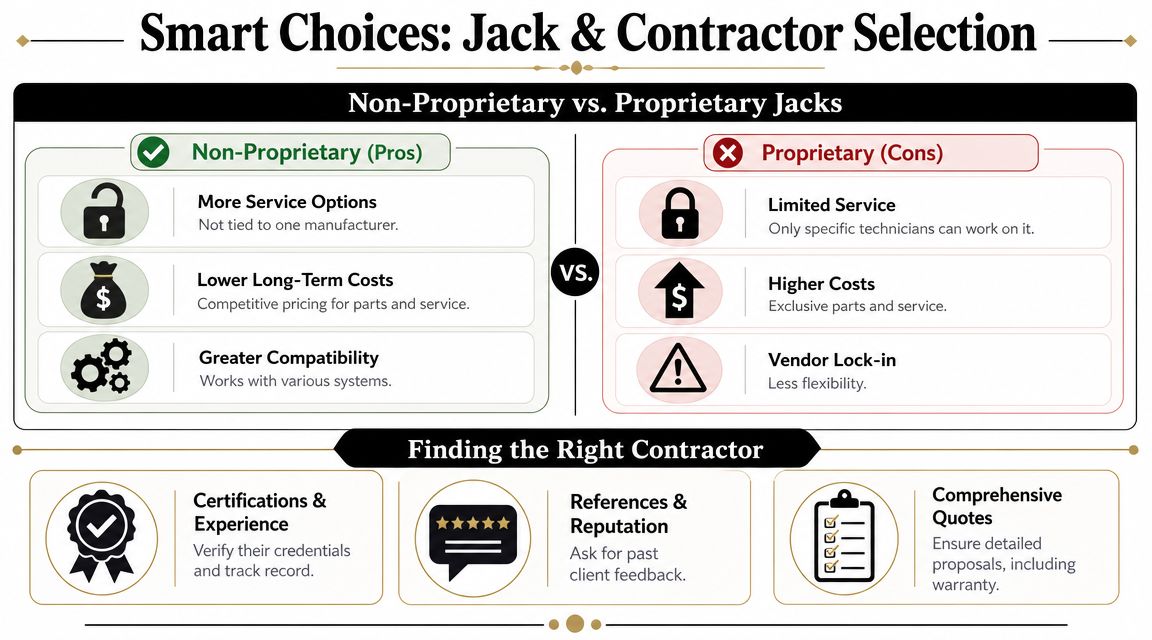
Owners who don't think about that up front often end up with a perfectly functional system that's more expensive to maintain, harder to service, and tied to one vendor's parts and labor model. That's why I usually push owners to ask a simple question before approving equipment. Will this replacement increase my freedom, or reduce it?
Why non-proprietary matters
A non-proprietary solution gives the owner more control after the project is over. It generally supports a wider service market, fewer restrictions on who can maintain the equipment, and a better chance of keeping maintenance pricing competitive over the life of the elevator.
A proprietary path can make sense in some situations, especially if the rest of the system already follows that architecture and the owner accepts the service model. But many owners don't fully understand the trade-off until later, when they try to rebid maintenance or source parts.
Crane Elevator Company is one Michigan contractor that focuses on non-proprietary elevator solutions, which reflects the broader principle that future service flexibility should be part of the buying decision, not an afterthought.
What to ask the contractor
Don't stop at license status. For hydraulic elevator jack replacement, installation quality is inseparable from project outcome.
Use questions like these:
- How often does this contractor perform hydraulic jack replacements: You want direct experience, not a team learning on your building.
- Who is responsible for alignment and final testing: Ask them to explain the critical steps in plain language.
- What insurance and safety documentation can they provide: Owners should verify coverage and risk management before work starts.
- Can they give local references for similar buildings: Hospitals, schools, apartments, and industrial properties all have different constraints.
- Is the proposal detailed enough to expose exclusions: Vague scope language is where disputes start.
Equipment choice and installer choice are linked
An open, serviceable jack installed poorly is still a problem. A well-installed but locked-down proprietary setup can still cost more than it should over time. The strongest projects pair a serviceable, non-proprietary design with a contractor who understands alignment, jobsite management, inspection coordination, and occupied-building communication.
Buy the future service model at the same time you buy the hardware.
Final Testing Maintenance and FAQs
A lot of owners think the project ends when the new jack is physically in place. It doesn't. The installation only becomes a successful replacement after the system is tested under load, properly commissioned, and signed off for return to service.
Commissioning that actually matters
After the new hydraulic jack is installed, the system should be fully pressure-tested under load across the cylinder, piping, and relief valve, and then cycled to purge air from the hydraulic circuit. Elevator repair guidance gives a practical benchmark of running the jack fully up and down roughly 20 times to bleed trapped air. That same guidance warns that skipping this step can leave spongy motion, uneven leveling, or incomplete lift performance, as explained in this overview of flat-bottom elevator jack replacement and post-install bleeding.
That detail matters because owners sometimes see a unit moving again and assume the job is finished. A rushed closeout can leave behind operational problems that look like defects but are really commissioning failures.
What to put in your post-project file
Once the elevator is back in service, keep the documentation organized. At minimum, owners should retain:
- Permit and inspection records: Final approvals should be easy to retrieve.
- Scope documentation: Keep the signed proposal, change orders, and closeout package.
- Testing results: Pressure and operational testing records matter later.
- Equipment details: Model information and service notes help future contractors work efficiently.
- Maintenance plan: The new jack still needs routine observation, clean hydraulic service practices, and scheduled preventive maintenance.
Common questions owners ask
Can an old hydraulic jack be repaired instead of replaced
Sometimes related issues such as seals, packing, or external hydraulic components can be repaired. But once the jack itself has failed, replacement is the right path. That's also consistent with the earlier industry guidance on failed jacks.
How long will the elevator be out of service
The honest answer depends on planning quality, equipment lead time, jobsite access, and inspection scheduling. A planned project is usually far easier to manage than an emergency outage.
Should I replace the jack during modernization even if it's still running
Often, yes. If the elevator already qualifies for broader modernization review, combining scopes can reduce duplicate disruption and avoid revisiting the same unit later under worse conditions.
What should I do right after replacement
Watch the ride quality closely, confirm documentation is complete, and keep the unit on a proactive maintenance program. A new jack isn't a reason to relax. It's a reason to protect the investment you just made.
If you're evaluating a hydraulic elevator jack replacement in Southern Michigan, Crane Elevator Company is one option to include in your bid process. They handle hydraulic elevator service, modernization, inspections, and non-proprietary upgrade work for commercial and residential properties, and they also offer second opinions for owners who want to compare scope before committing.