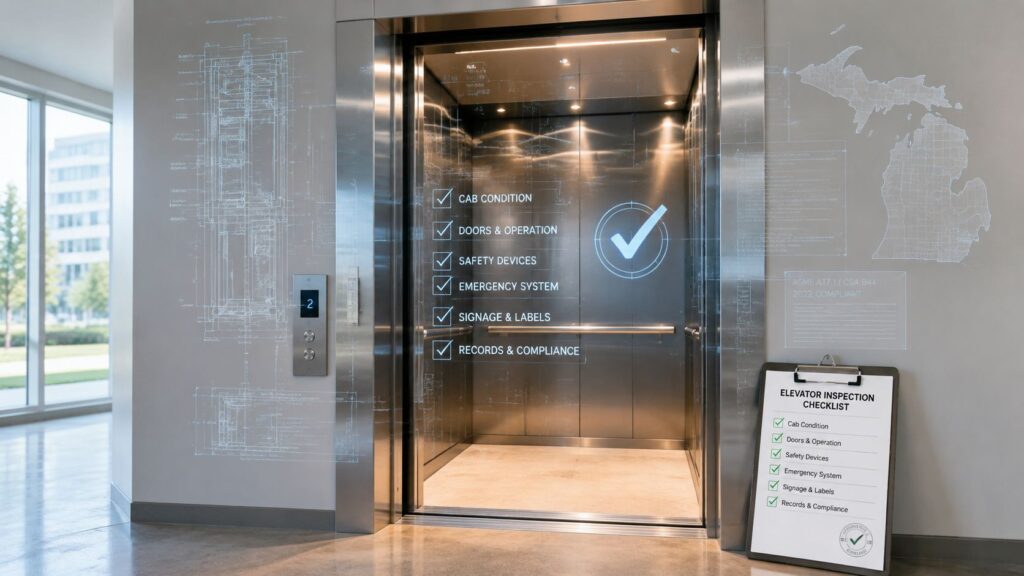
A lot of Southern Michigan owners first deal with elevator code requirements when something goes wrong. A state notice shows up. A tenant complains that the emergency phone doesn't work. A modernization quote includes items nobody budgeted for. Suddenly you're staring at code terms like ASME A17.1, annual inspection, alteration, accessibility, and fire service, trying to figure out what applies to your building in Ann Arbor, Detroit, Lansing, Flint, or Kalamazoo.
That confusion is normal. Elevator compliance in Michigan isn't one rule on one page. It's a layered system with national safety standards, accessibility rules, state adoption, and local enforcement. What matters to owners isn't the theory. What matters is knowing what your inspector will look for, what work will trigger upgrades, and how to avoid turning a manageable repair into an expensive compliance problem.
An Introduction to Elevator Compliance in Michigan
A facility manager in Ann Arbor gets an inspection correction list on Tuesday. By Thursday, the owner is asking why an elevator that still carries passengers every day suddenly needs new work, new paperwork, and a new budget line.
The short answer is simple. Elevator code requirements continue long after installation.
In Michigan, compliance is tied to the condition of the equipment, the testing history, the maintenance records, and the code standard that applies to that unit. If any one of those pieces is missing, an elevator can be running and still fail inspection. That is the part many owners in Southern Michigan do not hear until a state notice arrives or a contractor prices corrective work.
Practical rule: If your compliance plan begins when an inspector writes you up, you're already late.
Owners who avoid expensive surprises usually stay ahead in three areas. They know what equipment is in the building and how old the major components are. They keep testing, maintenance logs, and required callbacks current. They ask code questions before approving alterations, especially with older units that may already be close to a larger upgrade threshold.
That matters more in Southern Michigan than many generic code articles admit. Buildings in Detroit, Ann Arbor, Jackson, Novi, Kalamazoo, and Lansing often have a long renovation history, mixed-use occupancy, and equipment installed under older code cycles. A medical office with heavy public traffic, a school with accessibility demands, and a downtown office tower with deferred modernization can all face very different compliance costs, even if each has a working passenger elevator.
The other local factor is timing. Many owners are trying to decide whether to repair, modernize, or wait, while state deadlines and adoption cycles keep moving. If that decision is on your desk now, review the Michigan elevator code deadline taking effect January 1, 2028 before you approve another partial upgrade. In a lot of buildings, the cheapest short-term fix is what triggers the more expensive conversation later.
Decoding the Code Hierarchy in Michigan
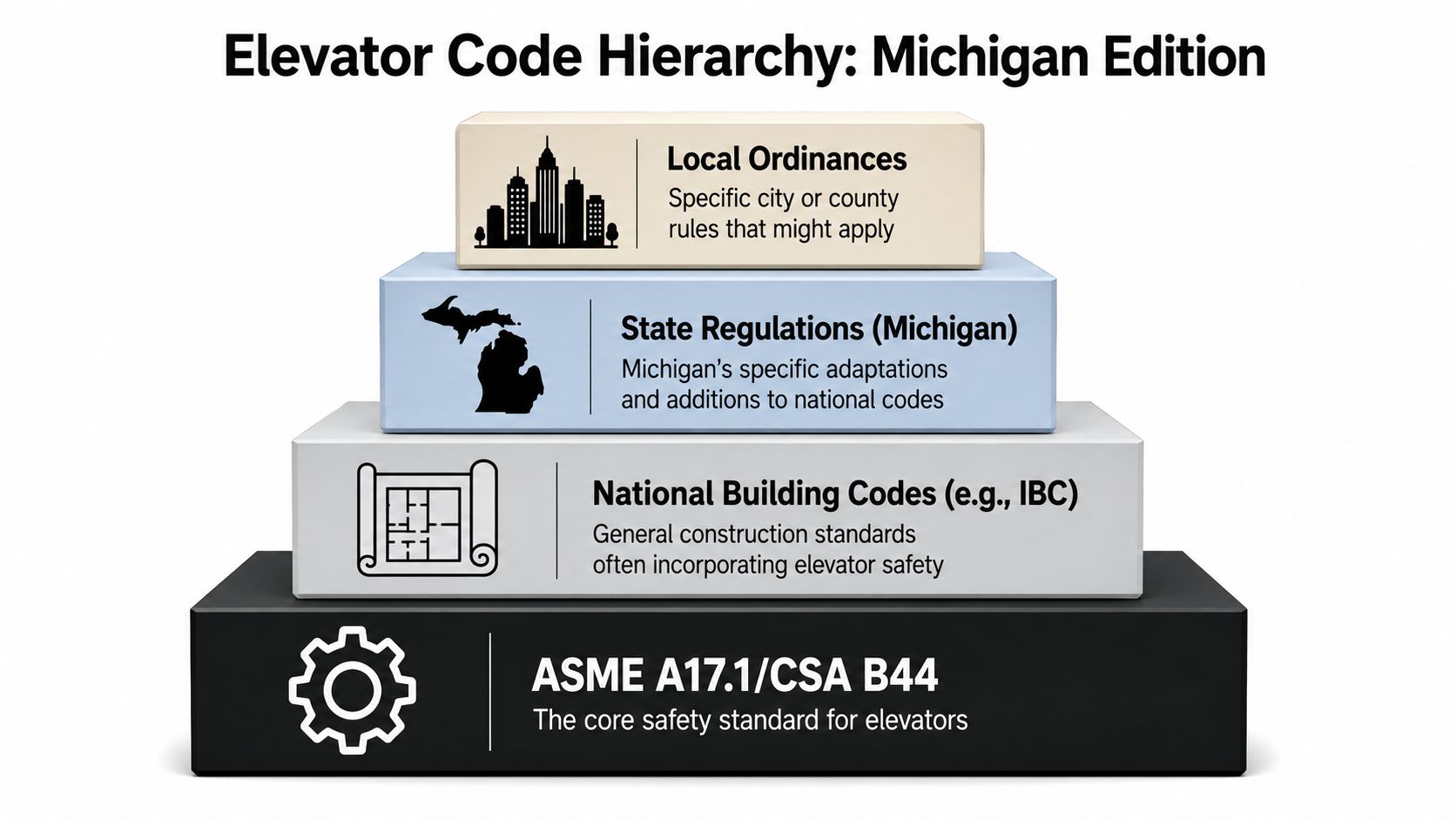
Most owners get tripped up because they're looking for one master rulebook. Michigan elevator code requirements work more like stacked building blocks. If you understand the stack, inspection notices make a lot more sense.
The foundation is ASME A17.1
The core technical standard is ASME A17.1/CSA B44. It governs the full lifecycle of an elevator system, including design, construction, installation, operation, inspection, maintenance, alteration, and repair across the U.S. and Canada (ASME A17.1 lifecycle scope). That matters because it answers a question owners ask all the time: “Does code apply only to new installations?” It doesn't.
If you replace a controller, change door equipment, modify braking behavior, or make another alteration that affects operation, the code conversation starts again. That doesn't always mean a full building-wide overhaul. It does mean the work has to leave the elevator in a compliant condition for the standard and adoption cycle that applies.
Michigan makes the standard enforceable
National standards become real-world obligations when the state adopts and enforces them. In Michigan, that's the layer that turns a technical code into something an owner has to answer for during inspection, permitting, modernization, and correction work.
A common pitfall involves costly assumptions. They assume the elevator was “grandfathered forever.” They assume a partial repair won't trigger anything else. They assume the state and local inspector will view the job the same way their maintenance vendor does. Those assumptions don't hold up well when a violation lands on your desk.
For owners tracking future compliance planning, it's worth reviewing Michigan elevator code deadlines and planning considerations before a major project reaches the quote stage.
Local enforcement is where theory becomes real
At the top of the stack sits local enforcement. That may involve state inspectors, local officials, or project review that reflects city-specific expectations. In Southern Michigan, this is the part owners experience. It shows up as correction orders, scheduling pressure, permit questions, and delays in getting work signed off.
A practical way to think about the hierarchy is this:
| Layer | What it does for the owner |
|---|---|
| ASME A17.1/CSA B44 | Sets the technical safety rules the equipment must meet |
| State regulation and adoption | Makes those rules enforceable in Michigan |
| Local enforcement | Determines how compliance is reviewed and corrected on the ground |
The code book tells you what the equipment should do. The inspector tells you whether your building has proved it.
Owners who handle this well don't argue with the hierarchy. They work through it. They ask which edition applies, what the state expects for this equipment, and whether local enforcement will require correction now or tie it to a larger project.
Core Technical and Safety Requirements
A Southern Michigan elevator can pass the hallway test and still fail where it counts. The cab runs. The doors open. Tenants stop complaining. Then an inspection, renovation, or entrapment exposes the systems that were never meeting current requirements.
###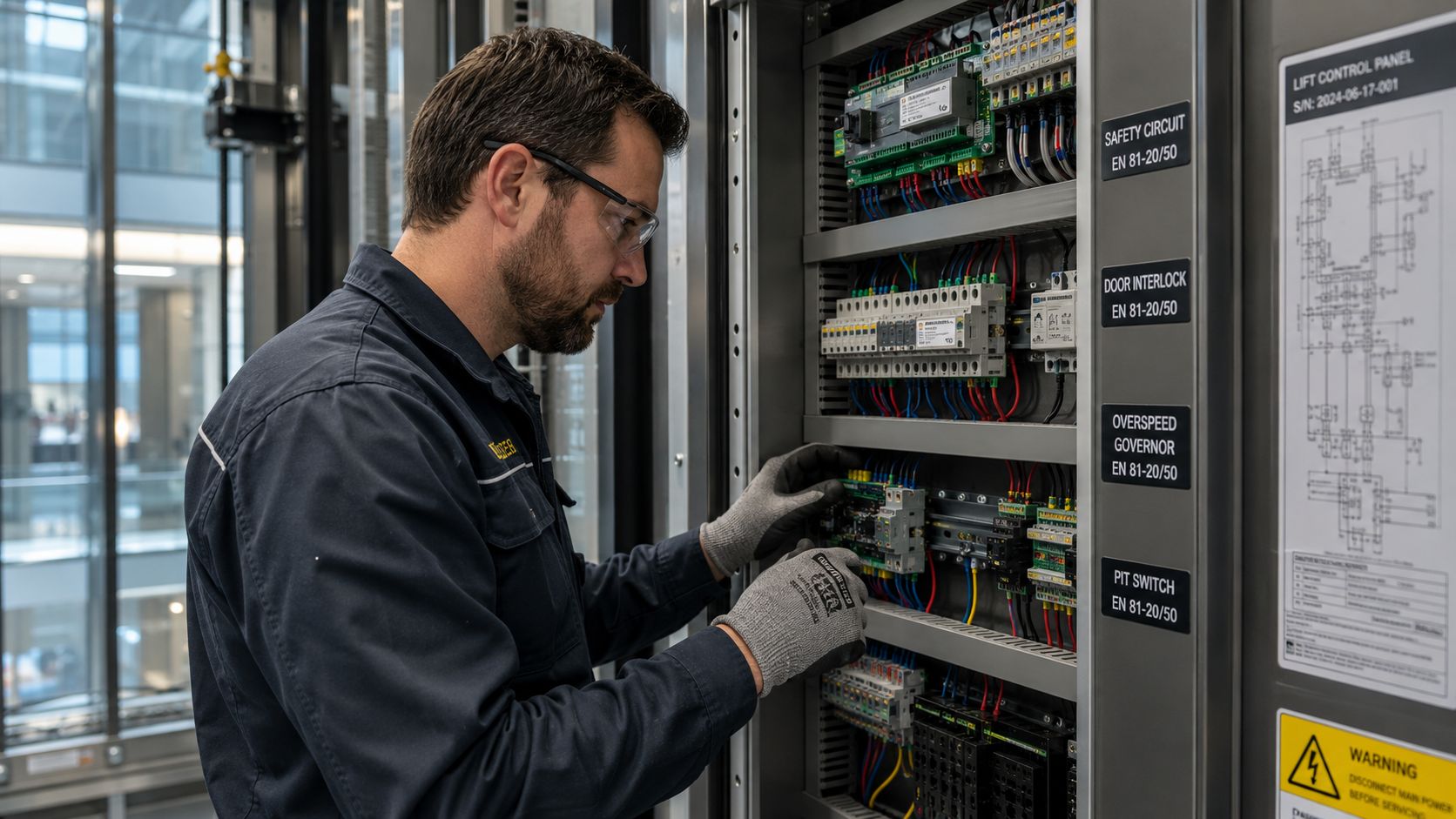
Inspectors and mechanics usually come back to the same categories. Fire service, emergency communications, and accessibility features drive a large share of correction orders because they affect emergency response, passenger protection, and day-to-day usability. Owners do not need to memorize every section of the code book. They do need to know where older equipment tends to fall short, what failures cost to correct, and which issues should be handled before a larger project forces the timeline.
Fire service
Firefighters' Emergency Operation changes how the elevator responds during an alarm so the car recalls correctly and authorized responders can take control. If that sequence fails, the problem is serious immediately. In practical terms, owners usually learn about it through failed recall, incorrect key operation, door behavior that does not match the required sequence, or equipment that reacts inconsistently when the alarm is tested.
Older Southern Michigan properties are especially exposed here. A car may still run fine in normal service while the fire service functions are unreliable because the controls are dated, the building fire alarm has been modified over time, or a past modernization stopped short of replacing the weak points. I have seen buildings spend money on visible upgrades and still end up chasing recall problems because the interface between the controller and alarm system was never cleaned up properly.
The common trouble spots are predictable:
- Aged controls: Older relays, boards, and wiring can drift out of tolerance or lose compatibility with current fire service functions.
- Partial upgrades: One component was replaced, but the rest of the circuit path stayed old.
- Poor coordination between trades: Elevator and fire alarm work were handled separately, and nobody verified the full sequence under test.
- Testing gaps: The feature exists on paper, but its actual performance has not been confirmed under real alarm conditions.
Emergency communications
Emergency communication failures catch owners off guard because the phone often appears to work until somebody needs it. A dial tone is not the standard. The system has to connect reliably, be intelligible, and fit the building's current communication setup.
That is where many Michigan buildings get tripped up. Legacy analog lines disappear. Cellular replacements get installed without checking signal strength in the hoistway environment. Monitoring arrangements change after a management transition. Then the car phone becomes the item that fails inspection or, worse, fails during an entrapment.
For a practical review of what compliant cab communication systems should include, see elevator emergency phone code requirements.
A working elevator with a failed emergency phone can turn a routine entrapment into a much bigger problem.
Facility teams should test the phone the way a passenger would use it. Confirm that the call connects, the conversation is understandable, the receiving party knows the building and car location, and the service remains active after telecom changes. That last part gets missed often.
A short visual overview helps if your staff needs a quick refresher on code-facing elevator safety systems.
Accessibility
Accessibility standards significantly expanded elevator code requirements beyond basic lifting performance. In the field, that means inspectors are not looking for a cab that feels usable. They are looking for specific dimensions, door clearances, control placement, markings, and passenger information features that can be measured and verified. A commonly cited requirement is a minimum cab size of 51 inches deep by 68 inches wide for side-opening elevators, a 36-inch minimum clear doorway opening, and call buttons typically mounted at about 42 inches above the floor (ADA-related elevator dimensions and controls).
This is important for Michigan properties because many older elevators look serviceable while still missing details that become expensive during tenant improvements, public-facing renovations, ownership transfers, or accessibility complaints. The trade-off is straightforward. A small correction such as signage, button marking, or signal work is manageable. A cab size or entrance width problem can push an owner into a much larger modernization discussion.
During a walk-through, focus on these problem areas:
- Cab dimensions: Older cars may be undersized for current accessibility expectations.
- Door clear opening: Near compliance still leaves the owner with a correction.
- Operating panels: Button height, tactile markings, and reach range all affect compliance.
- Passenger-facing features: Audible and visual signals should be integrated, rather than treated as separate afterthoughts.
Owners usually save money when they identify these issues before design drawings are finished or contracts are signed. Once a project is underway, the same correction often costs more and gives you fewer workable options.
Navigating Inspection and Testing Schedules
A Southern Michigan owner usually learns the testing schedule the hard way. The elevator runs for months, nobody checks the last test date, an inspector arrives, and a preventable paperwork issue turns into a violation, a shutdown risk, or a rushed service call at premium rates.
Inspection and testing are calendar work. If no one owns the dates, the building owner owns the consequences.
Federal rules and state enforcement both point to the same practical standard. Elevators need recurring inspection, routine checks, documented corrections, and records that can be produced quickly. In Michigan, that matters even more for older schools, medical offices, apartment buildings, and mixed-use properties where the equipment may still be operating but the documentation trail is weak.
What owners should track year round
The annual inspection is only one date on the calendar. The better question is whether the elevator has been managed between inspections.
I look for a few basics first: maintenance logs, open repair items, test due dates, permit postings, phone operation, fire service performance, and repeated nuisance callbacks. Those recurring shutdowns often cost owners more than the scheduled testing they tried to postpone.
The buildings that get cited or surprised usually have one of these problems:
- No single point of responsibility: Facilities, property management, and the service contractor each assume someone else is watching the dates.
- Scattered records: Prior tests, corrections, and approvals exist, but they are spread across email chains, binders, and old invoices.
- Last-minute scheduling: The owner waits for a notice, then tries to book testing during a busy period when inspectors, contractors, and building staff are all harder to line up.
Michigan Elevator Inspection and Testing Schedule
The exact schedule depends on the type of equipment, how the elevator is used, and what the state or local authority requires for that unit. For most Southern Michigan properties, this is the working framework owners need to plan around.
| Test Type | Frequency | Primary Purpose |
|---|---|---|
| Routine operational checks | Ongoing, with monthly checks in some occupancies | Catch operating problems early and confirm the elevator is serviceable |
| Annual inspection | Annual | Verify current condition, code-related items, and required records |
| Category 1 test | Annual | Check core safety functions that are part of yearly compliance |
| Category 5 test | On its required cycle | Perform a more involved safety test that usually requires added coordination, shutdown planning, and documentation |
Category 5 testing is where owners in Michigan often get squeezed. It is not just another appointment. It can require tenant notice, after-hours access, coordination with the inspection authority, and enough lead time to address deficiencies before they turn into a failed test or a prolonged outage.
If you cannot identify the last Category 5 date in a few minutes, start there.
For a practical breakdown of what these events usually involve, Michigan elevator testing requirements and service scope gives owners a clearer picture than the notice taped in the machine room.
Documentation is part of compliance
An elevator can run fine and still put the owner in a bad position if the records are missing. Inspectors want to see what was tested, what failed, what was corrected, and when the work was closed out. If that history is incomplete, the building looks unmanaged, and owners lose time proving work that may already have been done.
Keep one current compliance file, digital or physical, with these items:
- Inspection reports
- Test records
- Maintenance logs
- Correction notices and closeouts
- Modernization and alteration history
That file saves money. It shortens inspections, reduces duplicate service calls, and helps owners make better decisions when an elevator starts showing a pattern of trouble instead of a one-time fault.
When Modernization Triggers Code Upgrades
Owners often think modernization is a way to avoid code problems. Sometimes it is. Sometimes it's the exact moment new code obligations show up.
That doesn't mean modernization is a bad idea. It means you need to understand the trigger before you approve the work. Elevator code requirements apply across design, operation, maintenance, alteration, and repair. Once you alter a major system, the question changes from “Was this elevator compliant when installed?” to “What does this work require now?”
Small scope on paper can become large scope in practice
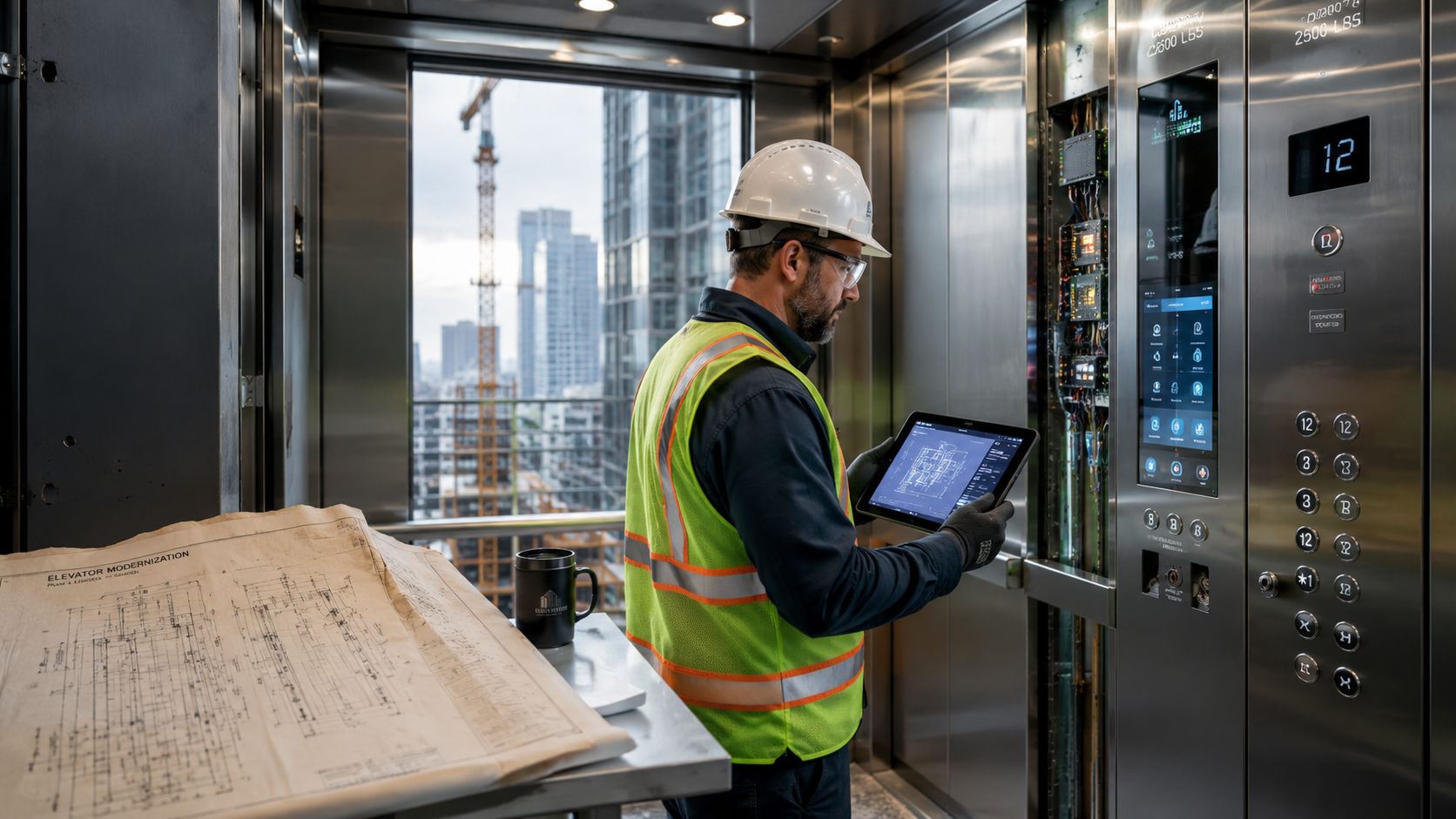
A controller replacement is a good example. Owners may view it as a reliability job. The contractor may price it that way initially. But once that new controller changes how the car runs, stops, monitors doors, handles recall, or interfaces with communication and safety systems, the project can pull in more than one subsystem.
The same thing happens with door operators, hall equipment, machine-room components, and rescue-related features. A piece-by-piece approach can make sense, but only if someone has checked what each piece will trigger.
Here's what usually doesn't work:
- Approving a repair quote in isolation
- Assuming the inspector will ignore related older deficiencies
- Waiting until permit review to ask code questions
- Trying to modernize around an obsolete component that should've been replaced with the rest
Why planning ahead usually costs less
Recent code revisions make this even more important. ASME A17.1-2025 adds requirements related to emergency responder radio coverage equipment, elastomeric buffers, and seismic standards, showing how code updates can shape future projects before they automatically apply to existing equipment (ASME A17.1-2025 update summary). For a Southern Michigan owner, the practical takeaway isn't “retrofit everything tomorrow.” It's “ask whether your next alteration pulls these issues into scope.”
If you know a car operating panel, controller, door package, or phone system is nearing the end of its useful life, it's usually smarter to bundle work with code review than to keep authorizing isolated repairs.
A proactive modernization plan should answer:
- What's failing now
- What code issues already exist
- What the next major alteration will trigger
- Whether bundling work reduces shutdowns and repeat mobilization
- How to phase upgrades if the budget can't absorb everything at once
Crane Elevator Company is one Michigan contractor that handles non-proprietary modernization, testing, and code-related corrective work, but the key point for owners is broader than any one vendor. Ask any contractor to show you the likely code consequences of the proposed scope before you sign the job.
Five Common Violations in Michigan and How to Fix Them
Most correction lists in Michigan don't come from exotic failures. They come from familiar issues that were ignored too long, patched badly, or misunderstood by the building team. The pattern repeats across offices, schools, apartment properties, municipal buildings, and healthcare sites.
Fire service that no longer matches the building
An older mid-rise in Detroit had alarm work done years after the elevator controls were last updated. On paper, both systems existed. In practice, recall behavior was inconsistent. That's the kind of problem that may not show up during daily use but becomes obvious during inspection or emergency testing.
The fix is usually straightforward in concept, even if the work itself varies. Verify the current interaction between alarm and elevator controls, identify whether the issue is configuration, interface equipment, or outdated control hardware, and correct the system so emergency operation behaves as required.
Emergency phones that technically power up but don't function well
A Lansing office property had cab phones that looked acceptable during a quick glance. The units lit up, wiring was present, and nobody had reported a problem recently. But when tested, the communication path was unreliable and the user experience was poor.
That's common in buildings where telecom changes happened over time and the elevator phone got left behind. The solution is to replace or reconfigure the phone setup so it provides dependable two-way communication and fits the building's actual communication environment.
If your staff hasn't tested the cab phone recently, don't assume your passengers can reach anyone when it matters.
Door monitoring and related safety corrections
In older equipment, door-related safety issues often appear after years of piecemeal service. The elevator still opens and closes, but the system isn't giving the level of monitoring and protection inspectors now expect after state adoption and later safety focus areas.
Owners often encounter trouble by choosing the cheapest narrow fix. Sometimes a targeted correction works. Sometimes the age of the equipment means you're better off discussing an overlay or a broader modernization path because repeated patching won't solve the underlying compliance problem.
Machine rooms and control spaces that became storage rooms
This one is less technical but very common. A facility team uses the machine room for spare ceiling tile, janitorial supplies, paint, or archived files. Lighting is poor. Housekeeping is inconsistent. Access is obstructed.
Inspectors notice this immediately because it signals weak control of a safety-critical area. The fix is not complicated. Clear the space, restore proper housekeeping, maintain access, and treat the room like equipment space, not overflow storage.
Using the wrong elevator for accessibility
This causes real confusion in mixed-use and older buildings. An owner assumes a freight elevator can satisfy accessibility because it reaches all floors. The ADA Access Board is explicit that freight elevators cannot be used to satisfy required accessible routes, and any service elevators used by passengers must meet all passenger-elevator requirements (ADA Access Board elevator route guidance).
That matters in Southern Michigan where many renovated industrial and commercial properties still have legacy freight equipment.
A practical fix starts with the use case, not the machine. Ask:
- Who uses the elevator now
- Whether the route is part of the required accessible path
- Whether the car is a passenger, service, freight, LULA, or private residence application
- Whether the current equipment can legally serve that function
If the answer is no, you need a compliant accessible route strategy, not a better argument.
Your Actionable Elevator Compliance Checklist
A Southern Michigan building usually does not fail on theory. It fails on missed paperwork, sloppy follow-up, and equipment issues everyone has been working around for months.
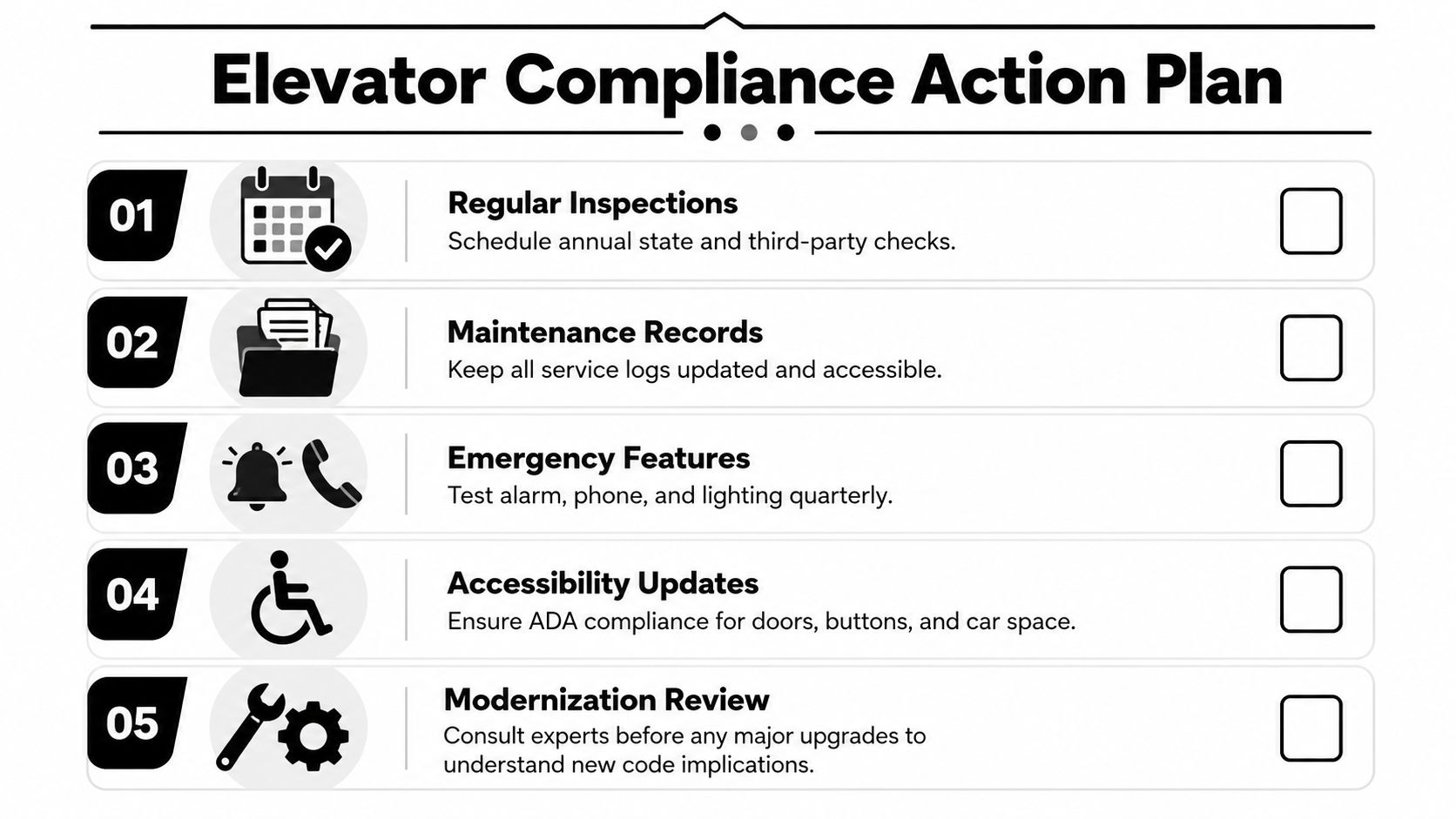
Use this checklist the same way I would use it before an inspection, a property transfer, or a budget meeting. The goal is simple. Find the items that can shut down service, trigger repeat violations, or turn a manageable repair into a rushed modernization job.
Administrative review
Start with the file, not the machine. In Michigan, owners get into trouble fast when records are scattered between the office, the property manager, and the service contractor.
- Confirm inspection status: Verify that the current inspection certificate, permit postings, and recent inspection reports are present and current.
- Pull maintenance history: Organize service logs, callback records, shutdown history, and any recommendations that were never approved or declined in writing.
- Review open corrections: Check whether cited items were corrected, documented, and accepted. Do not assume a return to service closed the issue.
Physical walk through
Then walk the elevator with an operator's eye. A ten-minute trip through the lobby, cab, landing entrances, and support spaces can expose problems that cost far more if they sit until the next state visit.
- Test passenger-facing features: Check the alarm, emergency phone, cab lights, hall indicators, position indicators, and button condition.
- Check entrances and equipment areas: Look for damaged sills, door strikes, poor lighting, blocked access, and signs that building staff are treating elevator spaces like storage.
- Watch the ride quality: Rough leveling, slow door response, nuisance shutdowns, repeated resets, and missed calls usually point to a fault pattern, not a one-time glitch.
The elevator usually shows its age before it fails an inspection. Tenants notice it first. Inspectors confirm it later.
Strategic planning
The expensive problems are usually scheduling problems. Owners in Southern Michigan get squeezed when annual testing, tenant work, and aging equipment all collide in the same quarter.
- Map upcoming tests: Put annual and periodic testing dates on the building calendar early, and confirm who is responsible for witnessing, coordinating, and documenting them.
- Flag aging components: Pay close attention to controllers, door operators, communication equipment, and fire service functions. These are common sources of repeat trouble calls and code-related scope creep.
- Review planned renovations: Before a buildout, lobby refresh, accessibility project, or power upgrade touches the elevator, verify whether the work changes your code obligations.
Assign ownership of the elevator compliance file to a single person for clear accountability. That person should control records, inspection follow-up, vendor communication, and the running list of open risks.
If your team is unsure whether the equipment is current, whether a cited correction is valid, or whether a modernization proposal includes the right compliance scope, ask Crane Elevator Company for a second opinion. A practical review of the equipment, records, and inspection history can help you separate routine maintenance from legitimate code exposure and budget the right work before the next inspection cycle.