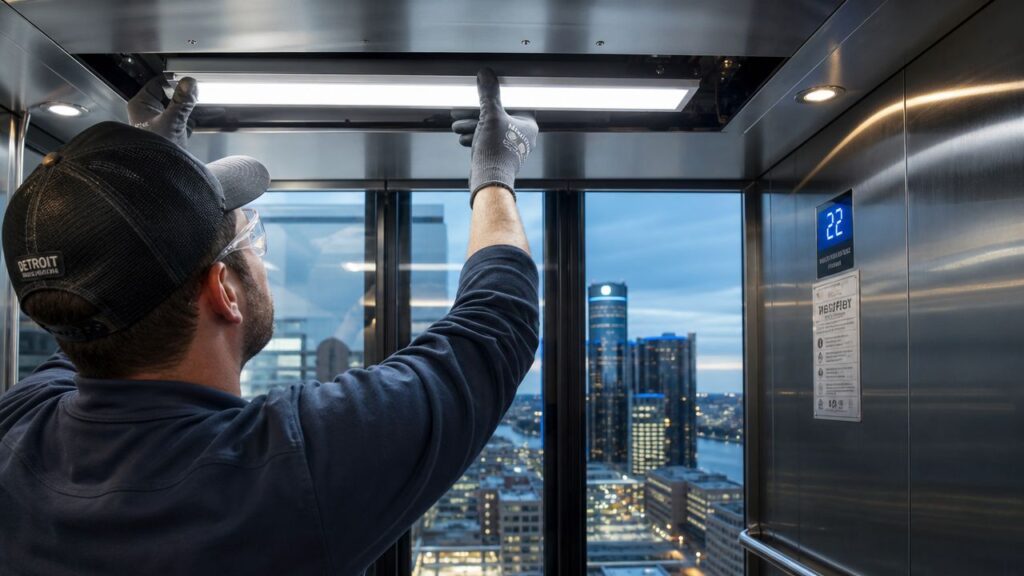
If you're still running an elevator with dim cab lights, yellowing halogen lamps, or an aging fluorescent strip that buzzes every time the car starts, you're paying for the problem twice. First on the electric bill. Then again when someone has to keep replacing lamps, chasing ballast issues, or answering complaints from tenants and visitors who notice the cab looks tired.
In Michigan, I see this most often in buildings that have put off modernization because the elevator still runs. That thinking usually holds until a light fails at the wrong time, the car looks unsafe even when the equipment is operating, or a maintenance visit turns up poor lighting in the pit or machine space. Elevator LED lighting upgrades are one of the simplest ways to improve daily appearance, reduce recurring service work, and tighten up compliance at the same time.
For owners in smaller communities such as Adrian, Grass Lake, and Manchester, the stakes are even higher. Rural and small-town properties often don't have the luxury of fast parts access, multiple service vendors, or easy repeat trips for minor lighting issues. A lighting upgrade that cuts repeat replacements and improves serviceability isn't a cosmetic project. It's a practical operations decision.
Why Smart Building Owners Are Upgrading Elevator Lighting
A building owner usually notices elevator lighting only after it becomes a problem. The cab looks uneven. One lamp is out. Another is flickering. The light color doesn't match. Tenants start reading that as poor maintenance, even if the elevator itself is still running normally.
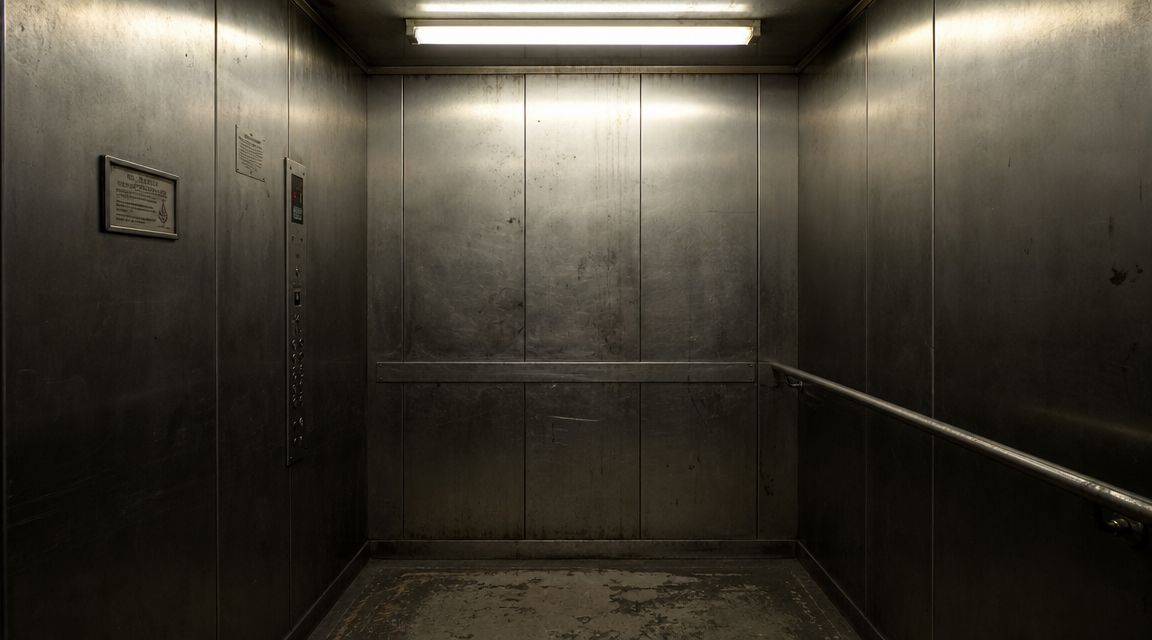
Old cab lighting creates three separate problems
Legacy cab lighting systems usually hurt you in more than one way.
- They waste power because older lamp types draw more electricity than modern LED systems.
- They add service calls because lamps, ballasts, sockets, and related components fail more often.
- They drag down the rider experience because dim or inconsistent light makes the cab feel older, dirtier, and less secure than it really is.
That combination matters more than many owners realize. ENERGY STAR's commercial building lighting guidance states that lighting accounts for 17% of all electricity consumed in U.S. commercial buildings, and that LED lighting can use 90% less energy than traditional bulbs while lasting 15 times longer. For elevator owners, that puts cab lighting in a broader operating-cost category, not in the "nice to have" category.
The business case is stronger in elevator work
Elevator lights often run for long hours. In some buildings, they effectively stay on all day and much of the night, whether anyone is riding or not. That makes lighting one of the faster-payback upgrades in an elevator modernization plan.
Practical rule: If a cab light burns for long hours and fails regularly, it isn't just a lamp problem. It's an operating-cost problem.
Michigan owners also have to think beyond the cab ceiling. A clean-looking elevator with weak lighting strategy can still leave you exposed if the machine room, pit, or emergency lighting setup doesn't support safe maintenance and code expectations. Good elevator LED lighting upgrades address the whole lighting environment, not just what the rider sees.
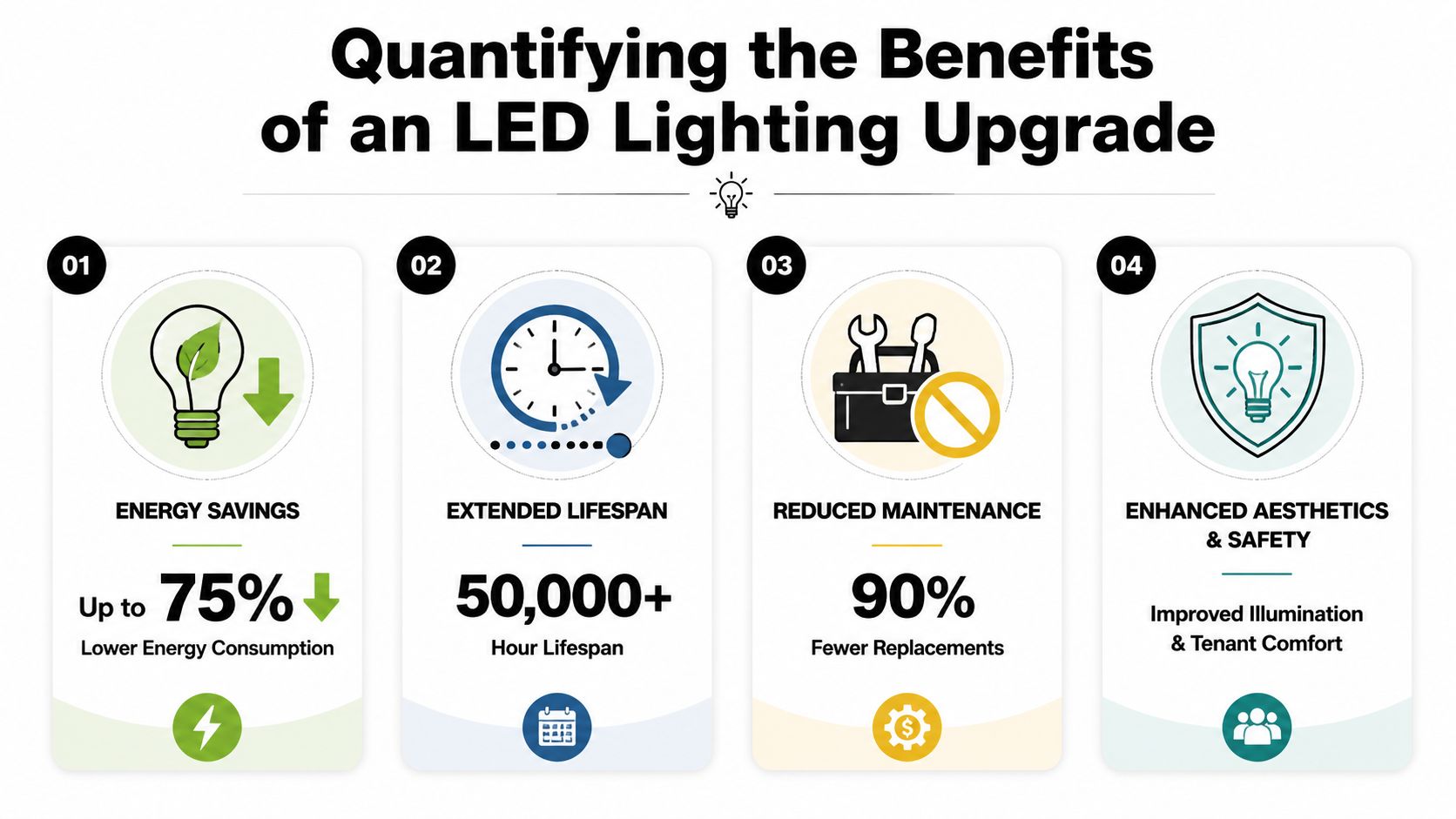
Quantifying the Benefits of an LED Lighting Upgrade
The value of an LED upgrade isn't theoretical. In elevator applications, the gains show up in lower load, longer lamp life, better light output, and fewer maintenance interruptions.
Energy and light quality improve together
One documented elevator LED downlight rollout reported 75% energy savings versus conventional halogen lighting in an elevator application, and another elevator conversion example described nearly 90% power reduction with 25,000-hour lamp life. In that same example, the cab lighting load dropped by 427 watts, while measured light at waist level increased to 40 foot-candles from 20 foot-candles before the upgrade, according to this elevator LED conversion report.
That matters because owners often assume efficiency means a dimmer cab. In a properly specified upgrade, the opposite can happen. You can cut power draw and still deliver a brighter, cleaner-looking interior.
Maintenance becomes more predictable
Longer lamp life changes the service picture. If the lighting system stops eating lamps, your team stops treating the elevator as a recurring nuisance item. The gain isn't only the lamp itself. It's the labor, access, scheduling, and tenant disruption tied to every replacement.
Here's where owners should think carefully. A cheap LED product can still create headaches if the driver fails early, the fixture is proprietary, or replacements are hard to source. So the maintenance benefit is real, but only when the product is selected for actual elevator conditions.
The visible result helps the property
Better lighting changes how riders judge the building. Clean white light makes finishes look newer, corners look cleaner, and control panels easier to read. It also reduces the perception that the elevator is neglected.
Better cab lighting doesn't fix a worn elevator by itself. It does remove one of the most obvious signs of neglect.
Compliance belongs in the benefits column
Owners often treat compliance as a separate issue from lighting quality. In practice, they overlap. A modern lighting upgrade can support safer operation, better emergency readiness, and a clearer path through inspection when the full lighting environment has been planned correctly.
Here is the shortest way to look at the value:
| Benefit area | What the owner actually gains |
|---|---|
| Energy use | Lower continuous lighting load |
| Maintenance | Fewer lamp-related interruptions |
| Rider experience | Brighter, more consistent cabs |
| Compliance support | Better foundation for safe, code-aware lighting design |
The strongest projects don't stop at "install LED." They specify light levels, serviceability, controls, and fixture layout so the upgrade still works years after turnover.
Understanding Costs and Calculating Your Return on Investment
Owners usually ask the right question first. What's this going to cost? The better question is what the current lighting is costing you every month in energy, repeat service, and avoidable nuisance work.
A complete financial review has to include lifecycle cost, not just the purchase price of lamps or fixtures. General elevator lighting guidance focused on lifecycle considerations points out that a serious upgrade analysis should account for LED driver failure modes, fixture serviceability, and long-term reliability in a vibration-prone elevator environment. That's exactly right. A low upfront number can become expensive if the product is hard to troubleshoot or impossible to service cleanly later.
What changes the job cost
The cost usually moves based on scope, not just fixture count.
Some jobs are simple retrofits where the existing cab fixture arrangement can stay in place. Others need full replacement because the old trim, housings, sockets, or wiring method no longer make sense. Controls can add value, but they also add parts and commissioning work. Emergency lighting requirements and standby-power integration can affect design choices too.
Compare the technologies before you price the project
| Metric | Incandescent/Halogen | Fluorescent (CFL) | LED |
|---|---|---|---|
| Energy use | Higher | Moderate | Lower |
| Heat output | Higher | Lower than halogen | Lower |
| Service life | Shorter | Moderate | Longer |
| Maintenance burden | Frequent lamp changes | Lamp and ballast issues | Lower when properly specified |
| Elevator suitability | Often outdated | Common in older cabs | Best fit for most modernization work |
A practical ROI method
Use a simple worksheet and keep it grounded in your building.
- List current pain points such as recurring lamp replacements, poor cab appearance, or unreliable fixtures.
- Identify the full scope including cab lights, controls, emergency lighting, and any adjacent elevator spaces that need attention.
- Estimate operating savings qualitatively if you don't have exact utility tracking for the car.
- Add avoided maintenance by looking at how often your team or contractor touches lighting now.
- Stress-test the equipment choice by asking whether future providers can service it without proprietary headaches.
If you're budgeting a broader modernization, this guide to elevator modernization cost planning is a useful place to frame the numbers around the whole system instead of treating lighting in isolation.
The cheapest fixture isn't the lowest-cost option if the driver fails, the trim doesn't hold up, or the next contractor can't get compatible parts.
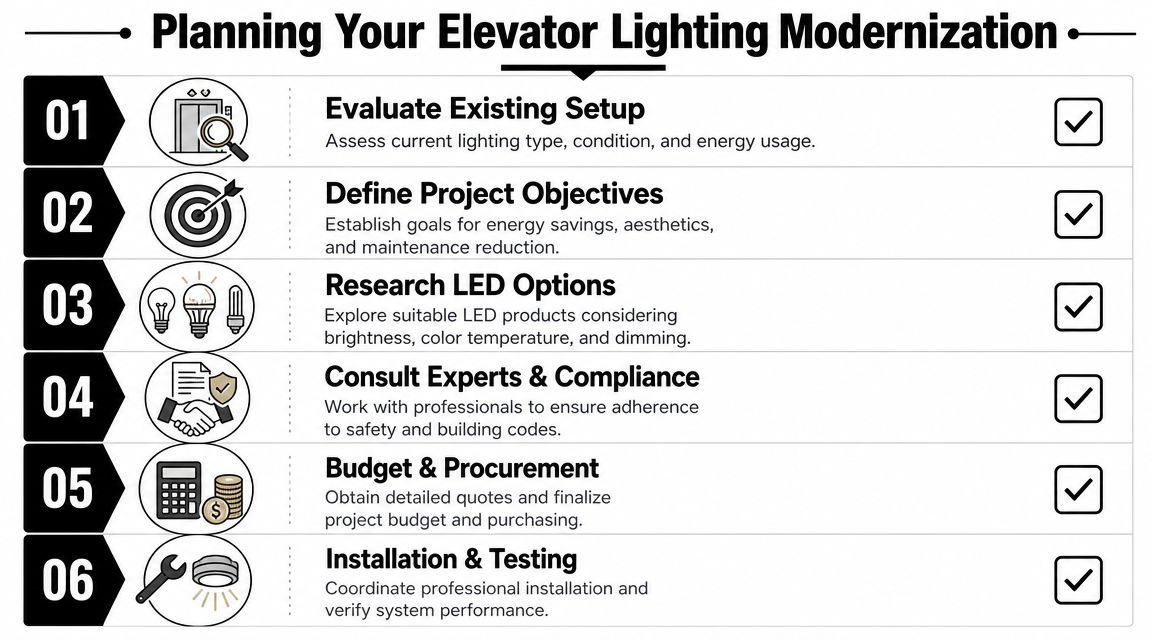
Planning Your Elevator Lighting Modernization
Lighting modernization goes wrong when the owner treats it like a bulb swap. In elevators, fixture layout, controls, emergency operation, pit lighting, and machine-room illumination all affect whether the job performs well after installation.
Start with the spaces people forget
Most owners think first about the cab, because that's what tenants see. The hidden spaces often matter more during maintenance and inspection. Poor pit or machine-room lighting creates shadows around equipment, trip hazards, and difficulty reading components or labels.
The University of Michigan elevator design guidance is useful here because it deals with light quality, not just raw brightness. It specifies 19 fc minimum in machine rooms and spaces containing elevator machinery, 10 fc minimum at elevator door sills, 10 fc minimum in pits, a CRI of 80 minimum, and L70 lumen maintenance of 50,000 hours minimum for LED sources. Those requirements push the conversation beyond "how many lumens are on the box."
Don't judge fixtures by wattage alone
I've seen LED installations that looked good in a sales sheet and failed in the field because the light pattern was wrong. Narrow beam products can create hot spots and dark corners, especially in pits and machinery spaces where uniformity matters more than one bright reading directly under the fixture.
A stronger plan checks these points before parts are ordered:
- Beam spread and spacing so light reaches controls, corners, and service points.
- Fixture serviceability so future maintenance doesn't require specialty parts.
- Driver access because drivers fail differently than lamps and need a replacement path.
- Emergency compatibility so the lighting strategy still works during power disruption.
- Surface reflectance and cab finishes because stainless, laminate, and darker interiors all read light differently.
Controls are part of the savings
Lighting wattage isn't the whole story. Controls decide whether the fixture stops drawing power when the elevator sits idle.
California's Energy Code is a useful benchmark because it states elevator cab lighting power density must not exceed 0.6 W/ft², and cab lights and ventilation fans must switch off automatically after 15 minutes when the car is stopped, unoccupied, and the doors are closed, according to the elevator section of Energy Code Ace. Even if your Michigan property isn't governed by that code, the principle is sound. Efficient fixtures save more when the controls strategy is efficient too.
Retrofit or full replacement
There isn't one answer for every property.
A retrofit can work when the existing fixture layout is solid, the housings are in good condition, and the new components can be serviced later without guesswork. Full replacement makes more sense when the cab lighting is visibly dated, the old setup runs hot, or the installation has become a patchwork of mismatched parts over the years.
If your building is already evaluating broader upgrades, it helps to review modernizing elevator systems as a coordinated project. Lighting, fixtures, controls, COP and PI bulbs, and cab appearance usually age together, even if they fail one at a time.
A good lighting plan should still make sense five years later, when a different technician opens the ceiling and needs to service it quickly.
Expert Elevator Service for All of Lower Michigan
Owners in Detroit, Ann Arbor, or Lansing usually have more contractor options. Owners in Adrian, Grass Lake, Manchester, and other rural or smaller Lower Michigan communities often don't. That's where lighting decisions can have outsized consequences.
When a property is far from major supplier routes or dense service areas, the wrong lighting product creates repeat trips. A failed driver, a proprietary trim kit, or a poorly planned pit fixture can turn a routine issue into a scheduling problem. That's why small-town owners tend to benefit most from lighting systems that are durable, straightforward, and serviceable by qualified elevator professionals without brand lock-in.
Rural properties need practical solutions
In rural Michigan, the best upgrade isn't always the flashiest one. It's the one that holds up, passes inspection, and doesn't create unnecessary callbacks.
That means asking tougher questions up front:
- Will the pit and machine-room lighting support safe maintenance
- Can another qualified provider service this fixture later if needed
- Will the product still be available when a replacement component is needed
- Does the layout reduce dark spots instead of just boosting peak brightness in one area
An industry discussion on hidden elevator-space lighting issues makes this point well. Many LED upgrade conversations focus on cab appearance, but a significant compliance risk often sits in pits and machine rooms where illumination and uniformity affect safety and inspection outcomes. The same issue is highlighted in this article on LED lighting challenges in elevator spaces.
Why local coverage matters
A building in Manchester has the same need for safe, code-aware elevator lighting as a building in a larger city. The difference is response expectations and provider availability. In outlying areas, owners need a contractor with actual Lower Michigan coverage, not just a website that lists a county.
If you're evaluating who can support your property over the long term, look for a reliable elevator company serving Lower Michigan communities with experience in modernization, maintenance, and the less glamorous details like pit lighting, machine-space clean-downs, and non-proprietary serviceability.
Your Next Steps for a Brighter More Efficient Elevator
If your elevator cab still relies on outdated lighting, the next move doesn't have to be complicated. Start by treating the issue as an operations and compliance review, not as a décor update.
Walk the property with fresh eyes. Step into the cab, check light consistency, and ask whether the elevator looks maintained or merely functional. Then look past the cab. Inspect the machine room and pit lighting conditions with the same seriousness, because that's where rushed upgrades often fall short.
A simple owner checklist
Use this list before you request proposals.
- Check the current lighting type and note whether you're dealing with halogen, incandescent, fluorescent, or a partial LED retrofit.
- Record recurring problems such as flicker, dark corners, repeated lamp failures, or heat buildup in the cab ceiling.
- Look for hidden scope including machine-room fixtures, pit lights, emergency backup lighting, and controls.
- Ask about serviceability so you know how future lamp, driver, or fixture replacement will work.
- Request a compliance-minded layout rather than a product-only quote.
- Favor non-proprietary thinking whenever possible so your building isn't locked into one future service path.
What a solid proposal should answer
A good contractor should be able to explain what will be replaced, what stays, how the controls work, how emergency lighting is handled, and whether adjacent elevator spaces need upgrades too. If the proposal only talks about brighter cabs and lower wattage, it isn't complete enough.
The right LED modernization leaves you with a cab that looks better, a system that requires less routine attention, and lighting that supports safe maintenance instead of creating new trouble later. That's the standard worth paying for.
If you're ready to evaluate elevator LED lighting upgrades anywhere in Lower Michigan, Crane Elevator Company is a practical place to start. Crane is family-owned, serves both major markets and smaller communities like Adrian, Grass Lake, and Manchester, and focuses on non-proprietary service, modernization, code compliance, and long-term reliability. If you want a second opinion on an aging elevator lighting setup, a broader modernization plan, or a property that's been overlooked by larger providers, contact Crane for a straightforward review.