When an elevator goes down, the problem usually lands on one person first. It's the property manager fielding tenant complaints, the facilities lead answering calls from staff, or the owner trying to decide whether this is a simple repair or the start of a bigger capital problem. That's why most searches for elevator repair services near me aren't casual. They happen when service reliability, occupant safety, and building operations are already under pressure.
A broken elevator is rarely just a broken component. It can affect accessibility, deliveries, patient movement, resident satisfaction, leasing, and inspection readiness. In mixed-use, healthcare, municipal, industrial, and residential settings, elevator service decisions have a direct effect on risk and total cost of ownership.
Local availability matters for practical reasons. In major U.S. markets, local search results tend to show a competitive field of elevator contractors rather than a single provider, which makes fast dispatch, local parts access, and emergency response important selection criteria, as reflected in Indianapolis elevator service listings. The same operational reality applies in Southern Michigan. The right service partner isn't just the one who answers the phone. It's the one who can keep equipment compliant, reduce repeat failures, and help you avoid getting trapped in a cycle of temporary fixes.
Your Trusted Partner for Elevator Services in Southern Michigan
Most building managers don't start by asking for modernization. They start with a complaint.
A car is misleveling. Doors hesitate. The unit is running, but not consistently. Or the elevator is down and everyone wants an answer now. In that moment, the choice of contractor affects far more than a single service ticket. It affects how quickly the unit returns to service, whether the root cause is identified, and whether the next invoice solves the problem or postpones it.
Southern Michigan properties need a service company that can handle the full lifecycle of vertical transportation equipment. That includes repair work, scheduled maintenance, testing, violation correction, upgrades, and modernization. A contractor focused only on break-fix calls may restore service for the day, but that approach often leaves the building owner carrying the long-term cost of repeated callbacks and avoidable downtime.
What building managers should look for
A reliable local elevator partner should be able to support several needs at once:
- Urgent response capability for shutdowns and life-safety issues
- Planned maintenance discipline that keeps equipment from sliding into reactive service
- Testing and inspection support so the building stays ready for code requirements
- Upgrade guidance when older equipment is still running but no longer serving the property well
- All-makes service experience for mixed portfolios and aging equipment
Practical rule: If a contractor only talks about emergency response, ask how they handle recurring faults, inspection readiness, and parts obsolescence. That answer tells you whether they're managing the asset or just chasing calls.
For owners and managers across Lower Michigan, that broader service model matters. Elevator systems don't fail in tidy categories. A door issue may be mechanical, electrical, adjustment-related, or a sign that the operator, controller logic, or worn landing equipment needs a broader corrective plan. Good service starts with that mindset.
24/7 Emergency Elevator Repair When You Need It Most
An emergency call should mean one thing. The condition creates an immediate safety, access, or operations problem that can't wait for normal scheduling.
Industry best practices reserve emergency response for entrapments, fire service issues, and other life-safety conditions, which is why a clear call protocol matters for property teams handling urgent elevator problems, as discussed by AES Elevator Repair on emergency service communication. If someone is trapped, if the car is behaving unpredictably, or if a fire service function isn't operating correctly, that's not a “watch and wait” situation.
For non-urgent issues, you still need service. You just need the right kind of service. A noisy door operator, occasional nuisance fault, rough stop, or minor indicator issue usually belongs in a scheduled call so the technician has time to diagnose rather than just restore operation and move on.
Call immediately for these conditions
- Entrapment when passengers are inside the car and can't exit normally
- Fire service concerns when recall or emergency features appear compromised
- Unsafe operation such as erratic movement, major leveling problems, or doors that don't behave properly
- Complete shutdown in a critical-use building where accessibility or operations are materially affected
For around-the-clock emergency coverage, use 24-hour elevator repair support when the issue is urgent and the building needs immediate dispatch.
Have this information ready before you call
When the phone rings on the contractor's side, the fastest path to resolution starts with good information. Be ready with:
- Building address and best entry point
- What the elevator is doing or not doing
- Whether anyone is trapped
- Whether the unit serves a critical function such as accessibility, patient transport, or freight movement
- Any recent history including repeated faults, previous repairs, or inspection issues
What a strong emergency response looks like
A solid emergency service process is straightforward. Dispatch confirms the nature of the issue, prioritizes life-safety conditions, and sends a technician prepared to secure the equipment, diagnose the fault, and determine whether the repair can be completed immediately or needs follow-up parts and planned return work.
Don't use the emergency line as a shortcut for routine service. Save it for true urgent conditions, and you'll get faster, clearer help when it matters most.
Proactive Preventative Maintenance to Reduce Breakdowns
Most expensive elevator problems don't start as expensive elevator problems. They start as dirt buildup, poor adjustment, worn door components, weak contacts, neglected lubrication points, or small recurring faults that no one addresses until the unit finally goes down.
That's why preventive maintenance matters more than most owners realize. It isn't paperwork. It's the operating discipline that keeps a serviceable elevator from becoming a chronic repair account.
According to international best practice guidance, periodic lift maintenance should include lubrication, inspection, cleaning, and adjustment at intervals not exceeding 1 month, with thorough examinations at intervals not exceeding 12 months according to the Hong Kong EMSD lift and escalator best-practices booklet.pdf). That schedule matters because elevators are mechanical and electrical systems that drift out of adjustment over time even when they haven't suffered a major failure.
What preventive maintenance should include
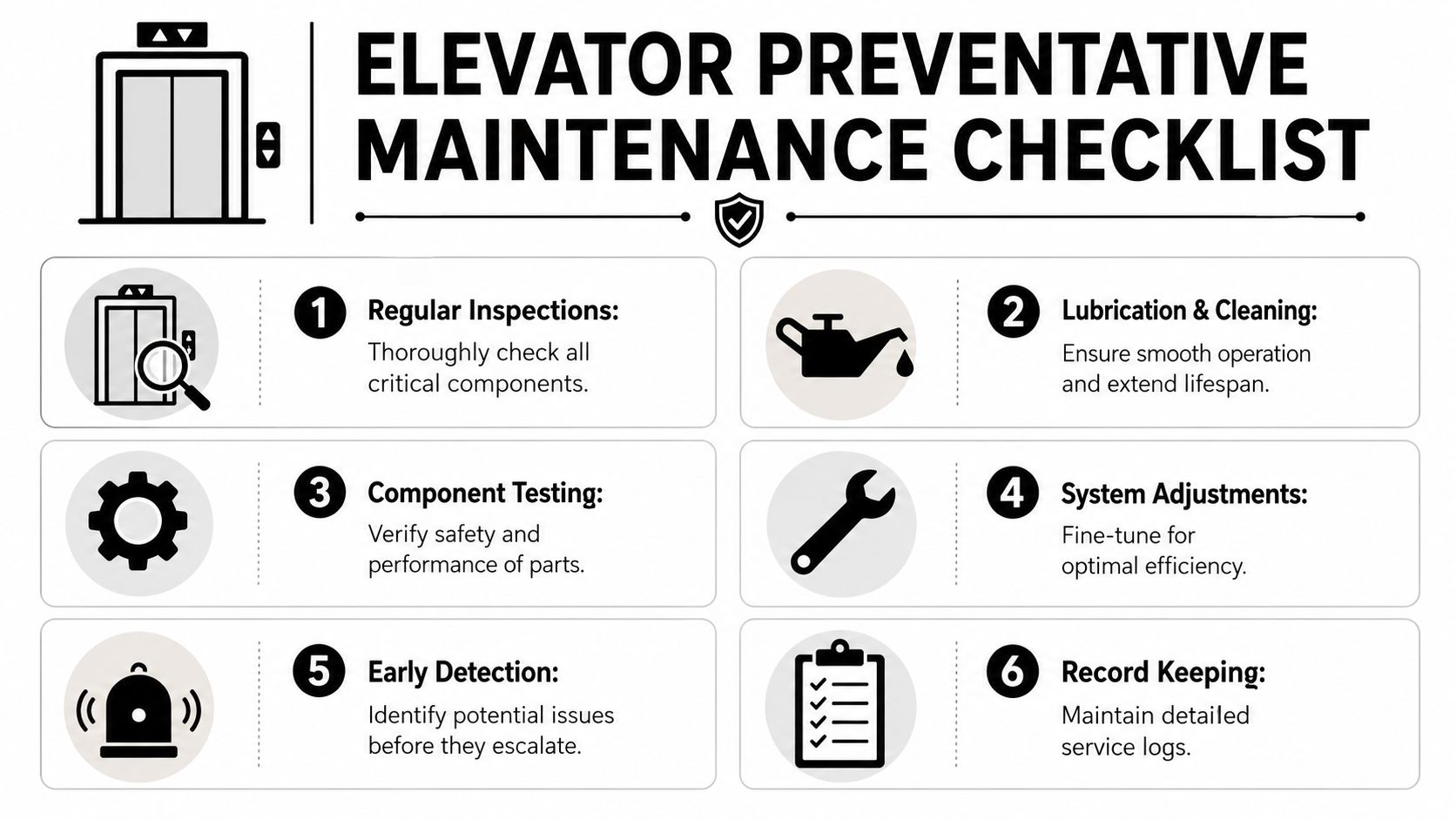
A real maintenance program should address the spaces and conditions that often get ignored until they cause trouble:
- Machine room housekeeping because dust, heat, and clutter contribute to reliability problems
- Pit and car-top cleaning because debris and contamination affect switches, rollers, guides, and overall safe access
- Lubrication and adjustment to reduce wear and keep moving parts operating smoothly
- Service records and trend tracking so repeat issues are identified early instead of normalized
For planned upkeep, elevator preventative maintenance programs are designed to reduce emergency calls and give building managers documented service continuity.
Why maintenance costs less than neglect
Reactive service looks cheaper only when you compare one invoice at a time. It usually looks much worse when you compare the full operating pattern of the equipment.
A neglected elevator tends to produce:
- More callbacks because the underlying cause wasn't addressed
- Longer downtime when dirty or worn components damage related parts
- Inspection stress because maintenance records and equipment condition no longer match
- Higher tenant frustration when the same elevator keeps acting up
A structured maintenance approach also helps owners separate a true repair need from a maintenance issue. If a door system repeatedly fails because tracks are dirty, rollers are worn, and reopening devices aren't being checked, replacing one part won't solve the pattern.
What works and what doesn't
What works is routine attention, clean equipment spaces, scheduled checks, and documented follow-through.
What doesn't work is treating the elevator like a light fixture. If it runs today, many buildings ignore it. Then a door fault, controller issue, or shutdown turns into an urgent problem with tenants waiting in the lobby and no service history to guide the repair.
Deciding Between Elevator Repair and Modernization
One of the hardest calls for a building owner is deciding when to stop repairing an older unit and start planning a modernization. The wrong choice can cost money in two different ways. Either you replace too early and spend capital before you need to, or you keep patching a system that's gradually becoming unreliable, hard to support, and expensive to keep alive.
The first sign that a modernization review is warranted usually isn't catastrophic failure. It's repetition. The same door issue comes back. The same hydraulic complaint returns. The same controller-related nuisance fault keeps interrupting service. When the pattern becomes familiar, the issue is no longer just repair cost. It's business disruption.
A common industry gap is helping owners understand when a recurring fault should trigger a modernization evaluation instead of another repair. As noted by Tri State Elevator's discussion of repair versus modernization, a low-cost repair can be the wrong long-term choice when downtime, parts obsolescence, or repeated callbacks drive total cost higher.
Signs repair may no longer be the right answer
Consider a modernization evaluation when you're seeing conditions like these:
- Repeat service calls for the same symptom
- Aging controls or components with poor parts availability
- Persistent ride quality complaints
- Door and leveling problems that continue after individual parts are replaced
- A building use change that places higher expectations on reliability or accessibility
Repair versus modernization in practical terms
| Situation | Repair may make sense | Modernization may make sense |
|---|---|---|
| Isolated component failure | Yes, if the rest of the system is stable | Less likely |
| Repeated callbacks for the same issue | Short-term only | Often yes |
| Obsolete or hard-to-source parts | Temporary measure | Often the stronger option |
| Poor tenant experience from chronic downtime | Limited benefit | Strong candidate |
| Major building repositioning or upgrade | Possible stopgap | Often aligned with long-term value |
Think in ownership cost, not ticket cost
A single repair invoice can look reasonable. That doesn't mean it's economical.
If an older system keeps generating downtime, service calls, tenant complaints, and difficult parts searches, the owner is paying in operational friction whether that cost appears on the elevator invoice or not. In healthcare, education, and multifamily properties, reliability has real consequences even when no one is trapped and no code issue is active.
The cheapest repair is sometimes the most expensive decision if it keeps a failing system in circulation without solving availability, supportability, or compliance risk.
Modernization isn't always the answer. But when repairs stop delivering stable performance, it becomes the responsible question.
Our Comprehensive Elevator Repair and Upgrade Services
A competent elevator contractor should be able to handle more than shutdown calls. Buildings need a provider who can diagnose recurring problems, replace worn components, support code-driven upgrades, and keep mixed equipment types serviceable across different ages and manufacturers.
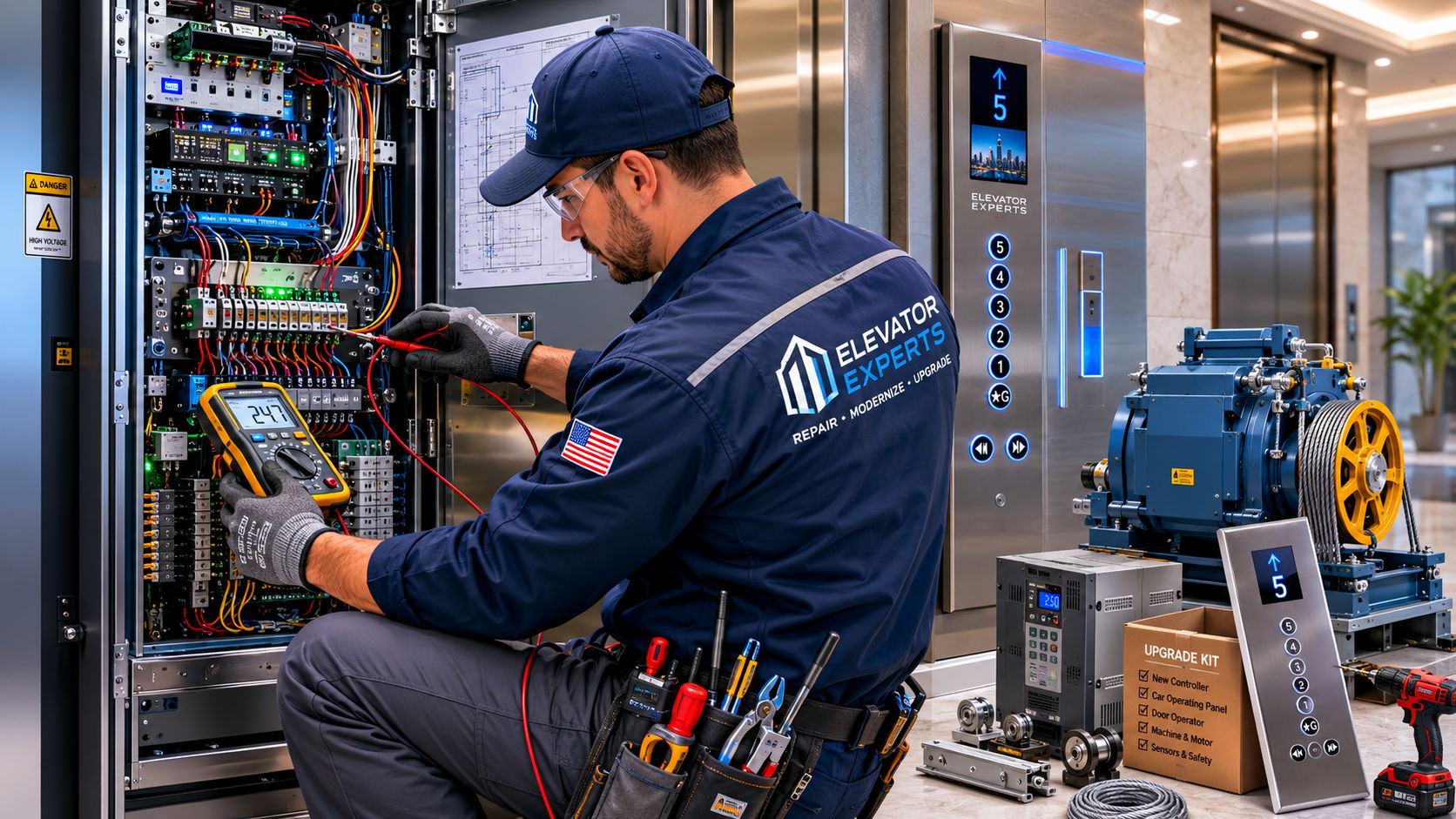
In a single metro market, elevator service providers commonly advertise support for hydraulic elevators, dumbwaiters, handicap lifts, inclined platform lifts, repairs, and annual state tests, which shows how broad modern service work has become, as seen in TK Elevator's Indianapolis service area page. That broad scope is what building owners should expect from a serious service partner.
Door systems and ride performance
Many recurring service problems show up first at the doors or in leveling accuracy. A high-quality repair program focuses on these failure points, including monthly checks of door operation, reopening devices, safety edges, door hardware, and leveling accuracy, along with annual safety testing, according to this elevator maintenance checklist from ServiceChannel.
Typical corrective work in this category includes:
- Door operator repairs when doors open slowly, reverse unexpectedly, or fail to close consistently
- Track, roller, and gib service when hardware wear causes rough or unreliable operation
- Door lock monitoring upgrades where code and safety requirements call for system changes
- Leveling adjustments when the car doesn't stop cleanly at the landing
Hydraulic, traction, and machine components
Not every problem starts at the entrance. Many service calls trace back to the power and motion side of the system.
That work can include hydraulic packing replacement, jack work, tank and power unit service, cable replacement, motor replacement, sheave work, and machine repairs. On older equipment, these repairs often determine whether a building can extend useful life responsibly or should move toward modernization planning.
Controls, fixtures, and electrical troubleshooting
Controller and electrical issues often hide behind symptoms that look mechanical. A car may stop intermittently, ignore calls, or fault out under specific conditions. Good troubleshooting means isolating whether the problem lies in a relay, board, contact, traveling cable issue, selector problem, safety circuit interruption, or a broader control-system limitation.
That's also where a non-proprietary approach matters. Crane Elevator Company provides repair, upgrade, and modernization support for all makes and models of vertical transportation, including older freight units, passenger elevators, residential elevators, wheelchair lifts, material lifts, and dumbwaiters.
A useful overview of field work in this category is below.
Cab, fixture, and user-facing upgrades
Not every upgrade is about machine-room equipment. Some projects are driven by usability, appearance, or accessibility expectations.
These can include:
- Car operating panel and position indicator work
- Emergency phone repairs or replacement
- Cab fixture updates
- Fire service function testing and correction
- Generator and emergency power interface work
For building managers, the key point is simple. The right contractor doesn't just swap parts. They identify why the part failed, whether the fault is likely to return, and whether the repair fits the remaining life and role of the equipment.
Navigating Elevator Testing and Code Compliance in Michigan
Many owners think about elevator service only when the equipment malfunctions. Michigan compliance doesn't work that way. Testing, documentation, and correction of deficiencies are part of ownership whether the elevator feels fine or not.
The practical issue is that compliance gaps usually appear at the worst time. A scheduled test is approaching. An inspection turns up violations. A fire service function hasn't been verified. The emergency phone has a problem. At that point, the owner isn't just dealing with a repair. They're dealing with scheduling pressure, possible shutdown risk, and the need to coordinate corrective action quickly.
What should be on your radar
A responsible compliance program usually includes attention to:
- Annual safety testing
- Load and operational verification where required
- Fire service testing
- Emergency communication checks
- Documentation for inspections and corrections
- Follow-up on noted deficiencies before they become larger issues
For Michigan properties that need required testing and inspection support, elevator testing services help owners coordinate scheduled obligations and corrective work.
Why compliance work needs planning
Testing is not separate from maintenance and repair. It exposes the consequences of poor maintenance and deferred upgrades.
If a unit repeatedly falls out of adjustment, if life-safety functions haven't been verified, or if prior deficiencies were addressed incompletely, compliance work becomes disruptive and expensive. A building owner then pays not only for the corrective repair but also for the operational scramble around it.
Inspection readiness comes from routine discipline. It doesn't come from trying to clean up months of neglect right before a test.
The best approach is straightforward. Keep records organized, know what equipment you have, track recurring deficiencies, and work with a contractor who treats testing as part of asset management rather than a separate event.
The Freedom of Non-Proprietary Elevator Solutions
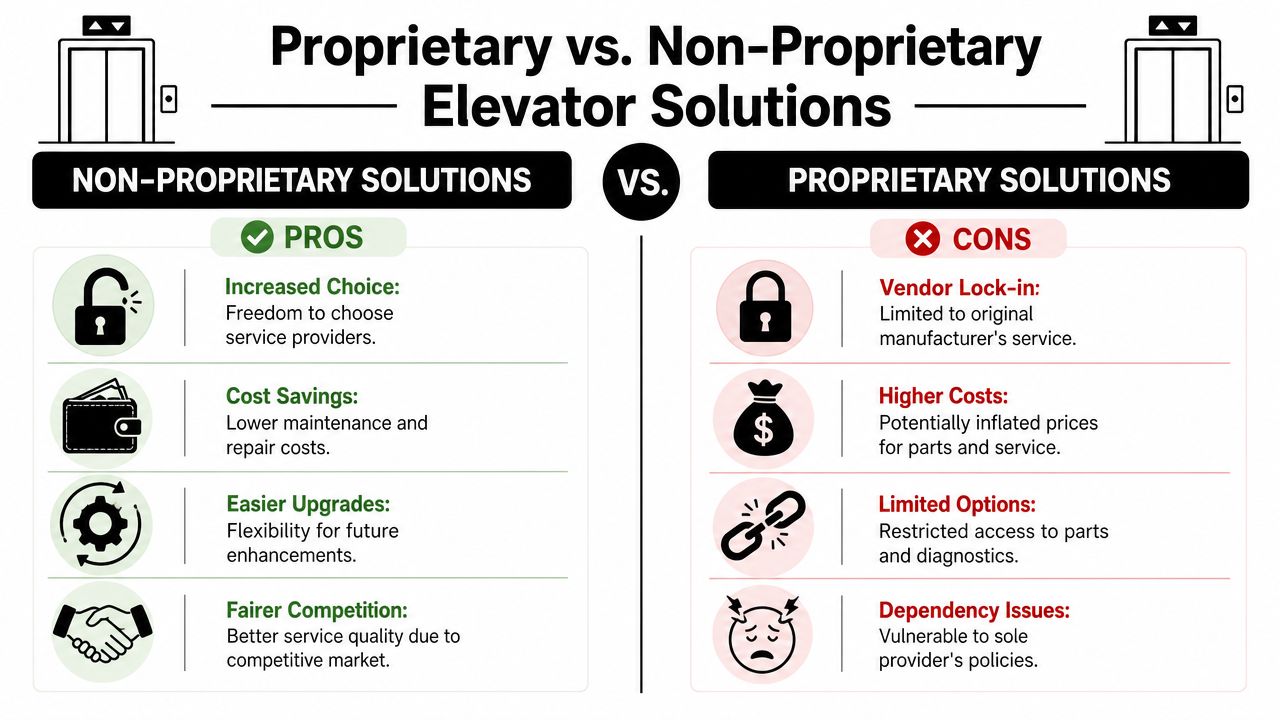
One of the biggest cost drivers in elevator ownership isn't the machine itself. It's who controls access to the parts, software, tools, and diagnostics needed to service it.
That's the difference between proprietary and non-proprietary systems. In a proprietary environment, the owner can end up dependent on a narrow service channel for support. That can affect pricing, turnaround, upgrade paths, and even the ease of getting a second opinion. In a non-proprietary environment, the owner has more freedom to choose qualified service providers and more flexibility in planning future work.
Why owners care about non-proprietary design
This isn't an abstract preference. It affects real decisions:
- Service competition helps owners compare providers instead of being cornered into one path
- Parts access is often more straightforward
- Upgrade flexibility improves when future changes don't depend on a closed ecosystem
- Budget control gets easier when labor and support options stay open
Where proprietary systems create friction
Some buildings discover the downside only after years of operation. The original installation may have looked fine on paper, but later the owner runs into restrictions around tools, software access, or parts sourcing. At that point, changing providers becomes harder than expected, even if service quality or pricing no longer makes sense.
For owners thinking beyond the next repair ticket, that limitation matters. An elevator is a long-life asset. Decisions made during repair, controller replacement, and modernization can shape who the owner is able to work with for years.
A serviceable elevator should not become a captive asset. If the building owns the equipment, the building should retain meaningful choice in who maintains it.
Non-proprietary solutions don't eliminate every service challenge. They do give owners more control, more options, and a better chance of keeping long-term service costs under control.
The Crane Elevator Company Difference
Some elevator contractors are built around dispatch. Others are built around account management. The difference becomes obvious after a few service calls.
A company with a long-term service mindset tends to look closely at housekeeping, recurring causes, testing readiness, documentation, and whether the repair recommendation matches the age and role of the equipment. That approach matters more than slogans because it changes the work performed in the field and the quality of advice the owner receives.
What building owners tend to value most
Across service relationships, a few traits consistently make the difference:
- Accountability when scheduled work is promised
- Clear communication about what failed and what should happen next
- Willingness to give a second opinion when a major recommendation affects capital planning
- Options for financing when modernization or major replacement work needs to be phased responsibly
- Broad equipment familiarity across older and newer systems
Family-owned contractors often bring another advantage. The people making decisions usually stay close to the field reality of the work. That can mean faster judgment, less script-driven communication, and better continuity for customers who manage the same equipment over many years.
Why this matters in practice
If you're comparing providers for elevator repair services near me, don't only compare who answers first. Compare how each company thinks.
Do they talk about repeat failures? Do they raise code concerns early? Do they explain the difference between keeping a unit running and keeping it supportable? Do they offer practical paths for repairs, upgrades, and compliance instead of pushing one answer to every problem?
Those details usually tell you more about future service quality than any marketing line will.
Proudly Serving Communities Across Southern Michigan
For a local search, coverage matters. If your building is in Southern Michigan, you need to know the contractor can support your property without treating your call like an outlier.
Service in this region often includes major cities such as Detroit, Ann Arbor, Lansing, Flint, and Kalamazoo, along with surrounding towns and smaller communities across Lower Michigan. That matters for commercial office buildings, schools, municipal facilities, healthcare sites, industrial properties, multifamily buildings, senior living communities, and residential applications with elevators or wheelchair lifts.
Local support means more than proximity
A workable local service footprint should mean:
- Dispatch familiarity with the region
- Ability to support recurring service, not just occasional emergency calls
- Coverage for mixed property portfolios spread across several communities
- Practical scheduling for testing, repair, and modernization work
For owners and managers, the primary question isn't only whether a company will travel to your site. It's whether your building falls inside a service area that receives consistent support for both urgent and planned work.
If you're evaluating elevator repair services near me in Southern Michigan, confirm your city, your equipment type, and whether the provider supports ongoing maintenance, testing, and upgrade work in that same area. That's how you avoid piecing together separate vendors for problems that should be managed under one service relationship.
What to Expect During Your Service Call with Crane Elevator
A good service call starts before the technician arrives. The office should gather the building address, elevator type, symptoms, whether the car is down, and whether anyone is trapped or access is restricted. That information shapes dispatch priority and helps the technician arrive prepared.
Once on site, the technician should first secure the situation. If the issue affects safe operation, the unit may need to remain out of service until the condition is diagnosed. That's the right call. Returning an elevator to operation before the cause is understood can turn a manageable issue into a repeat outage or a safety problem.
The usual flow of a professional call
- Initial information review from dispatch and building staff
- On-site assessment of the complaint, equipment condition, and immediate risks
- Diagnosis to identify whether the issue is isolated or part of a larger pattern
- Communication with the customer about findings and next steps
- Repair completion or follow-up plan if parts or additional work are needed
The best technicians also leave the customer with context. They explain not just what failed, but whether the problem points to wear, lack of adjustment, deferred maintenance, or a larger modernization question. That's what helps property managers make better decisions after the car is running again.
Frequently Asked Questions About Elevator Services
What information should I have ready when I call?
Have the building address, elevator type if you know it, a short description of the problem, whether the unit is completely down, and whether anyone is trapped. It also helps to mention recent repeat issues, pending inspections, or any access limitations for the technician.
How is the cost of a repair determined?
Repair cost depends on the fault itself, the time needed to diagnose it, parts availability, equipment age, and whether the issue is isolated or tied to a broader system problem. A cheap one-time fix can become expensive if it doesn't address the root cause and results in more callbacks.
Do you service more than standard passenger elevators?
Yes. Elevator service often extends beyond standard passenger units to include freight elevators, residential elevators, wheelchair lifts, material lifts, and dumbwaiters. The right contractor should be able to explain whether your equipment is best served by repair, preventive maintenance, testing, upgrade work, or a longer-term modernization plan.
When should I ask for a second opinion?
Ask for one when the recommendation involves major component replacement, a controller change, repeated unresolved faults, or a modernization proposal. A second opinion is especially useful when the current advice doesn't clearly explain why the problem keeps returning.
What's the biggest mistake owners make?
Waiting too long to move from reactive service to planned service. Once a unit develops a history of repeat failures, the owner is often paying in downtime, complaints, and avoidable disruption even if each individual invoice looks manageable.
If your building needs help with repair, testing, maintenance, or modernization planning, contact Crane Elevator Company to discuss your equipment, service area, and the most practical next step for your property.