
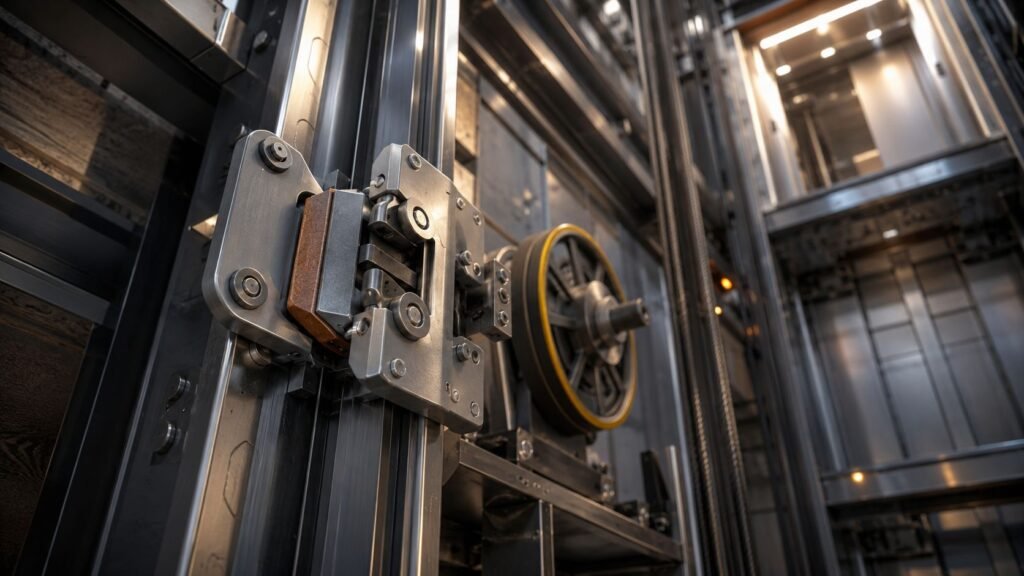
If you own or manage a building, you probably assume the elevator is fine until a tenant reports a rough stop, a leveling issue, or a shutdown. That's normal. Elevators are designed to disappear into the background when they're working properly.
But the quiet parts of an elevator are often the parts carrying the biggest responsibility. The elevator safety brake is one of them. It protects passengers, limits liability, and supports the reputation of the building every time the car starts, stops, and holds at a landing.
The Unseen Guardian in Your Elevator Shaft
It is 8:15 on a Monday. Tenants are heading upstairs, and your property manager tells you one car stopped a little hard at the lobby and then leveled twice before the doors opened. The elevator is still running, so it is easy to treat that as a minor nuisance. In the field, that is exactly the kind of report that should put the brake system on your radar.
The brake is one of the parts that stands between normal service and a car that cannot be trusted to stop and hold where it should. Passengers rarely notice it unless something starts to change. Owners should.
Elevators have a strong safety record in the United States, and that record comes from layered protection, code requirements, and disciplined maintenance. It does not come from assumptions. A brake that looks acceptable during a quick visual check can still have weak torque, contaminated linings, uneven wear, or release problems that only show up under measured testing.
That distinction matters more than many owners realize.
A visual inspection has value. A technician can spot heat damage, oil contamination, loose hardware, worn components, and obvious adjustment issues. But a visual check does not prove the brake is producing the holding force the equipment needs under load. It does not confirm stopping performance. It does not give you numbers you can defend if there is an incident, an audit, or a code question.
Why owners should care
Owners usually judge elevator service by uptime, call volume, and repair cost. Brake performance changes that calculation because the consequences spread beyond one service ticket.
- Passenger confidence: Riders notice hard stops, floor drift, rollback, and delayed door opening.
- Legal exposure: After an incident, investigators look at maintenance records, testing history, and whether the provider verified performance or only looked things over.
- Operational continuity: If brake condition is questionable, the safest decision may be to remove the car from service until the system is tested and adjusted.
I tell building owners to treat the brake like the parking brake and service brakes on a heavy truck. You do not judge them by whether the pedal is still attached. You judge them by whether they stop and hold the vehicle under real conditions. The same standard applies here.
A good maintenance provider should be able to tell you more than "the brake looks fine." They should be able to explain how it was checked, what was measured, whether the results were within spec, and what wear trends they are watching. That is the difference between routine attention and validated safety performance.
The brake protects passengers, but it also protects your operating margin. Catching weak brake performance early is usually cheaper than handling shutdowns, damaged tenant confidence, emergency calls, or a rushed modernization decision later.
How an Elevator Safety Brake Actually Works
The basic idea is older than most building systems in service today. The elevator safety brake was invented in 1852 by Elisha G. Otis, whose device gripped the guide rails when the cable lost tension and made elevators practical as safe vertical transportation, according to the history of elevator safety systems at NCBI.
That matters because the core safety philosophy hasn't changed. Good elevator braking is fail-safe. When something goes wrong, the system should move toward stopping and holding, not toward uncontrolled motion.
Think of it like a seatbelt system
A useful comparison is a car seatbelt. During normal driving, you can pull the belt smoothly and it moves freely. In a sudden event, the mechanism locks. An elevator brake system works in a similar way. It stays out of the way during normal travel, then reacts when operating conditions move outside safe limits.
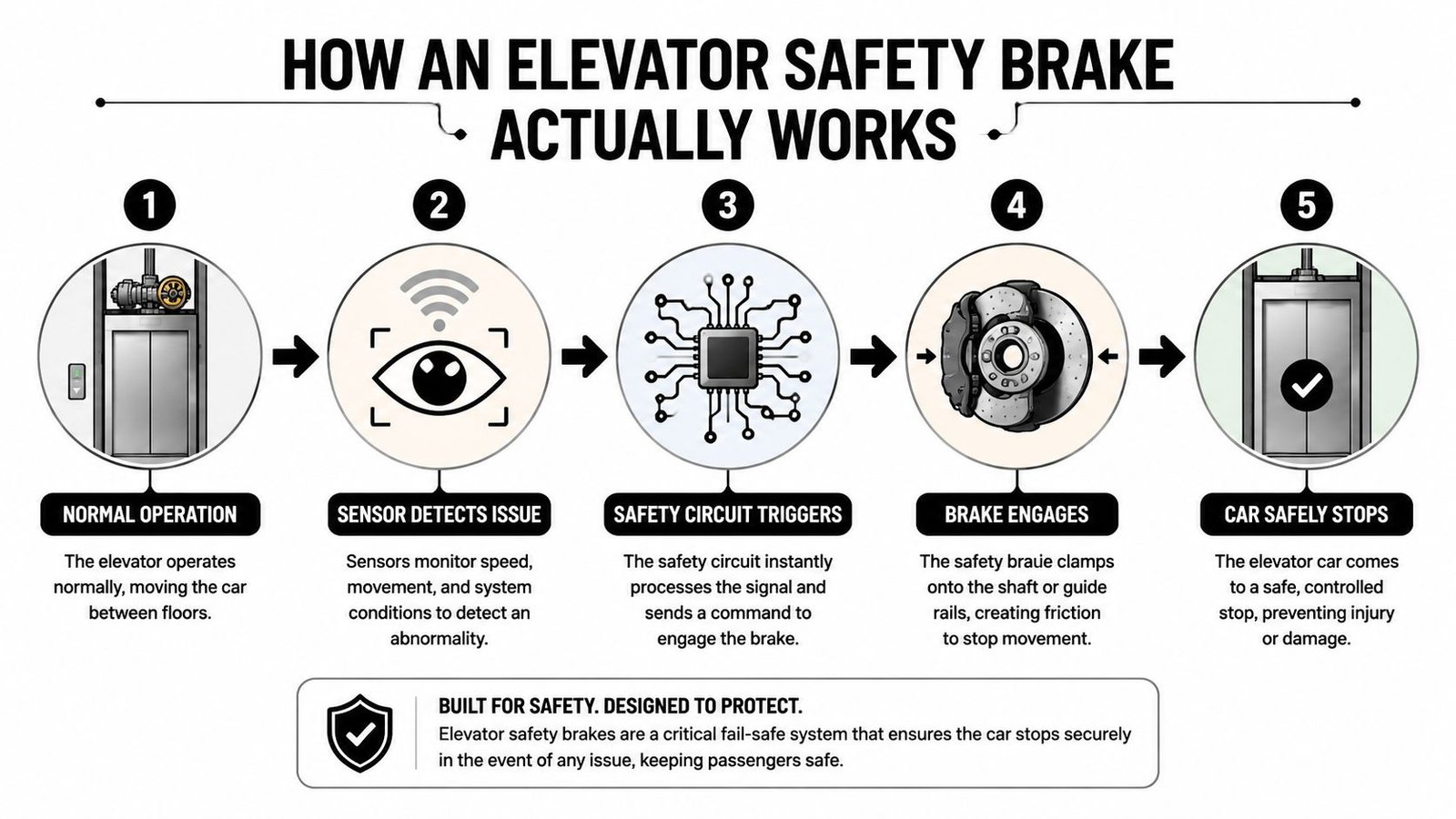
The sequence is straightforward:
- The elevator runs normally. The car travels at its intended speed and the machine brake releases as designed.
- A fault condition appears. That could involve overspeed, loss of proper control, or another abnormal condition.
- A detection device responds. The system identifies that the car is no longer behaving within safe operating parameters.
- The brake action occurs. Depending on the failure mode, the machine brake, safety gear, or both act to stop or hold the car.
- The car remains secured. The goal is not just stopping. The goal is controlled stopping and holding.
A short visual helps make that sequence easier to picture.
What owners should understand about fail-safe design
Most owners don't need to know every relay, spring, and shoe detail. They do need to understand one practical point. In elevator work, fail-safe usually means the brake is applied by mechanical force and released electrically. If power is lost, the default condition is braking.
That design choice is why an elevator doesn't become “out of control” because the lights flicker or power drops. The system is built so loss of power leads toward stopping and holding.
The smartest safety devices are the ones that don't need a perfect electrical system to protect passengers.
The original Otis concept proved that principle. Modern hardware has improved, code requirements are tighter, and testing is more formal. But the reason owners can operate elevators with confidence is still the same. The safety system assumes components can fail and plans for that failure in advance.
The Three Layers of Elevator Braking Protection
When someone says “the brake,” that sounds like one part. In practice, a modern elevator uses a coordinated protection system. Owners make better maintenance decisions when they understand those layers separately, because each one does a different job.
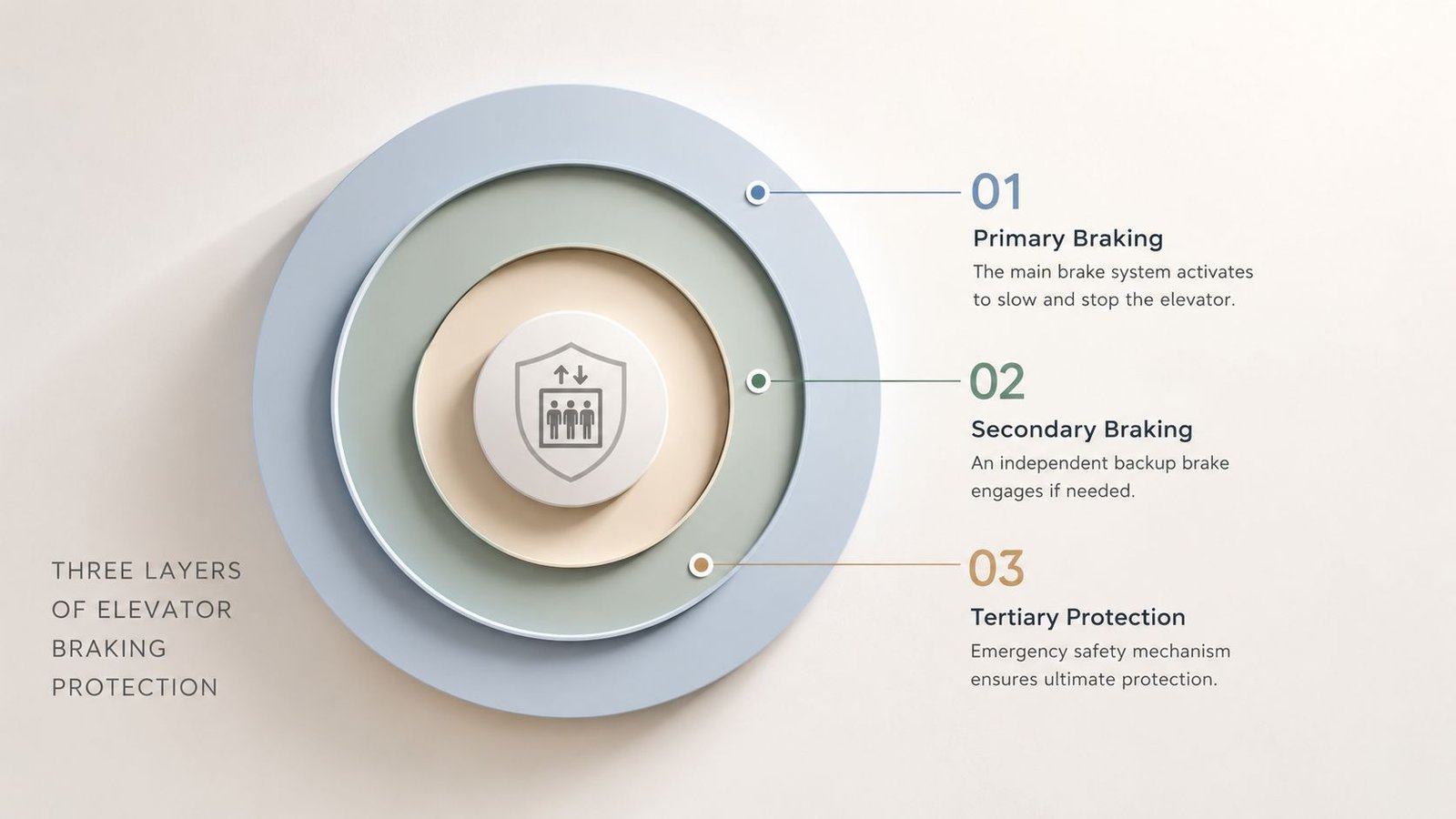
The machine brake
Start with the brake that does the daily work. The machine brake is the holding brake. It keeps the car stationary at rest and helps control stopping under normal operation.
Owners can think of it as the elevator's parking brake. If it's out of adjustment, contaminated, worn, or weak, you may see symptoms long before a major failure. Rough landings, slight drift, or inconsistent floor holding often show up here first.
The overspeed governor
The governor is the watchman. It doesn't do the gripping itself. It monitors speed and decides when the car is outside acceptable limits.
Public misunderstanding often begins concerning elevator safeties. People often assume elevator safeties fire the instant there is any slip or irregularity. That isn't how the system is designed. According to the MSHA explanation of rope brake activation, rope brakes or tripping mechanisms are designed to activate only when normal running speed is exceeded by 15%. That threshold avoids nuisance engagement during minor fluctuations.
The safety gear
The safety gear is the hard stop. If the governor trips under the right fault condition, the safety mechanism acts on the guide rails to stop the car.
This is not a convenience device. It is the emergency layer. It's also one reason careless language about “free fall” creates confusion. The public often imagines an elevator dropping and the brake instantly grabbing. Real systems are more specific than that.
A brake system is only as trustworthy as your understanding of what it does, and what it does not do.
What this means in practical terms
Here's the simplest way to separate the three:
| Component | Primary job | What owners may notice when it degrades |
|---|---|---|
| Machine brake | Holds and helps stop the car in normal service | Drift, rough stops, leveling issues |
| Overspeed governor | Detects excessive speed | Usually not obvious in day-to-day riding |
| Safety gear | Stops the car on the rails during a serious fault | Not a routine passenger-facing symptom |
That distinction matters during maintenance conversations. If a contractor says “the brake checked out,” ask which brake function they mean. Daily holding performance and emergency overspeed protection are related, but they are not the same thing.
A second practical point is just as important. The 15% overspeed trigger exists for a reason. The system must ignore small operational variation and respond only when conditions cross a defined safety threshold. That's good engineering. It prevents unnecessary activation and focuses emergency braking on actual danger conditions.
Meeting Michigan Code and Testing Requirements
Owners in Michigan don't need to memorize every code paragraph, but they do need to understand what the testing is trying to prove. The purpose isn't paperwork. It's verification.
One of the clearest requirements involves holding power. ASME code mandates that elevator motor brakes must hold the car stationary with 125% of its rated load, which is why the brake must remain fail-safe even during power loss or overload conditions, as described in this summary of elevator machine brake requirements.
What 125 percent really means
For a building owner, that requirement answers a simple question. If the car is loaded heavily, can the brake still hold it securely when the system needs to stop and stay stopped?
That's not an abstract engineering number. It affects:
- Landing safety: The car needs to remain stable at the floor.
- Power-loss behavior: The brake must apply automatically when power is removed.
- Inspection confidence: Code officials and service providers need evidence that the system performs, not assumptions that it probably will.
A brake that only works under ideal conditions isn't a safety device. Code expects margin. That margin is what protects you when real-world conditions are less forgiving.
Why code testing saves money
Some owners treat required testing as an expense with no operational value. That's shortsighted. Code testing often catches weakness before it turns into entrapment, damage, or an after-hours emergency call.
A proper safety test helps you answer questions that matter:
- Is the brake holding with enough reserve?
- Is the car stopping and staying where it should?
- Are adjustments, wear, or contamination reducing performance?
- Do the inspection records support your liability position if something goes wrong?
For owners who want a clearer picture of what these required procedures involve, this overview of elevator testing services in Michigan is a useful reference point.
Code compliance isn't a technicality. It is documented proof that a critical life-safety system still performs under stress.
What doesn't work
What doesn't work is treating annual or periodic testing as a box to check while ignoring ride quality complaints in between. A car that stops unevenly in March won't become a code-compliant non-issue just because the next formal test is months away.
The better approach is to connect day-to-day symptoms with formal testing obligations. When operators, tenants, or staff report odd behavior, those observations should trigger a closer look at braking and holding performance. Owners who do that usually avoid the expensive version of the same problem later.
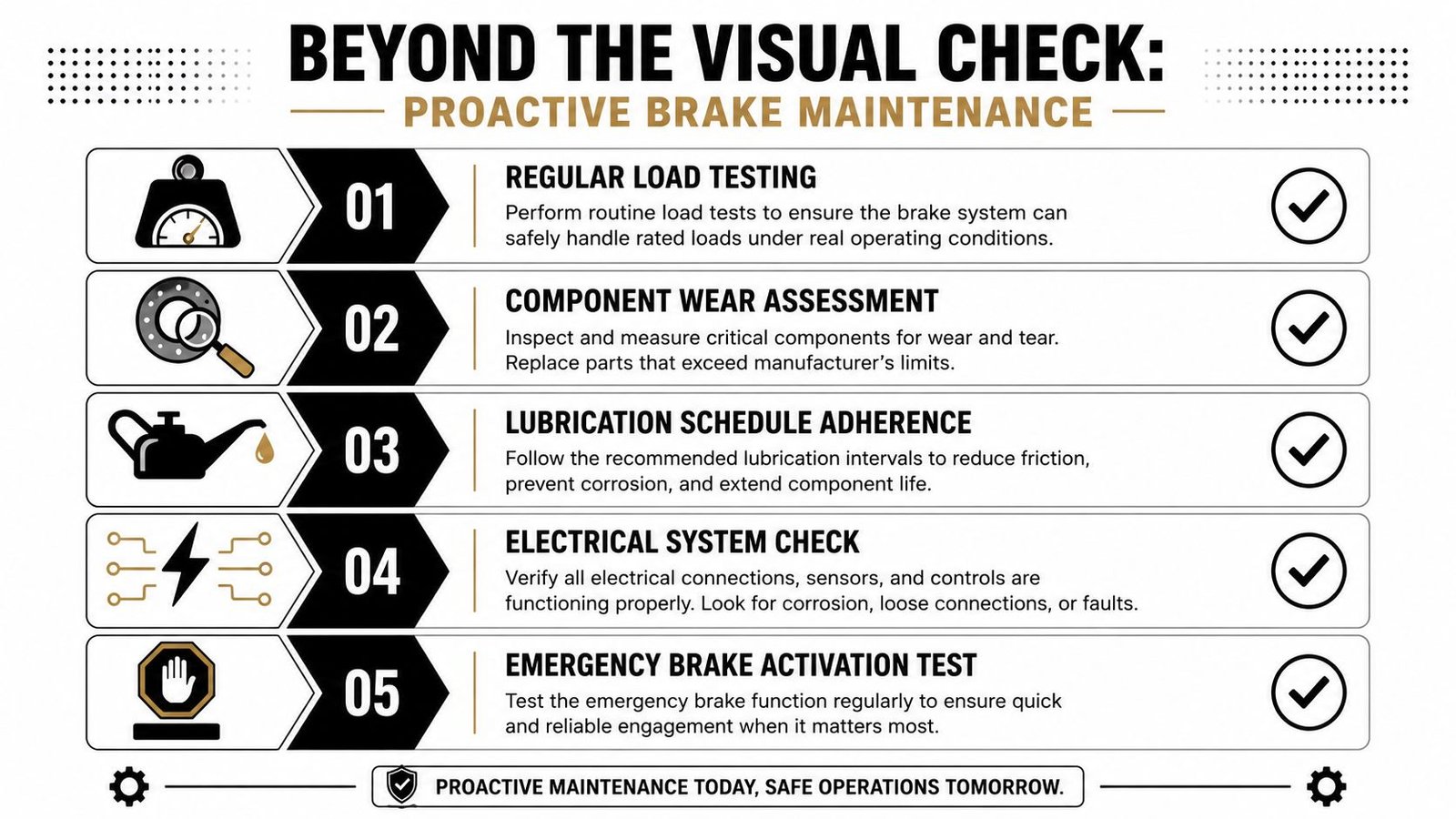
Beyond the Visual Check Proactive Brake Maintenance
A building owner gets a maintenance ticket that says the brake was inspected and adjusted. The elevator goes back into service. On paper, that sounds reassuring. In practice, it leaves out the question that matters most. Did anyone prove the brake can stop and hold the car within acceptable limits, or did they only confirm that the parts did not look obviously damaged?
That gap is where weak maintenance programs hide. A visual check has value. It can catch broken hardware, contamination, missing parts, and signs of overheating. It cannot confirm actual braking performance under load and motion.
Modern brake evaluation puts measurement ahead of opinion. Elevator World's discussion of brake assessment methods explains that modern brake maintenance requires empirical measurement of brake slipping distance. For owners, the practical takeaway is simple. "Looks fine" and "tested fine" are not interchangeable.
Looking at parts versus measuring performance
I explain it this way to owners. A tire can look usable in a parking lot and still fail a hard stop on wet pavement. Elevator brakes work the same way. Condition matters, but verified performance matters more.
A visual inspection can identify:
- Friction material condition: Pads may be worn, glazed, or contaminated.
- Hardware condition: Springs, pins, arms, and linkages may show corrosion, wear, or damage.
- Obvious adjustment problems: The brake may be out of alignment or set incorrectly.
A visual inspection does not tell you, with confidence, whether the brake stops consistently, holds properly, or has enough margin when conditions are less forgiving.
A quantitatively validated test answers those questions with measured results. Depending on the equipment and brake type, that can include slipping distance, stopping behavior, response during release, and holding ability under defined conditions. That is the difference between a technician's impression and a record you can stand behind if there is a complaint, incident, or code review.
Questions owners should ask their provider
Maintenance reports often use safe-sounding language. Inspected. Adjusted. Checked. Those words are not useless, but they are incomplete if no one recorded performance.
Ask your provider:
- What brake performance values were recorded?
- Was slipping distance measured, or was brake action only observed during operation?
- What tools or test method were used to verify brake behavior?
- After adjustment, was the brake retested and documented?
If the answers stay vague, the work may have stayed at the visual-inspection level. Owners who want a clearer standard should review what a stronger preventative elevator maintenance program is supposed to include.
If a contractor cannot tell you what was measured, you do not have much proof that the brake was validated.
What proactive maintenance includes
Good brake maintenance combines housekeeping, adjustment, and verification. Leaving out any one of those steps creates a blind spot.
- Clean contact surfaces: Oil, dust, and debris can change friction and release behavior.
- Check electrical release function: A fail-safe brake still depends on proper control and release during normal service.
- Set tension and alignment carefully: Usable components can still perform poorly if adjustment is off.
- Retest after corrective work: An adjustment is only half the job. The brake has to be checked again under defined conditions.
- Document the results clearly: Records matter for troubleshooting, budgeting, and liability.
Real incidents have shown the same pattern repeatedly. Wear or poor adjustment may be visible, but the larger failure is assuming that observation alone equals safe performance. Backup safeties may stop a worse event, but owners should not accept maintenance practices that rely on the backup system to reveal a brake problem.
The cost trade-off owners need to understand
Visual-only brake checks usually cost less in the short term. Measured validation takes more labor, more skill, and sometimes specialized tools. That is the honest trade-off.
The cheaper approach can also hide the more expensive risk.
| Maintenance approach | Short-term cost | Risk profile |
|---|---|---|
| Visual-only brake check | Lower | Greater chance that weak stopping or holding performance goes unnoticed |
| Measured brake validation | Higher | Better evidence that the brake performs as required |
The right standard depends in part on the building. A lightly used private lift does not carry the same exposure as a school, medical office, apartment building, or municipal property. But any occupied building benefits when the owner can produce a service record showing that brake performance was measured, not just viewed.
Warning Signs and When to Consider Modernization
Most brake problems announce themselves before they become emergencies. Owners and facility staff don't need to diagnose the issue, but they should know what to report quickly and precisely.
What to watch for
Watch for operational symptoms that repeat, not just one odd ride on a busy day.
- Uneven stopping: The car feels harsh at one landing and soft at another.
- Floor drift or re-leveling: The elevator doesn't seem to settle and stay where expected.
- Machine room noise: Buzzing, chattering, scraping, or a sharp change in release sound can signal brake trouble.
- Burning odor or friction smell: That can indicate heat, slip, or contamination.
- Intermittent shutdowns after normal use: The system may be detecting a problem before passengers fully notice it.
Small ride-quality complaints are often early warnings, not minor annoyances.
When repair stops being the smart answer
Repairs make sense when the issue is isolated and the brake system remains supportable. They stop making sense when the owner keeps paying to chase the same symptoms.
Modernization becomes the better decision when:
- Parts are difficult to source: Delay becomes part of every repair.
- Repeated adjustments don't hold: The brake returns to the same problem pattern.
- Related systems are aging together: Controls, machine components, and brake hardware may all be working against each other.
- Downtime is costing more than planned replacement: Tenant impact, staff time, and emergency calls add up quickly.
If you're weighing repair against replacement, this page on elevator modernization services shows the kinds of system upgrades owners typically evaluate.
A modernization decision should be practical, not emotional. If the current brake setup can still be tested, adjusted, and trusted, keep it in service. If the building is paying repeatedly for uncertainty, replacement is usually the more economical path over time.
Your Partner in Vertical Transportation Safety
A reliable elevator safety brake is not something owners should take on faith. It should be understood, maintained, tested, and documented. That's the difference between assuming your elevator is safe and being able to prove it.
The strongest takeaway is simple. A visual brake check has limits. Serious owners should expect more than a glance and a verbal reassurance. They should expect measured performance, clear records, and maintenance decisions based on its performance in service.
That approach protects passengers and usually lowers long-term cost because it catches weak performance before it turns into shutdowns, injuries, or emergency repairs. In elevator work, the safest system is usually the one that gets verified, not the one everyone assumes is fine.
If you want a second opinion on brake condition, code testing, maintenance quality, or modernization planning, Crane Elevator Company serves Lower Michigan with practical, non-proprietary elevator expertise. Their team works with building owners who want clear answers, responsive service, and maintenance that goes beyond a basic visual check.