
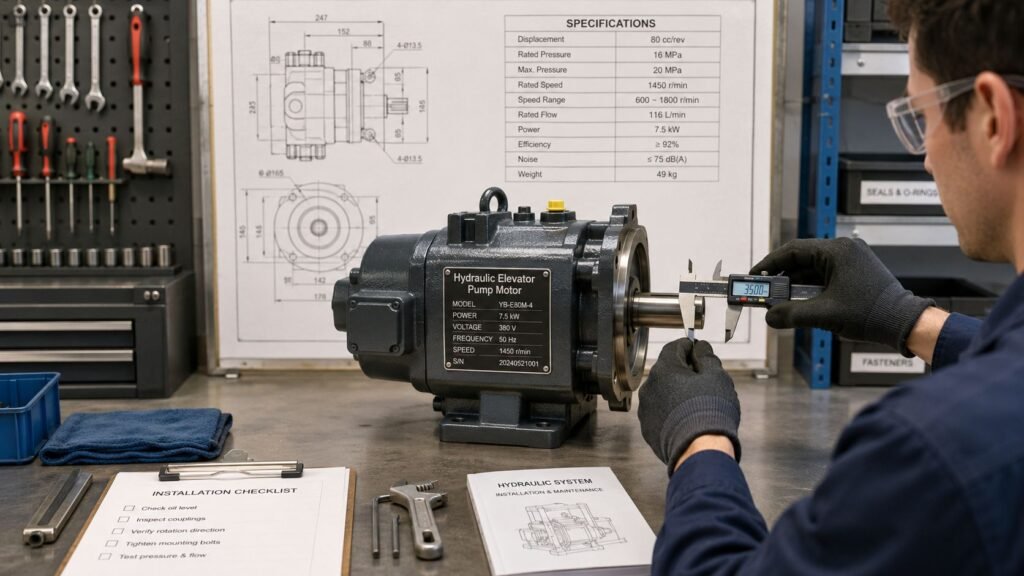
The smarter choice usually shows up when repair cost crosses about 50% of a new equivalent unit, when the motor is older than 12 years, or when failures keep repeating within 24 months. On a hydraulic elevator, that usually means the pump motor isn't “suddenly bad,” it's been drifting toward failure for a while.
A manager gets the call after lunch. The car is down, the machine room smells hot, the breaker has tripped again, and the mechanic is standing there with two quotes, a rewind and a full replacement. That's the decision most owners end up making under pressure, even though the warning signs were already there.
When a Pump Motor Replacement Becomes the Only Real Option
In a 1980s Detroit office building, the hydraulic elevator starts tripping on hot afternoons, the machine room feels hotter than the rest of the basement, and maintenance has already swapped contactors, relays, and a couple of starters. The car still misses level, and the pump motor is drawing complaints every week. At that point, the question is not whether the motor is tired. The question is whether another repair is worth the labor, lost uptime, and repeat callbacks.
The service call tells the story before the nameplate does
A hot hydraulic unit is a clue, not a verdict. If the motor is running hot, the oil is degrading, or the pump is making more noise than it used to, the system is telling you something upstream or downstream is wearing out. Guidance on elevator lifecycle planning puts hydraulic pump and motor assembly overhaul or replacement in the 15 to 20 year window, while modern elevators often last 20 to 30 years, so a pump motor replacement at mid-life is often a planned modernization event, not the final retirement of the entire elevator system. How long elevators last and when replacement typically happens
If the unit is under 12 years old, repair can still make sense when the problem is isolated and parts are available. Once the repair quote creeps past about half the cost of a comparable new unit, or the same failure keeps coming back within 24 months, replacement usually stops being a gamble and starts being the sensible call. In one maintenance review I've seen on repeated hydraulic callbacks, the owner had already paid for two partial fixes, lost enough service time to frustrate tenants, and still faced another shutdown, so the full replacement won on total cost, not just parts price.
Practical rule: don't let a single rewind quote decide the job. Compare the quote against the recurring failure pattern, the age of the unit, and the odds that the same symptom will return after the repair.
A high-traffic commercial elevator that's making 200 to 300 trips daily often reaches its economic life around 20 to 25 years, which is why owners in major markets rarely treat pump motor replacement as a one-off panic fix. How long elevators last and when replacement typically happens
Core Motor Specifications Every Replacement Decision Depends On
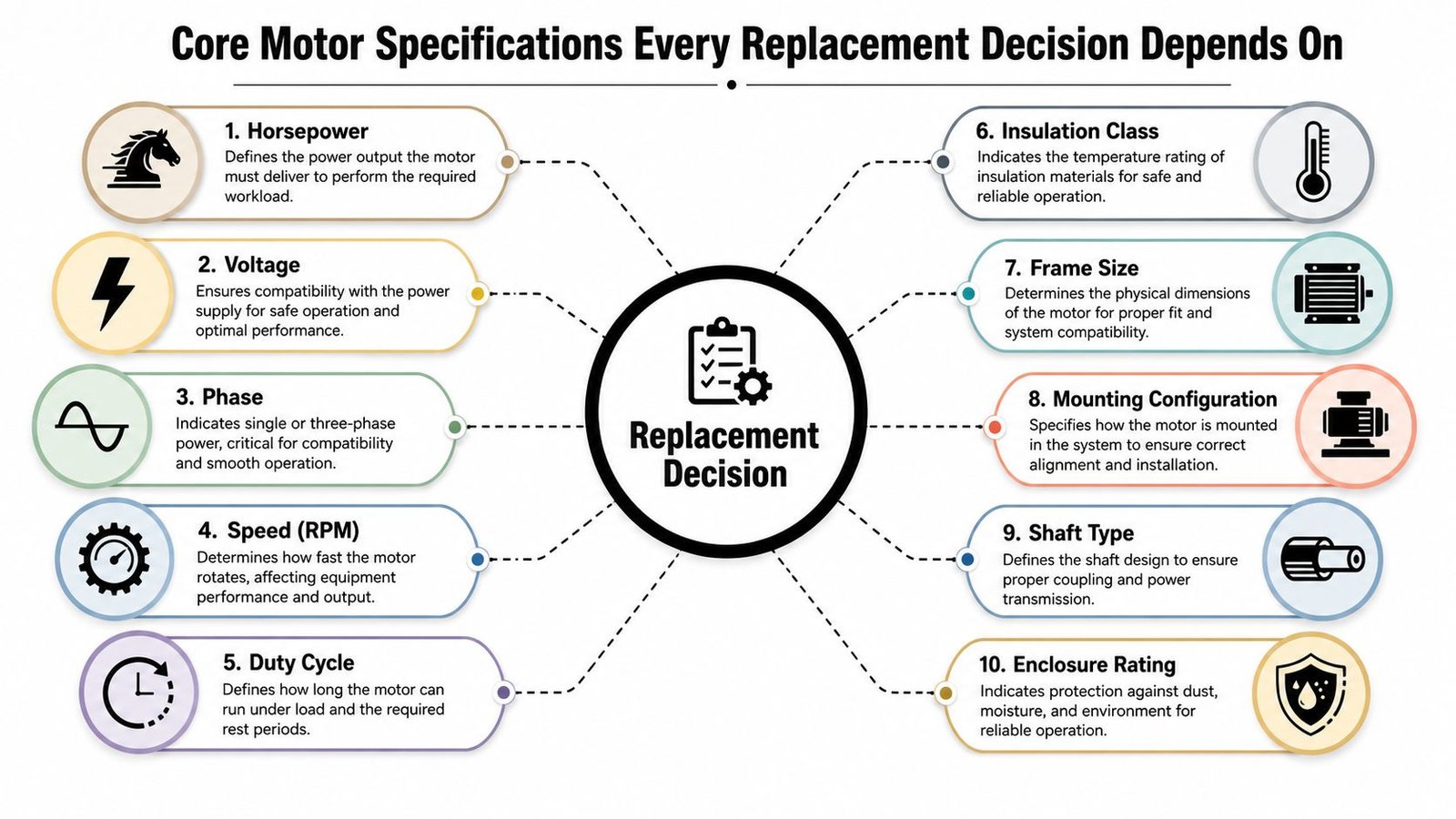
A replacement motor has to do three jobs at once. It has to fit the machine, match the electrical system, and survive the duty cycle the building puts on it. Miss one of those, and the “replacement” becomes another service call.
Start with the nameplate, not the sales sheet
The nameplate tells you what the motor was built to do. For a hydraulic elevator pump motor, the fields that matter most are horsepower, voltage, frequency, full-load amperes, speed, insulation class, enclosure type, and the NEMA design letter. The same acceptance guidance also calls for checking the manufacturer, frame size, insulation class, enclosure type, and the original ratings before the unit goes back in service. Pump motor repair and testing guidance
If the old motor says one thing and the quote says another, stop there. A motor that “sort of fits” can still overload the starter, run outside the protection settings, or leave the pump underpowered in real operating conditions.
- Horsepower: The output rating. It has to match the load the pump needs, not the size someone guessed at years ago.
- Voltage: The building supply has to match the motor rating.
- Frequency: Usually either 50 or 60 Hz, and it has to align with the supply.
- Full-load amperes: This is critical because overloads and circuit protection depend on it.
- Speed, or RPM: Hydraulic pump motors are commonly selected around the speed the pump expects, not just the speed the motor can spin at.
- Insulation class: This tells you how much thermal stress the winding can tolerate.
- Enclosure type: Open, drip-proof, or totally enclosed choices change how the motor handles heat and contamination.
- NEMA design letter: This affects starting behavior and torque characteristics.
- Frame size: A mismatch here means the mounting won't line up cleanly.
- Duty rating: Continuous duty and short-time duty are not interchangeable.
Don't ignore the support fields
Frame size, mounting configuration, shaft dimensions, ambient rating, and efficiency class don't sound glamorous, but they're what decide whether the motor installs without drama. A motor can match the horsepower and still be wrong if the shaft or mount doesn't match the pump coupling.
Field note: if the replacement motor needs adaptation hardware to “make it fit,” the quote is already drifting away from a true like-for-like swap.
The easiest mistake is to focus only on horsepower. A hydraulic elevator pump motor replacement lives or dies on the whole nameplate, not one line item.
Typical Spec Ranges by Elevator Type and Duty Cycle
Hydraulic elevators do not all ask the motor to do the same job. A low-rise commercial unit with steady traffic, a residential lift with light use, and a freight application all stress the drive in different ways, even when the cabinet looks similar from the outside. A motor that survives fine in one setting can run hot, trip, or wear out early in another.
Match the application before you compare the quote
The primary distinction is between traffic intensity and duty cycle. A unit that sees frequent starts, heavier loads, or longer travel times needs a tighter match than one that runs only a few cycles a day. As noted earlier, elevator drive components do not age on the same schedule, and that matters on a replacement decision. If the building is already past the point where repeated repairs are eating into downtime and labor, the motor spec should be chosen with the next service interval in mind, not just the immediate fix.
Here is a practical benchmark table for hydraulic applications. Use it as a field check, not as a substitute for the nameplate or the pump maker's data.
| Elevator Type | Typical HP | RPM Range | Voltage | Duty Rating |
|---|---|---|---|---|
| Low-rise commercial hydraulic | Commonly in the mid-range for building-service pump sets, often paired to the existing pump load | Usually matched to the pump's expected operating speed | Common building supply voltage | Continuous duty is common |
| Mid-rise commercial hydraulic | Often sized higher than a residential unit, with headroom for repeated starts and longer run times | Usually matched to the pump and valve package already in the pit or machine room | Common building supply voltage | Continuous duty is common |
| Residential hydraulic | Usually smaller than commercial units, especially on light-traffic homes and small private lifts | Usually matched to the pump and system design | Common residential supply voltage | Intermittent-to-lighter duty is common |
| Freight or material lift | Sized to the load, start frequency, and travel profile, not just the car rating | Usually matched to the pump and system design | Common industrial or building supply voltage | Heavier-duty operation is common |
The exact number should still come from the existing motor data and the pump manufacturer's requirements. On a real job, I look for whether the replacement lands in the same operating envelope. If the old motor was running near its thermal limit, matching horsepower alone is not enough, because the new unit can still fail early if the starts are too frequent or the pump is asking for more torque than the winding can handle.
In-ground and hole-less systems do not behave the same
In-ground hydraulic cylinders and hole-less roped hydraulic designs can push the motor differently. One may ask for longer run times, another may care more about startup torque, and both can expose poor ventilation or oil degradation faster than the owner expects. That changes the replacement call. A motor that looks acceptable on paper can still be the wrong choice if the system spends too long under load or if the pump has to work harder after years of wear.
A practical example comes up in buildings where the original setup was quiet and forgiving, then traffic changed. The motor may still fit, but the duty pattern now favors a stronger continuous-duty unit or a closer look at the pump and valve condition before installing anything new. In those cases, replacing the motor without checking the duty pattern is often a short-term save that turns into another service call.
For high-use buildings, the traffic pattern matters as much as the equipment label. A car that makes 200 to 300 trips daily is much less forgiving than a light-duty residential lift, which is why the motor decision should always be tied back to how the elevator is used. If the car spends most of the day cycling under load, the replacement should be judged by heat, starts, and runtime, not by the old model number alone.
Standards That Govern an Elevator Pump Motor Replacement
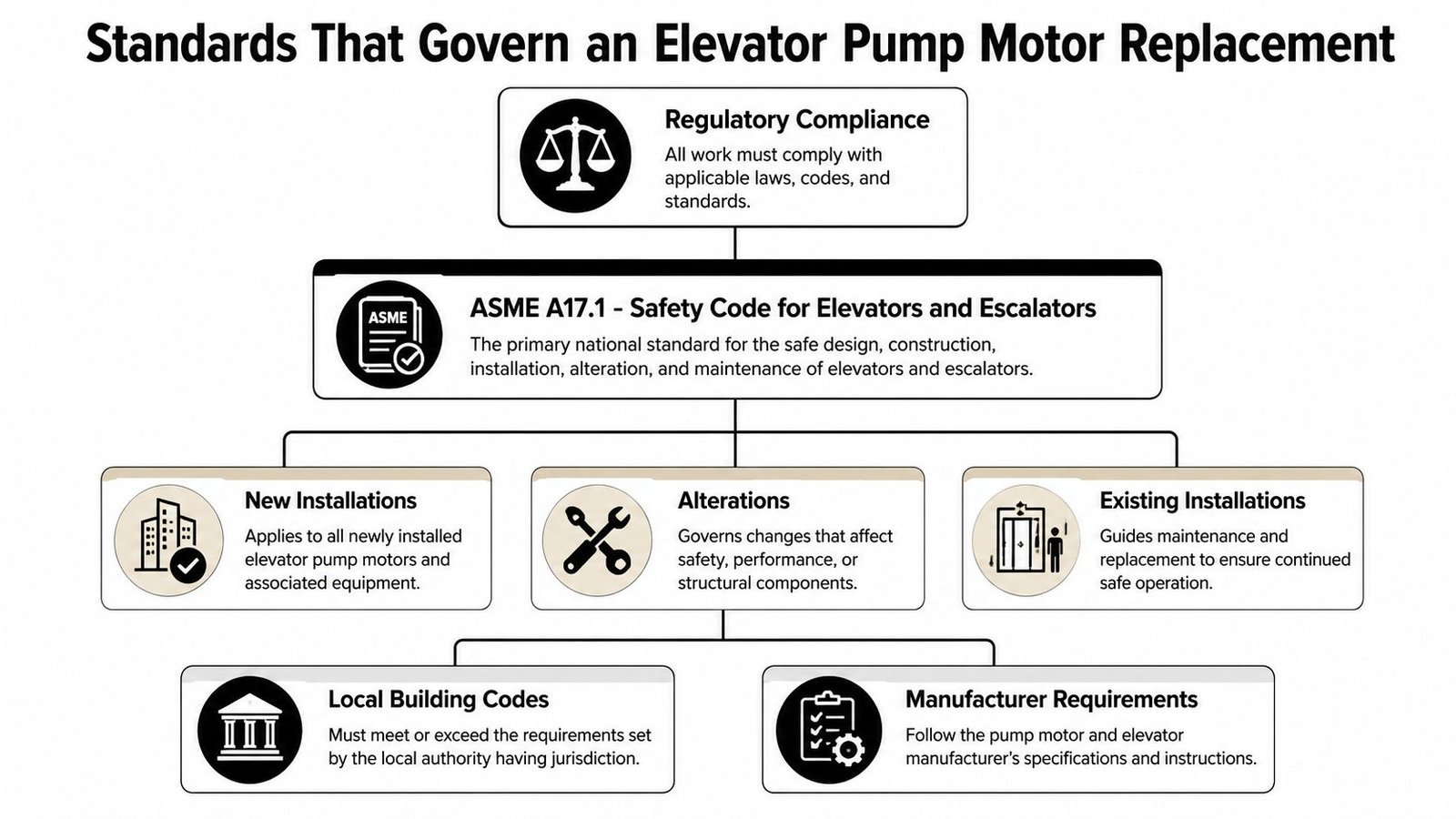
A pump motor swap is not just a mechanical trade. The moment the unit is altered, the work moves into a compliance lane, and the paperwork has to match the hardware.
The code layer is part of the job
ASME A17.1 is the main safety code governing new and altered elevators, and local jurisdictions can add their own rules on top of it. Electrical installation is shaped by NFPA 70, the NEC, while motor construction and performance fall under NEMA MG 1. For acceptance testing, the insulation checks reference IEEE Std 43, which is why a contractor can't treat the job like a simple motor changeout. Pump motor repair and testing guidance
The practical difference matters. Original installation rules tell you how the equipment should have been built and installed. Acceptance testing rules tell you what has to be verified after the replacement. A good installer documents both.
Local requirements can be stricter than the model code, and that's where owners get burned if they assume one set of rules applies everywhere. The safest move is to treat the replacement as a regulated alteration and ask for the permit and inspection path before the motor is ordered.
What the standards change on the service call
The standards don't just affect the inspector. They affect how the mechanic records the work, what gets tested before startup, and what lands in the maintenance file afterward. When a contractor skips that trail, the owner is left with a repair that may run, but can't be easily defended if something goes wrong later.
A clean motor replacement file should show the original ratings, the replacement data, the test results, and the final acceptance record. That's not paperwork for paperwork's sake. It's what keeps the job from turning into a compliance dispute.
How to Select a Compatible Replacement Motor
The right replacement starts with the old motor in hand, not the quote. Before anyone orders a unit, the nameplate has to be copied exactly, because guessing on one field is usually how the wrong motor ends up in the machine room.
Match the physical fit first
Frame size, mounting configuration, and shaft type decide whether the motor can be installed without improvisation. If the motor sits under the tank, above the tank, or in a tight machine room, the installation space can be just as important as the electrical rating. The pump coupling has to line up cleanly, or you're buying noise, wear, and bearing problems on day one.
After that, verify the electrical match. Voltage and frequency have to align with the building supply, and full-load amperes need to stay compatible with the overload and circuit protection already in place. Upsizing horsepower without re-coordinating protection is one of the easiest ways to create a problem that looks like a motor issue but is really an installation mistake.
Choose the replacement path on purpose
There are usually three paths. An exact OEM replacement is the cleanest when the part is available. A NEMA-equivalent motor can work when the dimensions and ratings line up. A non-proprietary aftermarket option makes sense when the goal is to avoid lock-in and keep future service options open.
- Exact OEM: Best when you need a straightforward swap and the original configuration is still supported.
- NEMA-equivalent: Useful when the motor is standard enough that dimensions and ratings can be matched closely.
- Non-proprietary aftermarket: Often chosen when owners want broader serviceability over the life of the elevator.
If the unit is part of a larger replacement plan, a contractor like Crane Elevator Company may be one option, since the company works on non-proprietary repairs and replacements across hydraulic equipment. The important part is not the logo on the invoice, it's whether the replacement motor matches the system and can be supported later.
Practical rule: if the quote doesn't show voltage, horsepower, frame, shaft, enclosure, and full-load amperes side by side with the existing motor, the quote isn't ready yet.
Repair Versus Replacement Using Lifecycle Economics
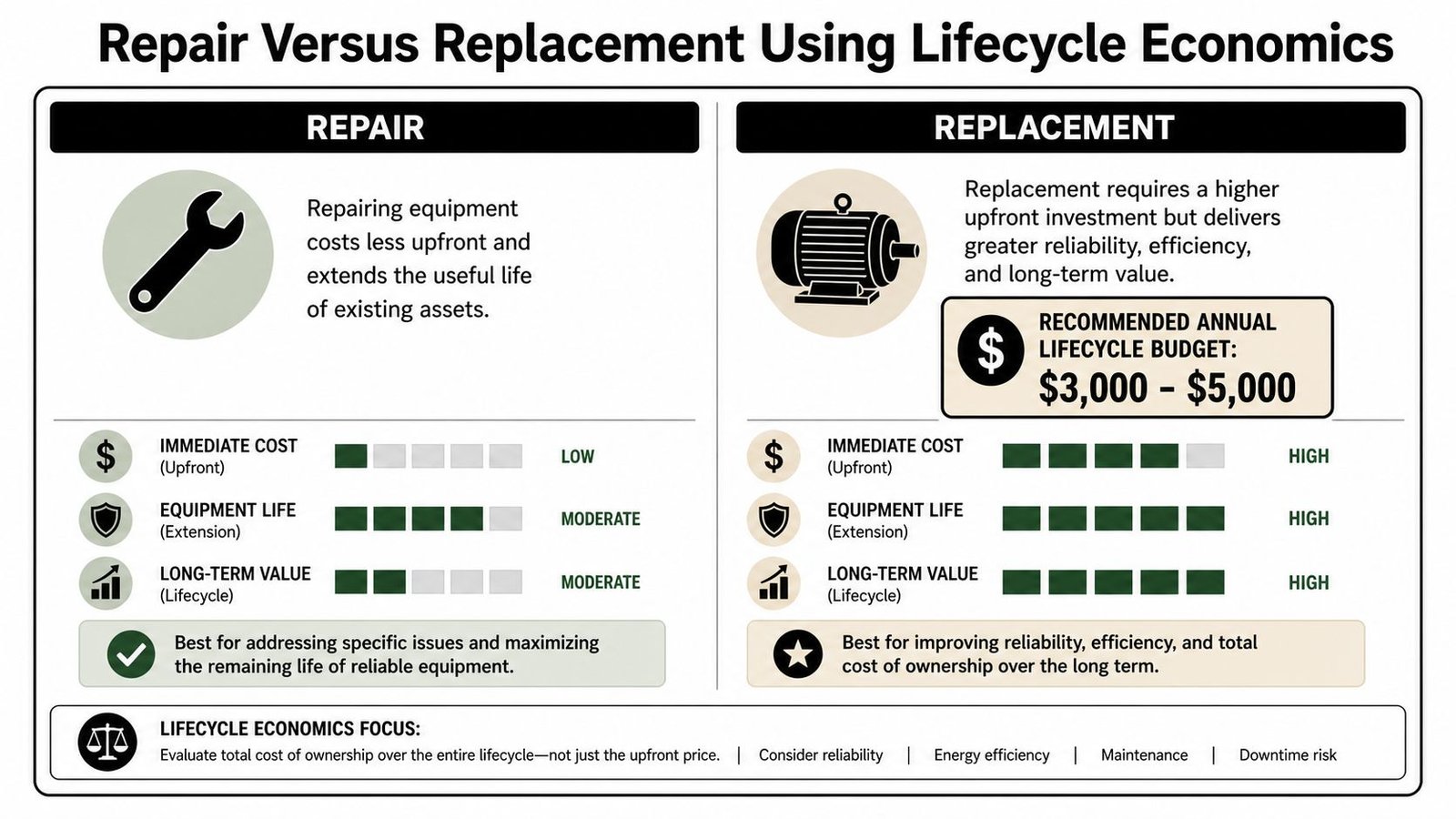
A cheap repair can look smart on paper and still become the expensive choice once the callbacks start. On a hydraulic unit, the cost includes labor, truck rolls, lost uptime, and the risk that the same complaint comes back a week later.
Cost is bigger than the first invoice
The hoist and elevator motors market is still moving because owners keep making the same trade-off, spend less now on repair, or spend more now and reduce repeat failures later. Hoist and elevator motors market report That matters on service calls because the decision is rarely about the motor alone. It is about whether the building is buying one fix or buying a short cycle of fixes.
Lifecycle planning also changes the math. The maintenance guidance that recommends setting aside funds for modernization near the later-life replacement window is useful here, because it shows how owners are expected to budget before the equipment turns into an emergency. Repair versus replace industrial pump motor guidance If the motor is already past the age where repeated failures start to show up, the repair quote has to be compared against the cost of getting the system back to a stable service life. Elevator lifespan and maintenance replacement guide
Use the 50 percent test, the age check, and the repeat-failure check
The practical rule is straightforward. If repair cost gets close to half the price of a like-for-like replacement, replacement deserves a hard look. If the motor is already around the point where age-related failures begin to stack up, the case gets stronger. If the same fault has come back within the recent maintenance cycle, the building is probably paying for uncertainty as much as for parts.
That is the point where a qualified contractor can help compare the options in real terms, not sales terms. A hydraulic elevator pump replacement through Crane Elevator Company is one example of how owners may approach a full swap when the numbers favor a new unit over another repair. The right call is the one that reduces repeated downtime, not the one that only lowers this month's invoice.
If the same motor keeps failing, the building is not just buying repairs. It is buying downtime, callbacks, and another round of uncertainty.
A rewind can still be the right answer when the motor itself is the problem and the rest of the hydraulic system is sound. It stops making sense when the repair is only cheaper because it delays a replacement that the building will need soon anyway.
When a Motor Swap Alone Is the Wrong Move
A motor can fail for its own reasons, but it can also be the victim of a bigger problem. If you replace the motor without fixing the root cause, you usually get the same callback with a fresh part number.
Look for the system problem behind the symptom
Heat, vibration, pump noise, oil breakdown, and leveling issues are strong clues that the motor isn't acting alone. The troubleshooting guidance for hydraulic power units says to document oil temperature, motor amperage, machine-room heat, and visible signs of cavitation before changing parts, because those clues help separate a bad motor from a system that's cooking the motor alive. Hydraulic power unit troubleshooting heat and vibration
Poor ventilation can push the entire power unit into a hotter operating range. Unstable supply voltage can make a healthy motor look weak. Contaminated oil can drive drag, heat, and wear. In those cases, a straight motor swap may fix the symptom for a while, but it won't solve the reason the part died.
Obsolete parts change the decision
Older hydraulic elevators often have parts that aren't easy to source anymore. That's where third-party sourcing, salvage, or modular upgrades enter the conversation, but only after the mechanic confirms what failed. If the motor is obsolete and the building wants to avoid a broader modernization, the swap still has to be tested against the root cause, not just the closest available part.
A targeted power-unit refresh or control upgrade can make more sense than another one-off motor replacement when the system itself is unstable. If you're weighing that route, the replacement process on this hydraulic pump replacement guide is a useful companion reference.
The cheapest work order isn't always the lowest total cost. If the machine room is hot, the oil is dirty, or the voltage is unreliable, the owner may be better off correcting the system around the motor instead of paying for the same failure twice.
Acceptance Testing After a Pump Motor Replacement
A replacement isn't finished when the bolts are tight. It's finished when the motor proves it can run cleanly, safely, and within spec.
Test the insulation before and after installation
Electrical acceptance starts with insulation resistance testing at 500 V or 1000 V DC in line with IEEE Std 43 practice. The test should include phase-to-phase and phase-to-ground measurements, and the repair record should stay tied to the original ratings. Pump motor repair and testing guidance
For motors below 1 kV, a commonly cited minimum insulation-resistance acceptance after rewind or replacement is 5 megohms. For motors above 1 kV, the benchmark is 100 megohms. Those values give the owner a clear pass-or-retest line before the elevator goes back into service. Pump motor repair and testing guidance
Don't skip the no-load run
Once the motor is installed, the no-load run should confirm current draw, vibration, and bearing temperature. If any of those readings look wrong, the contractor should stop and recheck the installation before the unit is put back into service.
- Current draw: Confirms the motor isn't overloaded at startup or no-load conditions.
- Vibration: Helps catch coupling, alignment, or bearing issues early.
- Bearing temperature: Flags friction or fit problems before they destroy the new motor.
For a practical post-job paper trail, the acceptance report should include the original nameplate data, the test readings, and a clear statement that the motor passed or failed. For owners who want a more formal checklist, the testing process outlined at Crane Elevator Company's elevator testing page is the right place to compare against your contractor's report.
Maintenance and Inspection Practices That Extend Motor Life
A motor usually doesn't die in one bad day. It wears out through small problems that nobody wrote down early enough.
Watch the machine room before it turns into a repair
Quarterly checks should catch the things that create heat and wear, especially motor temperature, abnormal noise, and loose connections. Annual work should include insulation resistance testing and alignment checks at the pump coupling, because those are the conditions that erode motor life long before the owner sees a failure. The article on elevator preventative maintenance at Crane Elevator Company's maintenance page is a good fit for owners trying to turn that cadence into a standing service plan.
Keep the records, not just the receipts. If the same temperature or vibration pattern shows up twice, it's no longer a surprise.
A useful machine-room log should note oil condition, venting, motor heat, unusual sounds, and any breaker events. It should also show who inspected the unit and when. That way, when the time comes to plan a pump motor replacement, the owner isn't guessing from memory.
Keep the replacement decision evidence-based
The best maintenance programs don't promise that a motor will last forever. They make the failure predictable enough that replacement can be scheduled instead of rushed. That's especially important on hydraulic equipment, where one failed part can be the start of a chain that includes oil contamination, heat, and repeat callbacks.
The more consistent the inspection record, the easier it is to tell whether the unit needs another repair, a full motor replacement, or a broader power-unit update. That's the difference between reacting to a breakdown and managing an asset.
Quick Reference Spec Sheet and Glossary
A facility manager facing a quote tomorrow morning needs something fast. This reference sheet gives you the terms that matter when you compare the old motor, the new motor, and the electrician's notes.
| Spec or Term | What to Check |
|---|---|
| Horsepower | Must match the load requirement |
| Voltage | Must match the building supply |
| Frequency | Must match the supply frequency |
| Full-load amperes | Must fit the overload and circuit protection |
| Speed, RPM | Must match the pump and system design |
| Service factor | Tells you how much margin the motor has under load |
| Insulation class | Shows thermal tolerance of the winding |
| Frame size | Must match the mounting pattern and physical fit |
| Enclosure type | Affects heat and contamination resistance |
| Duty rating | Confirms whether the motor is built for the actual run pattern |
Glossary terms owners see on quotes and reports
FLA means full-load amperes, the current the motor draws at rated load. Service factor is the margin the motor can tolerate beyond rated conditions. Insulation class is the winding's thermal rating, often listed as B, F, or H. NEMA design letter describes starting and torque behavior. IP rating tells you how well the enclosure resists dust and water intrusion. Encoder or feedback device shows the motor's position or speed information where used. Brake type matters when the motor and holding function are part of the same assembly. ASME A17.1 relevance means the replacement has to fit the elevator's safety and alteration requirements.
A motor quote that leaves out FLA, enclosure type, or frame size isn't complete enough to approve.
A good nameplate match makes the rest of the decision easier. A bad one turns the replacement into a parts chase that burns time before the elevator ever moves again.
Crane Elevator Company handles hydraulic repairs, preventative maintenance, code-required inspections, and non-proprietary modernization work across Lower Michigan, including pump, motor, and power-unit service. If you're weighing elevator pump motor replacement, Crane Elevator Company can review the current condition, compare repair and replacement options, and help you decide what makes sense before the next breakdown forces the issue.