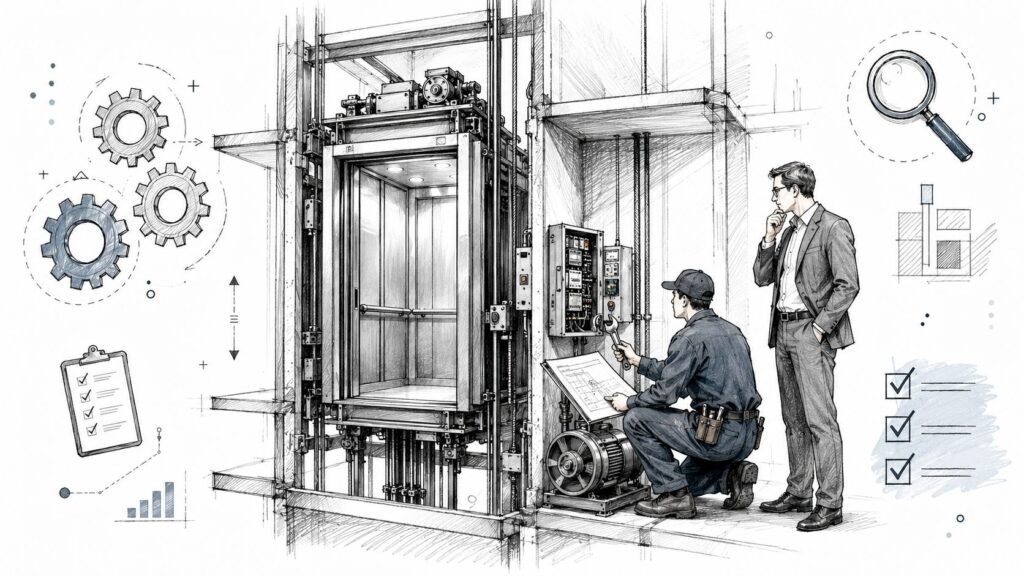
The call usually comes in after a rough week. A property manager in Detroit or Toledo has a cab out of service, a tenant complaint that won't go away, and a quote that seems to cover everything except the part that matters. By the time the inspection report lands on the desk, the question isn't whether the elevator can move again. It's whether the current service setup is protecting the building or just billing it.
That's where a good elevator repair service separates itself from a cheap one. Real service keeps people moving, keeps the building compliant, and gives owners a clean paper trail when something fails. In a market that supports more than 19 million operational elevators and escalators across 160+ countries, with each elevator typically needing 12 to 16 maintenance visits per year to stay safe and compliant, this is recurring infrastructure work, not a one-off fix, according to the industry estimate on the global repair and maintenance market (industry estimate).
The Call That Started the Search
The first sign that a provider's not earning the contract is usually small. A building owner gets a vague scope, a surprising repair line item, or a failure that should've been caught long before the cab stopped leveling. In Detroit, Ann Arbor, and Toledo, I've seen owners sit on the lobby bench with a stack of service reports and realize they're paying for visits, not results.
A good service relationship should answer three plain questions. What was inspected, what was corrected, and what got documented? If those answers aren't clear, the contract is already weak.
Practical rule: if the report doesn't tell you what was examined, adjusted, lubricated, cleaned, and repaired, you're not buying accountability, you're buying a promise.
That matters because elevator systems don't fail all at once. Door gear starts dragging, contactors get tired, contamination builds in the hoistway, and a small nuisance turns into a shutdown at the worst possible hour. Owners usually don't need more sales language, they need a provider who can explain why the fault happened, what got checked, and what's being done to keep it from repeating.
For Crane Elevator Company, the conversation starts there. Maintenance, repair, and modernization aren't separate silos in the world, they're connected decisions tied to uptime, code compliance, and the age of the equipment. A family-owned contractor with field experience in Lower Michigan and Northwest Ohio should be able to say where the problem is, what's urgent, and what can wait.
What an Elevator Repair Service Actually Covers
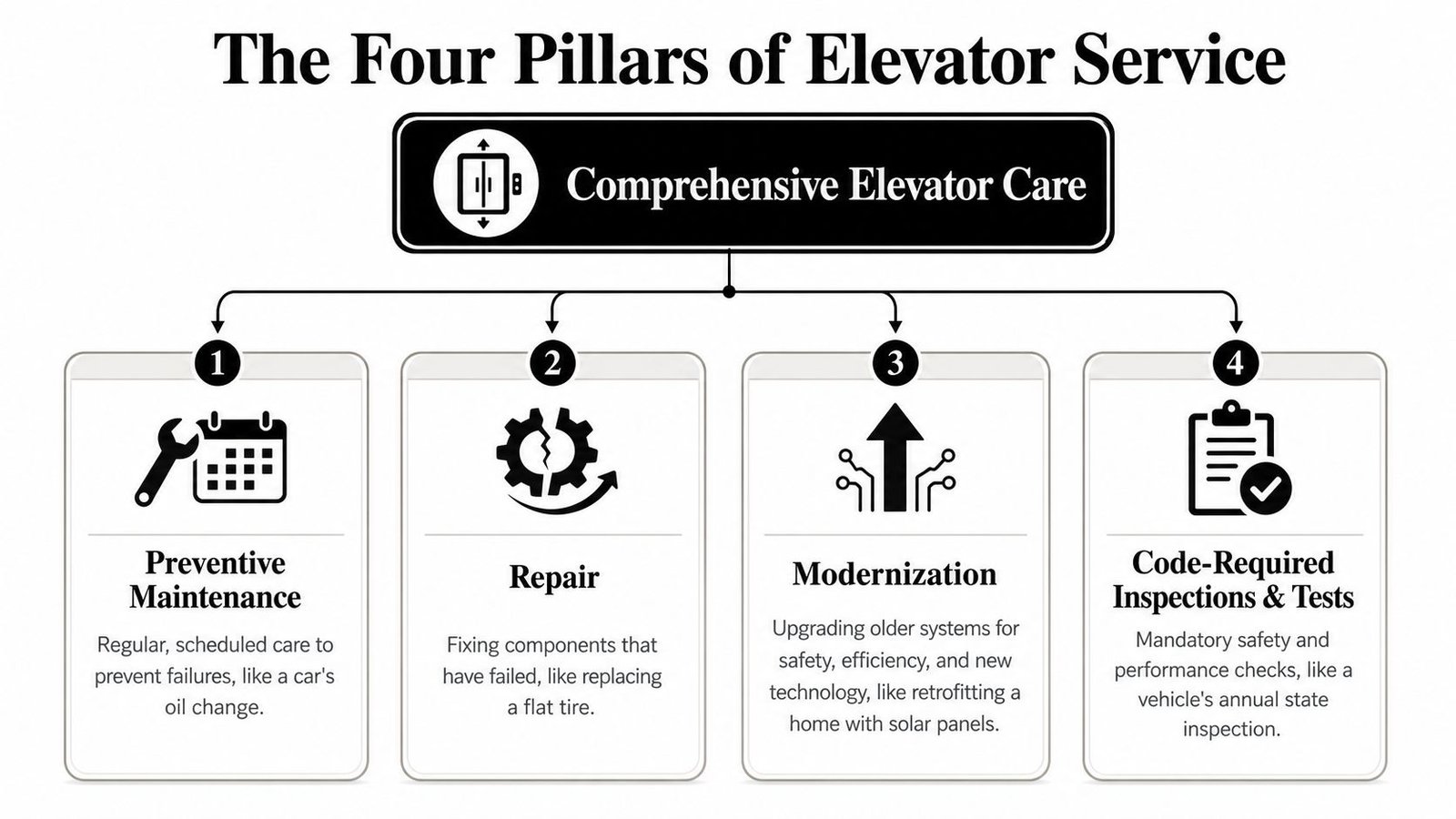
Most owners think of service as “fix the broken thing.” That's only one piece. A proper elevator repair service covers preventive maintenance, repair, modernization, and code-required inspections and tests. Those four pieces work together, like tires, brakes, alignment, and annual inspection on a truck that never gets to sit still.
Preventive maintenance keeps the problems smaller
Preventive work is the regular visit that stops nuisance faults from becoming hard shutdowns. Technicians examine, adjust, lubricate, clean, and repair the equipment, then document what changed. On-site Maintenance Control Program records create the baseline that lets everyone see repeat wear on parts like door interlocks, brake assemblies, controllers, and guide components, which makes fault isolation faster when the cab goes down.
That's where the machine room, pit, and car top matter. Cleaning those spaces isn't cosmetic. Dust, oil film, and debris cause missed contacts, sticky door operation, and needless callbacks. In our own field model, that means full clean-downs, COP and PI bulb replacements, and door lock monitoring are part of normal upkeep, not extras.
Repair and modernization solve different problems
Repair is the wrench work. Replace the failed part, correct the fault, and return the car to service. Modernization is different. It changes the equipment set when the old one no longer makes sense to keep patching. In practice, owners need both, because a building with aging equipment doesn't benefit from pretending every problem is a repair problem.
The inspection schedule is not optional
For traction elevators, the schedule usually includes monthly machine and brake inspection, cab and communication checks, controller verification, door system checks, and annual deep cleaning of the guide rails and hoistway. ASME A17.1-based schedules also call for six-month inspections, annual testing, and five-year traction-specific tests. A dirty hoistway increases friction, disrupts leveling, and makes safety devices less reliable, which is why cleaning rails with a nonflammable or high-flash-point solvent is part of doing the work right (traction maintenance specification).
OEM Service Versus Independent Service
The choice most owners face is simple to describe and hard to unwind later. Stay with the original equipment manufacturer and its proprietary service program, or move to an independent non-proprietary contractor that can support the equipment without locking the building into one vendor. The difference shows up in parts access, response time, price structure, transparency, and whether you can switch later without starting from zero.
A written Maintenance Control Program is the foundation for either path. It has to stay on site and align with ASME A17.1, because the contractor's job is to create a traceable maintenance record, not just show up and leave. Procurement specs commonly require the provider to examine, adjust, lubricate, clean, and repair equipment, then schedule periodic inspections and testing and document corrective actions (MCP procurement specification). That's the difference between a service relationship and a paper trail.
Side by side trade-offs
| Criterion | OEM proprietary service | Independent non-proprietary service |
|---|---|---|
| Parts availability | Often tied to one channel | Broader sourcing options when the equipment is designed for it |
| Response time | Can be good, but depends on the vendor's local footprint | Can be faster when the provider is local and the equipment isn't locked down |
| Cost structure | Sometimes harder to separate labor, parts, and admin charges | Usually easier to compare line by line |
| Transparency | Can be limited by proprietary systems | Clearer when the MCP and service logs are written well |
| Freedom to switch | Lower, especially on older proprietary installs | Higher, because any qualified provider can service it later |
Practical rule: if a contract makes it hard to tell what parts are covered, what labor is included, and who can service the equipment next year, it's not reducing risk, it's creating dependency.
That's why Crane Elevator Company's non-proprietary model matters in Lower Michigan and Northwest Ohio. When the equipment is built and documented for open servicing, the building isn't trapped if response slips or pricing drifts. Owners keep safety and uptime, but they don't lose bargaining power.
If you're comparing quotes right now, start with the service scope and response language in fast elevator service, then compare the logbook, not just the monthly number.
Inspections and Tests Your Building Must Pass
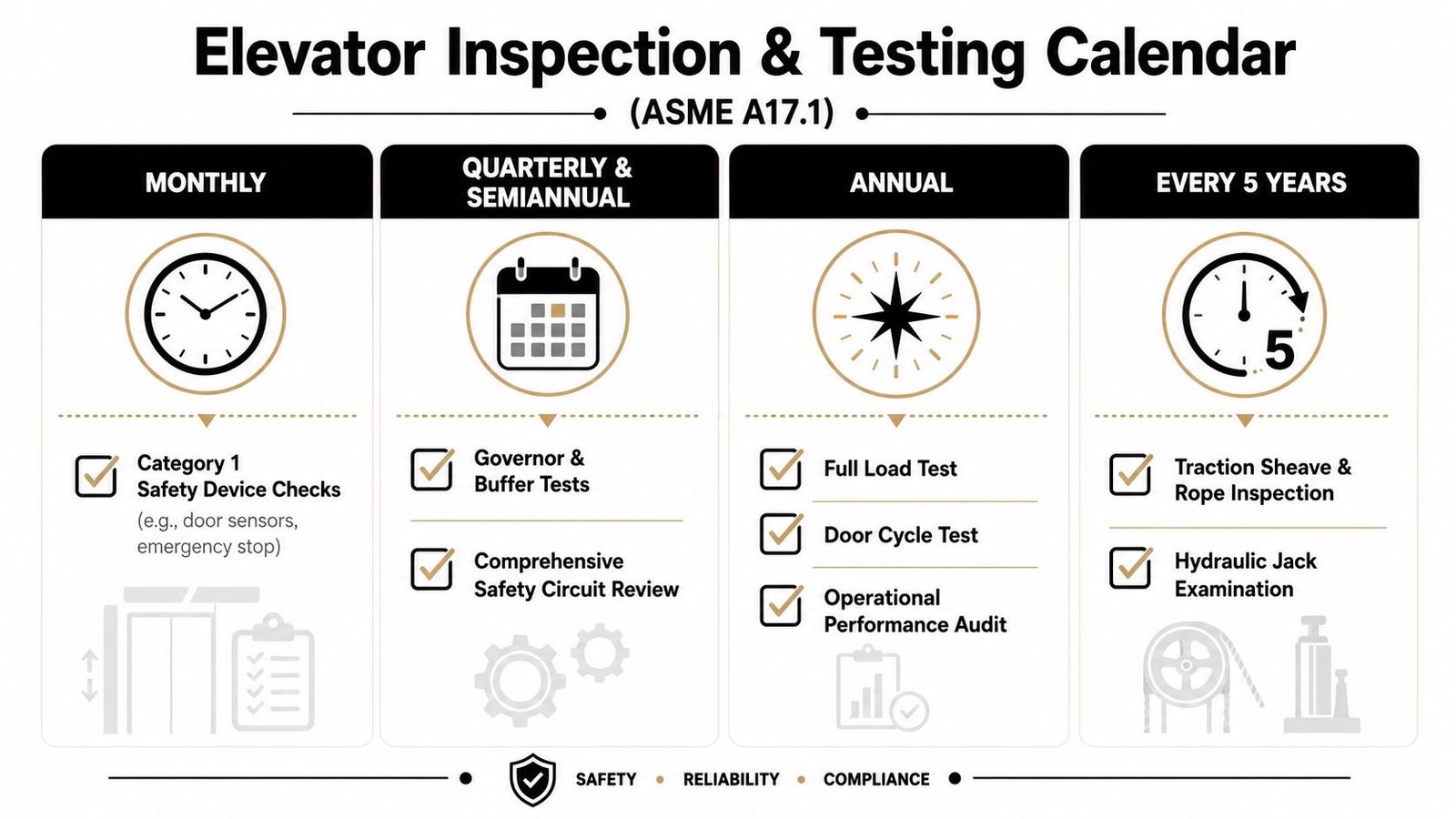
The cleanest way to manage inspections is to turn the code into a calendar the facility team can use. Owners don't need to memorize the book, but they do need a repeatable rhythm that keeps the elevator legal, safe, and ready for the next test. In practice, that means matching the ASME A17.1 schedule to the equipment in the building and making sure the provider can prove the work was done.
A workable inspection calendar
- Monthly. Category 1 safety device checks, emergency stop function, door sensing, communication checks, and the basics that show whether the car is behaving.
- Quarterly and semiannual. Governor and buffer tests, plus a broader review of the safety circuit and supporting systems.
- Annual. Full load testing, door cycle testing, and a performance audit that shows whether the cab is still operating the way it should.
- Every five years. Traction-specific inspection work such as sheaves, ropes, and related deep checks for the equipment that carries the load.
Michigan makes this more specific. Michigan Administrative Code R. 408.7030 covers elevator monitoring, the state adopted the 2015 edition of ASME A17.3 on June 27, 2023, and existing elevators face a January 1, 2028 compliance window for door lock monitoring. That matters because owners can't treat door lock work as an optional upgrade anymore. It's part of the legal and safety picture.
Crane's field work across Detroit, Ann Arbor, Lansing, Flint, Kalamazoo, Toledo, and surrounding service areas has to include category testing, emergency phone verification, fire service Phase 1 and Phase 2, generator testing, and violation corrections. If a provider can't explain those items in plain English, keep looking.
The right maintenance partner doesn't just pass the test, it makes the next test easier to pass.
For owners who want a service calendar that matches the inspection schedule, elevator testing is the right place to start the comparison.
When to Repair and When to Modernize
The worst money I see owners spend is on repeated repairs to a system that already told them it's done. A single failed component is a repair problem. A repeated pattern of faults across the same cab is usually a modernization problem in disguise. The trick is to stop asking only, “Can it be fixed?” and start asking, “What's the lowest total cost over the next five to ten years?”
Component failures usually point to repair
Some failures are straightforward. A bad hydraulic packing, leaking jack, worn cables, tired tank, weak power unit, burned-out motor, worn sheave, failing machine, or a single controller issue can often be handled at the component level. The key is whether the failure is isolated or part of a broader pattern. If it's isolated, repair makes sense.
The cost picture matters. One industry newsletter places individual repairs in the range of $1.5K to $10K+ depending on age and usage, and says a full elevator modernization commonly costs $50,000 to $100,000 per cab (elevator services newsletter). That's why owners shouldn't compare one repair invoice to one modernization quote and stop there. They need to compare repeated outages, code deficiencies, and future service risk too.
System-wide failure usually points to modernization
When the equipment shows persistent glitches, obsolete controls, repeated safety-code issues, or parts that are hard to source, modernization usually wins. The same goes for cabs that can't keep up with accessibility needs, fire service requirements, or current building use. In older commercial buildings, the crossover point often shows up before the owner expects it, because small repairs accumulate into a heavy operating burden.
Practical rule: if you're fixing a cab for the third time and every repair exposes another worn-out subsystem, you're no longer repairing the machine, you're financing its decline.
That's where non-proprietary modernization becomes useful. A commercial elevator financing program can spread the cost, while the upgrade resets accessibility, fire service, and code compliance in one project. Owners get a predictable path instead of one expensive surprise after another.
How One Building Switched Providers and What Changed
The building was a mid-rise commercial property in Lower Michigan with an OEM contract that looked fine on paper and kept getting uglier in practice. The owner called after a failed inspection and a repair quote that didn't explain why the same door issues kept coming back. The audit found a dirty machine room, worn door locks, and outdated fire service settings that should have been addressed long before the inspection report.
The switch wasn't dramatic. It was documented. The new scope included a No Show, No Pay accountability clause, full clean-downs of the machine room, pit, and car top, COP and PI bulb replacements, and a written Maintenance Control Program kept on site. That mattered because the owner finally had something measurable, not just a vendor's promise.
The first 90 days changed how the building felt to tenants. The elevators stopped acting like a recurring mystery, response times were clearer, and the pricing was easier to read. Just as important, the owner could take the contract back to market at renewal without wondering if the equipment documentation was trapped inside one provider's system.
That's the value of non-proprietary service. It doesn't promise magic. It removes lock-in, documents the work, and gives the owner room to make a better decision next time.
Evaluating and Switching to a New Provider
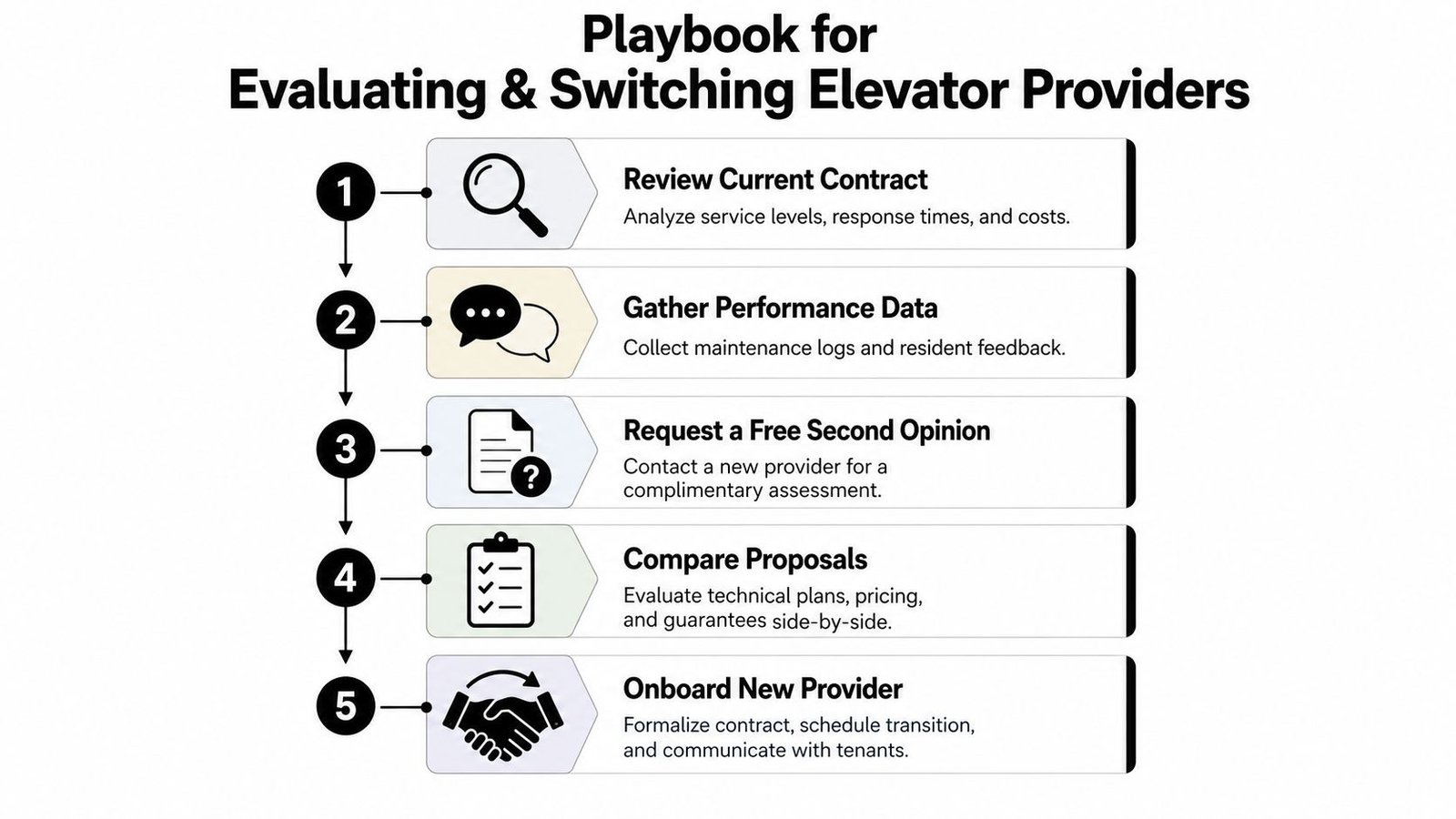
The cleanest way to change providers is to treat it like a procurement project, not a complaint call. Start by pulling the current agreement, the maintenance logs, the inspection history, and every invoice tied to repairs or violations. If the paperwork is thin, that tells you something already.
What to demand in writing
- Scope of work. Spell out what gets inspected, adjusted, lubricated, cleaned, and repaired.
- Maintenance Control Program. Require an on-site MCP aligned to ASME A17.1.
- Response commitments. Ask how emergency calls, entrapments, and after-hours work are handled.
- Parts transparency. Make the provider identify what's included and what isn't.
- Accountability language. A No Show, No Pay clause tells you the contractor is serious about showing up.
- Clean-down commitments. Machine room, pit, and car top clean-downs should be explicit.
- Price-beat guarantee. If a provider offers one, put the terms in the contract.
A free second opinion is worth asking for before you sign anything new, especially if the current contract is auto-renewing. For owners comparing open-service options, non-proprietary elevators is the right concept to verify before you commit.
What to verify in the first 90 days
- The service log should match the scope.
- Dirty spaces should be cleaned, not just noted.
- Door locks, bulbs, communication devices, and safety checks should stop getting ignored.
- The provider should document every correction.
- The owner should be able to explain the contract to another bidder at renewal.
That's how commercial elevator financing, modernization financing, and 24/7, 365-day field operations fit together. The building keeps moving through shutdowns and emergencies, and the owner keeps control of the next decision.
Key Takeaways and Next Steps for Building Owners
The best decision usually falls into one of three buckets. Stay with OEM service if the performance is documented and the scope is clear. Audit the current provider if the work looks sloppy, the logs are thin, or the repair bills keep climbing. Move to a non-proprietary contract when you want more flexibility, better transparency, and a path that any qualified provider can support later.
Owners usually get into trouble in the same ways. They sign long proprietary renewals without a strong MCP. They ignore door lock monitoring work before the January 1, 2028 deadline. They treat bulbs, clean-downs, and logbooks as cosmetic. They choose the lowest headline price instead of the most complete documented scope.
The bigger lesson is simple. Elevator repair service is not just about getting a stalled cab moving again. It's about choosing a service structure that matches the building's age, code obligations, and future operating cost. If the current contract can't show you that in writing, it's time to compare it against something better.
Request a free second opinion or competitive quote from Crane Elevator Company for service, repair, or modernization work anywhere in Lower Michigan or Northwest Ohio, including Detroit, Ann Arbor, Lansing, Flint, Kalamazoo, Toledo, and the surrounding communities. The right review now can save you from paying for the same failure twice.
If your building needs a sharper maintenance program, a cleaner repair plan, or a realistic modernization quote, Crane Elevator Company can look at the equipment and tell you what holds up and what doesn't. Visit Crane Elevator Company to request a second opinion, compare service options, or schedule work in Lower Michigan or Northwest Ohio.