
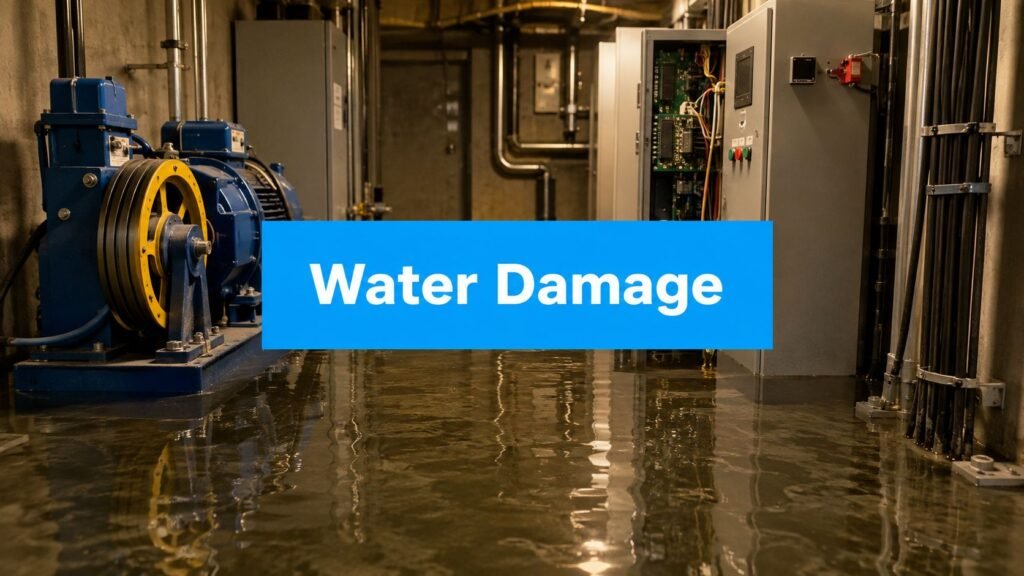
At 2:00 a.m., a burst sprinkler line above an elevator machine room can turn a quiet commercial building into a safety, insurance, and compliance problem. Alarms sound, water reaches the pit, tenants may be trapped in cars, and the first person on site has to make decisions before anyone knows whether the damage is limited to cleanup or has reached the controller, hoisting machine, or safety circuit.
Ohio treats that situation as more than a maintenance inconvenience. The state's elevator provisions address sprinkler shutdown, water infiltration, pit conditions, permits, and inspection controls because water can disable power, damage controls, and keep an elevator out of service until qualified personnel test and restore it. Independent forensic data also shows why owners need a disciplined response: water accounted for 47% of vertical transport equipment claims, with an average claim amount of $306,890.06, compared with breakdown claims at 24% and $98,657.44, according to Envista Forensics' vertical transport damage assessment.
This guide follows the sequence that protects people first, then preserves evidence, limits avoidable damage, and supports a defensible return to service. It also explains where building staff should stop and bring in licensed elevator professionals.
When Water Meets Vertical Transportation
The first mistake after an elevator flood is treating the water as a janitorial problem. A facility manager may want to get a pump into the pit, dry the machine room, and restore service before tenants arrive. That instinct is understandable, but moving too quickly can expose workers to energized equipment, destroy evidence, or place passengers in a car with compromised safety devices.
Ohio's building code makes the hazard clear. Where a sprinkler-protected elevator hoistway or machine room contains control equipment, an automatic shutdown means must disconnect main line power before sprinkler water is applied, and the device can't reset itself automatically. The code also requires occupant evacuation elevator hoistways to resist sprinkler-water infiltration. These provisions reflect a practical reality, water can damage electrical controls and mechanical equipment even when the visible pool looks shallow. See the state's Ohio elevator and conveying systems provisions for the underlying requirements.
The after-hours decision
Suppose a Columbus office building reports a sprinkler discharge above the machine room. The fire alarm panel is active, a water alarm indicates moisture in the pit, and one elevator has stopped between floors. The building engineer must coordinate with the fire department, building security, the sprinkler contractor, the insurer, and an elevator contractor without allowing anyone to enter a flooded space casually.
The building's location and construction can shape the event. Freeze-thaw cycles can stress exterior water-entry points, spring rain can overwhelm drainage, and aging municipal infrastructure can contribute to basement seepage or pressure problems. Plumbing chases, roof equipment, HVAC condensate, groundwater, and firefighting operations can all deliver water to an elevator space.
Practical rule: Stop the source, secure the elevator, and document the original condition before cleanup changes the scene.
The owner's financial exposure can change dramatically depending on what the water touched. A dry pit with contaminated debris may need cleaning and testing. A wet controller cabinet or submerged safety device may require component replacement, engineering review, permits, and a formal inspection. The difference isn't determined by the amount of water alone. It depends on exposure, contamination, corrosion, equipment type, and whether the technician can prove that the restored system meets applicable requirements.
Facility teams should keep emergency contacts and equipment information available before an event. The Ohio elevator services resource can help building teams identify the type of contractor support needed before an incident occurs. During the event, the most useful first records are the alarm time, discovery time, source of water, elevator position, visible water level, names of witnesses, and every action taken.
Immediate Safety Shutdown and Isolation
A flooded elevator must be treated as energized until a qualified person proves otherwise. Water can reach mainline conductors, control circuits, door equipment, pit junction boxes, lighting, hydraulic components, and emergency power connections. A sump pump running in the pit doesn't make the elevator safe to operate or safe to enter.
Secure the equipment
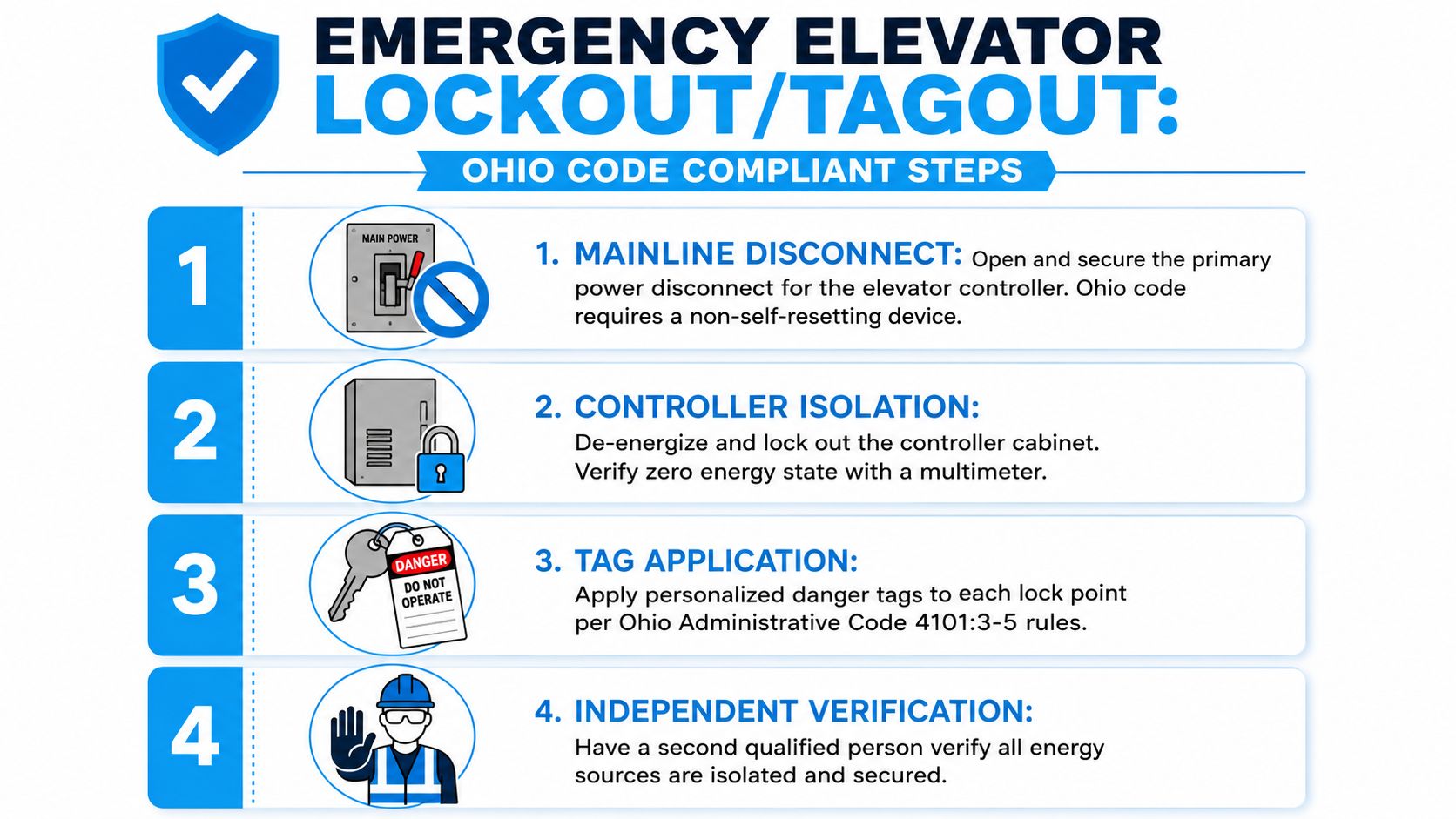
Use a controlled lockout and isolation sequence:
Stop passenger operation. Place the elevator out of service, post signs at every landing, and prevent new calls. If a passenger is trapped, maintain communication and keep untrained staff from forcing doors or entering the hoistway.
Control the water source. Coordinate sprinkler, plumbing, fire protection, or building maintenance personnel to stop the discharge where safe. Don't enter a wet machine room or pit to reach a valve or disconnect if electrical exposure is possible.
Open the mainline disconnect. Secure the elevator's primary disconnect in the open position. In a sprinkler-protected machine room, Ohio code requires an automatic shutdown device that disconnects main line power before water is applied and doesn't self-reset.
Identify every energy source. A typical commercial installation may have 480-volt three-phase power, 120-volt control circuits, battery-backed equipment, and emergency-generator feeds. Those values describe possible sources, not a permission for unqualified staff to test them.
Apply personal locks and tags. Each qualified worker should control the lock point used for the work. The person who applies a lock should be able to identify it and remove it under the site's lockout procedure.
Verify zero energy. A qualified elevator technician should use properly rated test equipment, confirm the instrument works before and after testing, and check relevant power sources rather than assuming one open disconnect has isolated everything.
Use the provided emergency elevator lockout and tagout infographic as a visual reminder of the sequence.
Manage passengers and pit hazards
If a car is occupied, keep passengers informed through the emergency communication system or another safe communication method. A fire department or trained elevator professional should decide whether a controlled release, manual lowering, or other rescue procedure is appropriate. Building staff shouldn't bypass interlocks, climb into a hoistway, or manually move a car without the required training and equipment.
Standing water creates multiple hazards. Submerged junction boxes may remain energized, hydraulic fluid may be contaminated, and wet surfaces can conceal debris or damaged components. The often-cited 18-inch clearance rule shouldn't be treated as a universal permission to operate. The governing question is whether water has reached any electrical, safety, or mechanical equipment and whether a qualified technician has verified safe conditions.
For emergency coordination, use emergency elevator repair support rather than improvising a rescue or pump-out. The elevator should remain isolated until the source is controlled, the water is removed, the equipment is inspected, and authorized personnel determine the next step.
Systematic Inspection of Elevator Components
A water event needs a component-by-component inspection, not a quick visual check from the machine-room doorway. The technician should record where water traveled, what was submerged or splashed, how long exposure may have lasted, and whether sediment, sewage, chemicals, or sprinkler residue is present.
Ohio rules require hoistways and pits to remain clean, free of rubbish, and free of accumulated water. They also prohibit using these spaces for storage and require hazardous conditions to be corrected or replaced promptly, as reflected in this Ohio and Michigan elevator maintenance communication.
Start at the machine room
Inspect traction motors, gearboxes, brakes, sheaves, controller cabinets, relays, drives, selector equipment, and overhead terminals. Look for water lines, mineral deposits, corrosion, swollen insulation, residue inside cabinets, and moisture trapped behind covers. A moisture meter can identify wet surrounding materials, but it doesn't replace insulation-resistance testing or a qualified electrical evaluation.
Solid-state controllers can be especially difficult to recover. Water may cause board delamination, corrosion beneath components, or damage that isn't visible after surface cleaning. Relays and contactors may appear serviceable while their contacts or coil insulation remain compromised. Cleaning can be reasonable where exposure is limited and testing supports it. A technician should recommend replacement when contamination is trapped inside a board, corrosion affects safety-related circuitry, or test results fail manufacturer or applicable code requirements.
Follow the hoistway downward
Guide rails, door operators, landing equipment, limit switches, traveling cables, selector tapes, governor ropes, and car-top wiring need inspection. Technicians may use visual examination, moisture readings, insulation-resistance testing, continuity checks, and dimensional checks against the equipment's manufacturer requirements and applicable safety code.
A wet traveling cable isn't automatically a replacement, but cuts, swelling, exposed conductors, contamination, or failed insulation testing are strong reasons to remove it from service. Selector tapes require attention to corrosion, tracking, alignment, and surface damage. There isn't a single public Ohio threshold that converts every moisture reading into a repair decision, so the record should identify the test method, instrument, result, manufacturer criteria, and technician's conclusion.
Treat the pit as a separate system
In the pit, inspect buffers, buffer springs, governor tension sheaves, pit switches, junction boxes, lighting, wiring, hydraulic cylinders, piping, and the sump system. Water may carry sediment into moving parts and conceal contamination around base components. Pumping alone doesn't remove residue from cable surfaces, concrete, or safety contacts.
Hydraulic units require special care. Water can contaminate fluid, damage seals, and promote corrosion inside valve assemblies or cylinders. A 500-ppm moisture threshold is used in the specified guidance as the point requiring hydraulic-fluid replacement, based on the lift-well water damage guidance. The technician should document the sampling method and laboratory or field-test basis before making that call.
| Component | Inspection method | Damage threshold | Required action |
|---|---|---|---|
| Controller cabinet | Visual inspection, moisture readings, insulation and electrical testing | Water inside the cabinet, corrosion on safety circuitry, failed test results, or trapped contamination | Isolate, clean only when technically justified, and replace affected boards or controls when testing cannot support reuse |
| Traveling cables | Visual inspection, continuity, insulation-resistance testing | Exposed conductors, swelling, contamination, physical damage, or failed insulation | Keep out of service and repair or replace according to manufacturer and code requirements |
| Hydraulic system | Fluid sampling, valve inspection, seal and cylinder assessment | Moisture at or above the cited 500-ppm replacement threshold, internal corrosion, or seal damage | Replace contaminated fluid and affected components; test before operation |
| Pit safety equipment | Visual inspection, continuity testing, functional testing | Water contact, corrosion, damaged contacts, or unreliable operation | Clean and test where permitted, otherwise replace and document |
| Guide rails and ropes | Visual corrosion assessment, alignment and condition checks | Pitting, strand separation, distortion, or contamination that affects safe operation | Obtain a qualified elevator assessment and replace components that fail safety criteria |
A good report includes photographs, serial numbers, component condition, test results, cleaning materials, replacement recommendations, and the reason each decision was made. That record supports both safe work and later review.
Documenting Damage for Insurance and Code Compliance
A flooded elevator can become a six-figure dispute when the record does not establish what happened, which components were affected, and why replacement was required. Insurance adjusters examine causation, scope, depreciation, and necessity. Ohio elevator officials need evidence that regulated equipment and safety systems satisfy applicable requirements before service resumes. “The controller got wet” answers neither review.
The financial exposure is not theoretical. Water accounted for 47% of vertical transport equipment claims, with an average claim amount of $306,890.06, while breakdown claims accounted for 24% with an average of $98,657.44, according to the Envista Forensics claims benchmark. Those figures do not determine the value of an Ohio loss, but they explain why owners should preserve evidence before cleaning, dismantling, or discarding equipment.
Build the evidence chain
Write the event timeline while details are available. Record when water was found, alarms activated, the source was shut off, the elevator stopped, power was isolated, pumping started, and each contractor arrived. Attach witness names, work orders, alarm screenshots, weather observations, and maintenance records.
Photographs must establish both location and condition:
- Wide views: Show the machine room, hoistway openings, pit, water lines, and affected building areas before cleanup.
- Close views: Record corrosion, sediment, water marks, wet insulation, damaged boards, cable contamination, and labels.
- Identity records: Photograph manufacturer plates, controller labels, serial numbers, and component part numbers before removal.
- Measurement records: Log moisture readings, test instruments, calibration information, locations, dates, and technician names.
- Causation evidence: Photograph the failed pipe, roof leak, drain, sump, or other source that introduced the water.
Keep failed parts identifiable. Tag removed boards, switches, cables, and other components with their location, removal date, and observed condition. A component without that chain of custody is harder to connect to the loss, even if it is visibly damaged.
Bring in an independent elevator or restoration consultant if the insurer questions replacement, alleges pre-existing wear, or receives conflicting contractor scopes. The guidance on documenting damaged elevators emphasizes photographs, witness notes, timing, and itemized repair proposals. That information helps separate sudden water exposure from long-standing deterioration.
Separate the two review tracks
| Documentation element | Insurance adjuster requirement | Ohio code inspector requirement |
|---|---|---|
| Event timeline | Establishes cause, duration, and relationship to failure | Shows when the unit was removed from service and what actions followed |
| Photographs | Supports scope, causation, and depreciation review | Shows condition of safety equipment and affected spaces |
| Test results | Supports cleaning, repair, or replacement pricing | Demonstrates whether equipment can safely return to service |
| Itemized proposal | Separates labor, parts, restoration, and betterment | Identifies altered or replaced regulated equipment |
| Maintenance history | Helps distinguish pre-existing wear from water damage | Shows whether required maintenance and inspections were performed |
| Permit and inspection records | Supports covered repair and compliance costs | Establishes authorization and final approval where required |
Ohio municipalities may impose additional reporting duties. Cleveland, for example, has historically required immediate reporting of device damage when repairs or replacements exceed $25. The Ohio flood-resistant construction documentation describes that type of requirement and shows why elevator damage may be treated as a regulated incident rather than ordinary upkeep. Confirm the current rule with the local authority and the Ohio Department of Commerce before relying on an older form or deadline.
Retain original photographs, not only compressed text-message copies. Preserve removed parts if the insurer or inspector may examine them, and obtain written authorization before disposal. For service history and preventive records, Ohio elevator maintenance guidance offers an operational reference. Clear documentation protects the claim, supports code review, and gives the licensed elevator contractor a defensible basis for each repair or replacement decision.
Drying Testing and Return to Service
Drying an elevator is a controlled recovery process. It isn't safe to wait until surfaces feel dry and close the disconnect. Moisture can remain inside cabinets, cable jackets, insulation, hydraulic components, and masonry long after visible water disappears.
Begin by pumping standing water through appropriate equipment and verifying that the sump, discharge route, float, and backup provisions work. Keep passengers and unauthorized staff away from the elevator. The practical remediation sequence is isolation, water removal, dehumidification, air movement, contamination inspection, electrical assessment, testing, and documented restoration, consistent with the lift-well remediation sequence.
Dry in stages
Use dehumidification and air movement in the pit, hoistway, and machine room while monitoring conditions. A detailed lift-well example required 8 days of desiccant dehumidification plus 2 air movers after pit pumping to dry surrounding brickwork, which illustrates why a complete dry-out can take days rather than hours. Don't use heat or airflow to push moisture into another building area without controlling humidity and contamination.
The supplied return-to-service visual shows the intended sequence:
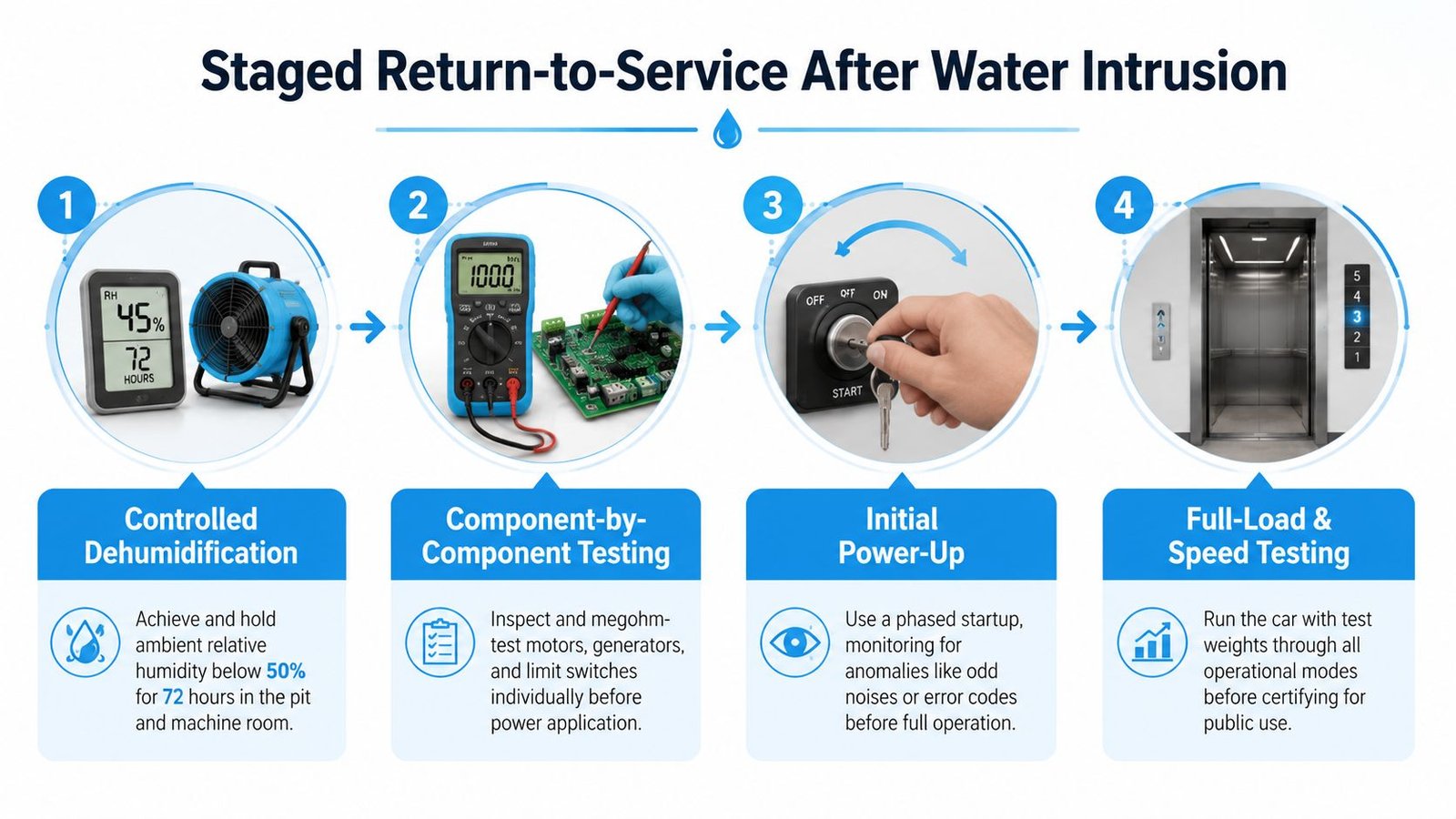
Before energizing, the technician should inspect and test motors, generators, limit switches, controller equipment, traveling cables, door circuits, pit safety contacts, and emergency systems. Dielectric and insulation testing must follow equipment requirements and safe procedures. A failed reading, internal corrosion, delaminated board, separated rope strand, or contaminated hydraulic valve assembly is a replacement decision, not a drying problem.
Restore power deliberately
A qualified technician should energize systems in a controlled order, watching for abnormal current, arcing, fault codes, noise, heat, or unexpected movement. The car should then undergo door, leveling, limit, safety, emergency communication, fire service, and operational tests before any passenger use.
Replacement of a controller, hoisting machine, or safety device may trigger permit and inspection requirements. Ohio elevator work is governed by permits and formal controls, and affected equipment shouldn't return to service merely because a contractor says it starts. The owner should receive a written scope, test record, list of replaced parts, permit information where applicable, and confirmation of the required inspection or approval.
Prevention and When to Call Crane Elevator Company
The cheapest elevator water-loss strategy is early detection. Ohio's rules prohibit water from accumulating in pits and restrict plumbing in elevator shafts and machine rooms, with limited exceptions for drains, sumps, and sump pumps. That design approach makes prevention practical: keep water out, detect it quickly, and prove that the drainage system works.
Michigan and Ohio owners also need a maintenance calendar that reflects local requirements. Ohio requires passenger and freight elevators, escalators, and moving walks to be inspected twice every twelve months, while permanently installed lifting equipment not designed to carry people generally requires inspection at least once every twelve months. Private-residence elevators are exempt from that statewide frequency, as summarized in Toledo elevator maintenance guidance. Michigan requires power elevators, with specified private-residence exceptions, to be maintained at least once every 90 days by a state-licensed elevator journeyperson and requires many elevator and conveyance types to be inspected at least once every 12 months, according to the Michigan elevator rule.
Prevent the repeat event
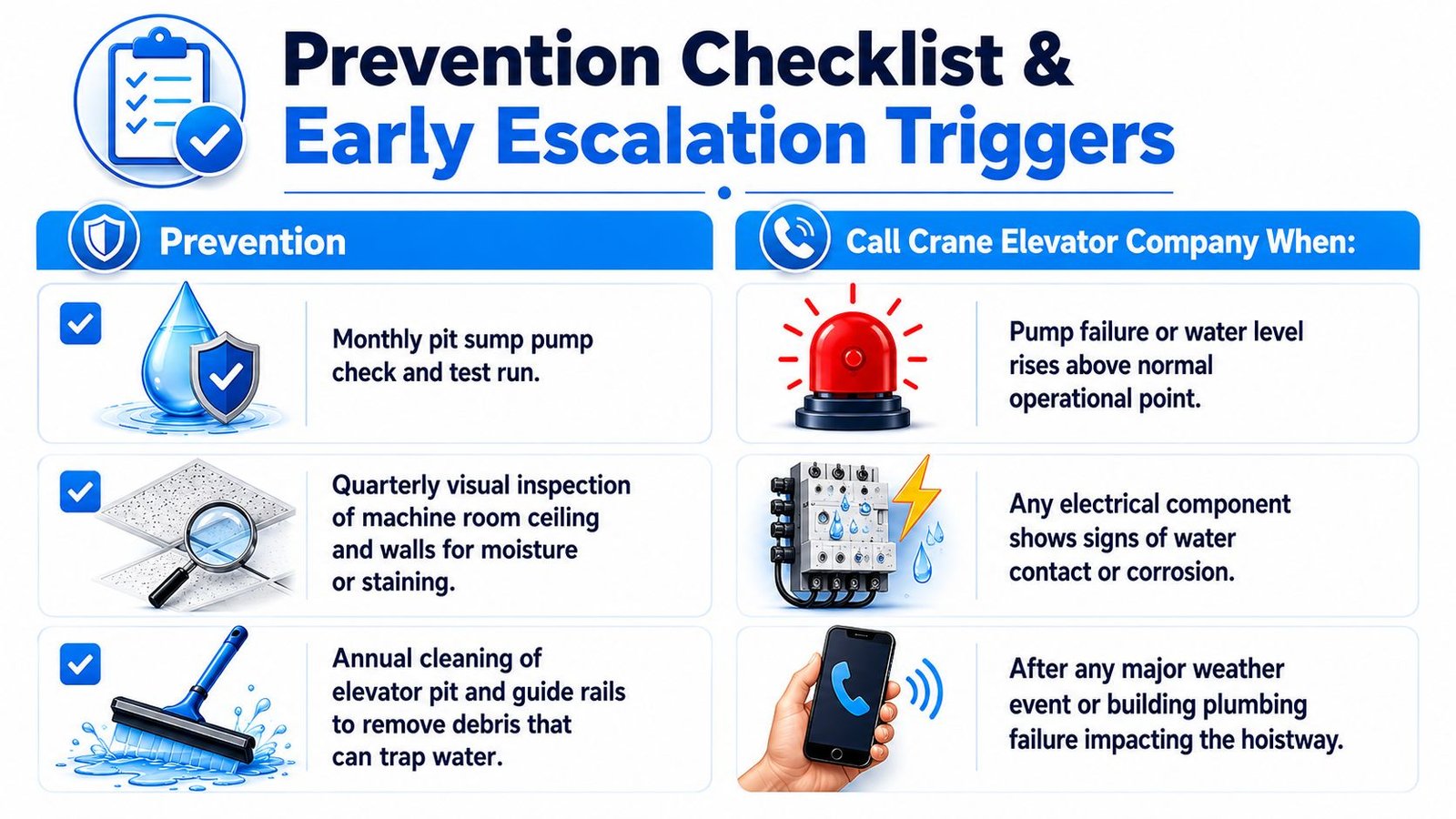
- Test drainage: Run pit sump pumps, verify floats, inspect discharge lines, and confirm that the drain can handle the expected flow before spring thaw and heavy rain.
- Inspect overhead sources: Check ceilings, walls, roof penetrations, HVAC equipment, plumbing chases, and sprinkler piping above machine rooms and hoistways.
- Monitor low points: Connect water-sensing alarms at pits and machine rooms to the building management system where appropriate.
- Keep spaces serviceable: Remove debris, maintain access, and don't use pits or hoistways for storage.
- Review modernization work: Michigan treats non-like-for-like work that requires adjustment, testing, or programming as an alteration requiring a permit and inspection, as explained in the Michigan elevator policy document.
Call a licensed elevator contractor immediately if water contacts a controller, safety circuit, hoisting machine, or door operator. Escalate when the pit contains significant standing water, hydraulic fluid may be contaminated, corrosion is visible, the sump has failed, passengers are trapped, or a fire suppression discharge has entered the hoistway. Building staff can stop the source and protect the area, but they shouldn't diagnose energized elevator equipment or authorize passenger service.
Crane Elevator Company performs maintenance, repair, and modernization services in Michigan and Ohio, including Toledo and surrounding cities. Its work covers commercial, healthcare, education, industrial, municipal, residential, wheelchair-lift, material-lift, and dumbwaiter systems, with non-proprietary solutions for all makes and models. For a water event, have the building address, elevator identification, source of water, alarm time, current shutdown status, photographs, and insurer contact ready when calling.
Crane Elevator Company provides 24/7/365 emergency response, water-damage assessment, maintenance, repair, code-required inspections, and non-proprietary modernization across Michigan and Ohio, including Toledo and surrounding communities. If your elevator has experienced water intrusion, visit Crane Elevator Company to request qualified help, a second opinion, or a clear plan for safe, documented return to service.