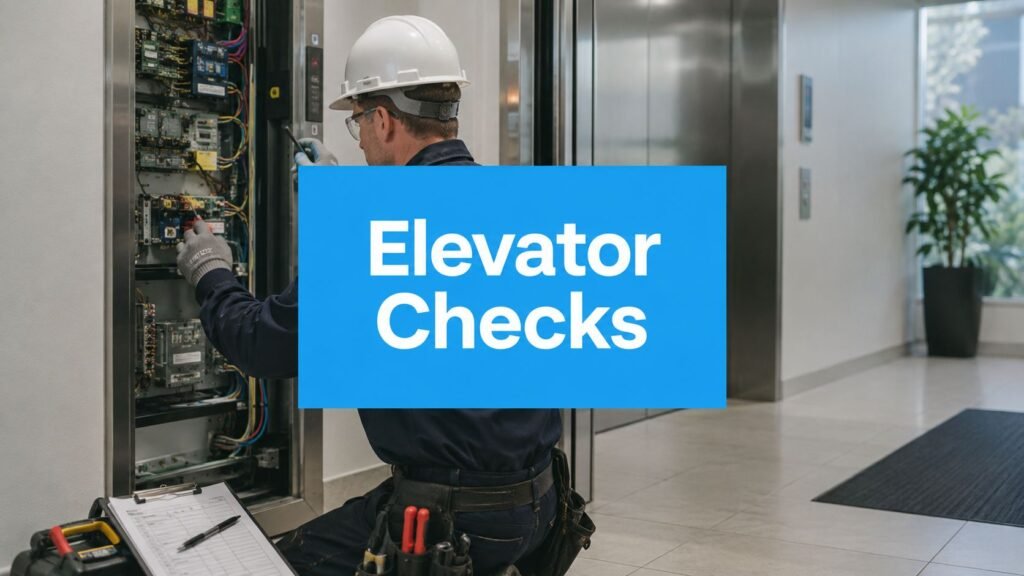
The surprising part of preventive elevator maintenance in Toledo is that it's tied to a fixed legal cycle, not just a building owner's preferred service calendar. Ohio requires passenger elevators, freight elevators, escalators, and moving walks to be inspected twice every twelve months, while permanently installed non-person-carrying power dumbwaiters, hoists, and similar equipment must be inspected at least annually, with private-residence equipment treated separately under the state rule (Ohio elevator law). Preventive service fills the space between those inspections.
This seven-part checklist organizes practical checks by both maintenance frequency and elevator system. Building owners and facility teams can handle observation, access, housekeeping, and record control. Qualified elevator professionals should handle safety testing, hydraulic work, controls, door locks, repairs, inspections, and modernization. Crane Elevator Company supports that full lifecycle across Michigan and Ohio, including Toledo, Perrysburg, and surrounding communities.
1. Crane Elevator Company
Crane Elevator Company is the strongest fit for owners who want preventive maintenance connected to repairs, inspection support, and modernization instead of a narrow oil-and-grease visit. The family-owned Michigan and Ohio contractor brings over 25 years of hands-on experience and serves building owners, facility managers, contractors, homeowners, and property managers across markets including Detroit, Ann Arbor, Lansing, Toledo, Perrysburg, Flint, and Kalamazoo. Its work covers passenger and freight elevators, hydraulic and traction systems, residential elevators, wheelchair lifts, material lifts, and dumbwaiters. Visit Crane Elevator Company for the company's service details.
The maintenance scope is unusually practical. Crane includes machine-room, pit, and car-top clean-downs, along with COP and PI bulb replacement, in its proactive program. Technicians can monitor door locks, service hydraulic packing, and replace jacks, cables, tanks, power units, motors, sheaves, and machines when condition or code requirements demand it. The same team can perform safety tests, emergency phone and fire-service testing, generator testing, and violation corrections.
Why the program works for Toledo buildings
Crane's strongest differentiator is its non-proprietary modernization approach. Owners can upgrade controls and related systems without automatically creating vendor lock-in, allowing any qualified provider to service the modernized elevator. That matters when a building manager wants competitive service options over the equipment's remaining life.
The company also offers 24/7/365 field operations for emergency response, free second opinions, competitive quotes, a price-beat promise, and commercial and modernization financing. Its stated No Show, No Pay maintenance guarantee gives owners a clear customer-service standard, while financing can make a larger modernization project easier to budget.
Practical rule: A maintenance agreement should explain what technicians will inspect, clean, adjust, document, and escalate. A low price isn't useful if recurring defects remain unexplained.
Crane's trade-off is geographic. Its service footprint is regional, so owners outside Michigan and Ohio need another provider. The website also doesn't publish third-party certifications, awards, detailed warranty terms, or specific parts policies. Ask about technician qualifications, OEM warranty impacts, parts availability, and modernization documentation before signing. For Toledo facilities that want one regional partner for maintenance, repair, inspection support, violation correction, and non-proprietary modernization, Crane deserves the first quote.
2. Toledo Elevator & Machine Co.
Toledo Elevator & Machine Co., an Elevator Service Inc. company, is a logical comparison for owners who prioritize long-standing local coverage in Toledo, Northwest Ohio, and Southeast Michigan. Its service model includes maintenance, repair, inspections, testing, modernization, violation correction, and new installations. The company emphasizes independent, non-proprietary solutions and local technicians, which can help facility teams avoid a maintenance plan that only supports one manufacturer's equipment.
Best fit for local portfolios
The company promotes preventive maintenance programs with 24/7/365 dispatch, local coverage, in-house testing, and violation corrections. Its stated same-day service aim is useful for commercial properties where a stalled elevator affects residents, deliveries, accessibility, or production. A multi-state parent organization provides broader resources while the local operation retains a Toledo-area identity.
Owners should still compare the written scope carefully. Ask whether routine visits include door equipment, machine-room housekeeping, pit and car-top conditions, hydraulic or traction components, emergency communication, and documentation of adjustments. Ask how the contractor analyzes callbacks, because repeated door faults or leveling complaints can reveal ineffective servicing even when visits occur.
- Strength: Deep Toledo metro familiarity and access to broader parent-company resources.
- Strength: Non-proprietary orientation can preserve service flexibility.
- Limitation: No public price sheet is available, so a site survey and written quote are necessary.
- Limitation: Very new OEM-locked systems may require manufacturer-specific tools or data access.
For a detailed comparison of service scope and local options, review Crane's Toledo elevator maintenance service. The best choice between these providers will depend on equipment age, controller type, traffic, inspection history, and the response terms written into the agreement.
3. Vertical Mobility of Toledo, LLC
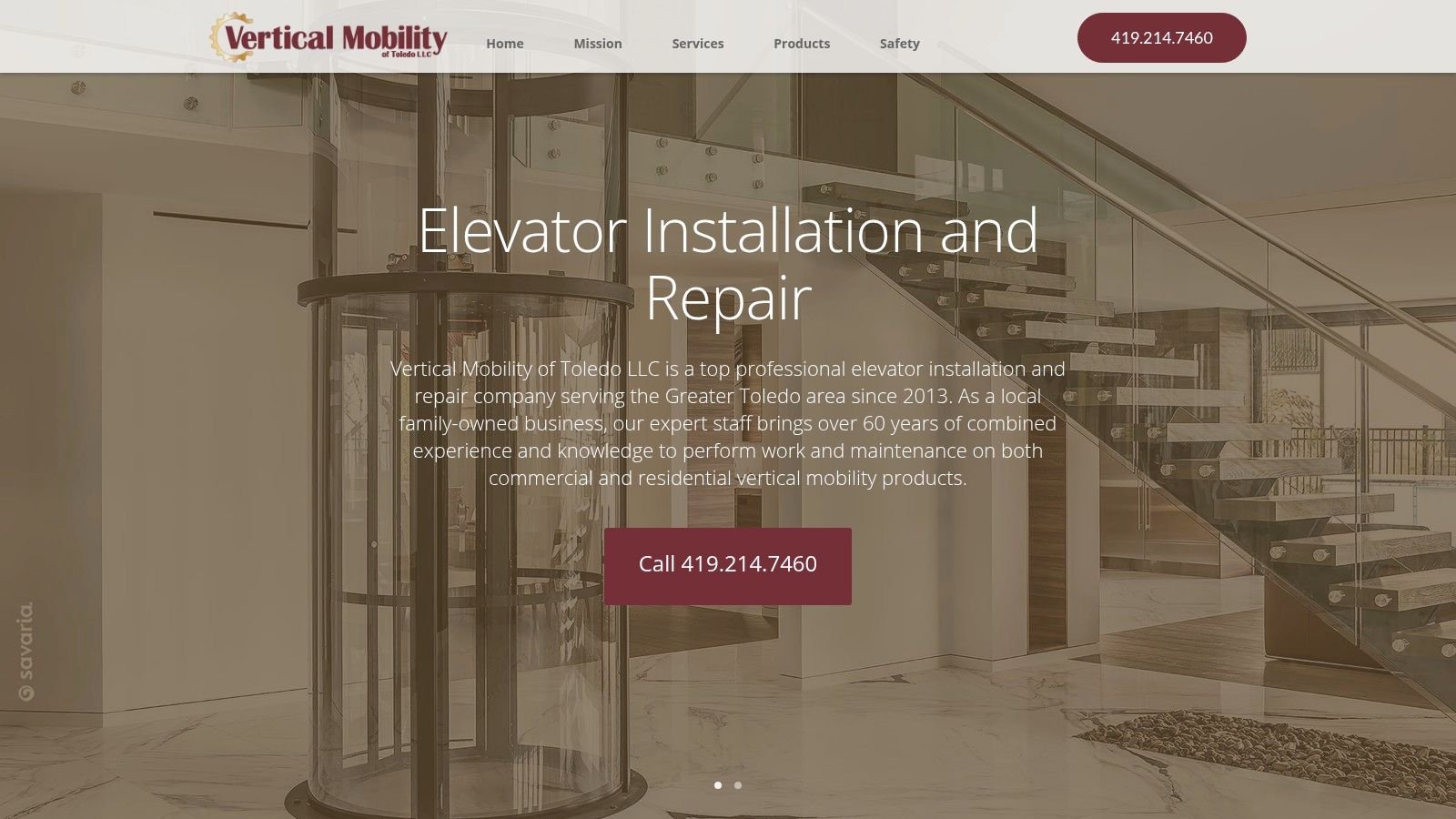
Vertical Mobility of Toledo, LLC suits owners who prefer a family-owned independent with direct local access. The company provides installation, preventive maintenance, repairs, modernizations, inspections, and violation corrections for commercial elevators, LULAs, accessibility lifts, and residential elevators. Its portfolio is broader than standard passenger equipment, which matters for schools, housing authorities, public buildings, and properties that combine elevators with wheelchair or platform equipment.
Strong coverage for mixed equipment
The company advertises 24/7 emergency calls and maintenance plans intended to reduce callbacks and downtime. Its familiarity with annual and full-load testing, along with Category 1, 3, and 5 testing environments, gives facility managers a useful point for discussing the difference between routine maintenance and formal safety testing. Qualified professionals must define the exact test requirements for each installation and coordinate the work with the applicable authority.
Building owners can handle daily observation and reporting, but they shouldn't adjust door locks, alter controls, bypass safety circuits, or work on hydraulic equipment. Those actions belong to qualified elevator personnel. Crane's explanation of preventive elevator maintenance is another useful reference when comparing whether a proposal covers proactive service or only reactive calls.
Vertical Mobility's advantages are local responsiveness, direct owner access, and experience with commercial and accessibility equipment. Public references include property management, public safety, and housing authority work. The smaller-team model may also mean faster decisions on local issues.
The trade-offs deserve equal attention. A smaller operation may have longer lead times for niche proprietary parts, and its public listing doesn't detail warehouse capacity or on-site inventory. Ask who handles after-hours calls, how parts are sourced, how inspection records are delivered, and whether the proposal includes a written callback review. Those answers will show whether the plan is built around measurable service results or just scheduled attendance.
4. Schindler Elevator Corporation
Schindler Elevator Corporation's Toledo service operation is based in Holland, Ohio, and offers preventive maintenance, modernization, 24/7 service, and multi-brand support. This is the kind of provider that can appeal to facility managers with several buildings, mixed equipment, or a preference for standardized reporting. Schindler also offers digital portfolio tools, including Schindler Ahead and Ahead ActionBoard, with remote diagnostic and performance-reporting capabilities.
When digital visibility matters
Remote data can help a facilities team identify recurring service activity, open issues, and equipment trends without waiting for a paper visit report. It doesn't replace a technician's physical inspection, safety test, or repair judgment. It's most useful when the building owner receives clear explanations of what the data means and which actions still require an on-site professional.
Schindler's local office and 24/7 emergency hotline provide a direct Toledo-area contact. Its engineering support, technician bench, and parts pipeline can be valuable for large portfolios or complex modernization programs. The company can also service equipment from multiple manufacturers, which prevents a mixed-brand building from needing a separate contract for every elevator.
The trade-off is the structure of OEM service. Contracts may be more standardized, and change orders or OEM parts can cost more than comparable independent proposals. Owners should ask whether the proposed modernization leaves the system serviceable by qualified providers, what data remains accessible after the project, and whether any existing warranties or proprietary features limit future choices.
Crane's Toledo elevator repair service is worth comparing when the priority is a regional, non-proprietary repair and modernization path. For either provider, require a scope that separates preventive work, corrective repairs, code upgrades, testing, and modernization recommendations. That separation makes competing quotes easier to evaluate.
5. TK Elevator
TK Elevator serves the Toledo area with preventive maintenance, repair, and modernization supported by local technicians, national engineering, and parts logistics. Its full-line capabilities cover hydraulic and traction elevators, and its OEM position provides access to diagnostic tools and technical bulletins for TK equipment. For owners managing several sites, that combination can make standardization and long-term planning easier.
A TK maintenance proposal should identify what the technician will check on each visit and what the facility manager will receive afterward. Look for explicit treatment of door operation, leveling, hydraulic fluid and packing where applicable, traction components, controller faults, safety devices, emergency communication, and unresolved deficiencies. A generic “routine maintenance” line doesn't tell an owner whether the contractor is addressing the actual failure patterns in the building.
TK's modernization packages and code-upgrade capabilities can be useful when an aging elevator needs more than component replacement. National parts logistics may support local dispatch, and a single provider can connect ongoing service with a longer modernization roadmap. That's particularly relevant when the owner wants to phase work around school calendars, hospital operations, industrial production, or municipal schedules.
The main limitations are flexibility and equipment access. Contract terms and OEM parts pricing may be less negotiable than those of an independent contractor. For non-TK proprietary controllers, access to certain tools or data may also be limited or slower. Ask whether a proposed controller replacement is proprietary, what documentation will be delivered, and whether qualified third-party providers can service the completed system.
A sound comparison isn't independent versus OEM. It's the practical question of whether the provider can document failures, correct root causes, support required tests, and give the owner a serviceable system for the next phase of its life.
6. KONE Service and Maintenance
KONE provides regional service for Ohio and the Toledo area, including preventive maintenance across major elevator brands. Its connected and predictive maintenance options, remote monitoring, customer portals, and 24/7 support are designed for owners who want centralized service management. KONE can also work on doors and escalators, which may simplify procurement for a campus or public facility with several types of vertical transportation.
Useful for centralized facilities management
A national process can help when a company manages multiple buildings and needs consistent escalation, reporting, and call handling. Remote monitoring may provide earlier visibility into faults, but facility managers should ask which alarms are monitored, who reviews them, and how quickly a data alert becomes a technician visit. Connectivity is only valuable when the contract defines the response.
KONE's multi-brand capability is a practical advantage for mixed portfolios. Its regional teams and national training structure may also appeal to public-sector and commercial owners who need repeatable procedures across locations. Still, a large provider's strengths can become limitations for a single building with unusual equipment or a highly negotiated service requirement.
- Best use: Multi-building portfolios that value portals, centralized reporting, and consistent processes.
- Best question: Does the proposal cover the equipment installed, including doors and related systems?
- Watch point: Regional coverage may not provide the same local office presence as a Toledo-based independent.
- Contract review: Confirm exclusions, parts treatment, emergency response, testing responsibilities, and documentation standards.
Owners should compare KONE's digital reporting with the actual maintenance record they need for compliance and budgeting. The record should show the system checked, defects found, corrective work, parts recommended, and follow-up status. A dashboard can support that record, but it shouldn't replace a technically specific service report.
7. Otis Otis Signature Service
Otis provides Toledo service through its regional network, with 24/7/365 OTISLINE dispatch, proactive maintenance programs, the eService customer portal, and optional Elite remote monitoring. Its scale is attractive for owners with legacy Otis, Westinghouse, or Montgomery equipment, as well as multi-building portfolios that need centralized communications and parts support.
Otis's large engineering and field resources can be especially useful when a building contains older equipment with difficult-to-source components. Remote diagnostics may help the service team prepare for a visit, while reporting tools give facility managers a way to track calls and planned work. Those tools don't eliminate the need for physical inspection, cleaning, adjustment, testing, or proper repair.
The primary trade-off is formal OEM contracting. Service terms may cost more than an independent proposal covering a similar routine scope, and software or diagnostic tools for newer Otis systems may remain proprietary. Owners should ask what the contract includes, which repairs are excluded, how emergency response is defined, and whether modernization preserves future service choice.
For Toledo operators, the right selection depends on the elevator's controller, age, traffic, inspection history, and the building's tolerance for downtime. An OEM may be the practical choice for specialized equipment and parts access. An independent may offer more flexible modernization and service terms. Crane Elevator Company's regional, non-proprietary approach is worth including in that comparison, particularly when the owner wants maintenance, repair, inspection support, violation correction, and modernization from one provider.
Toledo Preventive Elevator Maintenance, 7-Company Comparison
| Provider | Implementation complexity | Resource requirements | Expected outcomes | Ideal use cases | Key advantages |
|---|---|---|---|---|---|
| Crane Elevator Company | Moderate, favors non‑proprietary modernizations | Regional field crews, parts, financing options | Reduced lifetime repair costs; improved availability | Local commercial, residential, budget‑sensitive modernizations | Non‑proprietary service, 24/7 response, price‑beat, financing |
| Toledo Elevator & Machine Co. (Elevator Service Inc.) | Moderate, local, established processes | Local technicians, in‑house testing, parts access | Fast response; compliant inspections and corrections | Toledo/NW Ohio portfolios needing local expertise | Deep local knowledge, 24/7 dispatch, multi‑state backing |
| Vertical Mobility of Toledo, LLC | Low–Moderate, hands‑on, owner‑driven | Small local team, IUEC affiliation, targeted parts | Quick local response; strong references; accessibility focus | LULA, accessibility lifts, local property managers | Strong local references; accessibility and LULA expertise |
| Schindler Elevator Corporation – Toledo | High for mixed fleets; streamlined for Schindler units | Large tech bench, OEM parts, IoT tools (Ahead) | Improved uptime via remote diagnostics and reporting | Multi‑brand portfolios needing OEM engineering support | OEM engineering, Ahead remote monitoring, parts pipeline |
| TK Elevator – Toledo service area | High for cross‑vendor retrofits; standardized OEM options | National parts logistics, OEM diagnostic tools | Scalable modernization roadmaps; reliable parts delivery | Large, multi‑site portfolios and TK equipment owners | Nationwide scale, OEM diagnostics, modernization packages |
| KONE – Service and Maintenance | High for proprietary integrations; predictive options available | Regional teams, predictive/remote monitoring, portals | Predictive maintenance; consistent performance reporting | Public/commercial portfolios wanting connected maintenance | Predictive monitoring, multi‑brand service, door/escalator support |
| Otis – Otis Signature Service | High for proprietary features; strong legacy support | Large field force, rapid parts logistics, remote tiers | High uptime for Otis/legacy units; robust reporting | Complex, multi‑building portfolios and legacy fleets | Extensive parts/engineering, OTISLINE dispatch, Elite monitoring |
Turn the Checklist Into a Service Record
A checklist only protects a building when someone records the result. Create a dated maintenance log for every elevator and record the system checked, issue found, action taken, responsible party, and required follow-up. Keep service reports with inspection certificates, violation notices, test results, repair approvals, modernization documents, and communications about equipment taken out of service.
Ohio's inspection cycle makes that record especially important. Passenger elevators, freight elevators, escalators, and moving walks require inspection twice every twelve months, while certain non-person-carrying lifting equipment follows an annual interval (Ohio elevator inspection baseline). Ohio administrative rules also require periodic safety tests for every elevator and at least one full-load safety test every five years under ASME A17.1 standards (Ohio elevator safety-test requirements). Owners should coordinate those requirements with a qualified elevator contractor rather than treating routine observation as a substitute for testing.
Michigan properties need a separate schedule. Most elevators, escalators, moving walks, material lifts, barrier-free lifting devices, and special elevating devices require inspection at least annually. Dumbwaiters, stairway chairlifts, platform lifts, and similar lower-risk devices generally follow a two-year inspection interval, while personnel hoists are inspected every 30 days under Michigan's rule (Michigan elevator inspection intervals). Michigan also requires maintenance inspections and tests after installations enter service, with car and counterweight safeties and governors tested at intervals of no more than twelve months by qualified personnel in the presence of an authorized inspector when available (Michigan maintenance testing rule).
Owners can observe, report, document, and control access. Qualified elevator professionals must handle safety devices, testing, hydraulic work, controls, door locks, repairs, inspections, and modernization.
Ask every contractor for a written scope and quote. The scope should distinguish scheduled preventive service from corrective repairs, code-required inspections, testing, violation correction, and capital modernization. It should also identify exclusions, response terms, parts policies, report format, and who schedules the authority having jurisdiction.
For Toledo and surrounding Michigan and Ohio communities, Crane Elevator Company can provide preventive maintenance, fast repairs, code-required inspection support, safety testing, violation corrections, and full non-proprietary modernization. Owners should request a free second opinion when a repair recommendation is unclear, compare competitive quotes, and ask about commercial or modernization financing before approving major work. The right service record gives the owner more than proof of a visit. It creates a defensible maintenance history, highlights recurring defects, supports budget decisions, and helps determine when repair no longer makes sense.
Crane Elevator Company provides proactive maintenance, repairs, inspection support, violation correction, and non-proprietary modernization for elevators and lifting equipment across Toledo, Michigan, and Ohio. Request a documented service scope, free second opinion, competitive quote, or financing information before the next breakdown turns into an urgent project.