
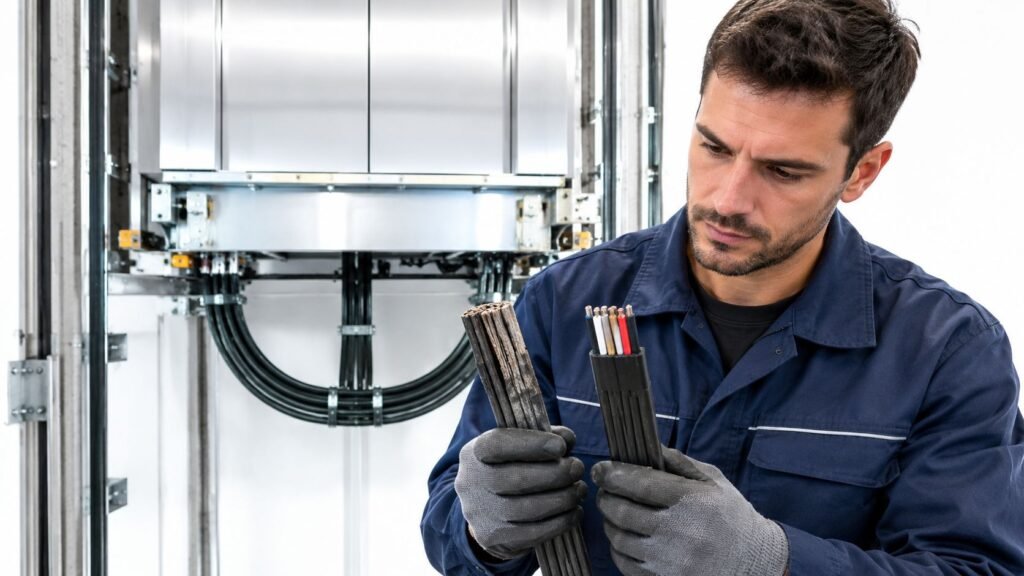
Your freight car hesitates near the top floor, then runs fine for the rest of the morning. The controller shows no hard fault, and the car passes a quick check at the landing. That pattern points many facility managers toward the traveling cable, because a cable can behave at rest and fail only when its loop bends in one part of the run.
Replacement Benchmarks at a Glance
A cable can still pass an electrical test while its repeated bends are weakening the assembly. For a facility manager, age and budget are useful planning inputs, but inspection evidence and the cable’s movement through the hoistway should guide the replacement decision.
A Washington State rulemaking document on traveling cable life and replacement cost cites an approximately 20-year operational life expectancy and a replacement cost of $2,500 to $3,500 per cable. Treat these as planning references, not a service-life guarantee or a current quote.
Traveling Cable Planning Benchmarks
| Benchmark | Figure | How to Use It |
|---|---|---|
| Operational life expectancy | About 20 years | Use as a prompt to review condition and budget for renewal |
| Replacement cost per cable | $2,500 to $3,500 | Use as a planning range, then confirm the actual scope and price |
| Spare conductor guidance | Greater of 10% or 10 conductors | Confirm applicable requirements and cable design before ordering |
The life expectancy alone cannot tell you whether the cable is ready for replacement. A low-use car and a busy freight car put different demands on the same type of cable. Travel distance, car speed, bending radius, loading, temperature, moisture, chemical exposure, installation quality, and flexing frequency all affect service life.
Look for evidence at the bend and suspension points, including jacket damage, deformation, inconsistent loop shape, or conductors that show intermittent faults during movement. A static electrical test can miss a mechanical problem that appears only as the cable travels. Record where the cable bends and how its loop tracks through the run, then compare those observations with the test results.
The cost figure is useful for budgeting a cable-level repair. It does not establish what a replacement will cost at a particular site, or whether the work should be bundled with other modernization. Define the cable scope from the inspection findings, and separate needed cable work from unrelated upgrades.
Practical rule: Age tells you when to inspect closely. Condition and movement evidence tell you whether to replace.
What a Traveling Cable Is and How It Is Built
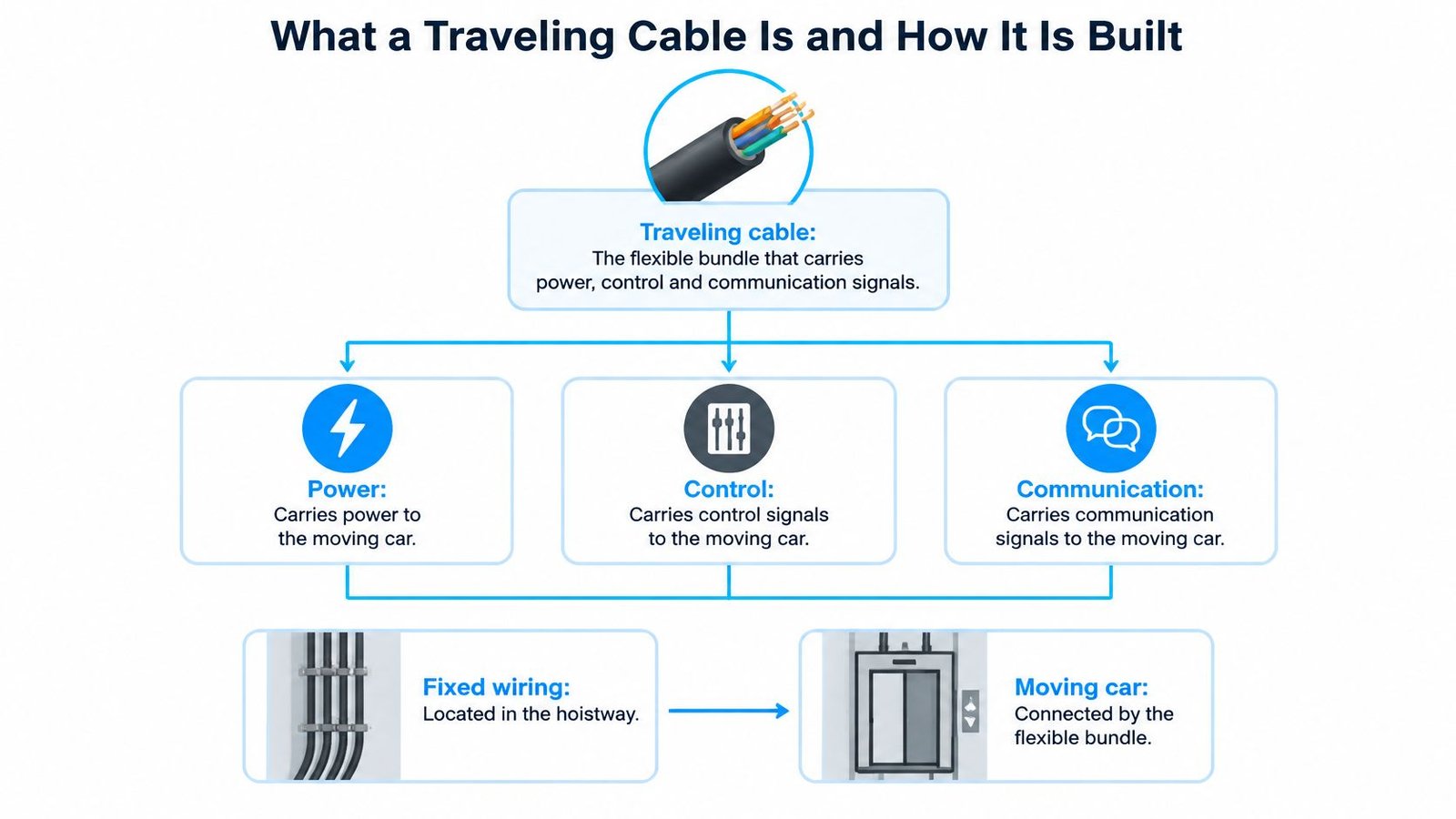
When a car moves through the hoistway, its flexible cable hangs in a loop that shifts position with each trip. The traveling cable is the main flexible link carrying power, control, and communication signals between fixed hoistway wiring and the moving car. Depending on the installation, it serves circuits such as car lighting, door controls, and emergency communication.
The loop behaves like a hose suspended between a fixed point and a moving one. It bends as the car travels, so the cable’s shape, support, and contact with clamps or other hardware matter as much as its electrical performance.
Built From the Inside Out
A traveling cable combines copper conductors with insulation, bundling, and an outer jacket. The conductor count and sizes must suit the circuits in the car. Signal circuits may use shielded pairs or coaxial conductors to limit interference. These details belong on the replacement specification, not just in a visual comparison of cable diameter.
The bundle’s construction also affects how it moves. Fillers can help organize conductors within a round cable, while flat cable places conductors side by side. The jacket must suit the installation environment and the cable’s movement. For a long suspended run, an integral support member may carry cable weight. Confirm the support design and attachment points before ordering; they affect the cable’s fit and how the load is carried.
A cable can pass a continuity check while its construction or condition is already affecting movement. Electrical readings alone do not show whether the cable fits the loop, rubs against hardware, or bends properly. Inspection evidence and the actual travel path should guide the repair-or-replacement decision, rather than age alone.
Traveling Cable Types and Where Each Fits
| Type | Build | Typical Use | Watch For |
|---|---|---|---|
| Round multi-conductor | Conductors bundled around filler in a round jacket | Passenger and freight cars | Twisting or kinking from poor installation |
| Flat (ribbon) | Conductors arranged side by side in a flat jacket | Tight hoistways and limited loop space | Compatibility with sheave and clamp geometry |
| Round with integral support member | Steel or fiber support member within the cable | Long suspended runs | Fatigue at clamps and support attachments |
| Communication add-on | Shielded twisted pairs or coaxial conductors | Emergency phones, cameras, card readers | Shield grounding and separation from power conductors |
For elevator traveling cable replacement, match conductor count, voltage, shielding, communications wiring, jacket construction, length, and support method to the elevator’s circuits and hoistway geometry. A similar-looking diameter does not confirm that a cable suits the loop, clamps, or electrical load. Check the cable’s construction against the equipment it must connect and the path it must travel.
Why Traveling Cables Fail Before Their Time
Take a paperclip and bend it back and forth at the same spot. Each bend feels harmless. Then the metal fatigues and snaps.
A traveling cable follows the same logic, except the bending repeats on every trip and the damage starts inside. Conductor strands can break down progressively while the jacket still looks presentable from the car top. That’s why age alone is a weak predictor, and why guidance on flat traveling cable deterioration and inspection ties replacement timing to observed deterioration and operating conditions.
This comparison shows the kind of fatigue pattern technicians are trained to take seriously.

The Freight Car That Passed at Rest
Consider a freight car in an older mixed-use building that starts stopping at odd floors. Continuity checks at rest look fine. A technician riding the run then finds a flattened section where the cable rubs a clamp as the loop travels.
That flattened spot explains the intermittent behavior. At one car position the conductors make contact, and at another the damaged section bends and opens up. The fault moves with car position because the damage is mechanical first and electrical second.
Failure Mechanisms in the Order Technicians Encounter Them
- Cyclic flex fatigue: Repeated bending damages conductor strands and insulation over time, often before the jacket fails visibly.
- Tight bend radius: A loop forced into too sharp a curve concentrates stress in the same section on every run.
- Kinking and snagging: Guides, brackets, and shaft equipment catch the cable and create permanent deformation.
- Uncontrolled sway: A missing or poorly set tensioning arrangement lets the cable rub, twist, or swing into hoistway equipment.
- Shaft environment: Moisture, oil, heat, chemicals, and abrasion attack the jacket and then the insulation beneath it.
A cable that has lost flexibility or can’t move smoothly deserves investigation even when continuity still passes. Mechanical damage can arrive well before a clean electrical failure. Stiffness, a permanent kink, or a loop that no longer hangs freely are findings, not cosmetic quirks.
An intermittent fault that comes and goes with car position is a mechanical clue. Treat it that way until inspection proves otherwise.
The acceptance standard after any repair or replacement is broader than a meter reading. The cable must move without rubbing, binding, twisting, or transferring motion-induced force into terminals through the full run. If it can’t do that, it hasn’t passed, no matter what a static test says at one landing.
How to Inspect a Traveling Cable Step by Step
Inspection has to cover the cable in motion and at rest, because each view catches different problems. A qualified technician should lead the work, since the cable is energized and sits near moving equipment. Building staff can support access and records, but they shouldn’t improvise hands-on checks in the hoistway.
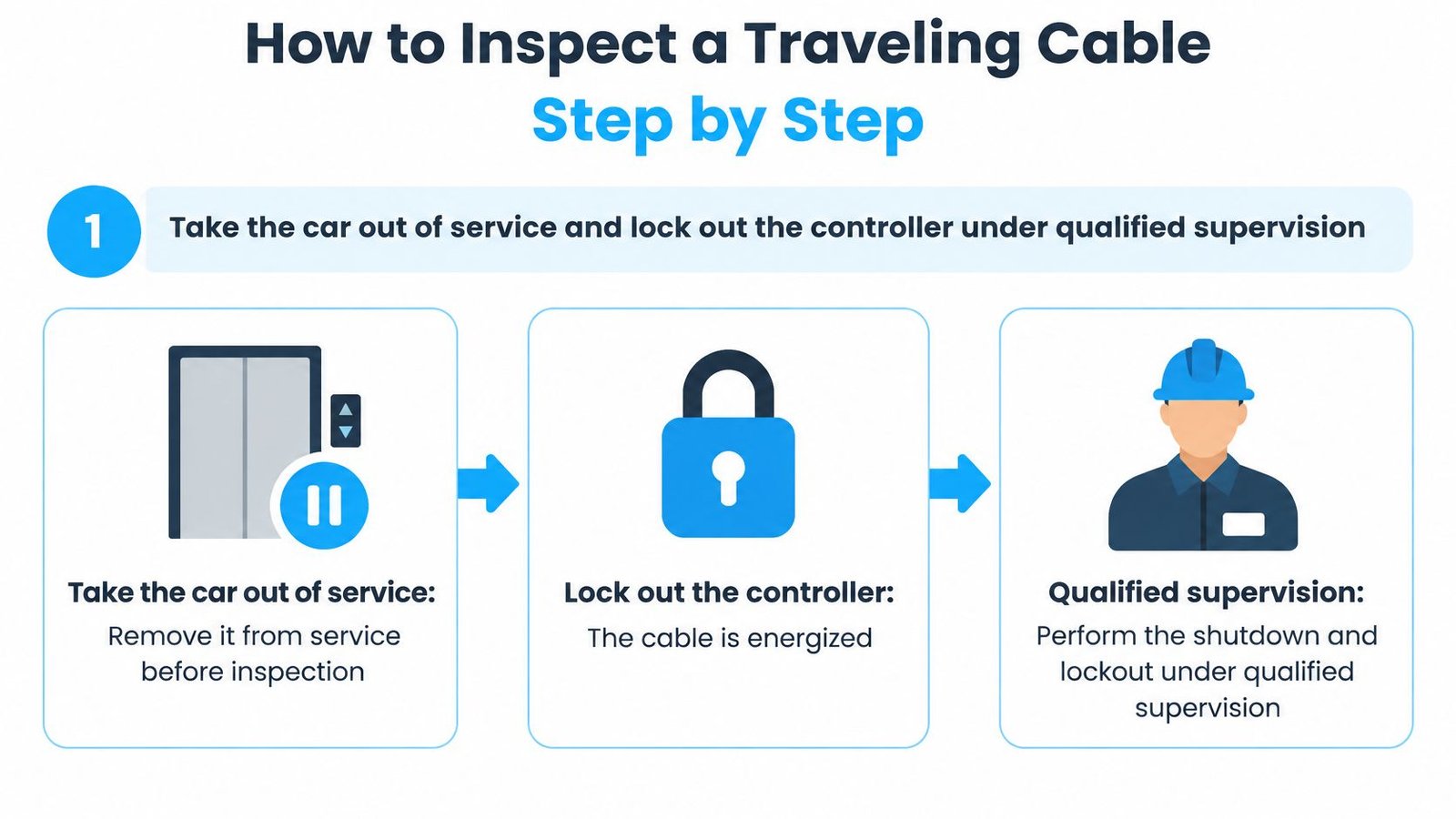
The first step sets the safety conditions for everything that follows.
The Eight-Step Inspection
- Take the car out of service and lock out the controller under qualified supervision. The cable carries live circuits, and the car must not move unexpectedly while anyone examines attachments or routing.
- Record car position, loop shape, and clearance at the top and bottom landings before touching anything. This baseline shows whether the loop hangs where it should through the extremes of travel.
- Walk the full moving length and examine the jacket. Look for surfaces that are cracked, cut, flattened, swollen, chemically damaged, or abraded, plus oil staining near the car that can soften or contaminate the jacket.
- Check for exposed conductors, exposed braid, and permanent kinks. These findings move the cable from surface wear into structural damage, and they change the repair conversation immediately.
- Run the car slowly through its travel and watch the loop. Sway, rubbing, binding, or twisting at clamps and guides reveals problems a static look can’t show.
- Confirm attachment points, strain relief, the support member, and the tensioning device. Each should be secure and set to the manufacturer’s specification, because loose or overtight hardware transfers force into conductors and terminals.
- Test continuity, insulation resistance, and shield-to-ground. Note any reading that drifts from the last test, since a trend can matter as much as a single pass or fail result.
- Photograph and log every finding with measurements. The next inspection needs a record to compare against, not a memory of what the loop looked like.
Watching a proper lockout and inspection sequence helps facility staff understand why this work can’t be rushed.
A healthy result is plain to describe. The car travels smoothly, the loop doesn’t rub or bind, attachments stay secure, and electrical readings hold stable across repeated runs. Scheduling these checks inside a structured preventative elevator maintenance program keeps the comparison records in one place instead of scattered across service tickets.
Documentation is the quiet payoff. When a fault appears six months later, dated photos and measurements show whether a flattened spot is new, growing, or unchanged. That evidence supports a defensible decision about monitoring, repair, or full replacement.
Choosing to Repair, Shorten or Fully Replace
The choice is rarely about which product to buy. It depends on what inspection found, where the damage sits, and what forces created it. Code-oriented guidance on traveling cable tensioning and length requirements notes that cables must include a tensioning device to control sway, prevent abrasion, and avoid overtensioning.
Traveling Cable Condition and Recommended Action
| Observed Condition | Recommended Action | Why It Matters |
|---|---|---|
| Surface scuffs, no exposed conductors, normal continuity | Monitor and re-inspect at the next scheduled visit | Cosmetic wear without structural damage |
| Localized cut or crushed section, cable still moves freely | Find the cause of rubbing or sway before any repair | Repairing the spot will not stop the same forces |
| Exposed braid or conductors | Replace the cable | Exposed conductors create a shock and fault hazard |
| Insulation breakdown or ground fault | Replace the cable | Electrical damage rarely recovers in service |
| Intermittent faults with passing continuity | Investigate mechanical damage and replace if confirmed | Mechanical damage can precede electrical faults |
| Loop sags, snags or exceeds bend limits | Re-route, re-tension or shorten with designer approval | Length and loop shape control sway and flex |
| Cable near 20 years with a clean inspection | Budget for renewal and schedule a reassessment | Age is a planning estimate, not a verdict |
| New communication or access-control needs | Replace with added spare capacity | Avoids a second shutdown later |
The Caveat That Changes the Answer
Replacing only a visibly damaged section can be the wrong move when the cable has taken repeated flexing or improper tension. The same loop geometry and sway will work on the new section as soon as the car returns to service. Fix the cause first, or you’ll schedule the same shutdown again.
Length problems deserve the same discipline. A cable that sags into the pit or snags on guides may need re-routing, re-tensioning, or shortening, but shortening changes loop geometry. Have the elevator designer check that the revised loop still respects bend limits through the complete run, not only at rest.
Older freight elevators and mixed-use buildings add a practical wrinkle. Downtime windows are tight, parts can be harder to source, and tenants feel every extra day out of service. Those pressures often push owners toward a full swap during one planned outage instead of a patch that risks a second one.
Before approving anything, write down which table row matches your inspection and the evidence behind it. If you can’t name the row, you don’t have a decision yet. You have a guess.
Specifying a Replacement Cable Without Repeat Work
A cable can pass electrical checks and still be close to failure. During travel, repeated bending, abrasion, excess weight, or strain at the terminals can damage it mechanically. Specify the replacement against both the inspection evidence and the cable’s path through the full elevator run, not just the old cable’s markings.
The Specification Checklist
Give your engineer or contractor a written scope before requesting prices. Record:
- Conductor count and gauge: Match the control, communication, and lighting circuits, then state spare capacity separately.
- Voltage and current ratings: Check the controller and car circuits. Treat faded markings on the existing cable as clues, not final specifications.
- Shielding and communication media: List the shielded pairs or coaxial conductors required for emergency phones, cameras, and access control.
- Jacket environment: Specify flame-retardant construction and suitability for the shaft’s moisture, oil, and temperature conditions.
- Overall diameter and weight: Confirm the cable fits existing clamps, routing, and car-top hardware without adding undue load.
- Bend radius and length: Check the cable’s loop through the full travel, including how it flexes while the car moves.
- Suspension and attachment hardware: Document the support method, strain relief, and attachment points before ordering.
- Controller compatibility: Match terminations and circuit assignments to the elevator controls and wiring diagrams, and identify terminal-board connections permanently.
Fit is mechanical as well as electrical. A cable that is too heavy, too large for the clamps, or forced into a tight loop can flex, rub, or pull on its terminals, even if its electrical readings are sound. Compare the specified cable with the actual route and attachment points before approving a quote.
Spare Capacity Is a Separate Decision
Set spare-conductor and communication-pair minimums using the applicable jurisdictional code and the cable manufacturer’s specification. Confirm that the selected cable also suits the controller, planned connections, and available bend limits.
Then weigh future needs against installation constraints. Is modernization planned? Could card readers, emergency-phone changes, monitoring, or fire-service interfaces require additional conductors? How disruptive would it be to reopen the hoistway later? A like-for-like cable can limit today’s scope, while added spare capacity may reduce the chance of another shutdown. Extra conductors still need suitable terminations and space in the cable’s route.
Field note: Identify every unused conductor at the terminal board. An undocumented spare is difficult to use safely later.
Put handling requirements on the work order: prevent twisting during installation, protect the jacket from damage, and keep knives and scissors away from conductors. Cable length, conductor count, and shielding affect cost. Have every bidder price the same written specification, including handling and termination requirements.
Modernization and Non-Proprietary Replacement Options
The traveling cable can pass electrical tests and still be wearing through at the same point on every trip. If a controller upgrade or new car equipment is already scheduled, decide whether replacement belongs in that project before approving a standalone cable swap. Inspection evidence shows the cable’s condition; the modernization schedule determines whether a separate repair is sensible.
When the Cable Belongs in a Modernization Scope
A wider scope may be appropriate when a planned change affects the connection between the car and controller:
- Controller upgrade: New interfaces may need conductors or shielding the existing cable does not have.
- Communication devices: Emergency phones and cameras need suitable cable media or a separately planned connection.
- Fire-service interface changes: Confirm circuit requirements with the authority having jurisdiction before the cable is specified.
- Remote monitoring: Identify the required connection between car and controller, then check whether the existing cable can support it.
A cable may still test sound today while its repeated bending path is already causing wear. Compare the inspection findings with the timing and requirements of planned work. Replacing the cable twice adds avoidable shutdown time; combining the work can reduce repeat access, provided the new cable and interfaces are specified together.
For a non-proprietary replacement, document the cable’s conductor count, voltage and current ratings, dimensions, bend radius, jacket rating, and test requirements. Tie those requirements to the equipment and planned interfaces, and require the completed installation to be tested and recorded. This gives the building a usable specification for future service instead of relying on a particular parts channel.
For a modernization project, plan elevator modernization around the building’s equipment and project scope. Crane Elevator Company can help facility managers define a modernization scope that accounts for the traveling cable and its controller interfaces. Ask for one written scope covering the cable, affected interfaces, and testing, then compare it with the inspection evidence. If no wider changes are planned, keep the work focused on the cable and the cause of its damage.
Confirm the Scope and Book a Cable Inspection
A cable can pass an electrical test and still be failing mechanically. If your elevator shows position-dependent faults, ask for inspection evidence before approving replacement. The findings should show whether the cable needs monitoring, a routing correction, or full replacement.
Your Six Actions
- Gather maintenance logs, inspection reports, and cable test results. Missing records make it harder to establish how the condition has changed.
- Check the applicable Michigan requirements. Michigan elevator inspection requirements set out the state’s inspection rules. Confirm the requirements for your equipment with the official guidance rather than relying on a general interval.
- Check Ohio testing requirements where they apply. Consult the Ohio periodic safety testing rules under ASME A17.1 for the rules that cover your elevator and required records.
- Request a written cable condition assessment based on the inspection steps, with photos and measurements of the cable’s moving path.
- Ask for a written replacement specification that records the spare-capacity decision and its reasoning.
- Compare quotes against the same scope so each proposal addresses the same work and evidence.
A calendar date alone cannot settle the decision. The inspector should document wear along the cable, its loop geometry, and any fault that changes with car position. Like a flexing hose, a traveling cable can deteriorate at its bend points before electrical readings show a clear failure.
Crane Elevator Company serves Detroit, Lansing, Ann Arbor, and Grand Rapids, as well as Toledo and Perrysburg. Make the first call for a documented cable inspection, before approving replacement. A written assessment can distinguish normal wear from a routing problem or a justified elevator traveling cable replacement, giving you a scope to budget against.
Request a cable condition assessment through Crane Elevator Company. Ask for the moving length, loop geometry, inspection evidence, and test results to be documented before you commit to work.