“Modernize every elevator before the deadline” is expensive advice, and it isn't a sound starting point for Michigan 2028 elevator compliance. Start with the equipment's records and the work it needs, not a proposal to replace everything.
A facility manager needs to separate mandatory safety corrections from optional improvements. A worn cab interior, a missing protective function, and a controller replacement are different projects with different reasons for spending money.
What the 2028 Deadline Does Not Order
Michigan's 2028 deadline does not order a blanket retrofit of every older elevator. BOMA Metro Detroit's current-issues guidance describes Michigan's adoption of ASME A17.3 requirements for existing elevators through a tiered schedule that ends in 2028. It also explains the historical practice: safely operating equipment generally was not required to meet later-adopted standards unless modernization or controller-alteration work occurred.
A deadline requirement applies only when the elevator and device meet its criteria. A unit may run smoothly yet lack a required safety feature. Another may still have useful components and need only a targeted correction. The right scope depends on installation history, device type, and whether the work addresses a deadline item, a condition or violation, or an alteration.
Sort the obligation before choosing equipment
Start by identifying why work may be required:
- Existing-equipment deadline: A covered elevator has a specific safety provision to address.
- Alteration-triggered work: A planned controller change or modernization must be reviewed under the code governing that project.
- Condition or inspection finding: Wear, a failed test, or a correction order calls for attention independently of the deadline.
A unit can have more than one of these obligations. Keeping them separate helps prevent a required correction from being mistaken for an optional upgrade.
Approve a scope that names the missing protection, the applicable requirement, and how the completed work will be verified. Age alone does not identify the work an elevator needs.
Device identity comes first
A wheelchair platform lift is not a small passenger elevator for compliance purposes. A stairway chairlift and a belt manlift are different devices, too. Michigan's framework distinguishes accessibility equipment and material-handling devices from conventional passenger elevators, so identify the equipment before applying a checklist.
Keep permits, inspection reports, alteration records, maintenance logs, and manufacturer information together. Use the same filing structure across sites, whether the portfolio includes Detroit, Lansing, Ann Arbor, Grand Rapids, Flint, Kalamazoo, or Ypsilanti.
The practical questions are: What rules govern this device? What has already changed? What remains unresolved? Answering them helps direct spending toward required corrections while avoiding modernization work that the elevator's circumstances do not call for.
Three Paths for Every Existing Elevator
Which 2028 path applies to the elevator
| Path | When it applies | Typical work | Do not assume |
|---|---|---|---|
| A17.3 deadline | Covered existing elevator with outstanding deadline items | Door-lock monitoring, firefighter service, buried-jack protection where the cylinder qualifies | A new cab or full controller is automatic |
| Alteration trigger | Controller change, modernization, or relocation | Permit under the code edition for that project, then inspection and testing before service | Routine maintenance equals an alteration |
| Condition or violation | Wear, failed test, or an open correction order | Repair the cited item and complete required verification | A current certificate erases a separate compliance gap |
| Other device | Platform lift, stairway chairlift, or belt manlift | Applicable accessibility-lift or belt-manlift code review, not a passenger-elevator score | Passenger-elevator door rules apply unchanged |
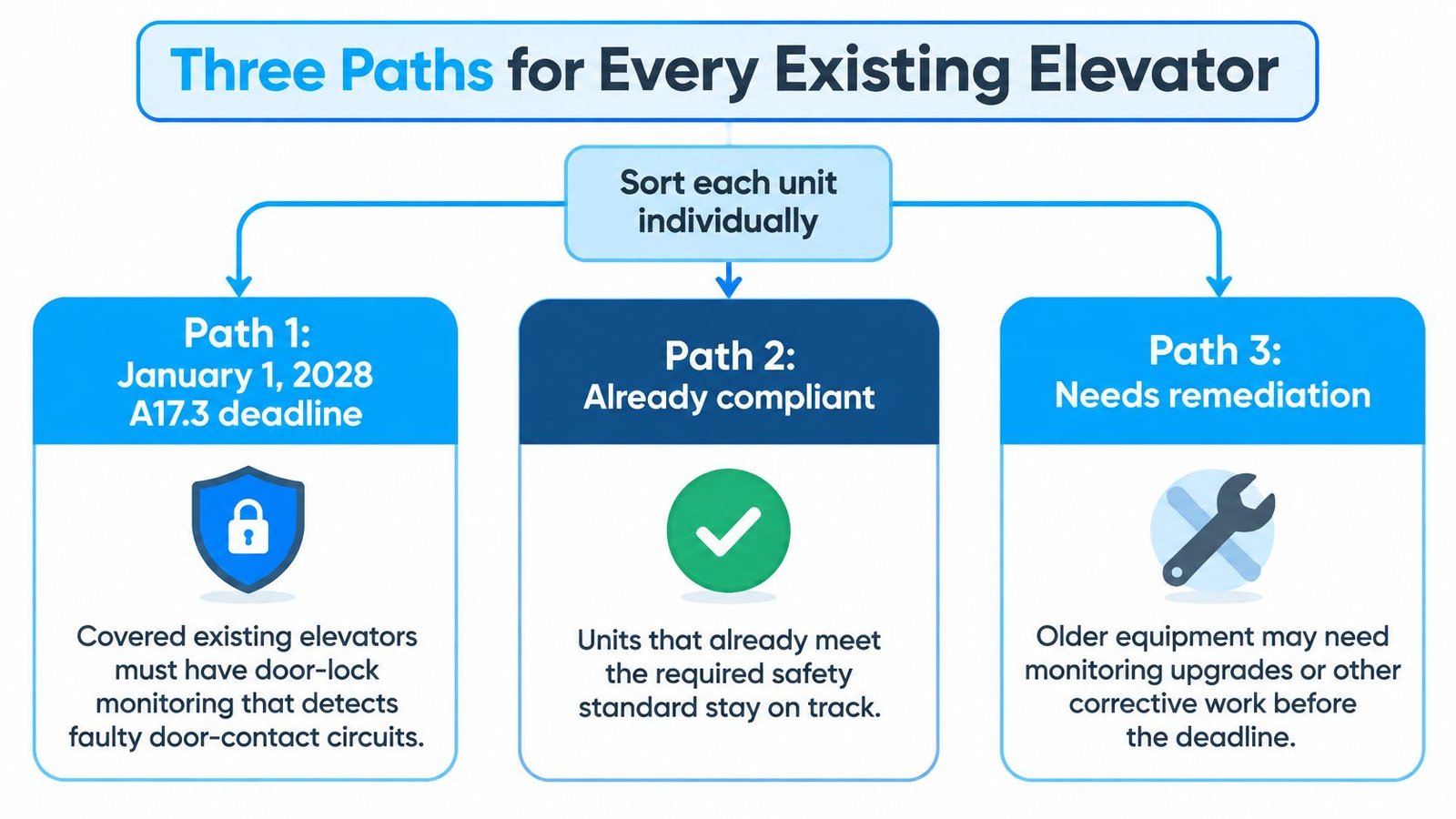
The Michigan School Business Officials elevator presentation identifies Michigan's 2028 requirements involving faulty door-contact monitoring, firefighter service, and protection for certain buried hydraulic jacks; it also states that new, altered, or relocated elevators require inspection and testing before service, and that safety/governor maintenance tests cannot be spaced more than 12 months apart.
Use the graphic as an initial screening aid. “Already compliant” is a finding to document, not permission to ignore future alterations or condition-related repairs.
Ask the hardware questions before pricing
For each unit, answer these questions:
- Controller capability: Can the installed controller support compliant monitoring, or will related wiring, door equipment, and machine-room equipment need alteration?
- Cylinder construction: Is the hydraulic cylinder buried, and is a double cylinder, safety bulkhead, cathodic protection, or approved protective casing already documented?
- Serviceability: Can the correction preserve non-proprietary components and allow another qualified company to service the system later?
- Building access: What acceptance testing, shutdown window, and temporary access arrangements will the project require?
Work through the equipment, not the sales package
Say a hydraulic freight elevator has a buried cylinder. Missing drawings aren't proof that protection exists or that it's absent. Confirm the cylinder construction and accepted protection, then determine whether a jack project is needed. Include oil handling, possible contamination controls, access for removal, and testing in the scope.
Now consider an elevator with sound door operators but inadequate monitoring of door-contact circuits. A jumper or short can defeat the intended indication that the door circuit is safe. The correction must detect the relevant fault and prevent automatic operation, not merely display a warning.
That project might preserve the doors and cab. It might also require controller-related changes and additional wiring. The assessment should identify those boundaries before the owner approves a component-only price.
Prioritize healthcare, education, industrial, and municipal equipment where an outage interrupts essential operations. Engineering, permits, testing, temporary accessibility, and environmental controls belong in the budget alongside the hardware.
Inspection Intervals and Fees to Budget
Michigan certificate, inspection, and reinspection fees
| Device class | Interval | Certificate fee | Inspection fee | Reinspection fee |
|---|---|---|---|---|
| Passenger, freight, inclined, LULA, special-purpose personnel, rooftop, plus permanent personnel hoists, material lifts, barrier-free devices, escalators, moving walks, belt manlifts, and other special elevating devices | Generally 12 months | $61.80 | $180.25 | $180.25 |
| Certain electric-powered elevators, platform lifts, and power sidewalk elevators | 24 months | $61.80 | $128.75 | $128.75 |
| Special services or overtime | As scheduled | No separate certificate amount identified for this service category | $154.50 per hour | Special-service/overtime hourly rate, not a separate device reinspection fee |
These benchmarks come from the published Michigan elevator rulemaking schedule, which lists the intervals and fees shown; applicable hoistway or floor-traveled charges are additional, and the state may revise fees before 2028.
One building can have different calendars
Consider a municipal building with a passenger elevator and a platform lift. Their inspection anniversaries may not match, and their device classifications may place them on different cycles. Don't assign the whole property a single renewal date merely because the equipment shares an address.
Confirm classification from the equipment record rather than from a casual description such as “electric lift.” The exception for certain electric-powered elevators doesn't mean every traction elevator receives the longer interval.
A useful register includes:
- Device identity: Type, serial number, location, and state classification.
- Inspection status: Anniversary, certificate status, and scheduled visit.
- Testing obligations: Required tests, completion reports, and outstanding documentation.
- Correction exposure: Open findings, responsible contractor, and whether reinspection remains necessary.
Separate state fees from project costs
The table isn't a modernization estimate. It doesn't price monitoring equipment, hydraulic work, contractor labor, acceptance-test preparation, or the operational cost of a shutdown.
Keep those costs in separate budget lines. Otherwise, a modest inspection allowance can make the total compliance budget look adequate when the actual equipment correction hasn't been funded.
Budget rule: A certificate renewal, a safety test, and a corrective project are separate commitments. Track all of them, even when they're coordinated during the same shutdown.
For buildings in Detroit, Jackson, Battle Creek, or Saginaw, coordinate access, contractor attendance, test preparation, and correction completion before requesting the return visit. A predictable calendar is more useful than a folder of invoices after the work.
Use an elevator-testing scope to distinguish periodic testing from acceptance testing and inspection support. Make the deliverable explicit: which device will be tested, what preparation is needed, and what report will close the record.
What Counts as a Code Violation
A violation isn't limited to something discovered during an annual inspection. Michigan's Act 227 of 1967, effective November 2, 1967, regulates elevator inspection, construction, installation, alteration, maintenance, repair, and operation, while governing contractor licensing and establishing the Elevator Safety Board.
Compliance therefore extends across the equipment's life. A permit problem, an unresolved safety defect, or missing required testing can matter even when the elevator still carries passengers.
Who checks the work
Michigan's Department of Licensing and Regulatory Affairs, through the Bureau of Construction Codes Elevator Section, administers installation and alteration inspections, annual safety inspections, accident investigations, and violation investigations. The framework also allows qualified special inspectors associated with authorized insurers and approved local government inspection departments to perform inspections.
The state has authority to inspect and enter premises when necessary. Facility managers should therefore know who holds the records, who can provide equipment access, and who is authorized to communicate about corrective work.
The Michigan elevator permit information page states that installation, alteration, repair, maintenance, servicing, adjustment, and testing must be performed by a licensed elevator journeyperson, and identifies ASME A17.1 for elevators and escalators and ASME A18.1 for platform lifts and stairway chairlifts.
Read the finding before ordering the fix
Common problems to investigate include:
- Door-circuit defects: Jumpers, shorts, or faults that defeat intended protective operation.
- Communication failures: An emergency phone that doesn't establish usable communication.
- Emergency-operation faults: Fire service that doesn't function correctly during testing.
- Administrative gaps: Missing test documentation, an expired certificate, or alteration work without the required permit.
These examples aren't interchangeable with a modernization recommendation. An emergency-phone repair doesn't justify a controller replacement unless the contractor identifies a separate technical reason.
Remote status information also isn't proof that a protective function works. A dashboard can show calls or equipment status without establishing that safety circuits perform correctly under the required test conditions. Don't use remote access to bypass protection or have building staff reset safety equipment to keep a car running.
A correction order should produce a traceable response: the finding, the repair, the verification, and the closure record.
Keep serial numbers, permits, prior inspection reports, test records, approved drawings, and corrective-action documents together. In Howell, Sterling Heights, or Port Huron, that file helps distinguish routine maintenance from a safety-device replacement or an alteration.
Follow the operating restrictions attached to the actual finding. Not every paperwork issue has the same consequence, and not every correction order automatically means full modernization. Budget for the required repair, verification, and any associated outage rather than assuming an unspecified penalty or replacement mandate.
Ohio Rules for Border Portfolios
Michigan and Ohio inspection rhythms
| Device | Michigan | Ohio |
|---|---|---|
| Passenger or freight elevator | Generally every 12 months | Twice in each 12-month period |
| Escalator or moving walk | Generally every 12 months | Twice in each 12-month period |
| Dumbwaiter, hoist, or non-passenger lift | Material lifts and similar devices generally every 12 months | At least once every 12 months |
| Certain electric elevators, platform lifts, power sidewalk elevators | 24 months for the listed Michigan classes | Classify under Ohio's passenger or non-passenger requirements |
| Private-residence elevator | Review under Michigan's applicable device rules | Exempt from ORC 4105.10 |
| Passenger elevator 750 lb or less | Follows its Michigan class interval | Board may allow once per year instead of twice |
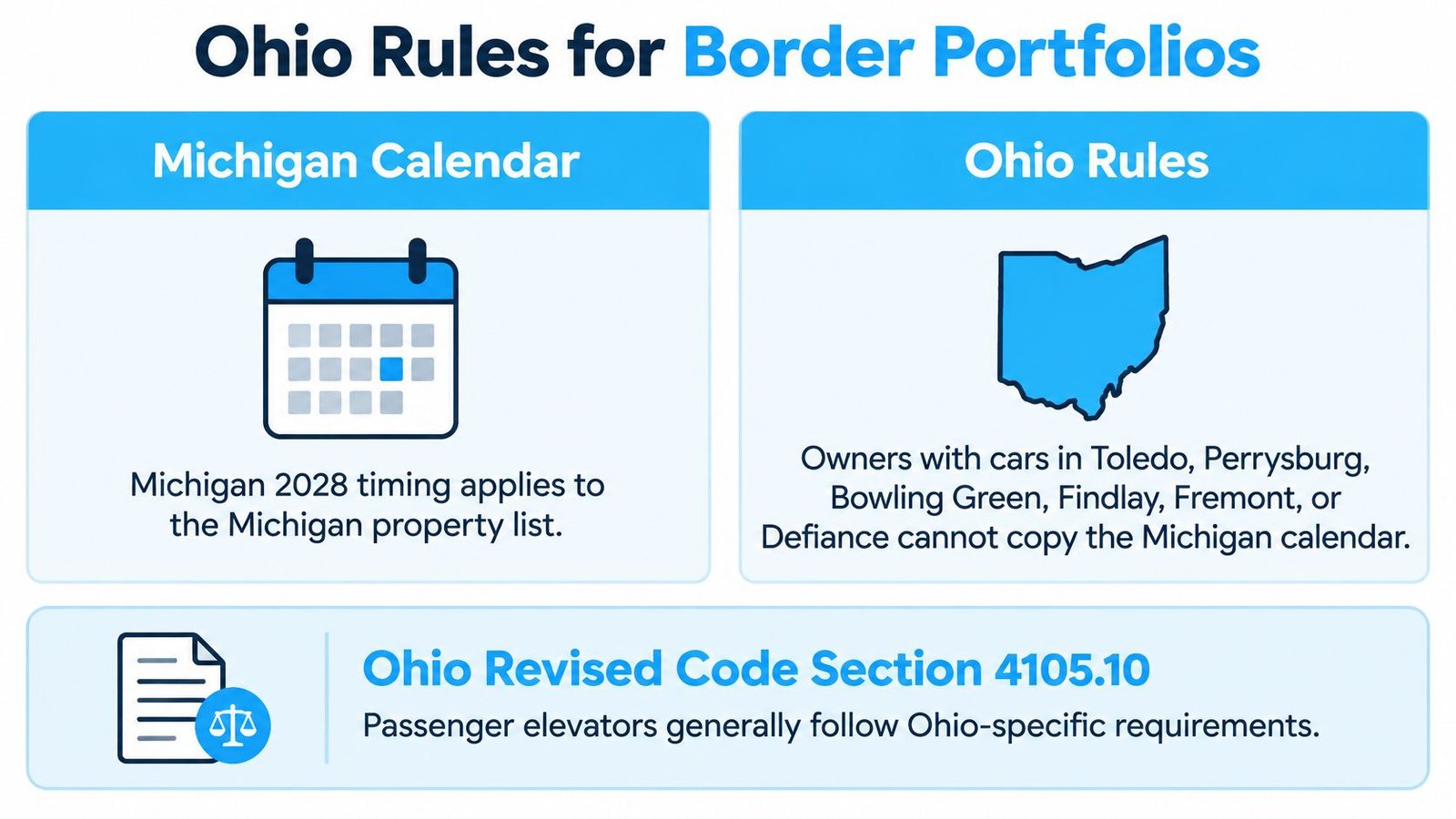
For Ohio, Revised Code Section 4105.10 establishes the table's twice-per-12-month passenger, escalator, moving-walk, and freight requirements, including gravity elevators; annual non-passenger equipment requirements; private-residence exemption; and potential annual designation for certain passenger elevators rated at 750 pounds or less.
Owners with buildings in Toledo, Perrysburg, Bowling Green, Findlay, Fremont, or Defiance can't copy the Michigan calendar. The device's location determines which state's inspection rules apply.
The easy misses are exemptions and load tests
The private-residence exemption belongs to the Ohio statute. It isn't an exemption for an elevator in Monroe or another Michigan community, and it shouldn't be extended to unrelated building types because they contain residential occupancy.
Inspection frequency also doesn't replace periodic safety testing. Ohio Administrative Code Rule 1301:3-6-04 requires testing under the adopted ASME A17.1 edition with ASME A17.2 inspection guidance, including at least one full-load safety test during every five-year period under Section 8.6.4.20.
Keep the inspection calendar and the test calendar separate. Otherwise, a manager can have regular inspection visits on file while still missing a load-test obligation.
Build the border portfolio around jurisdiction
Use dedicated register fields for state, device class, required inspection rhythm, next periodic test, and unresolved findings. A shared spreadsheet works if it preserves those distinctions rather than assigning every building the same recurring task.
For Ohio elevator maintenance planning, coordinate preventive visits with test preparation and inspection access. Keep Michigan's existing-equipment review separate from Ohio scheduling, so a project on one side of the border doesn't distract from a due visit on the other.
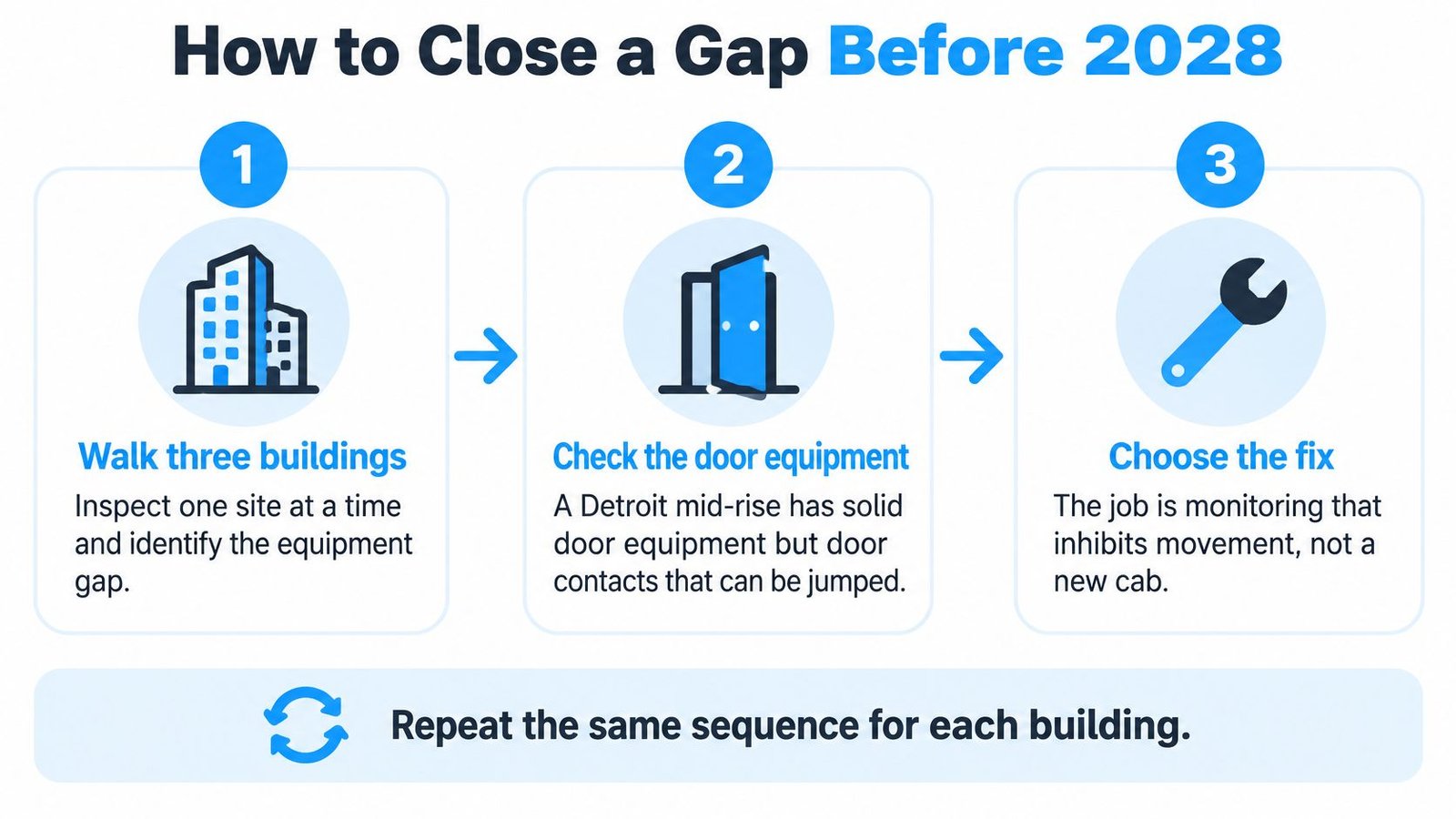
How to Close a Gap Before 2028
Say a Detroit mid-rise has sound door equipment, but its door-contact arrangement lacks the necessary fault monitoring. The useful scope is to establish compatible monitoring that inhibits automatic operation under the relevant fault conditions. A decorative cab replacement wouldn't address that problem.
At a Lansing hospital, suppose records confirm a buried hydraulic jack without accepted protection. The project needs more than a replacement component: patient routing, oil control, removal access, and acceptance testing all affect the shutdown plan. First confirm that no other accepted protective arrangement already resolves the issue.
An Ann Arbor campus wheelchair lift needs a different review. Applying a conventional passenger-elevator checklist can send the owner toward the wrong scope and permit assumptions.
Use one sequence for each device
- Create the equipment record. List every elevator, lift, escalator, and dumbwaiter with its type, serial number, jurisdiction, and certificate date. Include equipment in remote service areas, not just public lobbies.
- Match the unit to the deadline, alteration, or condition-based path. Identify overlapping obligations rather than forcing every problem into a single category.
- Confirm existing protection. Have a licensed elevator journeyperson evaluate controller capability and hydraulic-jack construction. Photographs help identify equipment, but they don't replace functional checks or construction records.
- Separate maintenance from alteration. A clean-down or packing repair shouldn't be bundled into a controller project without explaining why the wider work is necessary.
- Set the permit and outage plan. Establish the required approvals, tenant notices, access arrangements, and inspection coordination before equipment is dismantled.
- Install the missing protection and verify the result. Preserve serviceable components where appropriate, choose non-proprietary controls when feasible, and complete required testing before returning the unit to service.
- Close the file. Retain the completed report, permit documentation, test results, and correction closure so the next manager doesn't have to reconstruct the project.
Schedule around building consequences
Prioritize a hospital's patient elevator, a school's accessible route, an industrial material-handling unit, or a municipal building's only practical lift according to the consequence of losing it. The most disruptive project isn't always the most visibly outdated car.
For Grand Rapids, Warren, Livonia, and Midland portfolios, stagger assessments and outages instead of grouping every project near the deadline. Allow room for equipment procurement, concealed conditions, inspection coordination, and changes to temporary access.
An elevator-modernization scope should distinguish required protection from reliability improvements and appearance upgrades. That separation lets an owner approve necessary work promptly while making a deliberate capital decision about the rest.
Schedule a Unit-by-Unit Gap Review
A 2028 review is not a blanket order to modernize every elevator. The right work depends on the unit's installation and alteration history, the devices it uses, and whether the next step is maintenance, a violation correction, or a controller change. Request written findings for each elevator so required work stays separate from optional upgrades.
Crane Elevator Company is a family-owned contractor with over 25 years of experience in the elevator industry. Its office is at 10983 Hi Tech Drive, Whitmore Lake, MI 48189, and it serves Detroit, Lansing, Ann Arbor, and surrounding communities.
Bring the records, not just the symptoms
Start with the documents that show what applies to each unit. A certificate, recent inspection report, and open correction order help identify its current status. Installation records, alteration permits, manufacturer information, and controller identification can clarify which requirements apply. Note the building's operating needs, accessible alternatives, and workable shutdown windows.
Crane also serves communities including Flint, Pontiac, Troy, Birmingham, Monroe, Jackson, Battle Creek, Kalamazoo, Ypsilanti, Saginaw, Bay City, and Port Huron, along with Ohio communities such as Toledo, Perrysburg, Bowling Green, Findlay, Fremont, and Defiance.
Get a scope that matches the obligation
Crane's services include preventive maintenance, state testing and inspections, major and minor repairs, and modernization for passenger, service, freight, and residential elevators, wheelchair lifts, material lifts, and dumbwaiters. The company works on hydraulic, traction, and drum equipment. Its services also include emergency phones, fire-service and generator testing, door-lock monitoring, jack and hydraulic packing work, and non-proprietary modernization controls that any qualified provider can service.
Violation and correction-order resolution covers Michigan, Ohio, and Detroit safety and regulatory standards. Crane offers a free, no-obligation quote for compliance and violation work. A second opinion on an existing elevator problem is also available at no extra charge, including a visit and solution plan.
For service or questions, call 1-734-726-4247. Have the certificate, latest inspection report, and any open correction order ready to focus the discussion on the unit's actual needs.
Crane Elevator Company provides testing, repairs, violation corrections, and non-proprietary modernization across Michigan and Ohio. Visit Crane Elevator Company to arrange a unit-by-unit review before deciding whether a repair, correction, or modernization is appropriate.