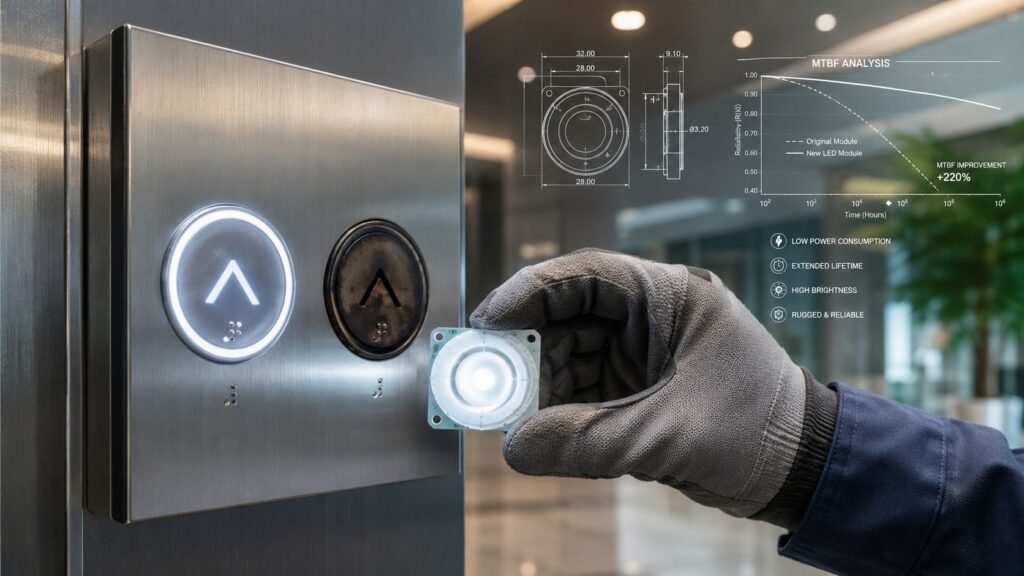
A tenant calls the office to say the hall button on the third floor still works, but the light is out. Someone else mentions the car button for Lobby looks dimmer than the rest. On paper, that sounds minor. In practice, it usually starts a familiar chain of problems. The manager has to decide whether this is a quick lamp change, a bad button module, or the beginning of a parts hunt that drags on longer than it should.
That's where most owners get stuck. Not on the labor. On the uncertainty. They don't want to order the wrong part, damage a board, or pay for a full panel swap when the problem is just a failed light source. Elevator Button Light replacement looks simple until compatibility questions, uneven illumination, and repeat service calls start affecting tenant confidence and maintenance budgets.
The Hidden Costs of a Burnt-Out Elevator Button
A dark button changes how people judge the whole elevator. Riders don't know whether the switch works, whether the car registered their call, or whether a bigger issue is developing behind the panel. Building staff then get pulled into reassurance mode, fielding complaints about an elevator that may still be running fine mechanically.
The expensive part usually isn't the bulb itself. It's the reactive process around it. A manager calls for service, a technician finds a failed light, then everyone pauses because nobody wants to guess on the replacement. If the property uses mixed equipment, older fixtures, or prior aftermarket repairs, ordering becomes its own project. This is the primary source of compatibility anxiety.
Industry forum data points to a pattern many contractors already see in the field. 68% of button failures are attributed to LED degradation rather than switch mechanism failure, and a 2024 ASME survey notes that 42% of elevator modernization projects delay due to incompatible button panel procurement according to this industry discussion on button replacement and procurement delays. In other words, a lot of teams chase the wrong fault first, then lose time waiting on parts that may not match.
Why a small failure turns into a budget problem
A burnt-out button often exposes a weak maintenance approach:
- No parts record: Staff may not know the existing voltage, pin count, or connector style.
- No failure history: The same fixture gets replaced repeatedly, but nobody tracks whether the issue is the lamp, the board, or a mismatch.
- No replacement standard: One visit installs one LED type, the next visit installs another, and the panel ends up uneven.
That's how a simple Elevator Button Light replacement turns into recurring service calls.
A button light failure is rarely expensive by itself. The cost comes from uncertainty, repeat trips, tenant complaints, and parts decisions made without records.
A better approach starts with treating button lighting as a reliability issue, not a cosmetic one. If you already have recurring COP or hall station light failures, you need more than a one-time repair. You need a repeatable process for diagnosis, documentation, and replacement. That's the difference between patching symptoms and managing uptime. For owners dealing with active issues, a focused elevator button repair service is often the first step toward getting that process under control.
What Is MTBF and Why Does It Matter for Elevators
Most owners don't need a textbook definition of reliability. They need a way to answer a practical question: how often is this part likely to fail, and what does that mean for my building?
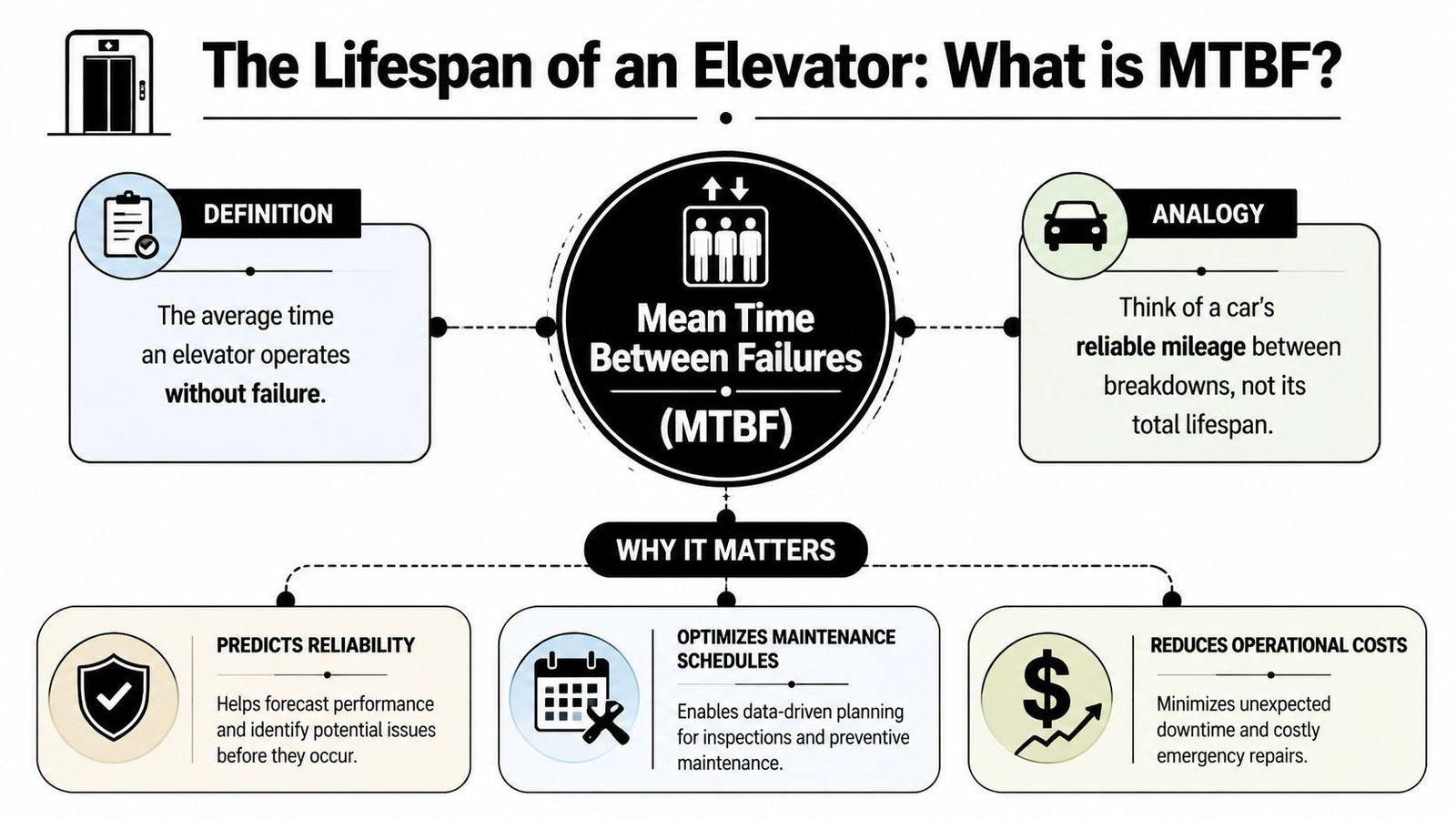
MTBF stands for Mean Time Between Failures. The simplest way to think about it is the same way you think about a vehicle that runs reliably between shop visits. It doesn't tell you the machine will never break. It tells you how long it usually runs before the next failure shows up.
The plain-English formula
The formula is straightforward:
MTBF = Total uptime / Number of failures
In elevator terms, that means you look at how long a component or system operated normally, then divide that by how many times it failed during that period. If a button light assembly runs for a long stretch with few failures, its MTBF is better than one that burns out often.
Here's what each part means in practice:
- Total uptime means the period the elevator or component was in service and expected to perform.
- Number of failures means actual performance failures, not cosmetic observations that didn't affect operation.
- The result gives you an average interval you can use for planning.
Why owners should care
MTBF matters because budgets hate surprises. When a property team tracks failures instead of just approving invoices, patterns start to show up. One hall station may be failing more often than the others. One supplier's replacement lamps may not last. One building may have chronic voltage or panel compatibility issues after prior modernization work.
Key takeaway: MTBF helps you predict failure patterns so you can schedule work before riders notice a problem.
That changes maintenance decisions in three ways:
- You stop treating every call as isolated. Repeat button light outages become data, not random annoyance.
- You can compare parts more intelligently. A cheaper replacement that fails sooner usually costs more once labor and callbacks are included.
- You get a cleaner maintenance calendar. Planned replacements are easier on tenants than recurring nuisance failures.
What MTBF does not do
MTBF is not a guarantee. It won't tell you the exact day a button light will fail, and it won't replace proper troubleshooting. It also doesn't excuse poor installation. A high-quality part installed at the wrong voltage can still fail early.
What MTBF does well is force discipline. It pushes owners and service providers to document what failed, when it failed, and whether the same component keeps creating avoidable downtime. For elevator systems, that's the beginning of reliability management.
Understanding MTBF MTTR and MTTF
Reliability conversations get muddy when everyone uses similar acronyms to mean different things. For elevator owners, the three that matter most are MTBF, MTTR, and MTTF. Together they tell the full story of performance.
The three metrics side by side
| Metric | What it means | What it tells a building owner |
|---|---|---|
| MTBF | Mean Time Between Failures | How often a repairable system or component tends to fail |
| MTTR | Mean Time To Repair | How long the elevator stays down once a failure occurs |
| MTTF | Mean Time To Failure | How long a non-repairable component typically lasts before replacement |
MTBF focuses on reliability between breakdowns. MTTR focuses on service recovery. MTTF applies best to parts that are consumed and replaced rather than repaired indefinitely.
For button lighting, this distinction matters. A light source may be treated more like an MTTF component because once it fails, you replace it. The button station as a broader assembly may be evaluated with MTBF if it is repaired and returned to service over time. Your maintenance records should reflect that difference.
To make the comparison easier to visualize, this short explainer helps frame how the metrics work together:
How the metrics work together
A building can have a decent MTBF and still feel unreliable to tenants if MTTR is poor. If the elevator only fails occasionally but every small issue takes too long to diagnose, source, and fix, occupants still experience the property as hard to manage.
On the other hand, fast repairs don't solve a bad component strategy. If a button light fails often but technicians replace it quickly, you still burn labor, annoy riders, and clog the service schedule with avoidable work.
Good elevator performance means the equipment doesn't fail often, and when it does, the repair process is short and controlled.
A practical reading of each metric
Use them this way:
- MTBF for planning: Which systems or subassemblies are producing the most nuisance failures?
- MTTR for operations: How long are tenants waiting for normal service to resume?
- MTTF for parts stocking: Which disposable components should be replaced proactively before failure affects riders?
That's the trio owners should ask about during service reviews. If your provider can't show a pattern of failures, repairs, and component life, you're mostly operating on memory. Memory is a poor maintenance system.
How to Calculate MTBF for Your Elevator Components
You don't need a software platform to start using MTBF. A clean service log is enough. The key is consistency. Track the same type of information every time a failure occurs, and don't mix cosmetic observations with confirmed component failures.
Start with one component group
Button lights are a good place to begin because the failures are visible, easy to document, and often repetitive. Pick a time window, usually a year or another stable maintenance period. Then collect:
- Operating period: The amount of time the elevator or component was in service.
- Failure count: How many confirmed failures occurred for that component group.
- Repair record: What was replaced, what voltage was present, and whether the issue returned.
The formula is still simple: total uptime divided by number of failures.
A practical example without guesswork
Suppose you review one elevator's records for a fixed operating period and isolate button light failures only. You then divide that unit's uptime during the review period by the number of confirmed button light failures recorded in the same period. The result is your working MTBF for that component category.
That number becomes useful only when the log is detailed enough to support decisions. If one work ticket says “replaced lamp,” another says “adjusted button,” and a third says “panel issue,” you can't compare them reliably. You need the records to answer specific questions:
- Was the failed item the light source or the switch?
- Was the replacement like-for-like or substituted?
- Did the technician verify control voltage before installing the new part?
- Did the same station fail again after the repair?
What to track in your log
A maintenance log for Elevator Button Light replacement should include more than the date.
| Log item | Why it matters |
|---|---|
| Button location | Identifies whether one floor or one car station fails repeatedly |
| Part type | Distinguishes universal replacements from model-specific assemblies |
| Voltage at terminal | Confirms compatibility before replacement |
| Connector and pin style | Prevents ordering errors on the next service call |
| Return failure | Shows whether the first repair solved the problem |
The formula for MTBF is easy. The discipline is in deciding what counts as a failure and recording it the same way every time.
How owners use the result
Once you have a working MTBF for button lighting, compare that result against your expectations for the building. If one property burns through button lights far more often than the rest of your portfolio, you likely have one of three issues:
- A parts mismatch problem
- An installation quality problem
- A broader electrical or panel condition problem
The number itself doesn't diagnose the cause. It tells you where to look. That's what makes it useful. MTBF moves you from “these lights keep going out” to “this elevator has a recurring failure pattern that needs a procurement and maintenance correction.”
If you're managing several buildings, calculate MTBF by component group first. Don't start with the entire elevator system. Door equipment, indicators, button lights, and communication devices fail for different reasons. Grouping them together hides the pattern you need to see.
Using MTBF for Smarter Procurement and Modernization ROI
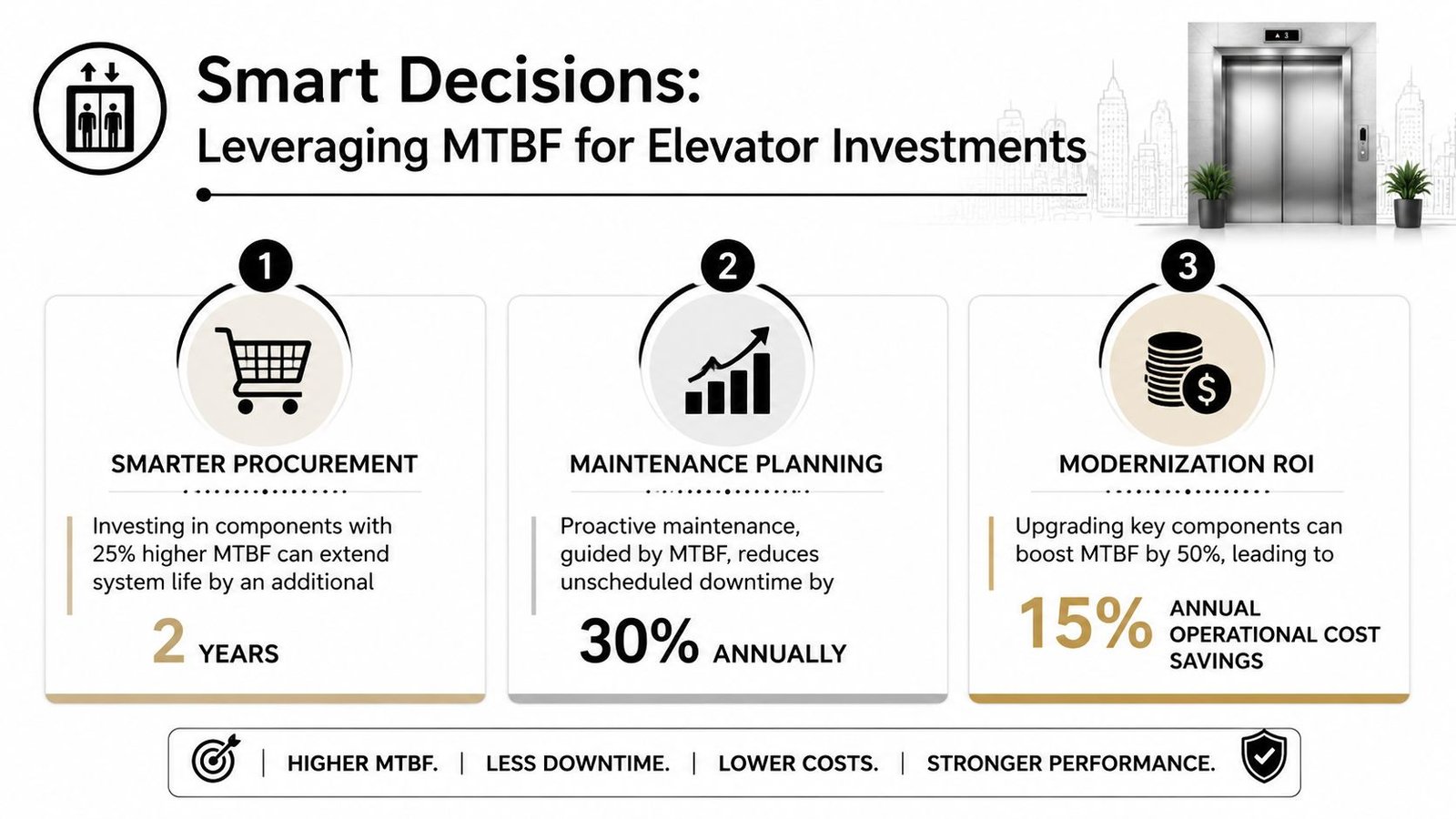
Most button light decisions get made backward. Someone sees a dark button, asks for the cheapest available replacement, and hopes it fits. That keeps the invoice small on that day, but it usually leads to the worst long-term result. Smart procurement starts by asking which option is most likely to stay in service without creating call-backs, mismatched lighting, or parts lock-in.
Procurement should focus on lifecycle behavior
A replacement part isn't just a part number. It's a future maintenance pattern. If two options both fit the station, the better procurement choice is the one that supports predictable service life, stable illumination, and easier replacement later. That's where MTBF thinking improves purchasing.
Owners should evaluate button lighting with these questions:
- Does this part match the existing electrical requirements?
- Can it be replaced without changing the whole panel?
- Will future technicians be able to source it without going back to one proprietary vendor?
- Does the maintenance record show stable performance after similar installs?
That last question is where many properties have no data at all. Without it, buyers are comparing invoice prices instead of reliability outcomes.
Modernization decisions need an operating-cost lens
Lighting upgrades are one of the clearest examples of why modernization should be measured beyond first cost. Replacing incandescent elevator button lights with LED alternatives results in a 90% reduction in energy consumption, provides a payback period of less than six months, and total expected annual savings of approximately $1,468 per elevator unit according to this video explanation of LED elevator lighting savings.
That kind of savings matters because it changes the conversation from “Do we need to spend money on button lighting?” to “How long are we willing to keep paying for avoidable energy and maintenance waste?”
Where non-proprietary modernization helps
Non-proprietary modernization supports reliability because it reduces future procurement friction. When a building uses parts and assemblies that qualified providers can service without being locked into one channel, owners usually get better flexibility on timing, sourcing, and long-term support.
That matters most in buildings with mixed-age equipment. If every minor component issue requires proprietary interpretation, procurement becomes slow and expensive. If the modernization path favors serviceable, documented, compatible parts, the owner gains more control over lifecycle cost.
Reliability has purchasing value. The easier a part is to verify, source, and replace correctly, the less often small failures turn into disruptive projects.
What to ask before approving a replacement strategy
Use this short decision screen:
| Decision point | Better answer |
|---|---|
| Part availability | Readily identifiable and not dependent on guesswork |
| Compatibility record | Verified against voltage, connector style, and application |
| Serviceability | Replaceable without unnecessary panel replacement |
| Operating impact | Supports lower energy use and fewer repeat failures |
A strong MTBF mindset doesn't make every decision technical. It makes every decision more accountable. If a replacement plan lowers nuisance failures, shortens parts delays, and improves budget predictability, it's usually the right one.
How to Improve Your Elevator's MTBF
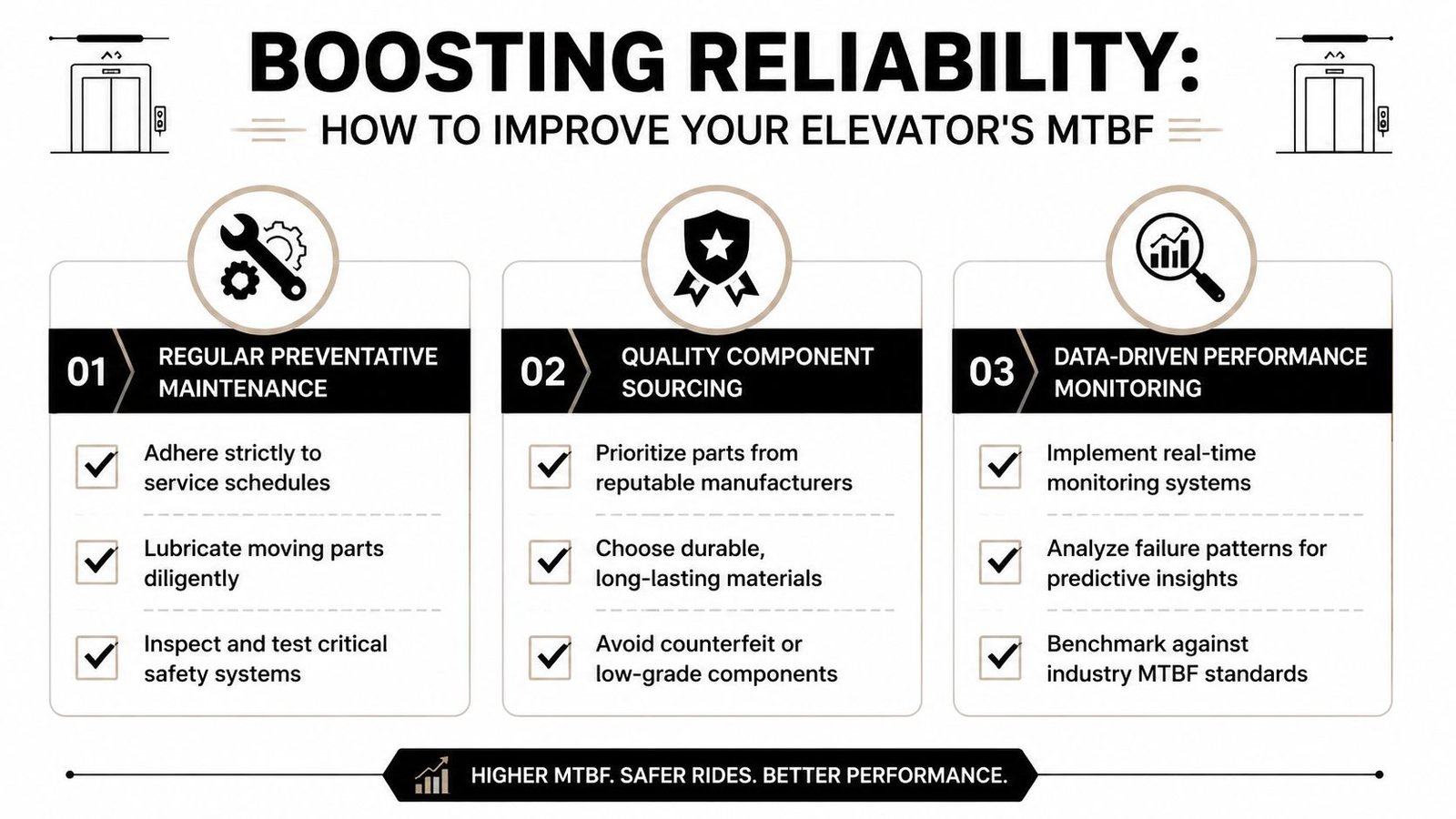
Improving MTBF starts with one rule. Stop waiting for visible failure before paying attention. Button lights, indicators, and panel components give early warning signs long before a tenant files a complaint. Dim output, inconsistent brightness, intermittent illumination, and heat-related failures all deserve a closer look.
Upgrade weak components before they become repeat calls
One of the simplest reliability upgrades is moving away from legacy incandescent lighting where it still exists. High-quality LED backlights for elevator buttons typically last between 25,000 to 50,000 hours, which translates to approximately 3 to 6 years of continuous operation, reducing maintenance intervals by up to 25 times compared to incandescent alternatives based on this industry overview of elevator LED backlight lifespan.
That's not just a lighting improvement. It's a maintenance scheduling improvement. Fewer replacement events mean fewer service interruptions, less labor tied up on nuisance issues, and more predictable inventory planning.
Build discipline into routine service
Reliability improves when technicians inspect small components with the same seriousness they give major assemblies. For button lighting and panel hardware, that means:
- Confirming electrical match before installation: A part that physically fits can still fail early if the circuit doesn't match.
- Cleaning and inspecting panel conditions: Dust, heat, and loosened connections make minor issues recur.
- Standardizing replacements: Mixed lamp types in the same panel often create future confusion.
A structured elevator preventative maintenance program is what turns those habits into routine practice instead of occasional cleanup after complaints.
Watch for patterns, not isolated incidents
A property team improves MTBF fastest when it reviews patterns across multiple service calls. One burnt-out button may be ordinary wear. Several dim or failed buttons in a short span usually point to something systematic. That might be inconsistent replacement stock, prior retrofits using different components, or a panel that needs deeper evaluation.
Field rule: If the same style of light fails repeatedly in one location, stop replacing parts on autopilot and verify the circuit, the part spec, and the installation history.
Three actions that pay off
- Standardize your approved parts list. Don't let every service call become a fresh sourcing decision.
- Keep a simple failure history. Date, location, part used, and whether the issue returned is enough to start.
- Replace strategically, not randomly. If several lights in the same panel show age, grouped replacement often beats serial callbacks.
Owners in Detroit, Ann Arbor, Lansing, and similar markets usually don't need more technology first. They need a cleaner maintenance process. Better records, verified compatibility, and planned upgrades raise MTBF more reliably than guesswork ever will.
Frequently Asked Questions about Button Light Replacement
The questions below are the ones owners usually ask after the first wrong part shows up, or after the new light works but doesn't match the rest of the panel.
What information is needed before ordering a replacement button light
Start with the electrical basics, not the catalog image. When replacing elevator button lights, the lighting voltage must precisely match the control system's operating voltage, commonly DC 12V or DC 24V. A mismatch can burn out the bulb and also damage the button's PCB board according to this guide on what to verify before ordering elevator button replacements.
You also need the connector style and pin configuration. Many problems happen because a replacement looks close enough, but the terminal arrangement or harness connection is wrong for the station.
A useful pre-order checklist includes:
- Control voltage
- Button or station model
- Pin quantity
- Connector shape
- Whether the current unit is LED or incandescent
- Whether the light source is replaceable by itself or integrated into the module
Why do some buttons look brighter or dimmer after replacement
Uneven lighting usually means the replacement wasn't equivalent to the existing parts. The most common causes are mixed LED types, voltage mismatch, or a difference in how the replacement handles illumination compared with the original assembly.
This is why one button can look sharp blue-white while the others look soft, warm, or visibly dimmer. The problem may not be the switch at all. It may be that someone installed a technically functional part that doesn't match the electrical and visual characteristics of the rest of the panel.
If new and old button lights don't match visually, treat that as a compatibility issue first, not a cosmetic complaint.
Can you replace only the bulb, or do you need the whole button assembly
It depends on the station design. Some panels allow bulb or backlight replacement without changing the full button assembly. Others use integrated LED arrays or modules that make full replacement the only practical option. That's why owners get frustrated shopping online. Two parts can look similar while having very different serviceability.
If the panel accepts a universal or non-proprietary light source, replacement can stay simple and cost-controlled. If the light source is integrated into a proprietary module, the repair path may be much narrower.
When is a dark button a bigger problem than just a failed light
A dark button becomes more serious when the button also fails to register the call, when several lights go out together, or when failures repeat after recent replacement. At that point, the issue may involve power supply, communication within the panel, or board-level problems rather than just a spent light source.
For properties dealing with recurring lighting issues, a dedicated elevator light bulb replacement service can help separate simple lamp failures from broader panel faults before more money is wasted on trial-and-error parts swaps.
How do you reduce compatibility anxiety on future repairs
Create a file for each elevator. Include station photos, voltage readings, part numbers, connector notes, and service history. That way the next replacement is an informed maintenance task instead of a guessing exercise. Good records turn Elevator Button Light replacement from a nuisance into a predictable line item.
If you're dealing with burnt-out, dim, or mismatched elevator button lights in Lower Michigan, Crane Elevator Company can help you sort out the actual issue, verify compatibility, and keep your equipment serviceable without unnecessary replacements. Their team handles repairs, preventative maintenance, inspections, and non-proprietary modernizations for all makes and models, with practical support for building owners who want fewer surprises and better long-term reliability.