
A freight elevator fails at the worst possible time. A warehouse shipment is staged, a hospital service corridor is busy, or a school renovation crew is waiting, and the car stops because a door lock, cable, hydraulic component, or power unit has been allowed to deteriorate unnoticed. The emergency repair is only the visible cost. Delayed operations, rushed parts decisions, inspection exposure, and repeated callouts create the larger problem.
Freight elevator preventative maintenance needs to move beyond a checklist completed on a fixed date. The practical standard is a documented program that combines scheduled service with condition data, failure history, compliance dates, and clear return-on-investment tracking. For facilities in Michigan and Ohio, that means pairing sensor-based monitoring with the inspection and testing requirements that apply to the specific elevator and jurisdiction.
Why Predictive Maintenance Matters for Freight Elevators
Reactive maintenance treats failure as the trigger for action. That approach is especially weak for freight equipment because freight cars work under changing loads, repeated door cycles, demanding environments, and uneven usage patterns. A technician may restore operation, but the underlying wear can remain in the door equipment, cables, jack, motor, pump, or controller.
A peer-reviewed reliability study found that low-tonnage freight elevators in demanding environments had an average failure rate of 63.9%, 32.7 percentage points higher than common freight elevators, underscoring the cost of waiting for breakdowns. See the peer-reviewed freight elevator reliability study for the reported comparison.
What the sensors should reveal
Predictive maintenance gives the maintenance team evidence before a component becomes an outage. Door-cycle data can reveal abnormal operating patterns. Vibration and temperature trends can expose developing motor or power-unit problems. Pressure readings can help identify changes in hydraulic performance, while cable or sheave observations can support decisions about inspection, shortening, or replacement.
The point isn't to install technology everywhere and hope the dashboard solves the problem. The point is to identify failure modes that matter, capture useful signals, and connect each alert to a qualified inspection or corrective action.
Practical rule: An alert has value only when a technician knows what to inspect, what evidence to record, and what action returns the elevator to a safe operating condition.
Michigan warehouses and Ohio hospitals don't have identical risk profiles. A warehouse may have concentrated loading activity and harsh material-handling conditions. A hospital may depend on predictable service access and cannot treat recurring door faults as ordinary inconvenience. In both settings, the maintenance plan should rank components by consequence, wear, and historical callouts.
Crane Elevator's predictive maintenance elevator service is one available model for connecting condition monitoring with scheduled elevator service. The wider recommendation is straightforward. Use predictive data to target labor and parts before failure, but keep qualified technicians and code-required testing at the center of the program.
Planning Your Predictive Maintenance Project
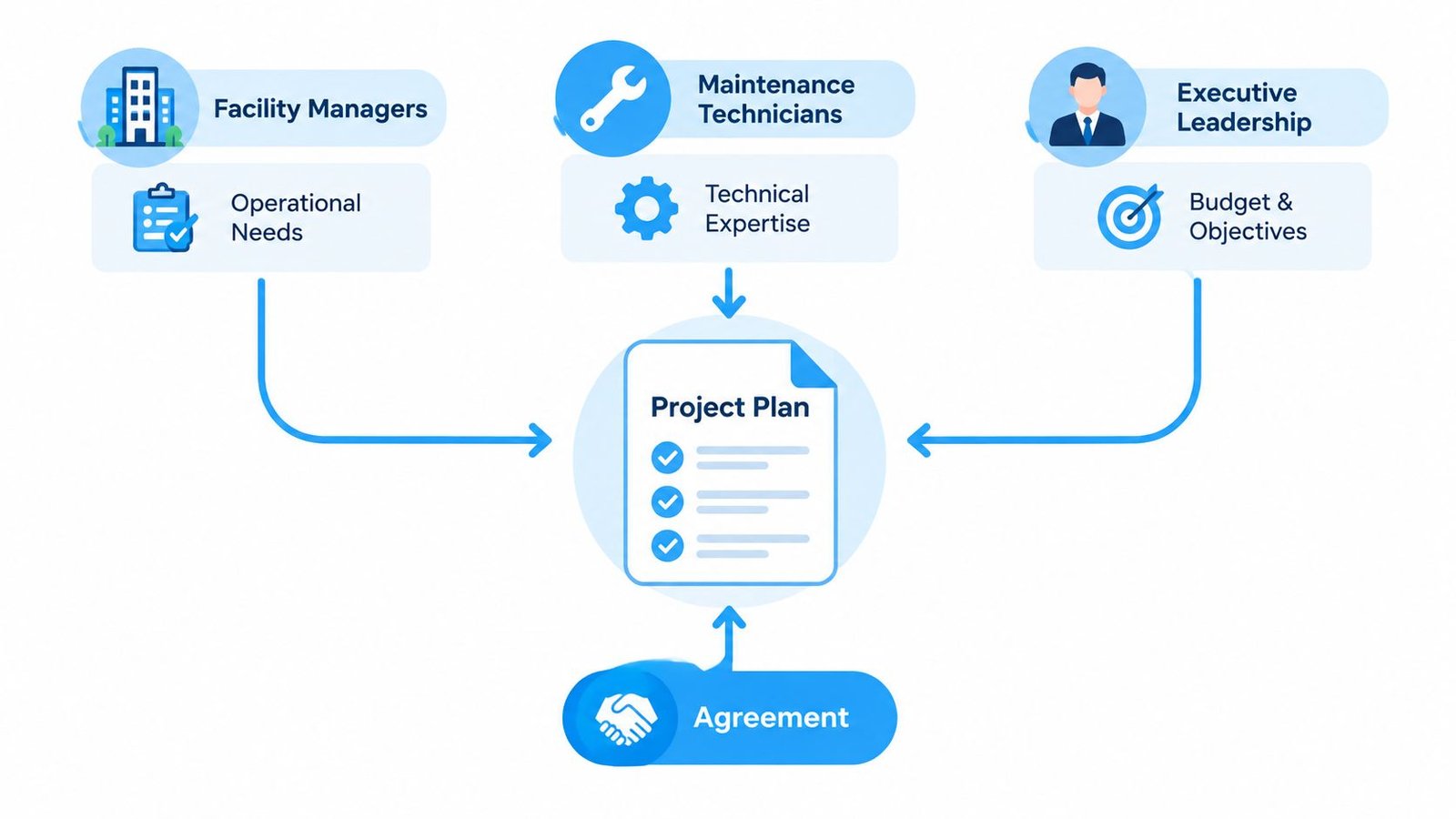
Start with a project charter, not a sensor order. The charter should identify each freight elevator in scope, its location, equipment type, age, usage pattern, known deficiencies, inspection history, and maintenance contract. It should also name the people who can approve access, interpret equipment behavior, authorize repairs, and fund modernization when repair no longer makes sense.
Build the plan around decisions
Facility managers define operational needs. Maintenance technicians identify accessible monitoring points and unsafe installation conditions. Executive leadership sets budget boundaries and decides which outcomes matter, such as fewer disruptions, stronger audit readiness, or a defensible modernization plan.
Use this planning sequence:
- Define the asset boundary. List the freight cars, machine rooms, pits, controllers, hydraulic units, door systems, cables, jacks, and emergency communication equipment included in the project.
- Document the failure risks. Review repeat door faults, leveling complaints, hydraulic leaks, motor overheating, cable wear, safety-device issues, and inspection violations. Separate a recurring symptom from the component that causes it.
- Set measurable operating goals. Track outage duration, repeat callouts, overdue corrective work, inspection completion, emergency repairs, and parts replacement. Don't promise a savings percentage before a baseline exists.
- Assign responsibilities. Specify who receives alerts, who verifies them, who creates a work order, who approves parts, and who closes the record after testing.
- Choose a pilot asset. Select a representative freight elevator, not the newest or easiest unit. A useful pilot exposes the operational conditions the broader fleet must handle.
- Set review gates. Approve sensor placement, confirm data quality, review early alerts, and decide whether the system deserves expansion.
The baseline needs enough context to prevent misleading conclusions. Record operating hours, load patterns, seasonal conditions, service interruptions, inspection findings, and the corrective work already planned. A dashboard that shows alerts without this context will encourage unnecessary parts replacement or, worse, cause technicians to ignore genuine warnings.
Make compliance part of the charter
The project plan must include the jurisdictional inspection calendar. Historical elevator safety guidance moved owners toward scheduled inspections and testing, and that framework remains central to modern maintenance practice. The U.S. Bureau of Standards historical circular records the early development of scheduled elevator safety testing.
Success means more than a working data feed. It means the facility can show what was monitored, what was inspected, what was corrected, and what was retested.
Selecting Data Sources and Sensors
Sensor selection starts with the component and its failure mode. Don't begin with a preferred device or a vendor dashboard. Begin by asking what changes before failure, where that change can be measured safely, and whether the measurement will alter a maintenance decision.
Match the signal to the equipment
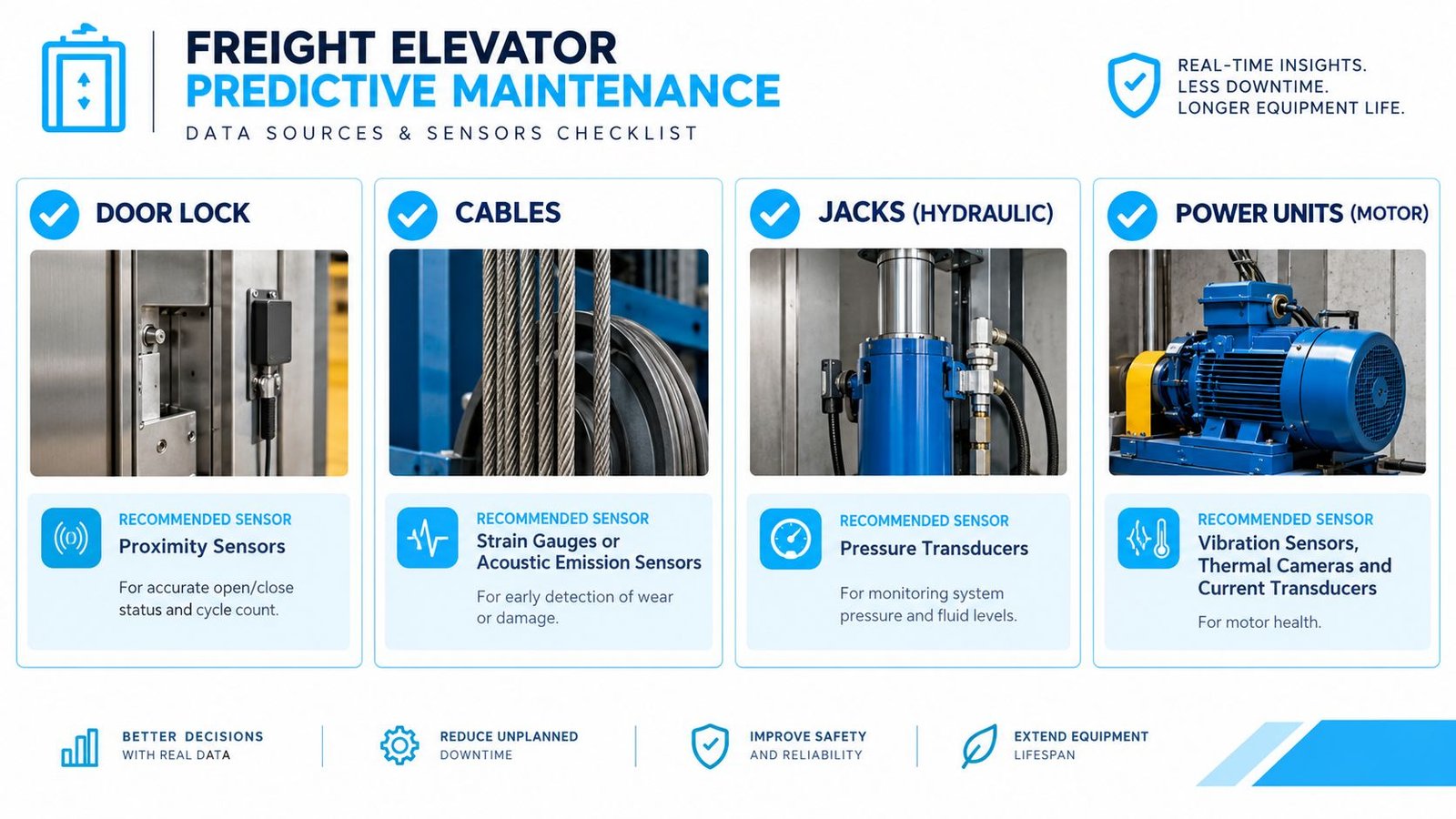
Door locks and interlocks need reliable open and close status, cycle information, and evidence of abnormal dwell or retry behavior. Proximity sensors can support that monitoring when installed without interfering with the safety circuit.
Cables and sheaves require a different approach. Strain gauges or acoustic emission sensors may help identify changes associated with wear or damage, but installation must never compromise the cable system or obstruct inspection access. For conventional inspection and corrective work, use a qualified provider for freight elevator cable replacement service.
Hydraulic jacks and power units benefit from pressure, temperature, fluid, vibration, and current information. A pressure transducer can identify changing system behavior. Motor vibration and temperature can reveal developing mechanical or electrical stress. Current data can help distinguish load-related behavior from a motor problem.
Safety devices deserve restraint. Monitoring can support inspection planning, but it must not replace required testing or encourage anyone to bypass, alter, or remotely reset a safety function.
Check the installation environment
Detroit machine rooms and older facilities often present tight spaces, dust, moisture, temperature variation, legacy controls, and limited communications infrastructure. Select equipment with an appropriate measurement range, accuracy, enclosure, mounting method, power requirement, and maintenance burden. A sensor that drifts, loses power, or detaches from a vibrating surface creates noise instead of insight.
ASME A17.1/CSA B44 requires scheduled cleaning, lubrication, adjustment, and component replacement based on equipment age, condition, and usage, which informs sensor-based maintenance intervals. The Illinois maintenance control program guidance also emphasizes records of maintenance, tests, adjustments, repairs, replacements, and callback actions.
Install in phases. Start with nonintrusive monitoring, verify signal quality during normal operation, and coordinate access with the elevator technician. Keep a record of sensor location and mounting condition, because future technicians need to know whether a changed reading reflects equipment wear or a disturbed sensor.
Evaluating Connectivity and Platform Options
A sensor is useful only if its data reaches the right person in time and in a form the maintenance process can use. Connectivity decisions should account for signal strength, cybersecurity, building infrastructure, power availability, latency, installation effort, and whether the platform can export records without locking the owner into one supplier.
| Platform | Connectivity Type | Key Features |
|---|---|---|
| Cellular | Mobile network | Useful where building networks are restricted, with independent connectivity and straightforward retrofit potential |
| Wi-Fi | Local wireless network | Convenient where coverage is strong, but dependent on building credentials, signal quality, and network policy |
| Ethernet | Wired network | Stable and manageable for fixed equipment, though installation may require pathway access and coordinated downtime |
| LoRaWAN | Low-power wide-area network | Suited to small data payloads and distributed sensors, with attention required for gateway placement and coverage |
| Hybrid gateway | Multiple connection methods | Can combine local sensor links with cellular or wired backhaul, reducing dependence on one path |
Choose the platform by building reality
An Ann Arbor office may already have managed wireless coverage, while a Grand Rapids industrial site may offer better reliability through a dedicated wired connection or cellular gateway. A hospital adds another constraint. Its information-security team may require network segmentation, approved devices, access controls, and documented data handling.
A non-proprietary platform is generally easier to evaluate because the owner can preserve access to data and connect maintenance records through supported APIs. Cloud systems can simplify fleet visibility, alert history, and remote reporting, but they still need clear rules for account ownership, retention, incident response, and technician access.
Keep alerts operational
Don't route every raw reading to a manager's phone. Establish alert tiers. A warning may create a review task. A confirmed abnormal trend may create a technician work order. A safety-related event should follow the site's emergency and shutdown procedures, not an automated repair workflow.
The platform should preserve timestamps, asset identity, sensor identity, alert status, technician notes, corrective action, and retest results. That record is more valuable than a colorful graph because it connects the signal to a defensible maintenance decision.
Designing Analytics Models and AI
Analytics should begin with a model the maintenance team can understand. A threshold alert, such as an unusual temperature or pressure reading, provides a useful first layer. It won't predict every failure, but it can identify conditions that warrant inspection and establish how the equipment behaves under normal operation.
Most industry materials still emphasize visual checks, while AI-powered predictive maintenance is identified as a major 2025 trend, reinforcing the case for sensor analytics instead of generic inspection lists. That trend is discussed in industry coverage of elevator maintenance, repair, installation, and modernization.
Use a model hierarchy
A practical analytics program can progress through distinct levels:
- Threshold rules: Flag readings outside approved operating limits or changes from a verified baseline.
- Trend analysis: Compare current behavior with prior cycles, operating conditions, and service events.
- Regression models: Estimate expected vibration, temperature, pressure, or current behavior and flag meaningful departures.
- Classification models: Sort events into likely conditions, such as normal operation, door obstruction, hydraulic irregularity, or motor concern.
- Failure-risk scoring: Combine sensor signals, age, usage, inspection findings, and callback history into a prioritized work queue.
The model shouldn't issue a repair order by itself. It should rank inspection priorities and show the evidence behind the ranking. A technician still needs to confirm the condition, identify the failed or worn component, complete the repair, and document the test that followed.
Treat records as training data
Historical service records are often messy. One technician may describe a door issue differently from another. A callback may be logged against a symptom instead of the root cause. Before using machine learning, standardize asset names, component categories, failure descriptions, corrective actions, and retest outcomes.
Model validation should compare predictions with confirmed field findings. False alerts waste labor and train teams to disregard the system. Missed warnings are more serious, especially when the affected component relates to doors, safeties, cables, hydraulic pressure, or emergency communication.
Retraining should follow evidence, not a fashionable schedule. Add confirmed failures, changed equipment, modernization work, seasonal operating patterns, and sensor replacements to the review set. Keep the simplest model that supports a better decision.
Executing a Pilot and Scaling Up
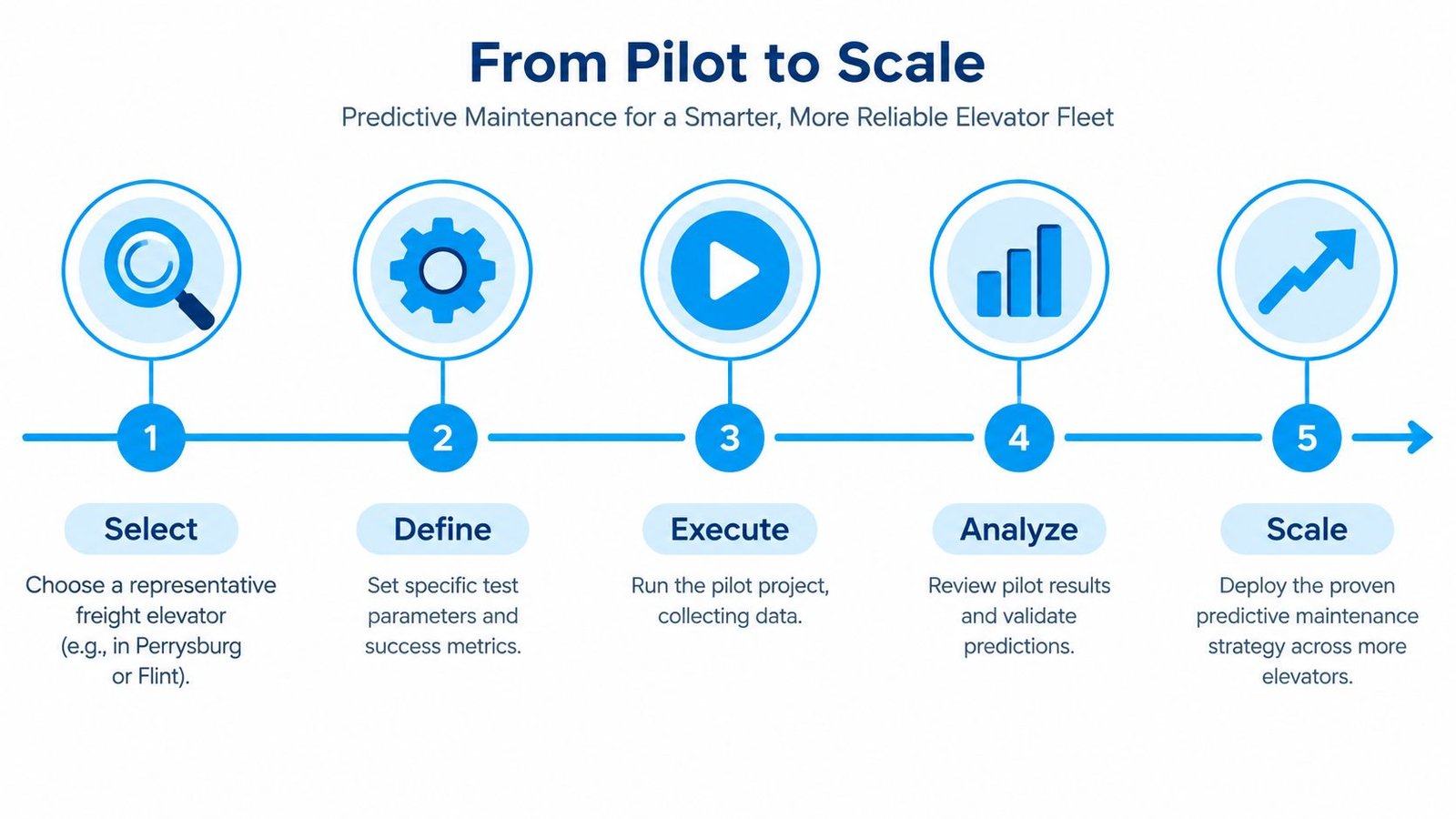
A pilot should answer one operational question: does the monitoring system help the maintenance team act earlier and more intelligently on a real freight elevator? Select a representative unit in Perrysburg or Flint, or another facility with similar operating demands. Avoid choosing an asset solely because it has the newest controls or the cleanest data.
Run the pilot in five moves
- Select the asset. Confirm the elevator's service history, known deficiencies, equipment configuration, environment, and operational importance.
- Define the test. Choose the components to monitor, the alert rules, the responsible technician, and the evidence needed to confirm an alert.
- Collect baseline data. Record normal cycles, loads, temperatures, pressures, vibration, service activity, and existing issues before changing thresholds.
- Review every alert. Have the technician inspect the equipment, classify the result, and record whether the alert was useful, premature, or missed something important.
- Approve the scale decision. Expand only when the system produces trustworthy signals, usable work orders, and records that support compliance and budgeting.
Crane technicians should inspect sensor mounts after installation and after any nearby repair. A loose accelerometer, shifted proximity sensor, or damaged cable connection can create a false trend. Maintenance staff should also compare the platform record with the physical equipment, because analytics cannot detect a condition that the chosen sensor never measures.
Routine freight elevator inspection intervals often include a six-month inspection cycle and five-year Category 5 tests, depending on jurisdiction and equipment requirements. The Oregon elevator inspection guidance supports using a pilot to refine both code-driven and condition-based scheduling.
Once the pilot earns approval, scale by equipment type and risk, not by geography alone. Create standard sensor kits, installation drawings, alert definitions, technician procedures, and reporting templates. For modernization decisions, use freight elevator modernization planning when the data shows that repeated repairs no longer provide a sensible operating path.
Integrating Maintenance Workflows and Tracking ROI
Predictive maintenance fails when alerts sit outside the maintenance contract. Every alert needs an owner, a response path, a work-order status, and a closeout record. Add the workflow to the existing service agreement instead of creating a separate technology program that technicians must remember to check.
The contract should identify the service cadence, inspection responsibilities, emergency response process, data ownership, alert review expectations, and documentation standard. It should also state how the provider handles no-show events, recurring faults, clean-downs, COP and PI bulb replacements, and parts that require owner approval.
Connect predictive work to compliance
Michigan and Ohio facilities may operate under different inspection schedules and local enforcement practices. The maintenance calendar should identify the applicable Category 1, Category 3, and Category 5 tests, emergency phone requirements, fire service testing, generator testing, and correction deadlines for violations.
Michigan rules require Category 1 testing at intervals not exceeding 12 months, Category 3 testing at intervals not exceeding 36 months, and Category 5 testing at intervals not exceeding 60 months. Temporary freight or passenger elevators used during construction require maintenance every 30 calendar days by a licensed elevator journeyperson under the cited Michigan rule, which is detailed in the Michigan elevator code.
Emergency operation and signaling devices also require attention. Michigan rules reference emergency recall and in-car emergency operation requirements, while ASME A17.1 requires a two-way emergency communication means between the car and a staffed location. That makes emergency phone repair and replacement a code-driven service issue, not a convenience upgrade. The relevant Michigan emergency elevator operation rule and ASME emergency communication reference should be included in the compliance file.
Crane Elevator Company serves Detroit, Ann Arbor, Lansing, Grand Rapids, and surrounding areas, with services including Category 1, Category 3, and Category 5 testing, emergency phone replacement, violation corrections, and full modernizations, as listed on the Crane Elevator Company service site. The same service reach extends to random Michigan and Ohio towns such as Toledo, Perrysburg, Flint, Kalamazoo, and nearby communities. A practical maintenance program should cover every type of elevator service, including Safety Edge repair and replacement, emergency phone repair and replacement, jack replacements, cable replacements and shortening, power unit replacement, pump and motor replacement, monthly and quarterly maintenance, modernization, and upgrades.
Track the financial decision
Use a simple ROI worksheet for each elevator:
- Avoided outage cost: Record the operational consequence of each prevented or shortened shutdown.
- Emergency repair spending: Compare urgent callouts and rushed parts with planned corrective work.
- Repeat-fault labor: Track technician visits tied to the same unresolved condition.
- Parts timing: Record whether predictive evidence allowed planned replacement instead of failure-driven replacement.
- Compliance exposure: Document completed inspections, corrected violations, retests, and emergency communication repairs.
- Modernization timing: Compare continued repair activity with the condition evidence supporting an upgrade.
Don't claim savings until the baseline and comparison period are complete. Report the result in operational terms that executives and technicians both understand: fewer repeat faults, earlier component decisions, cleaner records, better inspection readiness, and a clearer choice between repair and modernization.
Crane Elevator Company provides preventative maintenance, Category 1, Category 3, and Category 5 testing, safety edge work, emergency phone repair and replacement, violation corrections, hydraulic and power-unit repairs, cable and jack work, modernization, and upgrades across Michigan, Ohio, Detroit, Lansing, Ann Arbor, Grand Rapids, Toledo, Perrysburg, Flint, Kalamazoo, and surrounding communities. Visit Crane Elevator Company to request an evaluation and build a documented freight elevator maintenance program that combines compliance, condition monitoring, and practical repair planning.