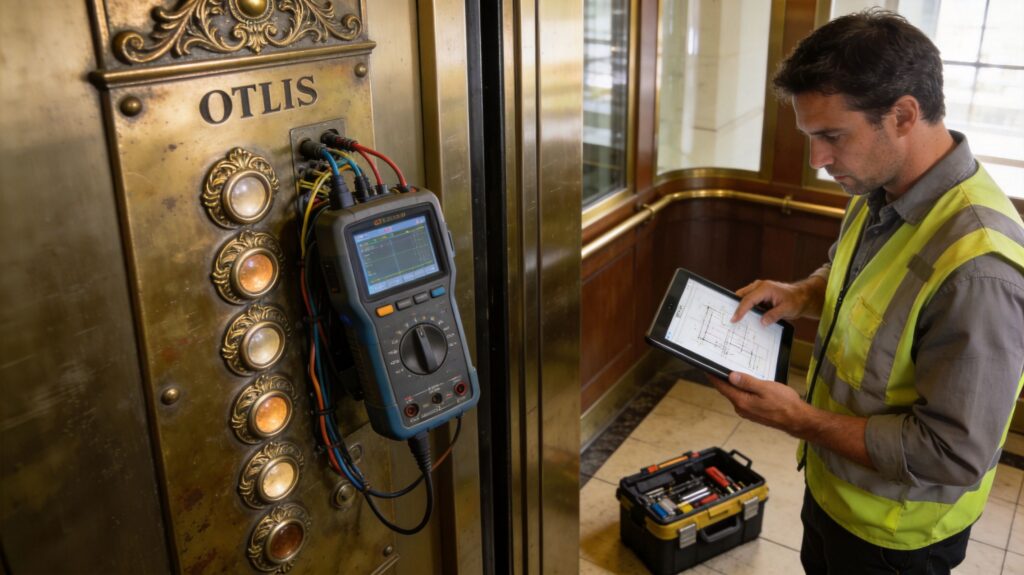
Crane Elevator Specializes In The Repair and Modernization Of Old Otis Elevators
If you’re responsible for an old Otis elevator, you probably already know the pattern. The car still runs, tenants complain just enough to keep it on your radar, and every service call raises the same question. Do you keep patching it, or do you finally modernize it without locking yourself into one manufacturer?
For Service Or Questions Call
734-726-4247
Or
Complete Form Below
That question matters more with aging Otis equipment than most owners realize. Some units are remarkably durable because Otis engineering goes back to the mid-19th century, but durability isn’t the same as compliance, parts availability, or predictable uptime. A machine can be historically impressive and still be a budget problem.
The practical path is usually not full rip-and-replace. In many buildings, the better answer is a non-proprietary modernization that keeps what still has value, replaces what causes failures, and leaves you with equipment that any qualified elevator contractor can service.
How to Identify Your Old Otis Elevator and Its Age
Before you talk about repairs, code issues, or modernization, identify exactly what you’re standing in front of. An old otis elevator can look simple from the lobby and be completely different once you open the machine room door.
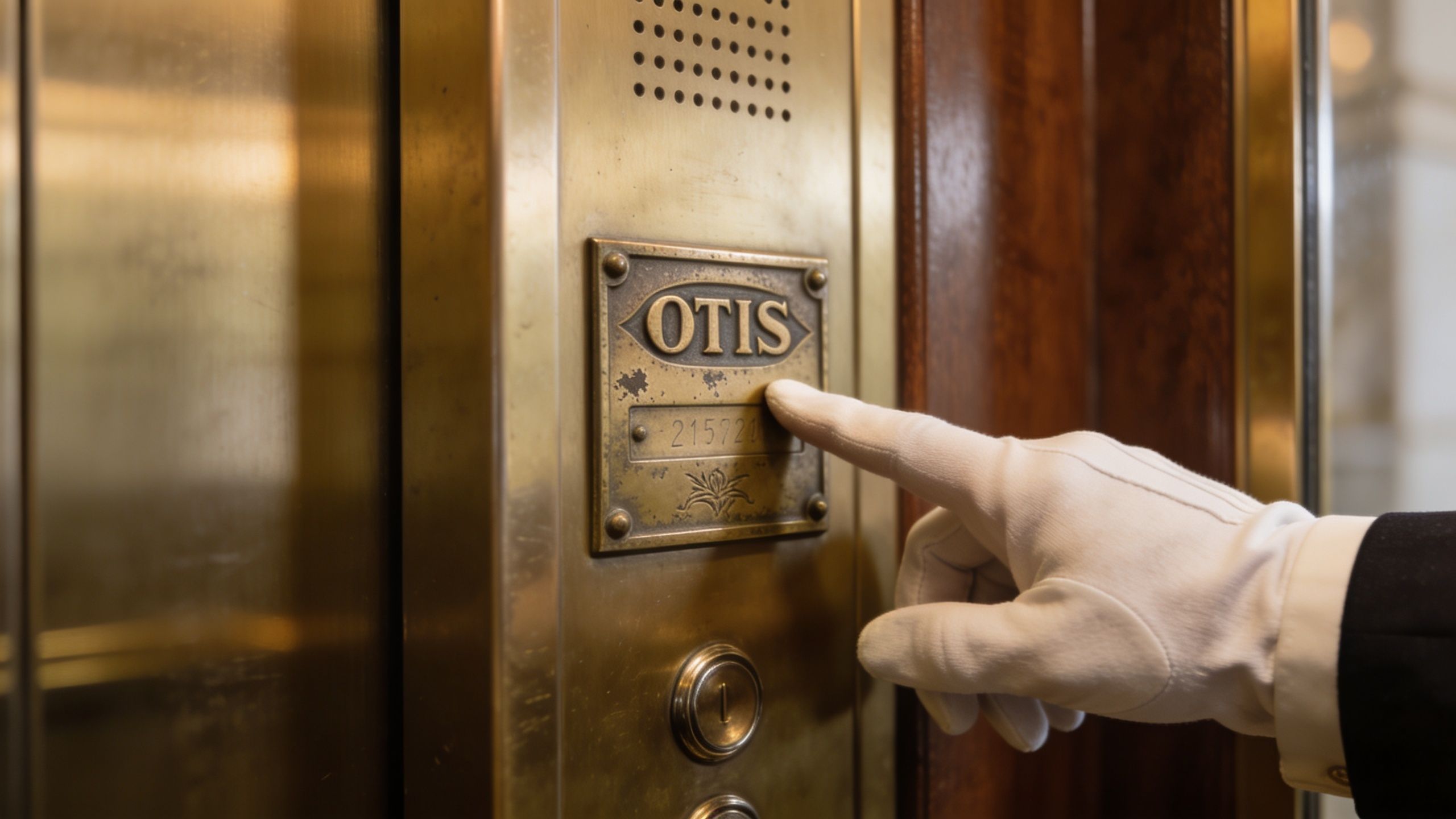
Start with the data plate and controller
Look in the places owners often skip:
- Inside the car. Check near the car operating panel, transom, or service cabinet for a plate with model or serial information.
- In the machine room. The machine nameplate, controller cabinet, and disconnect area often hold better identifying information than the cab itself.
- On the controller. If the controller has been changed over the years, it may tell you more about the last major modernization than the original installation date.
- At the door equipment. Door operator tags, interlock markings, and replacement labels can reveal what has already been upgraded.
If the original tag is gone, don’t stop there. The machine type, controller style, fixtures, and door arrangement still tell a lot.
Read the visual clues
A few field cues narrow the era quickly:
| Feature | What it often suggests |
|---|---|
| Manual swing door or gate | Much older passenger or freight configuration, often with multiple code and door protection issues |
| Relay-heavy controller cabinet | Older control logic, more moving electrical parts, and usually more troubleshooting time |
| Brass fixtures and ornate indicators | Original or partially original finishes from earlier installations, though cosmetics alone don't date the machine |
| Simple hydraulic layout | Often later low-rise modernization or an original hydraulic system from a newer era than classic traction units |
| Large gearless traction machine | Older traction application, often worth preserving mechanically if the machine is still sound |
Field rule: The elevator's age and the age of its controls are often not the same thing. I've seen cars that look original but run on much newer control packages, and machines that look modernized but still rely on tired door equipment.
Tie it back to Otis history
Otis has a long timeline, and that helps with identification. Elisha Otis founded the Otis Elevator Company in 1853, and his invention of the safety brake, demonstrated at New York's Crystal Palace Exhibition in 1854, made tall buildings possible. The first passenger elevator was installed in 1857, as noted in this history of early Otis development. That history explains why some old Otis units still have strong core mechanical bones today.
But age cuts both ways. A machine can be durable because its original design was well-built. It can also be overdue for updates because today's code environment expects safer door operation, better monitoring, more reliable leveling, and cleaner electrical performance than many older systems were built to provide.
Sort the unit into a useful category
For planning purposes, classify the elevator into one of these buckets:
-
Mostly original and still running
These are the hardest to budget because they can operate for years while hiding serious obsolescence. -
Partially modernized
Common setup. Maybe the controller changed, but the machine, door operator, or fixtures didn't. -
Mechanically solid but electrically outdated
Often the best candidate for non-proprietary modernization. -
Repeatedly patched with mixed components
Usually the unit that burns service money because every callback uncovers another incompatible workaround.
Once you know which type you have, the repair conversation gets much clearer.
Common Failure Modes and Immediate Safety Checks
Most owners don't call because the elevator failed all at once. They call because it started acting different. Older Otis units usually warn you before they stop, and those warnings matter.
Old Otis elevator failure mode checklist
| Symptom | Potential Cause | Urgency / Action |
|---|---|---|
| Car mis-levels at the floor | Worn brake components, control issues, valve trouble on hydraulic units, or traction wear | Remove from normal use if leveling is significant and call for service immediately |
| Doors hesitate, bounce, or reopen | Door operator wear, misalignment, dirty tracks, weak interlocks, or control faults | High priority. Door problems escalate fast and should not be ignored |
| Shudder or rough start | Brake drag, machine wear, sheave condition, rope issues, or hydraulic valve problems | Prompt inspection needed before normal wear becomes a shutdown |
| Unusual grinding, knocking, or loud hum | Motor, bearings, brake assembly, sheave damage, or loose hardware | High priority. Mechanical noise changes are meaningful |
| Oil on floor or in pit | Hydraulic leak, packing wear, tank or line issue | Service quickly. Keep records and prevent slip hazards |
| Frequent shutdowns or nuisance trips | Aging controls, intermittent relays, loose connections, sensor faults | Investigate systematically, not one reset at a time |
| Visible cable wear or dirty, dry sheaves | Rope aging, lubrication neglect, sheave groove wear | Immediate qualified inspection |
| Freight doors or locks not securing correctly | Worn door locks, linkage wear, poor adjustment | Critical safety concern. Restrict use until checked |
Know which symptoms mean stop using it
There are nuisance issues, and there are shutdown issues. Mis-leveling, faulty door locks, visible rope wear, and hard mechanical noise belong in the second category.
That isn't alarmism. The U.S. Bureau of Labor Statistics notes 15 elevator-related fatalities annually, often occurring in aging freight units due to worn components like sheaves, cables, or door locks, as summarized in this discussion of aging freight elevator risk and modernization concerns. Older freight equipment deserves special caution because owners often normalize behavior that shouldn't be normalized.
If a freight car starts running rough, landing unevenly, or failing to secure its doors properly, don't call it character. Call it a warning.
Check these items the same day you notice a problem
Use this as an owner or facility-manager triage list:
- Look at floor leveling. If the car isn't landing consistently, treat it as a trip hazard and accessibility issue, not just a comfort complaint.
- Watch a full door cycle. Don't just press the button and walk away. Watch whether the doors open smoothly, close fully, and latch correctly.
- Listen from the machine room and the landing. Mechanical noise that changes over time usually points to wear, looseness, or poor adjustment.
- Inspect for oil and debris. Leaks, dirty sills, and excessive dust around moving equipment tell you maintenance has slipped.
- Check service history. Repeated callbacks for the same symptom usually mean the unit is being patched, not fixed.
What usually sits underneath the symptom
Older Otis systems often fail in clusters. A worn brake doesn't just affect stopping. It can affect leveling and ride feel. Neglected sheaves don't just wear ropes. They change traction performance and increase the chance of a shutdown. Door issues don't stay isolated to doors either. They create entrapments, nuisance faults, and compliance headaches.
The practical mistake is treating each service call as a one-off event. If the same old otis elevator keeps producing different symptoms every few months, the building isn't dealing with separate problems. It's dealing with an aging system that needs a larger plan.
When and How to Plan a Non-Proprietary Modernization
An old elevator becomes a modernization candidate when repairs stop buying stability. If you're replacing parts, chasing callbacks, and still apologizing for downtime, the issue isn't one failed component. It's system age.
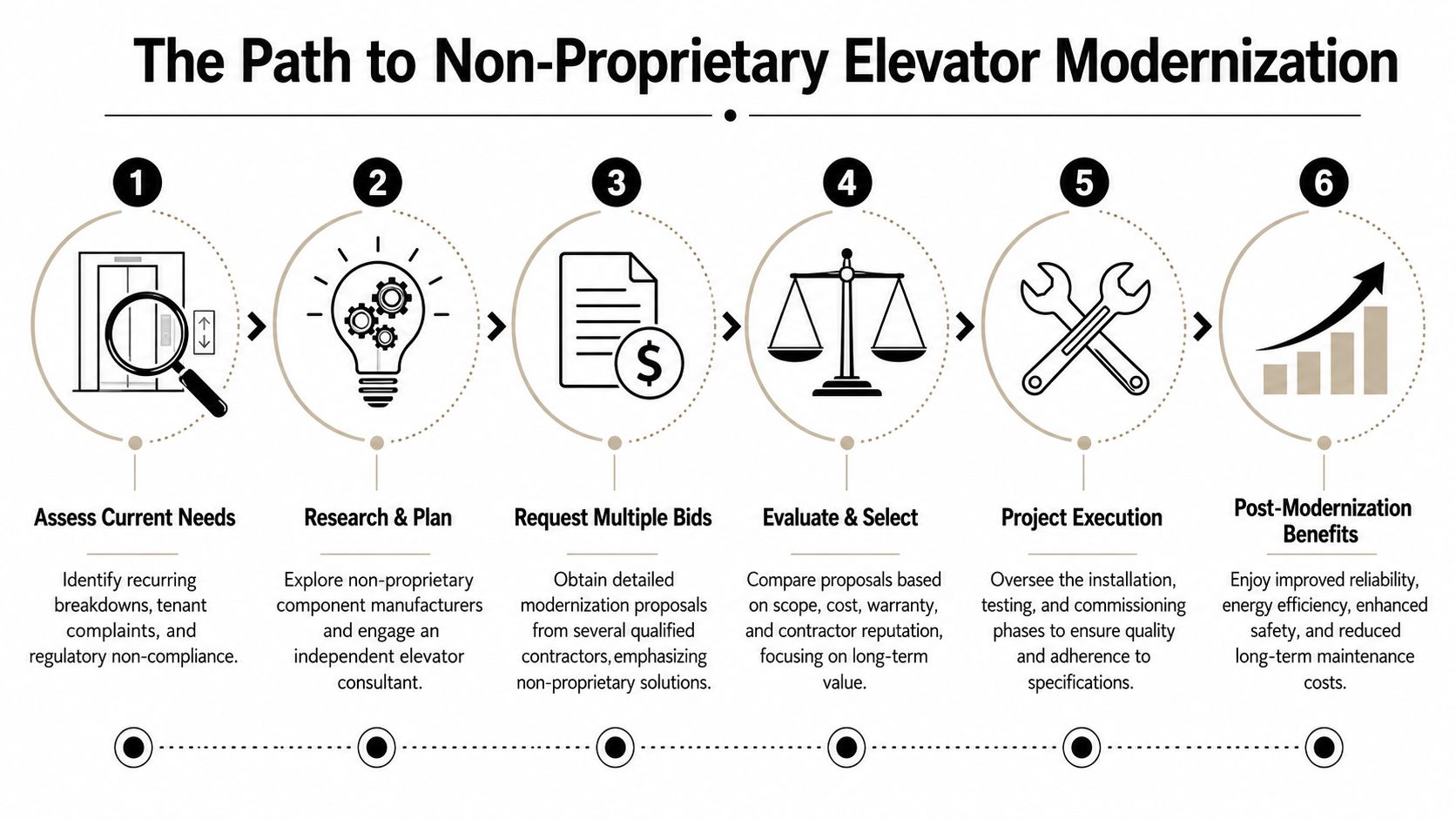
What non-proprietary actually means
A non-proprietary modernization uses components and system architecture that qualified elevator contractors can service without exclusive manufacturer control. That usually applies to the controller, door operator, fixtures, communication equipment, and other high-failure or high-obsolescence items.
That doesn't mean every original part gets scrapped. In many Otis jobs, the machine, rails, and some structural elements stay in place because they're still serviceable. The smart move is selective replacement, not blind replacement.
Why owners push away from OEM dependency
The biggest operational benefit is freedom. If your elevator can only be diagnosed, adjusted, or reset with restricted tools and locked-down support, your service options narrow fast. That affects response time, pricing power, and long-term budgeting.
The cost case is also real. Industry statistics show that non-proprietary modernization approaches can reduce an elevator's lifecycle costs by 25-35% compared to manufacturer-exclusive service models. Key replacement components like machine brake linings with a 5-7 year interval and rope assemblies with an 8-12 year lifespan can be sourced and installed by any qualified contractor, according to the Otis contractor safety requirements protocol document.
Signs your old otis elevator is ready
A few conditions usually justify action:
- Parts are becoming a project. If every repair starts with parts hunting, lead time is now part of your downtime problem.
- The controller is the weak link. Old relays, inconsistent logic, and hard-to-repeat faults often point to controls that have reached the end of practical service life.
- Door issues keep coming back. Door operators and interlocks are common chronic offenders in aging systems.
- You need code-driven upgrades. Fire service, communication updates, fixture changes, or accessibility work often make a broader modernization more economical than piecemeal fixes.
- You want bidding power. Open-service equipment gives owners more than one qualified maintenance option.
Practical rule: Modernize when you can still choose the schedule. Waiting until a major failure forces the project usually shrinks your options and raises the stress level.
What a good modernization package includes
The strongest packages are balanced. They target reliability and serviceability first, then appearance.
Common scope items include:
-
Controller replacement
This is often the center of the project. It removes obsolete logic and makes troubleshooting cleaner. -
Door operator and interlock work
Doors create a large share of real-world service headaches, so don't under-scope this portion. -
New fixtures and communication equipment
Cab controls, hall stations, indicators, emergency communication, and related interfaces often need updating for function and code. -
Machine and brake review
Some machines should stay. Others need brake work, sheave attention, or deeper replacement planning. -
Hydraulic or traction-specific scope
Hydraulic units may need packing, jack, valve, or power unit attention. Traction units may need ropes, sheave work, and brake-related upgrades.
If you're comparing approaches, this overview of non-proprietary elevator modernization options is a useful reference point for what an open-service path typically involves.
Use a repair versus modernize filter
Ask three blunt questions:
- Is the equipment still basically serviceable?
- Will this repair remove a root cause or just buy time?
- After the work is done, will you be in a better service position or the same trapped one?
If the answer to the last two is no, modernization usually wins.
Estimating Modernization Costs and Exploring Financing
Owners often stall on modernization because the number looks large in isolation. That's understandable. What gets missed is the cost pattern of doing nothing. Repeated shutdowns, emergency calls, tenant complaints, delayed inspections, and drawn-out parts sourcing create a long tail of expense that rarely shows up in one clean line item.
Budget the project as infrastructure, not repair
The right way to view modernization is as a capital improvement tied to reliability, compliance, and service flexibility. That mindset changes the discussion. Instead of asking whether the project is expensive, ask whether the current failure pattern is affordable.
That question matters even more in Michigan. With 2025-2026 code-driven upgrades on the horizon in states like Michigan, demand for modernization is increasing. Non-proprietary solutions in Midwest markets like Detroit and Ann Arbor have been shown to cut downtime by 60% and can yield a 15-20% ROI through reduced breakdown costs, based on the projection summarized in this discussion of modernization demand and financing logic.
What actually drives the price
Modernization budgets vary because elevator projects are not commodity work. Two buildings can both have an old Otis elevator and need very different scopes.
The biggest cost drivers are usually:
- Controller complexity. Replacing outdated controls is often the anchor item.
- Door equipment condition. If the doors are worn, noisy, or unreliable, the scope grows quickly.
- Hydraulic versus traction layout. The system type changes the labor and component path.
- Code gaps. Fire service, emergency communication, accessibility-related fixture changes, and testing requirements affect final scope.
- Condition of retained equipment. If the machine, jack, sheaves, or ropes need more than expected, the project expands.
A useful owner move is to request alternate pricing. Ask for a base modernization scope and then separate prices for machine work, fixture upgrades, interior refinishing, or any optional item. That shows you what improves reliability and what improves appearance.
Financing can fix the timing problem
A lot of buildings don't avoid modernization because they disagree with it. They avoid it because the timing is wrong for reserves or operating cash.
That's where financing becomes practical. It converts a lumpy, reactive problem into a scheduled improvement with predictable payments. If you're trying to compare project scenarios, this guide to elevator modernization cost and budgeting lays out the variables owners usually need to evaluate before signing.
A short visual overview can help frame the business side of the decision:
The worst budgeting position is paying for the same weak system over and over while telling yourself you're avoiding a big expense.
Don't compare a modernization to zero
Compare it to the next few years of your actual path. If the elevator is already consuming management time, service dollars, and tenant patience, the baseline is not zero. The baseline is recurring disruption.
That doesn't mean every old unit needs immediate full modernization. It means the decision should be made against real operating pain, not wishful accounting.
How to Choose the Right Local Elevator Contractor
The contractor matters as much as the scope. A good modernization with a weak contractor turns into change orders, vague answers, and callbacks. An average scope with a strong contractor often performs better because the installation, adjustment, and maintenance discipline are tighter.
Ask questions that reveal how they really work
Most owners ask about license and insurance first. That's fine, but it doesn't separate average firms from capable ones. Ask these instead:
-
How do you handle legacy Otis equipment when original parts are obsolete?
A strong answer includes open-service replacements, equivalent component strategy, and a clear approach to documentation. -
Which components in your proposal will remain serviceable by other qualified contractors?
If the answer is vague or defensive, you're probably looking at a lock-in model. -
What does your monthly maintenance include on older equipment?
Good contractors can describe tasks, not just promises. -
How do you inspect sheaves, brakes, and control components on legacy systems?
You want specifics. -
Who handles code-required testing and violation correction?
The contractor should be comfortable owning that process, not treating it as a separate surprise.
Look for evidence of real preventive maintenance
Here, many proposals fall apart. They say "full maintenance" but describe almost nothing.
A legitimate preventive program on legacy Otis equipment should be detailed. A rigorous preventative maintenance protocol involving monthly inspections across 15+ systems can reduce emergency breakdowns by 40-60%. One critical step is monthly machine sheave inspection, including hammer-sounding the spokes and rim to identify micro-fractures before failure, according to this legacy Otis maintenance checklist reference.
That kind of detail matters because old equipment responds to disciplined maintenance. It doesn't respond to quick wipe-downs and generic service tickets.
Red flags in proposals and contracts
Watch for these:
-
Undefined proprietary tools or restricted access
If only one vendor can meaningfully troubleshoot the system, your advantage vanishes after the contract is signed. -
No clear maintenance task list
If the proposal doesn't describe what technicians inspect and adjust, expect arguments later. -
Overemphasis on cosmetics
New fixtures and cab finishes don't solve chronic shutdowns if the doors and controls are still weak. -
No documentation process
Legacy equipment needs records. Without them, each technician starts from scratch.
If you're evaluating whether a contractor supports open-service systems, this overview of non-proprietary elevator service philosophy helps clarify what owners should expect.
Ask a contractor to describe a monthly visit on an aging traction or hydraulic unit. If they can't walk you through the machine, sheave, brake, controller, and door checks in plain language, they probably don't do them thoroughly.
What a good answer sounds like
A good contractor sounds concrete. They talk about brake linings, sheave groove wear, relay condition, door lock adjustment, oil contamination, logs, testing, and callback patterns. They don't hide behind sales language.
A weak contractor sounds broad. They say the unit is "older but manageable" and promise to "keep an eye on it." That's not a maintenance strategy. That's a placeholder until the next failure.
Building Your Long-Term Elevator Management Plan
The best result for an old otis elevator isn't just a successful modernization. It's a boring operating year afterward. No repeated entrapments. No mystery shutdowns. No emergency budgeting because one neglected component finally failed.
Build the plan around five habits
- Keep a clean equipment history. Record shutdowns, recurring faults, replaced parts, and test results. Patterns show up in logs before they show up in invoices.
- Treat maintenance as inspection, not just response. Monthly visits should produce findings and corrections, not just signatures.
- Schedule code-related work early. Don't wait for a failed test or violation notice to start planning.
- Review callbacks by category. Door issues, leveling issues, communication issues, and controller faults should be tracked separately.
- Reassess the retained equipment annually. Even after modernization, the machine, ropes, sheaves, or hydraulic components may still need longer-range planning.
Keep the contractor accountable
A maintenance agreement should define response expectations, housekeeping responsibility, documentation, and what routine service includes. Old elevator reliability often improves because the basics finally happen consistently. Machine rooms get cleaned. Pits get cleaned. Burned-out indicators get replaced before they become nuisance calls. Small problems stop snowballing.
Reliable elevator management is rarely about one dramatic repair. It's usually the result of consistent inspection, decent records, and a contractor who fixes root causes instead of resetting faults.
Think in phases, not one event
Some owners can modernize immediately. Others need a phased plan. That's fine, as long as the phases are deliberate. Start with life-safety and chronic failure points, then move into controls, doors, fixtures, and long-range retained equipment.
The main thing is to stop drifting. Once you identify the unit properly, address the actual hazards, and choose an open-service path where it makes sense, the elevator becomes manageable again.
If your building in Lower Michigan is dealing with an aging elevator, Crane Elevator Company can provide a practical second opinion on maintenance, repair strategy, code compliance, and non-proprietary modernization options. Their team works on legacy passenger units, freight elevators, wheelchair lifts, and modern systems across Southern Michigan, with a focus on open-service solutions that improve reliability without locking owners into a single vendor.